· deep dive · 17 min read
Artemis II
Four astronauts, a patched-together heat shield, and a $50 billion question: whether NASA can still send humans beyond low Earth orbit. Tomorrow, we find out.
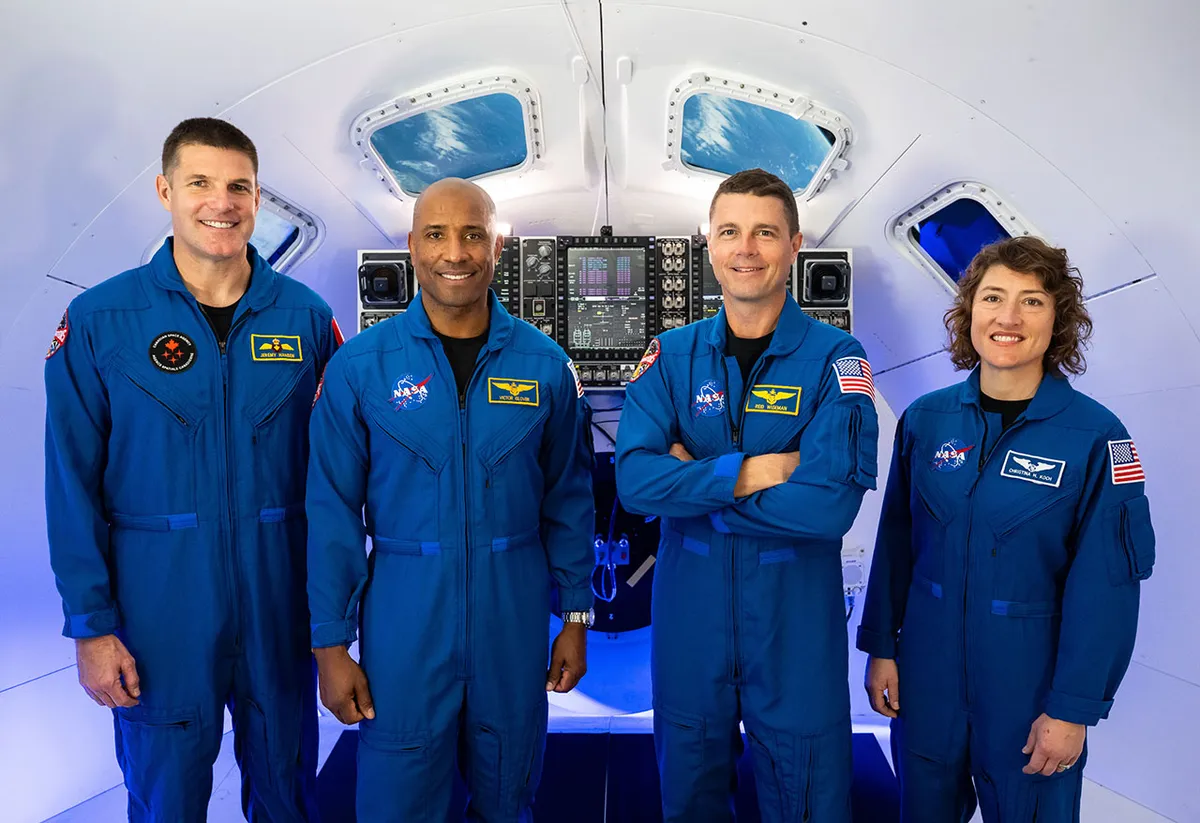
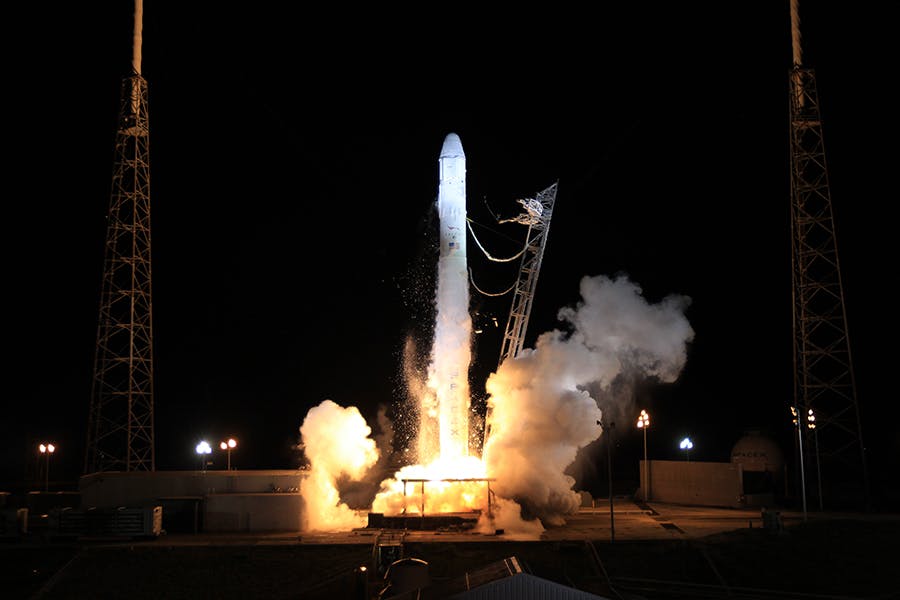
As of this writing, four human beings are sitting in quarantine at Kennedy Space Center, eating controlled meals, sleeping on controlled schedules, and waiting for the moment that a 322-foot rocket loaded with 700,000 gallons of cryogenic propellant hurls them toward the Moon. The countdown clock is running. Weather looks 80% favorable. If everything holds, Artemis II will lift off at 6:24 PM Eastern on April 1, 2026 - no fooling - and Reid Wiseman, Victor Glover, Christina Koch, and Jeremy Hansen will become the first humans to leave low Earth orbit since Gene Cernan climbed back into his lunar module in December 1972.
That’s 53 years. More than half a century since anyone has seen Earth shrink to the size of a marble outside a spacecraft window. An entire generation of engineers, flight controllers, and astronauts have built careers in the space industry without ever supporting a crewed mission beyond the relatively cozy confines of the International Space Station’s 400-kilometer orbit. Artemis II is about to change that, assuming a heat shield that didn’t behave as expected on its last outing holds together at 25,000 miles per hour.
The mission itself is deceptively simple on paper: fly four people around the Moon on a free-return trajectory and bring them home. No landing. No orbit insertion. No docking with anything on the lunar surface. It’s the kind of flight profile Apollo 8 executed in 1968, albeit with a trajectory that more closely resembles Apollo 13’s path - a distinction that carries some unfortunate irony, since Apollo 13 flew its free-return because things had gone very wrong. Artemis II is flying one because NASA wants the safety margin of knowing the Moon’s gravity will send the crew home even if Orion’s propulsion system fails entirely.
But calling Artemis II “simple” would be like calling a first solo flight in a brand-new aircraft design “simple.” Every system aboard Orion that keeps humans alive is being tested in the deep space environment for the first time. The life support. The radiation protection. The navigation. The communication links. And most critically - most controversially - the thermal protection system that has to survive an atmospheric reentry faster than any crewed spacecraft has ever attempted.
Artemis II
NASAThe Hardware
The Space Launch System is, depending on your perspective, either the most powerful rocket ever built for crewed spaceflight or the most expensive jobs program in aerospace history. Both things can be true simultaneously.
Standing 322 feet tall at Launch Complex 39B - the same pad that launched Skylab and several Space Shuttle missions - SLS Block 1 generates 8.8 million pounds of thrust at liftoff. The twin five-segment solid rocket boosters, evolved from Shuttle heritage hardware built by Northrop Grumman, produce over 75% of that thrust during the first two minutes of flight. The core stage, essentially a stretched and modified Space Shuttle external tank, feeds four RS-25 engines - themselves refurbished Shuttle main engines with flight heritage dating back decades. The RS-25s on this particular rocket have collectively flown on multiple Shuttle missions before being pulled from storage, refurbished, and bolted to a new core stage.
Sitting atop the core stage is the Interim Cryogenic Propulsion Stage (ICPS), a modified Delta IV upper stage that will eventually perform the trans-lunar injection burn sending Orion moonward. The ICPS has been the source of some recent headaches - a helium flow issue discovered on February 21 forced a rollback from the pad to the Vehicle Assembly Building, delaying the mission from its February window to April. Engineers traced the problem, fixed it, and rolled back out to the pad on March 20.
Then there’s Orion - or more precisely, “Integrity,” as the crew has named their spacecraft. The crew module is a Lockheed Martin-built capsule that seats four, with an interior volume roughly equivalent to a large van. The crew will eat, sleep, work, and use a toilet within arm’s reach of each other for ten days. If that sounds uncomfortable, consider that the Apollo command module was about 45% smaller, and those crews managed.
What makes Orion genuinely impressive is what’s underneath it: the European Service Module (ESM), built by Airbus Defence and Space in Bremen, Germany, under contract from the European Space Agency. This is the first time NASA has entrusted a non-American company with building a mission-critical element for crewed spaceflight. The ESM provides Orion’s propulsion, electrical power, water, oxygen, and thermal control. Its main engine - a refurbished AJ10 that previously flew on Space Shuttle missions - will perform the critical trans-lunar injection burn about 25 hours after launch. Four solar array wings, each about seven meters long, generate roughly 11 kilowatts of electricity.
The international nature of Artemis II extends beyond hardware. Jeremy Hansen, the Canadian Space Agency’s contribution to the crew, flies under a 2020 treaty between the United States and Canada that secured Canadian participation in the Artemis program. ESA gets three astronaut seats on future Artemis missions in exchange for continuing to supply European Service Modules. It’s a very different model from Apollo, where international cooperation meant other countries watched on television.
The Crew
The four people strapped into Integrity on launch day represent something NASA has been promising since the program’s inception: a crew that doesn’t look like 1969.
Commander Reid Wiseman is the most experienced of the bunch in terms of NASA leadership, though not in terms of flight hours. A retired Navy captain and test pilot, Wiseman previously served as Flight Engineer on ISS Expedition 41 in 2014, logging 165 days in orbit. He later served as NASA’s Chief Astronaut from 2020 to 2022 - a role that put him in charge of astronaut training during the pandemic - before stepping down specifically to become eligible for crew assignments again. Selected as part of NASA’s 2009 astronaut class, he’s been waiting for this flight for over a decade. He’s also a single father raising two daughters after the death of his wife, a detail that humanizes a mission that can easily drown in technical specifications.
Pilot Victor Glover, 49, is a Navy aviator and test pilot who flew the first operational SpaceX Crew Dragon mission to the ISS in 2020-21, logging 168 days in orbit and four spacewalks. He’ll become the first Black person to travel beyond low Earth orbit - a milestone that’s both historic and, frankly, overdue given that it’s 2026. Glover holds multiple master’s degrees and has logged over 3,500 hours of flight time across more than 40 aircraft types, including 24 combat missions.
Mission Specialist Christina Koch, 47, brings perhaps the most relevant operational experience of anyone on the crew. During her 328-day stay on the ISS in 2019-2020, she set the record for the longest single spaceflight by a woman and participated in the first all-female spacewalk alongside Jessica Meir. Koch’s background is in electrical engineering and physics, and her pre-NASA career included stints at Goddard Space Flight Center and the Johns Hopkins Applied Physics Laboratory.
Mission Specialist Jeremy Hansen rounds out the crew as the first Canadian to travel to the Moon - and, notably, the only crew member who has never been to space before. A former CF-18 fighter pilot and combat operations officer who worked with NORAD on Arctic flying operations, Hansen was selected by the Canadian Space Agency in 2009 and has spent the intervening 17 years training for a flight that kept getting delayed. In 2017 he became the first Canadian to lead a NASA astronaut class. His first-ever spaceflight will take him farther from Earth than all but 24 humans in history.
The Trajectory
Artemis II’s flight plan unfolds over roughly ten days, with each phase designed to progressively validate Orion’s systems before committing to the lunar transit.
After launch, the SLS core stage burns for approximately eight minutes, placing Orion in a highly elliptical orbit with an apogee roughly five times higher than the ISS. The ICPS doesn’t fire during ascent - it just rides along. Once in this initial orbit, Koch and Hansen will unstrap and begin activating Orion’s life support systems while Wiseman and Glover monitor spacecraft health from the cockpit.
For the next 23 hours or so, the crew runs through a comprehensive checkout of every system that matters: environmental controls, navigation, communications, and manual flight capability. This checkout phase happens in a high Earth orbit deliberately chosen so that if something goes badly wrong, the crew can abort back to Earth relatively quickly. During this period, the crew will also perform a proximity operations demonstration using the spent ICPS as a target - practice for the rendezvous and docking skills that future Artemis missions will require.
Launch and Earth Orbit
SLS places Orion in high elliptical orbit. Crew begins 23-hour systems checkout. Proximity operations demo with spent ICPS upper stage.
Trans-Lunar Injection
ESM main engine fires for roughly six minutes, boosting velocity by ~900 mph. Orion departs Earth orbit on a free-return trajectory toward the Moon.
Outbound Transit
Four-day coast to the Moon. Crew monitors systems, performs trajectory correction burns, and gathers data on deep-space radiation environment.
Lunar Flyby
Orion passes within ~4,100 miles of the lunar surface, flying around the far side. Crew photographs regions of the far side never seen by human eyes. Approximately 21% of the far side will be sunlit.
Return Transit
Free-return trajectory carries Orion back toward Earth. Crew performs return trajectory correction burns.
Reentry and Splashdown
Orion separates from ESM, reenters atmosphere at ~25,000 mph - the fastest crewed reentry ever - and splashes down in the Pacific Ocean under parachutes.
Assuming everything checks out, the ESM’s main engine fires for about six minutes on Day 2, adding roughly 900 mph to Orion’s velocity and pushing it onto a free-return trajectory toward the Moon. This is the point of no return in a very literal sense - the trans-lunar injection burn commits the crew to a roughly 600,000-mile round trip. The safety net is the free-return trajectory itself. If Orion’s propulsion system fails completely after TLI, lunar gravity will still sling the spacecraft back toward Earth. No engine burns required. The crew comes home regardless.
The lunar flyby happens around Day 6. Orion will pass within approximately 4,100 miles of the Moon’s surface at closest approach before swinging around the far side and heading home. At maximum distance - roughly 4,700 miles beyond the Moon - the Artemis II crew will be farther from Earth than any human beings have ever been, narrowly breaking the distance record set by Apollo 13 in 1970.
There’s a genuinely unique scientific opportunity during the flyby. Unlike Apollo missions, which were timed to ensure daylight at equatorial landing sites (meaning the far side was in darkness during their passes), Artemis II’s April trajectory means about 21% of the far side will be sunlit. The crew will see - with their own eyes - portions of the lunar far side that no human has ever directly observed. Two crew members at a time will rotate to Orion’s windows with cameras and recording equipment in what Jeff Radigan, the lead flight director, described as a carefully planned observation sequence.
The Heat Shield Problem
Here’s where the mission narrative gets uncomfortable.
During Artemis I’s uncrewed return in December 2022, Orion’s heat shield behaved in ways nobody expected. The Avcoat ablative material - the same substance that protected Apollo capsules, but applied in a fundamentally different way - lost material in large chunks instead of charring and eroding smoothly as designed. Post-flight inspections revealed more than 100 locations where pieces of the heat shield had broken away, leaving deep gouges and holes in the Avcoat blocks.
The investigation took nearly two years. NASA eventually determined that the root cause was insufficient permeability in the Avcoat material. During Artemis I’s skip reentry - where the capsule dips into the atmosphere, bounces back out, then reenters again - heating rates dropped during the “skip dwell” phase. This allowed thermal energy to accumulate inside the Avcoat, generating gases that couldn’t escape through the insufficiently permeable outer layer. Pressure built up. The material cracked. Chunks broke free.
The uncomfortable part: the Artemis II heat shield had already been built and installed before Artemis I even launched. It uses the same block-based Avcoat application method, and it’s actually less permeable than the Artemis I shield - a manufacturing choice made to facilitate ultrasonic testing. NASA cannot replace it without a year-plus delay.
So NASA’s solution is to fly Artemis II on a different reentry trajectory. Instead of the skip reentry that exacerbated the gas-trapping problem, Orion will make a steeper, more direct atmospheric entry. This reduces time at peak heating and should prevent the gas accumulation cycle. The trade-off is higher g-forces on the crew during reentry, but within acceptable limits.
NASA administrator Jared Isaacman endorsed flying with the existing heat shield after reviewing the agency’s analysis, and the Flight Readiness Review on March 12 polled unanimously “go.” But not everyone is convinced. Charles Camarda, a former Shuttle astronaut and heat shield expert who once directed engineering at Johnson Space Center, has been vocal in his concerns, drawing parallels to the institutional reasoning failures that preceded the Challenger and Columbia disasters. Other experts have noted that NASA is essentially relying on the same analytical tools that failed to predict the spalling problem in the first place to now predict that spalling won’t happen under the revised conditions.
The crew is aware of the risk and has publicly expressed confidence in the engineering analysis. Former astronaut Danny Olivas, who worked on the heat shield investigation, has said he’s convinced NASA has done enough, noting redundant layers of protection beneath the Avcoat. But he also acknowledged the inherent uncertainty with a frankness that’s worth respecting: there’s no flight that takes off without lingering doubt.
Reentry will happen at approximately 25,000 miles per hour - the fastest any crewed spacecraft has ever attempted. At those speeds, the air compressed ahead of the capsule heats to roughly 5,000°F. The Avcoat is supposed to char and ablate in a controlled fashion, carrying that heat away from Orion’s titanium skeleton and carbon fiber skin. If large chunks break away instead, they could damage the parachute compartment on top of the capsule, alter the aerodynamic flow in unpredictable ways, or - in the worst case nobody wants to discuss - expose the structural body of the spacecraft to temperatures it was never designed to survive.
A Program in Transition
Artemis II doesn’t exist in a vacuum. It launches into a political and programmatic landscape that has shifted dramatically even in the past month.
On February 27, NASA Administrator Isaacman announced a sweeping restructure of the Artemis program. The changes are significant. The planned SLS Block 1B upgrade - which would have featured a new Exploration Upper Stage and cost an estimated $5.7 billion to develop - has been cancelled. NASA will instead standardize on the existing Block 1 configuration, swapping the ICPS for a Centaur V upper stage on future missions. The Lunar Gateway space station, once central to NASA’s sustained-presence architecture, has also been cancelled. And Artemis III, previously planned as the first crewed lunar landing in 2028, has been redefined as a low-Earth orbit systems test in 2027.
The first crewed landing is now designated Artemis IV, targeted for early 2028, with a second landing (Artemis V) later that year. Isaacman’s framing was blunt: going directly from an Apollo 8-style flyby to a lunar landing without an intermediate test flight isn’t a path to success. He explicitly invoked the Apollo program’s incremental approach, where Mercury, Gemini, and multiple Apollo missions built toward the lunar landing one step at a time.
Artemis vs. Apollo: First Crewed Lunar Flyby Missions
| Artemis II (2026) Current Mission | Apollo 8 (1968) | |
|---|---|---|
| Crew Size | 4 | 3 |
| Duration | ~10 days | ~6 days |
| Trajectory | Free-return (no lunar orbit) | 10 lunar orbits |
| Closest Lunar Approach | ~4,100 mi | ~69 mi (orbital) |
| Farthest Distance from Earth | ~4,700 mi beyond Moon | ~234,000 mi |
| Reentry Speed | ~25,000 mph | ~24,696 mph |
| Spacecraft Mass (CM) | ~26,000 lbs | ~12,800 lbs |
| International Partners | ESA, CSA | None |
- Crew Size
- 4
- Duration
- ~10 days
- Trajectory
- Free-return (no lunar orbit)
- Closest Lunar Approach
- ~4,100 mi
- Farthest Distance from Earth
- ~4,700 mi beyond Moon
- Reentry Speed
- ~25,000 mph
- Spacecraft Mass (CM)
- ~26,000 lbs
- International Partners
- ESA, CSA
- Crew Size
- 3
- Duration
- ~6 days
- Trajectory
- 10 lunar orbits
- Closest Lunar Approach
- ~69 mi (orbital)
- Farthest Distance from Earth
- ~234,000 mi
- Reentry Speed
- ~24,696 mph
- Spacecraft Mass (CM)
- ~12,800 lbs
- International Partners
- None
The urgency isn’t purely technical. China’s lunar program continues to advance, with plans to put taikonauts on the Moon by 2030. While Isaacman has said competition is “good” and that the Artemis restructuring is common sense regardless of geopolitics, his February announcement explicitly referenced “credible competition from our greatest geopolitical adversary.” Congress appears aligned - the One Big Beautiful Bill Act included $4.1 billion specifically for SLS rockets supporting Artemis IV and V.
The cost picture is staggering by any measure. The SLS program alone has consumed roughly $23.8 billion through 2022, and the Orion capsule another $20.4 billion from its origins in the Constellation program. NASA’s Inspector General estimated in 2022 that each of the first four Artemis missions would cost approximately $4.1 billion per launch - a figure the IG described as “unsustainable.” The total Artemis program was projected to cost $93 billion through 2025, and those numbers have only grown.
Whether that spending is justified depends entirely on what happens next. A successful Artemis II generates political momentum, public enthusiasm, and engineering confidence for the lunar landing missions that follow. A failure - or worse, a loss of crew - could set the entire program back years, potentially fatally.
What Success Looks Like
The ten-day mission will generate vast quantities of data, but the critical deliverables boil down to a few key questions. Can Orion’s life support systems keep four humans alive and functional in deep space? Can the navigation and communication systems maintain contact across cislunar distances? Can the ESM perform the precise burns needed for translunar flight and trajectory corrections? And can the heat shield - this heat shield, with its known issues and its modified reentry profile - bring the crew home safely?
Artemis II also carries the Orion Artemis II Optical Communications System (O2O), which will test laser-based data transmission between the spacecraft and Earth. If it works as planned, optical communications will dramatically increase the bandwidth available for future deep-space missions, enabling high-definition video from the lunar surface rather than the compressed, delayed feeds we’ve grown accustomed to from the ISS.
There are quieter experiments too. The AVATAR investigation will use organ-on-a-chip devices to study how increased radiation and microgravity affect human tissue, collecting data that will inform crew health planning for the longer missions to come. Every sensor on the spacecraft will be recording, building the dataset that engineers need to certify Orion for repeated lunar missions.
But the most important data point is binary: do four humans leave Earth, fly around the Moon, and come home alive? If yes, the Artemis program has cleared its most fundamental hurdle. If yes, NASA can credibly argue that its $50-billion-and-counting investment in SLS and Orion is paying off, that the heat shield question is answered, and that lunar landings in 2028 are more than PowerPoint projections.
Tomorrow evening, if the weather cooperates and the countdown holds, the RS-25s will ignite, the solid boosters will light, and the loudest sound on Florida’s Space Coast in over three years will announce that humans are heading for the Moon again. Four people in a capsule the size of a van, riding an expendable rocket built from Shuttle spare parts and powered in part by a German-built engine that previously flew on the Space Shuttle Atlantis, heading out on a trajectory designed for maximum survivability even if everything goes wrong.
It’s not elegant. It’s not cheap. It’s not fast - this mission was supposed to fly in 2024 at one point, and was originally penciled in for as early as 2021. But it’s happening. After decades of PowerPoints and concept studies and canceled programs and restarted programs and budget fights and heat shield investigations, NASA is putting people on a rocket aimed at the Moon.
The countdown is running.
References(13)
- Artemis II Mission Overview - NASA
- Artemis II Launch Countdown Blog - NASA
- NASA Identifies Cause of Artemis I Heat Shield Char Loss - NASA (December 2024)
- NASA Adds Mission to Artemis Program, Updates Architecture - NASA (February 2026)
- Heat Shield Safety Concerns - The Conversation
- Artemis II Heat Shield Analysis - Ad Astra
- European Service Module for Artemis II - ESA
- ESM-2 Journey from Europe to the Moon - ESA Orion Blog
- The Cost of SLS and Orion - The Planetary Society
- Artemis Course Correction Details - NASASpaceFlight.com
- Artemis II Crew Profiles - National Air and Space Museum
- Crew Backgrounds and Milestones - CBS News
- SLS Cost Transparency Report - U.S. GAO (2023)

Theodore Kruczek