· deep dive · 12 min read
DROID.002 - Turion Space's Eyes on the Orbital Junkyard
A 90-kilogram spacecraft with iodine thrusters and two Australian-built cameras is quietly building the case that tracking space debris is a business worth billions - and that a four-year-old startup from Irvine can own it.
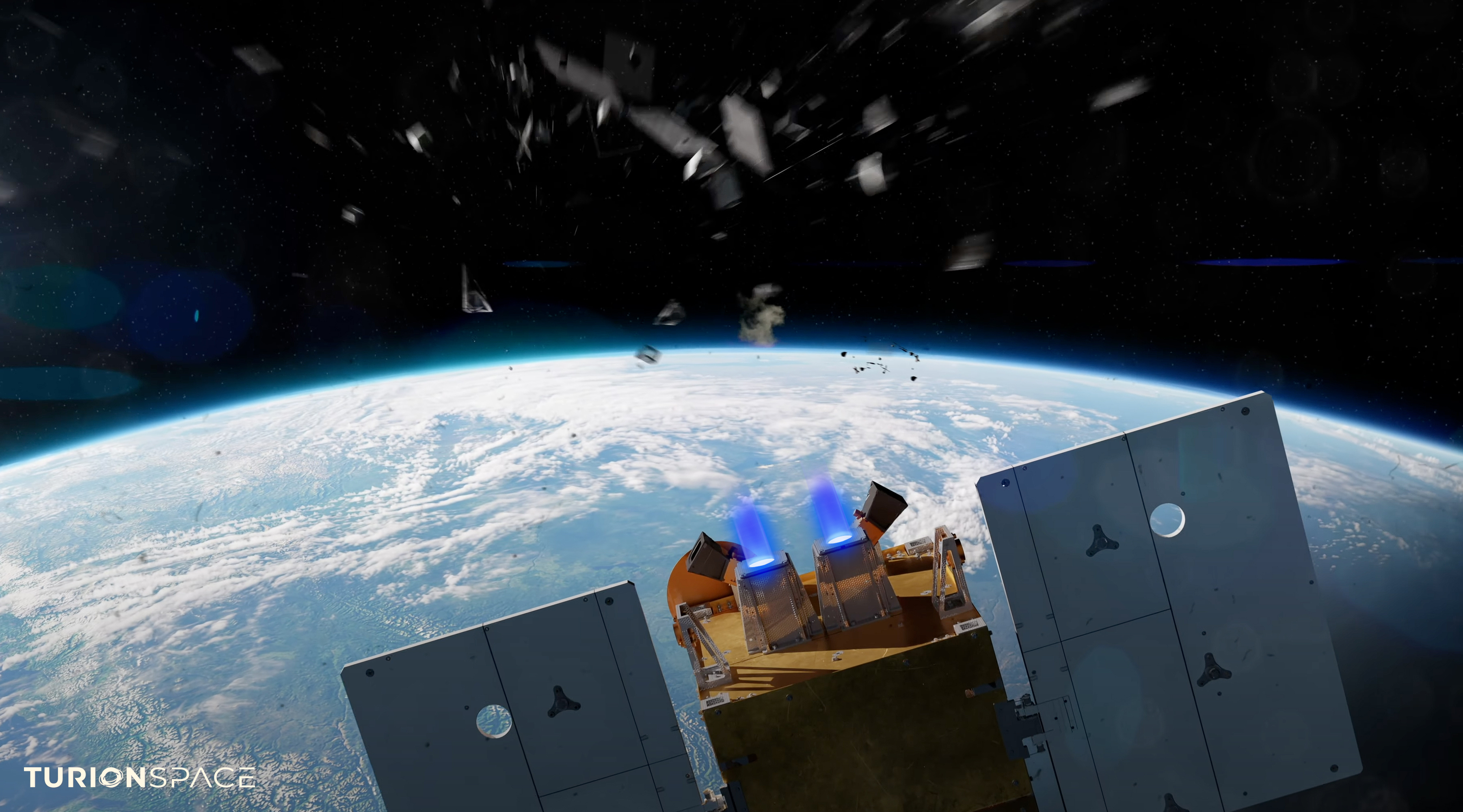
Most satellites look down. DROID.002 looks sideways.
Launched on March 15, 2025, aboard SpaceX’s Transporter-13 rideshare mission from Vandenberg Space Force Base, DROID.002 is the second spacecraft built by Turion Space - a four-year-old startup out of Irvine, California, that wants to photograph other objects in orbit, clean up the junk, and eventually mine asteroids. That’s quite a roadmap for a company whose entire founding team came from SpaceX and whose first satellite weighed less than a golden retriever.
But DROID.002 represents a genuine step up. At 90 kilograms, it’s nearly three times the mass of its predecessor, DROID.001, and carries considerably more capable hardware. Where DROID.001 was essentially a proof of concept - “get something to orbit quickly, do something useful, and figure out what we need to know going forward,” as CEO Ryan Westerdahl put it - DROID.002 is built to do real work. It carries two cameras from Australian non-Earth imaging (NEI) firm HEO, including the debut flight of HEO’s larger Adler imager. It runs iodine-fueled electric thrusters from French propulsion company ThrustMe. And its onboard computer is powerful enough that third-party software companies have already uploaded and executed their own code on it from the ground.
A year into its mission, DROID.002 is less a single satellite and more a testbed for an entire business model - one where the spacecraft watching the debris field becomes the foundation for the spacecraft that eventually clears it.
DROID.002
activeFrom SpaceX to Space Janitors
Turion Space exists because Ryan Westerdahl spent eight and a half years as a propulsion dynamicist at SpaceX and decided the hardest problem in the space industry wasn’t getting to orbit - it was what happens after you get there.
He co-founded Turion in 2020 with Tyler Pierce, an aeronautical engineer whose resume includes Lockheed Martin’s Skunk Works, and Patryk Wiatr, a software engineer. The trio went through Y Combinator’s Summer 2021 batch and raised a $6.2 million seed round with a pitch that was equal parts pragmatic and audacious: build satellites that photograph and track other objects in space, sell that data to the military and commercial operators, and use the revenue to fund development of spacecraft that can physically grab defunct satellites and deorbit them. Step three - asteroid mining - was listed with the kind of straight-faced optimism that YC tends to reward.
The pragmatic part worked first. DROID.001, a 32-kilogram spacecraft built on a NanoAvionics bus from Lithuania, launched in June 2023 on a Falcon 9 rideshare. It carried a single HEO Holmes camera and was designed primarily to prove that Turion could get hardware to orbit and operate it. That process took longer than expected - Westerdahl initially hoped to be selling imagery by late 2023, but commissioning the spacecraft and developing precise enough pointing control to aim the camera at passing objects without accidentally staring at the Sun took nearly a year.
By the time DROID.001 was delivering useful data, Turion had learned enough hard lessons about satellite operations to inform a far more ambitious second vehicle.
What’s Actually On Board
DROID.002 is a box-plus-two-panel satellite roughly 0.8 meters long, 0.6 meters in diameter, with a 2-meter wingspan when the solar panels are deployed. The “Droid” bus was designed in-house by Turion, a shift from the NanoAvionics-supplied platform used for DROID.001. This matters because Turion’s long-term plan requires building satellites at scale - the company has talked about producing 45 per year by 2027 - and you can’t do that if your core bus is someone else’s product.
The payload suite is where things get interesting. DROID.002 carries two cameras from HEO, the Australian company (formerly HEO Robotics) that has carved out a niche in non-Earth imaging - the practice of photographing other objects in space rather than the ground below. The first is a Holmes Mk1, the same model that flew on DROID.001. The second is the Adler, HEO’s larger and more capable imager making its orbital debut.
The Adler is a meaningful piece of hardware. It features a 194mm aperture - roughly twice that of the Holmes - and can achieve 1.1-meter ground sample distance at 500 kilometers. It shoots at up to 100 frames per second, enabling both still imagery and short video sequences of passing spacecraft. For context, that resolution from that distance means DROID.002 can distinguish major structural features on a satellite during a flyby encounter - solar panels, antenna booms, and general configuration - without needing to maneuver anywhere near the target. The host spacecraft stays in its own orbit; the camera does the work.
This fly-by technique is central to how HEO and Turion sell their service. A camera mounted on a satellite in low Earth orbit will naturally pass within imaging range of thousands of other objects over the course of a year. No fuel-burning proximity operations required. Just point, shoot, and downlink.
Non-Earth imaging is a relatively young discipline, but it’s growing fast. Traditionally, militaries and space agencies tracked objects in orbit using ground-based radars and telescopes - systems that work well for determining where something is, but less well for determining what it is. A ground-based radar can tell you an object’s orbit. A camera 500 kilometers away in space can tell you whether it still has its solar panels attached. That distinction matters enormously for space domain awareness, and it’s one reason HEO has been able to build a business distributing cameras across other people’s satellites. The company claims to have identified over 80 space objects before they appeared in any public catalog, with 66 still listed as unknown in official databases. DROID.002, carrying both a Holmes and the new Adler, is HEO’s most capable host platform to date.
For propulsion, DROID.002 uses ThrustMe’s NPT30-I2-1.5U thrusters - iodine-fueled electric propulsion systems. Iodine is notable as a propellant because it’s stored as a solid, which makes it far more volumetrically efficient than gaseous alternatives like xenon. The 1.5U form factor packs considerable total impulse into a small package. Turion selected these thrusters specifically to enable orbit raising - moving DROID.002 to higher altitudes where debris is more prevalent and less well-tracked - and end-of-life disposal.
DROID.001 vs. DROID.002
| DROID.001 Pathfinder | DROID.002 Operational | |
|---|---|---|
| Mass | 32 kg | 90 kg |
| Bus | NanoAvionics MP42 | Turion Droid (in-house) |
| Camera(s) | HEO Holmes Mk1 | HEO Holmes Mk1 + Adler |
| Propulsion | Green monopropellant | ThrustMe iodine electric |
| Launch | June 2023 | March 2025 |
| Primary Mission | SSA demonstration | SSA operations + on-orbit compute |
- Mass
- 32 kg
- Bus
- NanoAvionics MP42
- Camera(s)
- HEO Holmes Mk1
- Propulsion
- Green monopropellant
- Launch
- June 2023
- Primary Mission
- SSA demonstration
- Mass
- 90 kg
- Bus
- Turion Droid (in-house)
- Camera(s)
- HEO Holmes Mk1 + Adler
- Propulsion
- ThrustMe iodine electric
- Launch
- March 2025
- Primary Mission
- SSA operations + on-orbit compute
The Software Play
Hardware gets you to orbit. Software is what keeps you relevant once you’re there.
Turion seems to have internalized this early. In June 2025, the company announced Starfire Nexus, a platform that lets third-party customers upload, test, and execute their own software on DROID satellites. Every DROID spacecraft has onboard compute dedicated to its core space domain awareness missions, but Nexus opens that processing power to outside developers - effectively turning each satellite into a shared computing node in orbit.
The first two Nexus customers were Tychee Research Group, a Los Angeles-based astrodynamics firm, and Critical Software, a Portuguese company specializing in mission-critical embedded systems. Both successfully ran their software on DROID.002’s flight hardware.
Tychee’s contribution is particularly notable. Their Mission Planning Library (TMPL) demonstrated what the company described as the highest-fidelity force model ever run on orbit - essentially, extremely precise calculations of how orbital mechanics affect a spacecraft, running directly on the satellite rather than on the ground. The library matched NASA’s GMAT reference tool to within one meter of accuracy in LEO while running roughly 25 times faster. That kind of edge computing capability matters for autonomous operations, where a satellite needs to make decisions about maneuvering without waiting for ground commands.
Critical Software, meanwhile, used Nexus to bring their Karvel flight software platform to Technology Readiness Level 8 (TRL-8), meaning it was successfully demonstrated in an actual operational environment. Karvel is designed for missions involving rendezvous operations, debris removal, and satellite inspection - exactly the kind of work Turion plans to do with future DROID variants.
The relationship with Tychee went deeper than a customer arrangement. In January 2026, Turion acquired Tychee outright, folding the TMPL library and its astrodynamics team into the Starfire software ecosystem. The acquisition signals that Turion sees mission planning and autonomous operations software as core to its business, not something to be outsourced.
Following the Money
Turion’s trajectory from YC startup to Space Force contractor has been fast, even by NewSpace standards.
The company has raised approximately $37.5 million in venture capital across multiple rounds, with investors including Veteran Ventures Capital, Forward Deployed VC, Washington Harbour Partners, and Y Combinator itself. Critical Software also made a strategic investment in early 2025. But the government contracts tell a more compelling story about where the business is heading.
The big one landed in December 2024: a $32.6 million firm-fixed-price contract from the U.S. Space Force’s Space Systems Command for three multi-payload satellites capable of rendezvous and proximity operations and high-resolution satellite-to-satellite imagery. The contract, awarded through SpaceWERX’s Strategic Financing Initiative (STRATFI), calls for two LEO vehicles and one designed for geostationary orbit, all to be completed by October 2028. Each satellite will carry three space domain awareness payloads and a long-range imager, plus optical communication terminals for high-data-rate downlinks.
That contract builds on earlier SpaceWERX awards - a $1.9 million Tactical Funding Increase (TACFI) for developing systems to engage uncooperative space objects, and Turion’s inclusion in a $237 million Space Force program for commercially developed spacecraft. The company says it has received over $50 million in government contracts to date.
DROID.001’s data is already integrated into the Space Force’s Unified Data Library, meaning Turion’s imagery is feeding directly into the U.S. military’s picture of what’s happening in orbit. DROID.002 is presumably doing the same, though Turion hasn’t explicitly confirmed this.
The military interest makes sense when you consider the threat environment. Both Russia and China have demonstrated anti-satellite weapons and deployed satellites that perform unexplained proximity operations near other nations’ spacecraft. The U.S. Space Force needs commercial sources of space domain awareness data because no single government sensor network can track everything in orbit at the resolution and cadence required. Companies like Turion fill a gap - providing resolved imagery of specific objects that ground-based systems can detect but can’t characterize in detail.
Turion Space founded
Co-founded by Ryan Westerdahl, Tyler Pierce, and Patryk Wiatr in Irvine, California
Y Combinator S21
Completes YC accelerator, raises $6.2M seed round
DROID.001 launched
32 kg pathfinder satellite reaches orbit on SpaceX Transporter-8
First SSA imagery
DROID.001 begins delivering space object imagery after nearly a year of commissioning
$32.6M Space Force contract
STRATFI award for three multi-payload RPO and surveillance satellites
DROID.002 launched
90 kg satellite with dual HEO cameras and iodine propulsion on Transporter-13
Starfire Nexus announced
On-orbit compute platform opens DROID satellites to third-party software
Tychee Research Group acquired
Astrodynamics firm and its TMPL library integrated into Turion's Starfire platform
The Bigger Picture
DROID.002 is interesting less for what it is right now and more for what it’s supposed to prove.
Turion’s stated roadmap progresses from passive observation (photographing objects from a distance during flyby encounters) to active proximity operations (maneuvering close to inspect or characterize targets) to physical engagement (grabbing defunct satellites or debris and deorbiting them). DROID.001 was step one. DROID.002 is meant to qualify the next generation of production satellites Turion calls “Droid Alpha” - larger, more capable vehicles with the propulsion and autonomy to perform closer inspections.
The company has also discussed a “micro-Droid” demonstration planned for 2026, co-funded by NASA, that would carry grappling mechanisms for capturing space debris. If that works, it would start answering the hardest question in the debris removal business: can you actually grab something that wasn’t designed to be grabbed, isn’t cooperating, and might be tumbling?
This is where Turion’s approach diverges from pure-play space domain awareness companies. Firms like LeoLabs track debris with ground-based radars. Companies like HEO distribute cameras across other people’s satellites to photograph objects from orbit. Turion is doing the imaging, but positioning it as the foundation for a physical services business - inspection, servicing, debris removal, and eventually orbital logistics. The imagery pays the bills today. The grappling arm is the point.
The space debris problem isn’t theoretical. There are over 23,000 tracked objects larger than 10 centimeters in orbit, hundreds of thousands of smaller fragments that can still damage operational satellites, and a handful of large defunct objects in popular orbital bands that represent potential Kessler Syndrome catalysts. Multiple companies - Astroscale, ClearSpace, and others - are working on debris removal approaches, but none have yet demonstrated a fully operational capability.
Turion’s advantage, if it materializes, would be vertical integration: a company that builds its own satellites, writes its own flight software, processes its own imagery, and uses all of that to inform the actual debris capture missions. Whether a startup with 70-odd employees and $37.5 million in venture funding can pull that off against well-funded competitors remains to be seen. But DROID.002 is doing what it needs to do - flying, imaging, and giving third-party software a place to prove itself - and the Space Force contract suggests at least some customers believe the roadmap is credible.
For now, DROID.002 is circling the Earth every 94.6 minutes at roughly 506 kilometers altitude, in a sun-synchronous orbit inclined at 97.4 degrees. It’s one of the approximately 10,000 active satellites in low Earth orbit, quietly photographing the ones that aren’t active anymore.
The next chapter is already taking shape. The three satellites funded by the Space Force STRATFI contract are expected to launch in 2026 and 2027, carrying more capable payloads and optical communication terminals for real-time command and control. Turion moved into a 2,400-square-meter production facility in Irvine and has grown to over 125 employees. The company talks about producing seven Droid Alpha vehicles as the next production batch - spacecraft large enough to carry 120 kilograms of payload and priced starting at $4 million for customers who want to buy rather than rent.
Whether Turion’s roadmap from “photograph the debris” to “grab the debris” is a two-year journey or a ten-year journey is an open question. But DROID.002 is doing its part - collecting imagery, validating flight software, and generating the kind of operational heritage that turns a PowerPoint roadmap into a credible proposal. In the space business, working hardware in orbit has a way of making everything else easier.
References(12)
- Turion Space Closing in on Initial SSA Service from First Satellite - SpaceNews
- Intelligence and Dual-Use Commercial Satellites Launch on Transporter-13 - SpaceNews
- Turion Space Secures $32.6 Million Military Contract - SpaceNews
- SpaceX Launches Transporter-13 Rideshare from Vandenberg - NASASpaceFlight
- ThrustMe Selected to Provide Turion Space with Propulsion - SatNews
- Adler Non-Earth Imaging Camera - HEO
- Turion Space and Tychee TMPL On-Orbit Milestone - Turion Space
- Starfire Nexus Enables Critical Software Karvel TRL-8 - Turion Space
- Turion Space Acquires Tychee Research Group - SpaceNews
- Veteran Ventures Capital Investment in Turion Space - PR Newswire
- DROID.001, 002 - Gunter's Space Page
- Turion Space - Y Combinator

Theodore Kruczek