· deep dive · 11 min read
EUTELSAT 172B
Europe's first high-power all-electric telecom satellite doesn't just sit above the Pacific - it got there on robotic arms and plasma thrusters, broke records doing it, and now keeps your airplane Wi-Fi running between LA and Tokyo.
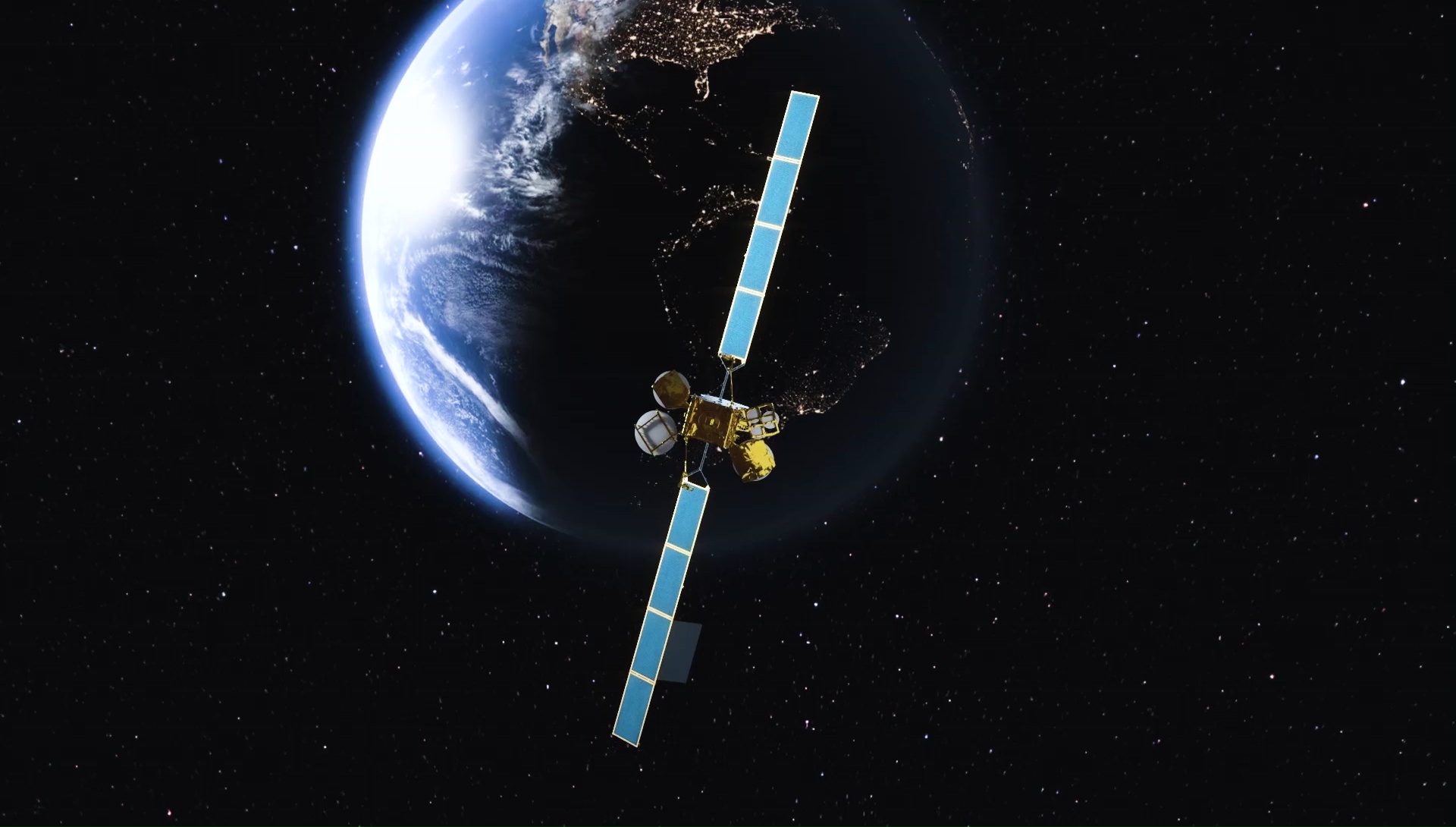
If you’ve ever connected to Wi-Fi on a transpacific flight and wondered how exactly you’re streaming video at 35,000 feet over the middle of the Pacific Ocean, there’s a decent chance the answer is a 3,550-kilogram French satellite parked 35,786 kilometers above the equator. EUTELSAT 172B has been one of the most-viewed objects in KeepTrack’s 3D visualization tool, and for good reason - it’s one of those satellites where the engineering story is genuinely more interesting than the marketing copy.
Launched on June 1, 2017, aboard an Ariane 5 from Kourou, French Guiana, EUTELSAT 172B was the first high-power all-electric telecommunications satellite built in Europe. That description undersells it. This spacecraft combined robotic arms, Hall-effect plasma thrusters, 3D-printed structural components, and a payload specifically designed to beam broadband into airplanes - and it did all of this while weighing roughly half of what a conventionally-propelled satellite with similar capabilities would have tipped the scales at.
The satellite sits at 172° East longitude, a prime piece of orbital real estate that provides coverage from the west coast of North America to Australia, and from Alaska down through the Pacific islands. It’s operated by Eutelsat - now part of the Eutelsat Group following the 2023 merger with OneWeb - and it replaced its predecessor, EUTELSAT 172A, which was shuffled over to 174° East and renamed accordingly.
But the real story isn’t where EUTELSAT 172B ended up. It’s how it got there, what it’s carrying, and why it matters for the future of satellite telecommunications.
EUTELSAT 172B
activeThe All-Electric Gamble
To understand why EUTELSAT 172B matters, you need to understand the problem it was designed to solve. Traditional geostationary communications satellites are heavy. Really heavy. A significant chunk of their mass - often more than half - is chemical propellant. They need it for two things: getting from the elliptical transfer orbit where the launch vehicle drops them off up to their final circular geostationary orbit (a process called orbit raising), and then staying in that precise position for 15+ years of operational life (station-keeping).
Chemical orbit raising is fast - you can get a satellite to GEO in about a week. But you’re essentially burning through tons of hydrazine and oxidizer to do it, and every kilogram of propellant is a kilogram that could have been payload. It’s the rocket equation applied to satellites, and the economics are brutal.
Electric propulsion flips the equation. Instead of burning chemical propellant at high thrust, electric thrusters ionize a noble gas - xenon, in most cases - and accelerate it using electric fields to produce a gentle but incredibly efficient push. The thrust is tiny compared to chemical engines, but the fuel efficiency (measured as specific impulse) is vastly superior. Where a chemical thruster might achieve a specific impulse of 300-350 seconds, Hall-effect thrusters routinely exceed 1,500 seconds.
The trade-off is time. Instead of reaching GEO in a week, an all-electric satellite takes months to spiral outward from its transfer orbit. For EUTELSAT 172B, that journey took approximately four months - which was actually a record at the time.
The mass savings are dramatic. EUTELSAT 172B launched at just 3,550 kg while delivering 13 kW of payload power - the kind of performance that would typically require a satellite massing over 6,000 kg with chemical propulsion. Airbus estimated the electric approach saved roughly 40% of the satellite’s mass. That meant EUTELSAT 172B could ride in the lower berth of an Ariane 5 dual-launch configuration, sharing the rocket with ViaSat-2 and splitting the launch costs. For operators watching every dollar, that’s a compelling sales pitch.
Robotic Arms and Plasma Thrusters
The engineering innovations on EUTELSAT 172B weren’t just about going electric. They were about making electric propulsion work better than anyone had managed before on a satellite this size.
Most satellites with electric thrusters mount them at fixed positions on the spacecraft body - typically at the corners or on a dedicated thruster panel. This works fine for station-keeping, where you’re making small, predictable adjustments. But for orbit raising, it creates a problem. As the satellite burns through xenon and its mass distribution shifts, the center of gravity moves. Fixed thrusters can’t compensate for this, which means some of the thrust is wasted on torque instead of translation. You’re pushing, but you’re also spinning yourself slightly off-axis and then correcting, which burns more fuel and takes more time.
Airbus solved this with a pair of three-meter-long, three-jointed robotic arms - each carrying a Fakel SPT-140D Hall-effect thruster at its tip. These arms could be repositioned throughout the orbit-raising phase to keep the thrust vector aligned precisely through the satellite’s shifting center of gravity. It’s an elegant solution to a tricky dynamics problem, and it’s one of the key reasons EUTELSAT 172B reached GEO faster than its Boeing-built predecessors.
The arms were developed through ESA’s ARTES (Advanced Research in Telecommunications Systems) program as part of a Propulsion Deployable and Pointing System. They launched in a stowed configuration and were deployed during the first days after separation from the Ariane 5. In-orbit data confirmed that the mechanisms operated flawlessly - which, for something with six powered joints operating in a vacuum for four straight months, was no small achievement.
The satellite also carried another piece of quiet innovation - a 3D-printed structural bracket. It was a single additively manufactured component that replaced a conventionally machined assembly of four sections and 44 rivets, coming in 35% lighter and 40% stiffer than its predecessor. In 2017, flying 3D-printed parts on commercial satellites was still relatively novel. EUTELSAT 172B was among the earliest operational demonstrations that additive manufacturing could meet the exacting structural and vibration requirements of spaceflight.
Three Payloads, One Satellite
EUTELSAT 172B carries three distinct communications payloads, each serving a different slice of the Asia-Pacific market. This triple-mission approach is part of what makes the satellite commercially interesting - it’s not a single-purpose bird, but a flexible platform serving multiple customer segments simultaneously.
The C-band payload consists of 14 transponders providing broad coverage across the Asia-Pacific region, particularly Southeast Asia. C-band is the workhorse frequency of satellite communications - it’s less susceptible to rain fade than higher frequencies, which makes it reliable for tropical regions where afternoon thunderstorms are a daily occurrence. This payload replaced and improved upon the C-band service previously provided by EUTELSAT 172A.
The regular Ku-band payload packs 36 transponders connected to five distinct service areas: North Pacific, Northeast Asia, Southeast Pacific, Southwest Pacific, and South Pacific. This more than doubled the Ku-band capacity at the 172° East position. Ku-band offers higher bandwidth than C-band at the cost of somewhat greater weather sensitivity - a perfectly acceptable trade-off for most video distribution and data services.
But the real headline act is the third payload - a high-throughput Ku-band system specifically designed for in-flight broadband connectivity. This payload features 11 elliptical spot beams optimized to cover the densely-traveled air corridors across the Pacific, interconnected with gateway ground stations operating in Ka-band. The overall throughput hits 1.8 Gbps, and the system includes an innovative multi-port amplifier (MPA) that can dynamically redistribute power between spot beams based on real-time demand.
That MPA is worth pausing on. Aircraft move. The busiest flight routes shift throughout the day as waves of departures roll across time zones. A static beam pattern would waste capacity illuminating empty ocean while aircraft clustered along popular routes compete for bandwidth. The MPA lets EUTELSAT 172B’s HTS payload essentially follow the traffic - allocating more power to beams covering busy corridors and pulling back from quiet ones. It was the first satellite to fly this capability, developed by Airbus under ESA’s ARTES program with support from the UK Space Agency.
Panasonic’s Pacific Network
The anchor customer for EUTELSAT 172B’s high-throughput payload was Panasonic Avionics Corporation, one of the largest providers of in-flight entertainment and connectivity systems globally. Panasonic had been working with Eutelsat since the EUTELSAT 172A era, but the 172B represented a step change in capability.
The partnership made strategic sense from both sides. The Asia-Pacific region was (and remains) the fastest-growing market for aviation connectivity. Industry projections at the time of launch estimated that over 8,000 new aircraft would be delivered to the region by 2034. Airlines were under growing competitive pressure to offer decent in-flight Wi-Fi, and passengers were beginning to treat connectivity as a baseline expectation rather than a luxury.
When EUTELSAT 172B entered commercial service in November 2017, Panasonic simultaneously rolled out its new BC-03 modem, developed with Belgian firm Newtec, supporting speeds up to 250 Mbps to individual aircraft. The system included three demodulators for seamless beam switching - essential when an aircraft moving at 900 km/h is passing from one spot beam to another mid-flight.
Beyond aviation, the satellite’s widebeam Ku-band coverage also serves maritime customers through Panasonic’s subsidiary ITC Global. Shipping operators across key Asia-Pacific trade routes use the satellite for crew welfare, operational communications, and fleet management. The same bandwidth that helps you scroll through emails at 35,000 feet also keeps container ships connected across the Pacific.
Contract Award
Eutelsat awards Airbus Defence and Space the contract to build EUTELSAT 172B, along with an Arianespace launch contract
Construction Complete
Satellite assembly finished at Airbus facility in Toulouse after approximately two and a half years of build
Shipped to Kourou
EUTELSAT 172B flown from Toulouse to Europe's Spaceport in French Guiana for launch preparation
Launch
Ariane 5 ECA flight VA237 places EUTELSAT 172B and ViaSat-2 into geostationary transfer orbit at 23:45 UTC
Electric Orbit Raising Begins
After initial checkout and deployment of solar arrays and thruster arms, the four-month climb to GEO begins
GEO Reached
EUTELSAT 172B reaches geostationary orbit - the fastest all-electric orbit raising ever achieved
Commercial Service
Satellite enters full commercial operations; EUTELSAT 172A transferred to 174° East
The Eutelsat Group Today
When EUTELSAT 172B launched in 2017, Eutelsat Communications was a pure-play GEO satellite operator headquartered in Paris, running a fleet of about 39 satellites. A lot has changed since then.
In September 2023, Eutelsat completed its merger with OneWeb, the LEO broadband constellation operator, in an all-share deal valuing OneWeb at $3.4 billion. The combined entity - now operating as the Eutelsat Group - became one of the first fully integrated multi-orbit satellite operators, with over 30 GEO satellites and a constellation of 600+ LEO satellites providing complementary service layers.
The strategic logic is straightforward. GEO satellites like EUTELSAT 172B excel at broadcasting and wide-area coverage - they can illuminate entire ocean regions from a single orbital slot. LEO constellations excel at low-latency, high-throughput point-to-point connectivity. Combining both in a single operator’s portfolio lets customers choose the right tool for the job, or layer both for redundancy.
In January 2026, Eutelsat awarded Airbus Defence and Space a contract for 340 additional OneWeb LEO satellites, bringing its total replenishment order to 440 spacecraft. These new satellites will begin delivery from late 2026, ensuring the LEO constellation remains operational well into the next decade while introducing upgrades like 5G integration and advanced digital channelizers.
EUTELSAT 172B, with its 15-year design life, is expected to remain operational until approximately 2032. That puts it right at the intersection of Eutelsat’s GEO-to-multi-orbit transition - a satellite that proved the viability of all-electric GEO platforms now serving alongside a growing LEO constellation that didn’t exist when it launched.
Why It’s Popular on KeepTrack
So why does EUTELSAT 172B consistently rank among the most-viewed satellites in KeepTrack’s 3D visualization? Part of it is likely the orbital slot itself - 172° East is a busy neighborhood, and the satellite’s coverage footprint overlaps with some of the most heavily trafficked air and shipping routes on the planet. Users tracking flights or maritime traffic in the Pacific are naturally going to notice the big GEO bird sitting overhead.
But there’s probably also something appealing about a satellite with a genuinely interesting backstory. Those robotic thruster arms, the dual solar arrays, the three-payload architecture - EUTELSAT 172B isn’t just another rectangular box at GEO. It’s a spacecraft that solved real engineering problems in clever ways.
For KeepTrack users interested in space situational awareness, EUTELSAT 172B is also a useful reference point. Its position at 172° East is well-documented, its NORAD catalog number (42741) is easily trackable, and its geostationary orbit makes it a reliable fixture in the catalog. While KeepTrack represents most satellites as generic models rather than accurate 3D recreations, the orbital data and tracking information are precise - making it a great satellite for understanding what’s happening in the GEO belt.
Whether you’re here because you spotted it in the catalog, because you’re curious about electric propulsion, or because you just want to know what’s keeping your airplane connected over the Pacific - now you know. EUTELSAT 172B is a quietly impressive piece of European engineering that’s been reliably doing its job 36,000 kilometers above the equator since 2017. And it’s got at least a few more years of work ahead of it.
References(10)
- EUTELSAT 172B Mission Overview - eoPortal
- Airbus: First High Power All-Electric Satellite Launched by Ariane 5 - Airbus Press Release
- EUTELSAT 172B Reaches Geostationary Orbit in Record Time - Airbus Press Release
- Largest All-Electric Satellite Completes Orbit-Raising in Record Time - SpaceNews
- Panasonic Introduces Giant Leap In Inflight Connectivity - PR Newswire
- Robotic Arms for Electric Orbit Raising - ESA Connectivity
- 172 East Orbital Slot - Eutelsat Official
- EUTELSAT 172B Technical Details - Gunter's Space Page
- Eutelsat Completes OneWeb Merger - SpaceNews
- Airbus Awarded 340 OneWeb Satellites Contract - Airbus Press Release

Theodore Kruczek