· deep dive · 12 min read
Guowang's First Ten - Inside China's Secretive Megaconstellation
When China finally launched its first batch of Guowang satellites in December 2024, they revealed almost nothing about the spacecraft. Sixteen months and 163 satellites later, the secrecy hasn't lifted - but the orbital data tells its own story.
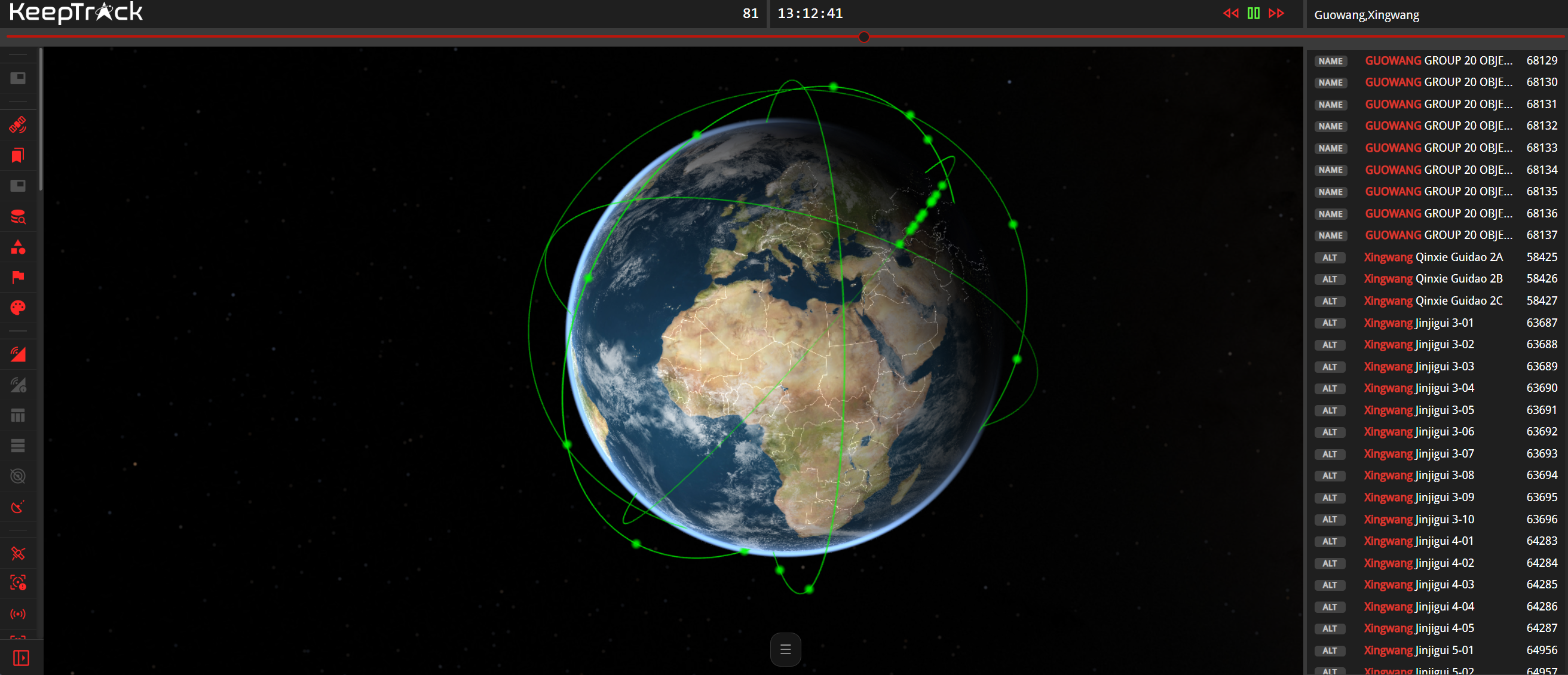
On December 16, 2024, a Long March 5B rocket lifted off from Wenchang Space Launch Center on China’s Hainan Island, carrying ten satellites into a polar orbit roughly 1,100 kilometers above the Earth. China’s state-run media said almost nothing about them. No mass figures. No dimensions. No capability descriptions. The Shanghai Academy of Spaceflight Technology confirmed the launch’s success two hours after liftoff and moved on.
This was the inaugural launch of Guowang - literally “national network” - China’s state-backed answer to SpaceX’s Starlink. But where SpaceX has been relentlessly public about Starlink’s capabilities, mass production, and service milestones, China’s approach to its own megaconstellation has been defined by what it doesn’t say. HULIANGWANG DIGUI-05, one of those first ten satellites, offers a useful lens into a program that’s simultaneously one of the most ambitious and most opaque space projects on Earth.
We can track it. We can measure its orbit. We can estimate its mass from the rocket that carried it. What we can’t do - what nobody outside a small circle in Beijing can do - is say with certainty what it’s actually doing up there.
That gap between what’s observable and what’s known is the defining feature of the Guowang program.
HULIANGWANG DIGUI-05
activeWhat’s in a name
The naming conventions alone tell a story about how China’s space bureaucracy handles this program. In Western tracking catalogs, this satellite shows up as HULIANGWANG DIGUI-05. The Chinese designation translates roughly to “Internet Low-Orbit 05” - a functional, almost aggressively uninformative label. It’s part of what the China Academy of Launch Vehicle Technology called the “satellite Internet low-orbit 01 satellite group,” which is about as evocative as a spreadsheet cell reference.
The broader constellation goes by several names depending on who’s talking. Guowang (国网) means “national network” or “state network.” Chinese media sometimes use Xingwang (星网), meaning “star network.” In ITU filings, the constellation appears under the designation GW. The operating entity is China Satellite Network Group, a state-owned enterprise established in April 2021 and placed directly under SASAC - the body that oversees China’s largest state-owned companies. That organizational placement signals how seriously Beijing takes this program. Rather than parking it as a subsidiary of existing aerospace giants like CASC or CASIC, the government gave SatNet its own seat at the table, with direct access to procurement and funding channels.
All of this contrasts sharply with how SpaceX discusses Starlink. Elon Musk tweets about individual satellite generations, publishes performance metrics, and livestreams launches. China SatNet doesn’t have a public website.
The rocket that raised eyebrows
The choice of launch vehicle for Guowang’s debut was notable for reasons beyond payload capacity. The Long March 5B is China’s heaviest-lift rocket for low Earth orbit, capable of hauling approximately 25,000 kilograms. It had previously been used exclusively for assembling China’s Tiangong space station - launching the Tianhe core module, the Wentian lab, and the Mengtian experiment module between 2021 and 2022.
Those earlier Long March 5B missions had earned international criticism for a design flaw that bordered on recklessness. The rocket’s core stage - a 22-metric-ton, 30-meter-long cylinder - would reach orbital velocity alongside its payload. Without restartable engines, the spent stage couldn’t deorbit itself. It would simply tumble in orbit for about a week before falling back to Earth wherever physics dictated. In 2020, debris from a Long March 5B core stage hit two villages in Côte d’Ivoire. In 2022, pieces came down near the Philippines. Space agencies and debris experts worldwide called it negligent. Jonathan McDowell, an astronomer at Harvard-Smithsonian who tracks global launch activity, noted that no other country was routinely leaving such massive objects to reenter in an uncontrolled manner.
For the Guowang launch, China added a Yuanzheng-2 upper stage - sometimes called a “space tug” - between the core stage and the satellites. This changed the mission profile significantly. The core stage didn’t need to reach full orbital velocity; the YZ-2 handled the final insertion, placing the ten satellites into their target orbits. SpaceNews reported that the core stage wasn’t expected to reach orbit at all, which would eliminate the uncontrolled reentry problem. Whether this was driven by genuine concern about international criticism or simply by the mission’s orbital requirements isn’t clear - but the result was the same. The debut Guowang launch didn’t produce the usual week of anxious tracking and reentry predictions.
The mass question
With ten satellites riding a rocket that can lift 25,000 kilograms, and accounting for the Yuanzheng-2 upper stage (which has its own mass and fuel), a rough estimate puts each satellite somewhere around 2,000 to 2,500 kilograms. Some tracking sources list the dry mass around 800 kg, which may represent the bus alone rather than the fully fueled launch mass, or it may simply be an estimate derived from limited information. Either way, these are substantially heavier than Starlink satellites.
For context, SpaceX’s current Starlink V2 Mini satellites weigh roughly 800 kilograms each, and SpaceX launches about 23 of them at a time on a Falcon 9. The original Starlink V1 satellites weighed about 260 kilograms. OneWeb’s satellites, which orbit at a similar altitude to Guowang’s, weigh about 150 kilograms each.
So what’s eating all that mass? There are several possibilities, and they aren’t mutually exclusive. Ka-band phased-array antennas for broadband communications are a given - Chinese state media confirmed the first group carried Ka-band payloads. But Chinese government sources have also stated that the Guowang program “can carry a variety of payloads, including broadband communication payloads, laser communication payloads, synthetic aperture radar payloads, optical remote sensing payloads, and others.”
That’s not a broadband constellation. That’s a multi-mission military-civil surveillance and communications network with broadband as one capability among several.
Two sizes, two mysteries
CAST - the China Academy of Space Technology, which manufactured the first Guowang satellites - has acknowledged developing both “large and small satellite platforms” for the constellation. They have not explained what the different platforms do. The evidence from launch vehicles provides the best clues.
The Long March 5B launches carry what appear to be the larger variant. The Long March 8A, a newer medium-lift rocket that entered service in early 2025, has been the workhorse for subsequent Guowang deployments, carrying nine smaller satellites per launch. The Long March 12, which debuted in late 2024, has also begun carrying Guowang batches. These rockets have significantly less lift capacity than the 5B, suggesting the satellites they carry are correspondingly lighter - likely in the 800-900 kilogram range, much closer to the mass listed in tracking databases.
Three different manufacturers are known to be producing Guowang satellites: CAST, the Innovation Academy for Microsatellites at the Chinese Academy of Sciences (IAMCAS/SECM), and Yinhe (Galaxy Space), a commercial firm. How their respective designs differ remains unknown.
What we do know from orbital data is that the constellation operates in two orbital shells within the higher GW-2 sub-constellation: one at 86.5° inclination (near-polar, providing global coverage including the poles) and another at 50.0° inclination (concentrating coverage over mid-latitude regions, including most of China’s territory and the Western Pacific). HULIANGWANG DIGUI-05 sits in the 86.5° shell at roughly 1,175 kilometers altitude.
Megaconstellation Comparison
| Guowang (GW-2) This Satellite | Starlink Market Leader | Qianfan | |
|---|---|---|---|
| Target Satellites | ~6,900 | 12,000-42,000 | ~15,000 |
| Orbital Altitude | ~1,145-1,175 km | ~550 km | ~1,160 km |
| Inclinations | 50.0° / 86.5° | Various (43°-97.6°) | Various |
| Est. Satellite Mass | 800-2,500 kg | 800 kg (V2 Mini) | ~300 kg |
| Operator | China SatNet (state) | SpaceX (commercial) | SSST (municipal govt) |
| First Launch | Dec 2024 | May 2019 | Aug 2024 |
- Target Satellites
- ~6,900
- Orbital Altitude
- ~1,145-1,175 km
- Inclinations
- 50.0° / 86.5°
- Est. Satellite Mass
- 800-2,500 kg
- Operator
- China SatNet (state)
- First Launch
- Dec 2024
- Target Satellites
- 12,000-42,000
- Orbital Altitude
- ~550 km
- Inclinations
- Various (43°-97.6°)
- Est. Satellite Mass
- 800 kg (V2 Mini)
- Operator
- SpaceX (commercial)
- First Launch
- May 2019
- Target Satellites
- ~15,000
- Orbital Altitude
- ~1,160 km
- Inclinations
- Various
- Est. Satellite Mass
- ~300 kg
- Operator
- SSST (municipal govt)
- First Launch
- Aug 2024
The ITU clock is ticking
China filed its Guowang constellation with the International Telecommunication Union in September 2020, declaring spectrum allocations for 12,992 satellites across two sub-constellations: GW-A59 (6,080 satellites at 500-600 km altitude) and GW-2 (6,912 satellites at approximately 1,145 km). Under ITU rules, China must launch half of the constellation - roughly 6,500 satellites - by 2032 to protect its spectrum rights.
As of mid-March 2026, there are approximately 163 Guowang operational satellites in orbit after 20 launch missions. The planned deployment ramp is steep: 310 satellites in 2026, 900 in 2027, and 3,600 per year starting in 2028. For some perspective on what those numbers require, consider that each Long March 8A mission carries nine satellites. Reaching 310 in 2026 would require roughly 34 launches dedicated to Guowang from that vehicle alone - or some combination of 8A, Long March 12, and Long March 5B missions. China launched 92 rockets total across all programs in 2025 and is targeting over 100 in 2026. Guowang deployment alone could consume a third of the national launch manifest.
China is betting heavily on new rockets and infrastructure to hit these targets. The Long March 8A, designed specifically for high-cadence constellation deployment, could theoretically launch from Wenchang’s commercial pad up to 16 times per year with current hardware - and efforts are underway to push that to 24. Reusable rockets, including the Long March 12A (a variant intended to land and refly its first stage), are in development to bring per-launch costs down.
Whether these targets are achievable is genuinely uncertain. The ramp from 163 satellites in March 2026 to 3,600 per year by 2028 would require an industrial transformation in satellite manufacturing, launch processing, and ground network operations that makes SpaceX’s own scaling look leisurely by comparison. China is certainly investing heavily - but “investing heavily” and “on track” aren’t the same thing.
The military question
In February 2024 - when only nine Guowang test satellites were in orbit - Taiwanese media reported that three Chinese Coast Guard vessels had entered waters near Taiwan’s eastern coast at high speed and in electronic silence. According to sources cited by Taiwanese outlets, the vessels were testing Guowang’s ability to provide targeting data for the PLA Rocket Force’s DF-21D and DF-26B ballistic missiles. The DF-21D, often called a “carrier killer,” is designed to strike moving naval targets in the Western Pacific. The DF-26B can reach Guam.
A retired U.S. Air Force intelligence officer, Greg Gillinger, analyzed the orbital data and determined that the nine test satellites could have provided roughly 8.5 hours of coverage over the Miyako Strait that day, with several windows of 30-60 consecutive minutes of multi-satellite coverage. Not continuous surveillance - but enough for testing purposes.
This aligns with broader statements from Chinese officials and academic papers. A team led by an associate professor at the PLA’s Space Engineering University has written about Guowang’s role in countering Starlink and securing orbital resources, framing it explicitly in military terms. The constellation’s architecture - thousands of satellites at two altitude bands, with near-polar coverage from the 86.5° shell and concentrated mid-latitude coverage from the 50° shell - makes military sense as well as commercial sense.
ITU Filing
China files for 12,992-satellite GW constellation with the International Telecommunication Union
China SatNet Established
State-owned China Satellite Network Group created under SASAC to manage Guowang
First Test Satellites
Initial Guowang test satellites launched into ~1,111 km orbits for on-orbit validation
Reported Military Test
Taiwanese media reports Chinese Coast Guard vessels testing Guowang for missile targeting near Taiwan
First Operational Launch
Long March 5B carries first 10 production Guowang satellites, including HULIANGWANG DIGUI-05
Long March 8A Debut
New medium-lift rocket begins Guowang deployment missions, carrying 9 satellites per launch
100+ Satellites On Orbit
Guowang surpasses 100 operational satellites after accelerated launch cadence through late 2025
163 Satellites and Counting
20th launch mission completed; 310 satellites targeted for 2026 deployment
The bigger race
Guowang doesn’t exist in isolation. It’s one of at least three major Chinese megaconstellations under construction. Qianfan (“Thousand Sails”), backed by Shanghai’s municipal government and developed by Shanghai SpaceCom Satellite Technology, has launched over 100 satellites and is targeting up to 15,000. Honghu-3, a commercial venture by Landspace Technology, plans 10,000 satellites. Between these three programs, China has ambitions to deploy roughly 40,000 satellites - a number that rivals the entirety of SpaceX’s Starlink plans.
But Guowang is the one that matters most to Beijing. As the state-backed program managed directly under SASAC, it’s the one with guaranteed funding, priority launch access, and the political backing to push through manufacturing and infrastructure bottlenecks. If China can only sustain one megaconstellation at full scale, it’ll be Guowang.
The geopolitical context is hard to overstate. China has signed over 117 space cooperation agreements with more than 30 countries. A 2021 White Paper explicitly linked satellite infrastructure to the Belt and Road Initiative. Much of Africa’s 4G infrastructure is already Huawei-built, potentially making a transition to Chinese satellite broadband relatively seamless. In a world where Starlink’s relationship with U.S. policy is increasingly politicized, some nations and military organizations may actively prefer a non-American alternative - regardless of whether it’s technically competitive.
China recently filed paperwork with the ITU for constellations totaling more than 200,000 satellites. That number should be understood as a spectrum reservation play rather than a literal construction plan. But it signals that Beijing sees orbital infrastructure as strategic terrain worth claiming, even speculatively.
What we know about HULIANGWANG DIGUI-05
Strip away the geopolitics and the speculation, and what can we actually say about this one satellite?
It was built by CAST on the Xingwang CL bus - a platform purpose-designed for the Guowang constellation. It has a box-shaped body with two deployable solar panels, measures roughly 3 meters long by 1 meter wide with a 10-meter wingspan when the arrays are deployed, and has a dry mass of approximately 800 kilograms. It carries Ka-band communications equipment designated as the Xingwang Jinjigui 1-05 payload. It launched from Wenchang’s LC101 pad on a Long March 5B/YZ-2 and reached its operational orbit at approximately 1,175 km altitude with an 86.5° inclination.
Its mean motion of roughly 13.24 revolutions per day and near-zero eccentricity tell us it’s in a stable, nearly circular orbit - consistent with a satellite that has finished maneuvering to its assigned station within the constellation. The orbital parameters suggest it’s positioned in one of the GW-2 sub-constellation’s polar shells, providing coverage that sweeps across virtually the entire globe, pole to pole.
Beyond that, we’re left with inference. The satellite is operational and active. It’s one of 163 currently in orbit. It will eventually be joined by roughly 6,700 more satellites in similar orbits, and perhaps another 6,000 at lower altitudes. Whether it’s providing broadband, collecting signals intelligence, supporting navigation, or some combination - that’s the kind of thing China SatNet doesn’t feel the need to share.
For now, HULIANGWANG DIGUI-05 keeps circling at 1,175 kilometers, completing just over 13 orbits every day, sweeping its radio beams across the planet below. One small node in what’s planned to be one of the largest satellite networks ever built. What those beams carry, and who they serve, is Beijing’s to know and the rest of the world’s to figure out.
References(10)
- China Kicks Off Guowang Megaconstellation With Long March 5B Launch - SpaceNews
- Developing and Testing China's Guowang Constellation - The Space Review
- Guowang Finally Launches Ten Large Production Satellites - CircleID
- Chinese LEO Satellite Internet Update: Guowang, Qianfan, and Honghu-3 - CircleID
- China's First Launches of 2026 - SpaceNews
- China Launches Fourth Group of Guowang Megaconstellation Satellites - SpaceNews
- China's Mega-Constellations Mega-Article - China in Space
- HWD (Hulianwang Weixing Digui) - Gunter's Space Page
- GuoWang Overview - SkyLinker
- Guo Wang: China's Answer to Starlink? - RUSI

Theodore Kruczek