· deep dive · 19 min read
LeoLabs and the Business of Watching Everything
A startup built on Cold War-era radar science now tracks 25,000 objects in orbit - and the Pentagon can't get enough of it. But can its radars really compete with the Space Surveillance Network?
On Thanksgiving Day 2023, Russia’s Cosmos 2570 satellite did something interesting. It split open like a nesting doll, releasing a smaller satellite, which then released an even smaller one. The three objects began performing close-proximity maneuvers around each other in low Earth orbit. The U.S. Space Force’s 18th Space Defense Squadron briefly lost track of the main satellite when it maneuvered after launch. A private company in Menlo Park, California, found it again within days.
That company was LeoLabs, and its analysts noticed something else: Russia seemed to be timing these kinds of maneuvers to coincide with American holidays. Christmas Eve 2022 saw a similar sub-satellite release from Cosmos 2565. China’s experimental spaceplane conducted rendezvous operations over Thanksgiving weekend the same year. “It may be on purpose. It probably is,” LeoLabs co-founder and CTO Ed Lu told Breaking Defense at the time.
It’s the kind of observation you can only make if you’re watching everything, all the time. And that’s exactly what LeoLabs has built itself to do - a global network of phased-array radars feeding a commercial catalog of over 25,000 objects in low Earth orbit, with revisit rates that sometimes exceed what satellite operators get from the U.S. government’s own tracking infrastructure. In the process, this SRI International spinoff has gone from an eight-person startup with $4 million in seed funding to a company pulling in $60 million in annual contract awards and positioning itself as the Pentagon’s preferred commercial eye on LEO.
But there’s a question that deserves honest scrutiny: can LeoLabs’ radars really match what the U.S. Space Force operates? The answer is more nuanced than either LeoLabs’ marketing or its critics suggest.
Built on Cold War Science
The technology that makes LeoLabs possible wasn’t invented in a Silicon Valley garage. It was developed over decades at SRI International - the nonprofit research organization formerly known as Stanford Research Institute - under funding from the National Science Foundation and the Department of Defense.
The key piece of heritage is the Advanced Modular Incoherent Scatter Radar, or AMISR, a phased-array radar system SRI developed through the 1990s and 2000s. The first deployment, the Poker Flat Incoherent Scatter Radar (PFISR) near Fairbanks, Alaska, went operational in 2007. It was built to study Earth’s ionosphere in the auroral zone, and it remains one of the most powerful instruments of its kind - a two-dimensional phased array with 4,096 transmitting and receiving elements.
Dan Ceperley led the space debris tracking program at SRI. Mike Nicolls built the phased-array radars to study the ionosphere. Ed Lu was a former NASA astronaut who’d spent 206 days in space, including six months aboard the International Space Station as part of a skeleton crew dispatched weeks after the Columbia disaster in 2003. Together with engineer John Buonocore, who’d spent 33 years at SRI designing everything from landmine detection radars to CubeSat payloads, they recognized that the same technology tracking ionospheric disturbances could track something far more commercially relevant: the growing swarm of satellites and debris in LEO.
The business case crystallized around 2015. SpaceX had just begun deploying Starlink precursors, Planet was scaling its Dove constellation, and the number of objects in LEO was accelerating in ways the U.S. government’s legacy tracking infrastructure wasn’t equipped to handle. The Space Surveillance Network - a collection of sensors built primarily during the Cold War - was designed around Northern Hemisphere coverage optimized for tracking Soviet ICBMs. It left significant gaps in equatorial and Southern Hemisphere coverage, and its data products, the familiar Two-Line Element sets, offered accuracy measured in kilometers when operators increasingly needed accuracy measured in meters.
SRI spun out LeoLabs in 2016. “Right out of the gate we had data, radar hardware and we could begin building,” Ceperley said at the time. The Poker Flat radar kept feeding data to SRI for ionospheric research while simultaneously providing LeoLabs with its first operational sensor for spacecraft tracking. It was an elegant dual-use arrangement.
The Radar Network
What separates LeoLabs from most of its competitors is vertical integration. The company doesn’t buy tracking data from someone else’s sensors or rely on optical telescopes that can only operate on clear nights. It builds, owns, and operates its own radars - and those radars work in any weather, day or night.
Poker Flat ISR (Alaska)
SRI-operated UHF radar, 4,096-element 2D phased array. LeoLabs' first data source through a partnership arrangement.
Midland Space Radar (Texas)
LeoLabs' first proprietary radar. UHF band, 1D phased array with around 100 elements - same fidelity at significantly lower cost.
Kiwi Space Radar (New Zealand)
First Southern Hemisphere radar in the network. S-band, designed to detect objects as small as 2 cm.
Costa Rica Space Radar
Near-equatorial site with X-shaped field of view. First coverage of low-inclination orbits. Built in nine months.
Western Australia & Azores
Sites in Australia and on Santa Maria Island off Portugal. Coverage expanded across Southern Hemisphere and North Atlantic.
Seeker Radar (Arizona)
First next-gen UHF Direct Radiating Array. Higher power, wider field of regard for high-altitude search and detection.
Scout Unveiled
Containerized S-band mobile radar for rapid deployment anywhere in the world, including potentially on ships.
The network’s expansion follows a deliberate geographic logic. The Alaska radar covers polar orbits. Texas catches objects near the International Space Station’s inclination. New Zealand and Australia provide Southern Hemisphere coverage. Costa Rica fills the equatorial gap that Cold War-era sensors never needed to address. The Azores close the North Atlantic coverage hole.
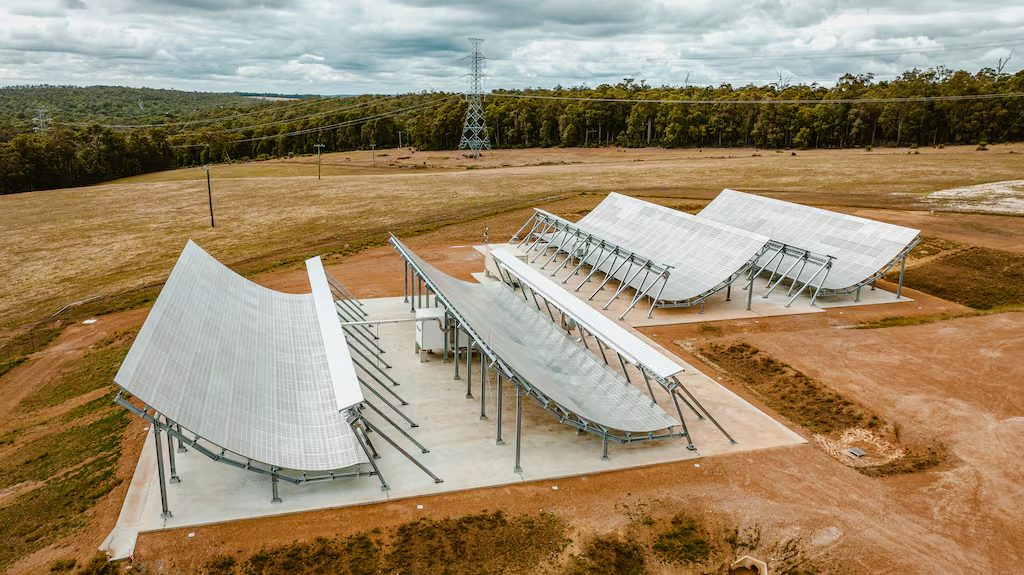
LeoLabs has also evolved its radar technology across three generations. The original Tracker-class PAFR (Phased Array Offset-Fed Reflector) radars form the backbone in Australia, the Azores, Costa Rica, New Zealand, and Texas. The Seeker-class UHF Direct Radiating Array, first deployed in Arizona in late 2024, brings higher power and a wider field of regard for detecting objects at higher altitudes and monitoring maneuvers. And Scout, unveiled at the 2025 Space Symposium, is something different entirely: a containerized S-band radar small enough to ship by truck or cargo vessel, designed for rapid deployment in response to specific threats.
The company’s pitch for Scout is straightforward. China completed a record 92 orbital launches in 2025, and the Space Force needs the ability to detect new launches and track deployed payloads quickly, from locations that existing sensors don’t cover. LeoLabs plans to deploy dozens of Scout units worldwide, starting with a Hawaii installation in early 2026 and potentially placing units on ships for ocean-based coverage.
LeoLabs vs. the Space Surveillance Network
Here’s where the story gets uncomfortable for LeoLabs’ marketing department. The company has occasionally implied - and its media coverage has often stated outright - that it can track objects as well as or better than the U.S. government. The reality is more complicated.
The Space Surveillance Network’s crown jewel is the Space Fence, a Lockheed Martin-built S-band radar on Kwajalein Atoll in the Marshall Islands that went operational in March 2020. It cost $1.5 billion. Its transmit array contains 36,000 GaN (gallium nitride) elements. Its receive array has 86,000 elements with element-level digital beamforming. The Space Force calls it the most sensitive search radar in the entire SSN, capable of detecting objects as small as a marble - roughly 1 centimeter - in LEO. It makes 1.5 million observations per day and can track objects out to geosynchronous orbit.
Radar Scale Comparison
| Space Fence (Kwajalein) Most Sensitive | LeoLabs Network (11 radars) Most Distributed | |
|---|---|---|
| Cost | ~$1.5 billion | ~$120M+ total funding |
| Band | S-band | - |
| Transmit Elements | 36,000 (GaN) | ~100 (Midland); 4,096 (PFISR) |
| Receive Elements | 86,000 | Varies by site |
| Min. Detection Size | ~1 cm (marble) | ~2 cm (S-band); ~10 cm (UHF) |
| Observations/Day | ~1.5 million | Millions (network-wide) |
| Coverage | Single equatorial site | 7 sites, global distribution |
| Bands | - | UHF and S-band |
- Cost
- ~$1.5 billion
- Band
- S-band
- Transmit Elements
- 36,000 (GaN)
- Receive Elements
- 86,000
- Min. Detection Size
- ~1 cm (marble)
- Observations/Day
- ~1.5 million
- Coverage
- Single equatorial site
- Bands
- -
- Cost
- ~$120M+ total funding
- Band
- -
- Transmit Elements
- ~100 (Midland); 4,096 (PFISR)
- Receive Elements
- Varies by site
- Min. Detection Size
- ~2 cm (S-band); ~10 cm (UHF)
- Observations/Day
- Millions (network-wide)
- Coverage
- 7 sites, global distribution
- Bands
- UHF and S-band
LeoLabs’ Midland radar in Texas - its first proprietary system - has “more than 100” radar elements. Even the 4,096-element PFISR in Alaska, which LeoLabs accesses through its SRI partnership, is a fraction of Space Fence’s scale. The physics here aren’t forgiving: radar sensitivity scales with the fourth power of range, meaning that to detect an object half the size at the same distance, you need roughly 16 times the radar power. Space Fence has that power. LeoLabs’ individual radars don’t come close.
Beyond Space Fence, the SSN includes systems like MIT Lincoln Laboratory’s Haystack Ultrawideband Satellite Imaging Radar (HUSIR), an X-band system that can resolve objects smaller than 1 centimeter, and the 85-foot Millstone Hill radar. These are research instruments not designed for catalog maintenance, but they give the U.S. government characterization capabilities that LeoLabs simply can’t match from its smaller commercial radars.
So when LeoLabs’ Australian managing director said in 2022 that the company would be able to “monitor more objects in low-Earth orbit than the legacy U.S. Space Surveillance Network,” that claim had a specific caveat: it was comparing against the SSN as it existed before Space Fence came fully online. That’s a materially different claim than parity with today’s SSN.
Where LeoLabs Actually Wins
None of this means LeoLabs is selling snake oil. The company’s genuine advantages are real, and they’re the reason the government keeps writing checks.
The first advantage is geography. The SSN’s most powerful sensors are clustered in the Northern Hemisphere - a Cold War inheritance. Space Fence is equatorial on Kwajalein, but the planned second site in Australia has never been funded. LeoLabs has seven sites spanning both hemispheres and the equatorial belt. That geographic distribution gives it observing opportunities on objects that government sensors simply miss or see too infrequently.
The second is revisit rate for commercial customers. LeoLabs claims 90% of the payloads in its catalog are revisited at least five times per day, with high-interest objects observed up to 13 times daily. For satellite operators who need actionable conjunction data - not a TLE updated whenever the SSN gets around to it - that cadence matters. The company’s position accuracy at epoch is stated as 100-200 meters, compared to kilometers for standard TLEs. That’s not competitive with what the SSN can achieve with its best sensors focused on a single target, but it’s dramatically better than the bulk catalog products most operators actually receive.
The third - and possibly most important - is speed and accessibility. LeoLabs delivers data via API and SaaS platform in near real-time. The government catalog has historically taken hours or days to update after maneuvers. When Cosmos 2570 maneuvered on Thanksgiving and the 18th Space Defense Squadron temporarily lost custody, LeoLabs re-established tracking within days and shared updates through the Joint Commercial Operations cell. The government has enormous raw capability. LeoLabs often gets usable information to operators faster.
The honest framing isn’t “LeoLabs is better than the Space Force.” It’s “LeoLabs provides different coverage, at different price points, with different latency, and the two are more complementary than competitive.” The government seems to agree - which is why it’s buying LeoLabs data rather than treating it as a rival.
Following the Money
LeoLabs’ financial trajectory tells the story of a market that barely existed a decade ago. The company’s $4 million seed round in 2016 came from Horizons Ventures and Airbus Ventures, investors betting that congestion in LEO would eventually demand commercial solutions. The $13 million Series A in 2018 funded the New Zealand radar. The $65 million Series B in 2021 accelerated global network expansion. An additional $29 million in 2024, led by GP Bullhound, focused on AI-powered analytics and partner integrations.
But the real inflection point has been government contracts. LeoLabs reported over $50 million in contracts during 2024, representing nearly 140% revenue growth year-over-year. In 2025, that number climbed to more than $60 million in total contract awards, with U.S. government bookings growing 186% year-over-year. The company also landed the $60 million STRATFI award from SpaceWERX to build the Indo-Pacific Seeker radar. And in March 2026, a contract modification brought the cumulative value of its Advanced UHF Phased Array Radar program to nearly $24 million.
A company founded to track space debris is now developing radar variants optimized for missile tracking. LeoLabs has been included in the competitive range for the Missile Defense Agency’s SHIELD contract - an IDIQ vehicle with a $151 billion ceiling - though MDA awarded positions to over 2,300 companies across three tranches. Being in the competitive range means LeoLabs can bid on future task orders. It doesn’t guarantee revenue.
The Astronaut, the Engineer, and the Maxar Guy
LeoLabs’ leadership evolution mirrors its strategic shift. Co-founder Dan Ceperley, the SRI electrical engineer with a Berkeley PhD, led the company from founding through 2024 - the build-and-prove phase. He assembled the radar network, won the early pathfinder contracts, and established LeoLabs’ commercial credibility with customers like BlackSky, Planet, and Maxar.
In February 2024, Ceperley stepped into the COO role and handed the CEO title to Tony Frazier, a former Maxar Technologies executive who’d led a $1 billion public sector intelligence business serving the U.S. government and over 60 international customers. The message was clear: LeoLabs had proven its technology. Now it needed someone who could scale government relationships and turn pathfinder contracts into programs of record.
Ed Lu, meanwhile, remains CTO and arguably the company’s most compelling biographical asset. A physicist with a Stanford PhD and 12-year NASA career, Lu became the first American to launch as Flight Engineer aboard a Russian Soyuz spacecraft during the emergency ISS crew rotation after Columbia. He co-founded the B612 Foundation to protect Earth from asteroid impacts, led Advanced Projects at Google (where he helped build Google Maps), and was inducted into the International Astronautical Federation’s Hall of Fame in 2024. At LeoLabs, he leads technology development. He also provides the kind of credibility that helps when you’re telling the Pentagon that a startup can do their job better than they can.
What They’ve Actually Caught
Technology comparisons are one thing. Operational results are another. LeoLabs has built its reputation on specific, high-profile detections that demonstrated what a commercially distributed sensor network could do - and these are the cases where the company’s geographic coverage and always-on operations genuinely filled government gaps.
The most consequential recent example is Russia’s Cosmos 2553. Launched in February 2022 - just 20 days before Russia’s full-scale invasion of Ukraine - the satellite was placed in an unusual orbit about 2,000 kilometers up, in a high-radiation zone that communications satellites typically avoid. U.S. intelligence linked it to Russia’s suspected nuclear anti-satellite weapons program. LeoLabs monitored Cosmos 2553 from launch. In November 2024, the company’s Doppler radar measurements detected anomalies suggesting the satellite had become unstable. By December, with confirmation from Maxar’s WorldView Legion imagery, LeoLabs assessed with “high confidence” that Cosmos 2553 was tumbling at roughly 2.3 degrees per second - effectively dead.
The finding rippled through the national security community. The Center for Strategic and International Studies cited LeoLabs’ analysis in its 2025 Space Threat Assessment, concluding the satellite was likely no longer operational. If Cosmos 2553 was indeed a testbed for nuclear ASAT technology, its failure represented a setback for one of the most alarming weapons programs in space.
LeoLabs also persistently tracked China’s experimental spaceplane (Test Spacecraft 2) for over 200 days between 2022 and 2023, detecting several maneuvers, deployments, and docking activities. And the company documented the Cosmos 2570 nesting-doll deployment on Thanksgiving 2023, providing the Space Force with tracking updates after the 18th Space Defense Squadron temporarily lost custody during the satellite’s post-launch maneuver.
These cases illustrate what LeoLabs actually provides at scale: not raw sensitivity that matches the government’s most powerful sensors, but persistent global coverage with fast data delivery. When the Space Force’s own analysts needed an independent track on a maneuvering Russian satellite, they turned to LeoLabs. That’s not because LeoLabs has a bigger radar. It’s because LeoLabs had a radar pointed in the right direction at the right time.
The TraCSS Play
While the defense contracts grab headlines, LeoLabs’ potentially more consequential bet is on the civilian side of space traffic management. The U.S. government has been working since 2018 to transfer basic space situational awareness services from the Department of Defense to a civil agency under the Department of Commerce. The resulting system, the Traffic Coordination System for Space (TraCSS), is meant to become the world’s primary civil space traffic coordination service.
LeoLabs has positioned itself as a foundational data provider for TraCSS from the beginning. It was one of three companies (alongside COMSPOC and Slingshot Aerospace) selected for the initial Consolidated Pathfinder in January 2024. In June 2025, it was selected for the Commercial Collision Avoidance Gap Pathfinder, addressing the elevated collision risk immediately after launch. And in September 2025, LeoLabs landed a contract that marked a genuine milestone: the first time the Department of Commerce and U.S. Space Force jointly licensed a commercial object catalog for both civil space traffic management and military space domain awareness.
Under that contract, LeoLabs feeds its entire LEO catalog - radar observations, object state vectors, maneuver detection data - into both the Space Force’s Unified Data Library and the Commerce Department’s TraCSS system. It’s the first real demonstration of civil-military data fusion using a commercial source, and it suggests a future where the Pentagon offloads routine catalog maintenance to civil and commercial providers while focusing its own sensors - including that $1.5 billion Space Fence - on the high-end threat characterization mission.
The Competitive Landscape
LeoLabs doesn’t operate in a vacuum. The commercial space domain awareness market has grown crowded, with each major player occupying a different niche.
ExoAnalytic Solutions, founded in 2008, built the world’s largest commercial network of optical telescopes - roughly 400 sensors focused primarily on medium Earth orbit and geosynchronous orbit. In March 2026, Anduril Industries acquired ExoAnalytic, absorbing its telescope network and tracking algorithms into Anduril’s broader defense technology portfolio. That acquisition underscored the strategic value of commercial SDA capabilities - and introduced a competitor with substantially deeper pockets.
Slingshot Aerospace operates its own optical sensor network and has won multiple Space Force contracts for persistent monitoring and satellite “fingerprinting.” COMSPOC offers analytics software - its Mission Awareness platform acts as a fusion engine for data from multiple sensor sources. Passive RF providers like Kratos Space monitor the signals satellites emit during routine operations, adding another layer of characterization that neither radar nor optical sensors provide.
LeoLabs occupies a distinctive position: it’s the only major commercial player that builds and operates its own radar network specifically for LEO tracking. That vertical integration gives it control over data quality, collection scheduling, and revisit rates that companies relying on third-party sensors or optical systems can’t easily match. The tradeoff is capital intensity - building and maintaining a global radar network is expensive, which partly explains why LeoLabs has raised over $120 million and is increasingly dependent on government contracts to fund continued expansion.
The competitive landscape is stratifying along orbital regime lines. LeoLabs dominates commercial LEO radar. ExoAnalytic (now Anduril) dominates commercial MEO/GEO optical. The emerging question isn’t which company wins, but whether the government consolidates around a few providers or continues buying from the whole roster through short-duration competitive contracts - the approach the Space Force’s Joint Commercial Operations cell currently favors.
The Risks
LeoLabs’ story is compelling, but it’s worth flagging the uncertainties.
The company’s revenue growth is heavily weighted toward U.S. government contracts, which means it’s subject to budget cycles, political priorities, and procurement bureaucracy. The TraCSS program, while bipartisan in principle, has faced funding constraints that commercial providers have publicly criticized. COMSPOC has raised concerns that inadequate funding could hold back long-term, diverse commercial data integration.
The pivot toward missile tracking and hypersonic detection pushes LeoLabs into territory dominated by established defense primes like Raytheon, L3Harris, and Northrop Grumman - companies with decades of missile defense experience and existing sensor programs like MOSSAIC and ATLAS. LeoLabs’ argument is that its commercial agility and lower cost structure give it an advantage, but defense procurement rarely rewards the smallest bidder by default.
Then there’s the debris tracking gap. LeoLabs has been talking about cataloging 2-10 cm debris since 2019. It’s central to the company’s narrative about addressing “95% of collision risk.” But the operational catalog remains dominated by 10 cm+ objects. Until LeoLabs demonstrates persistent tracking and catalog maintenance for sub-10 cm debris at scale - not just single-pass detection capability - that claim remains aspirational. The forthcoming Ranger radar class is designed specifically for this mission, but it hasn’t been deployed yet.
And there’s the question of what happens when China and Russia develop countermeasures specifically designed to defeat commercial radar tracking. LeoLabs’ ability to detect maneuvers and characterize objects is a genuine intelligence advantage today. Whether it stays one depends on the adversary’s willingness to invest in deception.
Where It Goes From Here
LeoLabs entered 2026 with momentum that would have seemed absurd a decade ago: $60 million in annual contract awards, 11 operational radars across seven sites, new radar classes entering production, a NASA Space Act Agreement, and a joint civil-military catalog license that’s the first of its kind. The company plans to deploy its first Scout mobile radar in Hawaii this year and its second Seeker radar in the Indo-Pacific by 2027.
The bigger picture is structural. Low Earth orbit went from roughly 2,500 active satellites in 2020 to over 10,000 today, with forecasts projecting 70,000 or more by 2030. Every one of those satellites needs tracking. Every launch creates a window of elevated collision risk. Every adversary maneuver generates intelligence requirements. The demand signal for what LeoLabs provides isn’t discretionary - it’s infrastructure, in the same way that air traffic control is infrastructure for aviation.
Whether LeoLabs specifically captures the lion’s share of that market depends on execution, on continued government funding, and on whether the company can maintain its technological edge as competitors - including defense primes like Anduril/ExoAnalytic - scale their own capabilities. But the market itself isn’t going anywhere.
The honest assessment of LeoLabs is this: it doesn’t have the most powerful radars in the world, and it knows it. What it has is a globally distributed network that provides persistent, all-weather LEO coverage at price points the government finds attractive, with data delivery fast enough to be operationally useful. A decade ago, the idea that a startup could complement - not replace, but genuinely complement - the U.S. government’s space surveillance capabilities sounded naive. Today, the government is paying LeoLabs to do exactly that. For a company that started with two radars and eight employees, that’s not a bad position to be in. Whether the 2 cm catalog ever materializes will determine if it becomes something more.
References(19)
- LeoLabs Achieves Record Bookings in 2025 - LeoLabs Press Release, Jan. 2026
- LeoLabs Receives DOC/USSF Joint Catalog License - LeoLabs Press Release, Dec. 2025
- Tony Frazier Takes the Helm at LeoLabs - SpaceNews, Feb. 2024
- LeoLabs to Build Space-Monitoring Radar in Indo-Pacific - SpaceNews, Mar. 2025
- LeoLabs Unveils Scout Mobile Radar System - Payload, Apr. 2025
- Pentagon Looks to Ground Radars for Space Domain Awareness - Air & Space Forces Magazine, Apr. 2025
- Russia, China Time Suspicious Space Activity for US Holidays - Breaking Defense, Dec. 2023
- Russian Satellite Linked to Nuclear Weapon Program Appears Out of Control - Reuters via U.S. News, Apr. 2025
- LeoLabs Lands Interagency Contract to Feed TraCSS - SpaceNews, Dec. 2025
- Space Fence Radar Overview - Lockheed Martin
- Space Fence System Overview - AMOS Technical Papers, 2015
- Space Fence Radar Leverages Power of GaN - Microwave Journal, Aug. 2016
- LeoLabs' Australian Radar to Exceed US Capability - Space Connect, Jun. 2022
- LeoLabs Commercial Ground-Based Tracking Service - eoPortal
- Case Study: How SRI's Spinout of LeoLabs Launched a Revolution - SRI International
- Satellite-Tracking Firm LeoLabs Opens for Business - SpaceNews, 2017
- Managing SDA Data Has Become a Greater Challenge Than Collecting It - SpaceNews, Dec. 2025
- LeoLabs Federal UHF Radar Contract Modification - DOD Contracts, Mar. 2026
- LeoLabs New Radar Tracks Tiny Space Debris - Breaking Defense, Oct. 2019

Theodore Kruczek