· deep dive · 13 min read
Neil Gehrels Swift Observatory
Designed for a two-year mission to catch gamma-ray bursts in the act, Swift is now 21 years old, slowly falling out of the sky, and the subject of an unprecedented private rescue mission. Nobody planned for it to be this hard to let go.
Gamma-ray bursts are, without much competition, the most violent events in the observable universe. In the time it takes you to read this sentence, one of them probably just went off somewhere - a beam of energy briefly outshining entire galaxies, triggered by a collapsing star or two neutron stars spiraling into each other at a fraction of the speed of light. They last anywhere from a few milliseconds to a few minutes. Then they’re gone.
The problem, for decades, was that astronomers couldn’t catch them fast enough. By the time a telescope could be pointed at a burst’s location, the gamma rays had long since passed. What was left was an X-ray and optical afterglow that faded quickly, and a lot of frustration. The origin of these bursts - what exactly was causing them, where they came from, how far away they were - remained genuinely unknown well into the 1990s.
NASA’s answer was a satellite that could move faster than the question. Launched on November 20, 2004, aboard a Delta II 7320 rocket from Cape Canaveral’s SLC-17A, the Swift Gamma-Ray Burst Explorer was designed around one core capability: autonomously detect a burst, compute its position, and repoint its telescopes to begin detailed observations - all within about 90 seconds of the initial detection. No waiting for a command uplink. No human in the loop. Just a spacecraft that, as its name implied, could actually keep up.
It was built with a nominal two-year mission in mind. Twenty-one years later, it’s still up there. Though not for much longer, unless a small company in Flagstaff can pull off something that’s never been done before.
Neil Gehrels Swift Observatory
activeThree Instruments, One Job
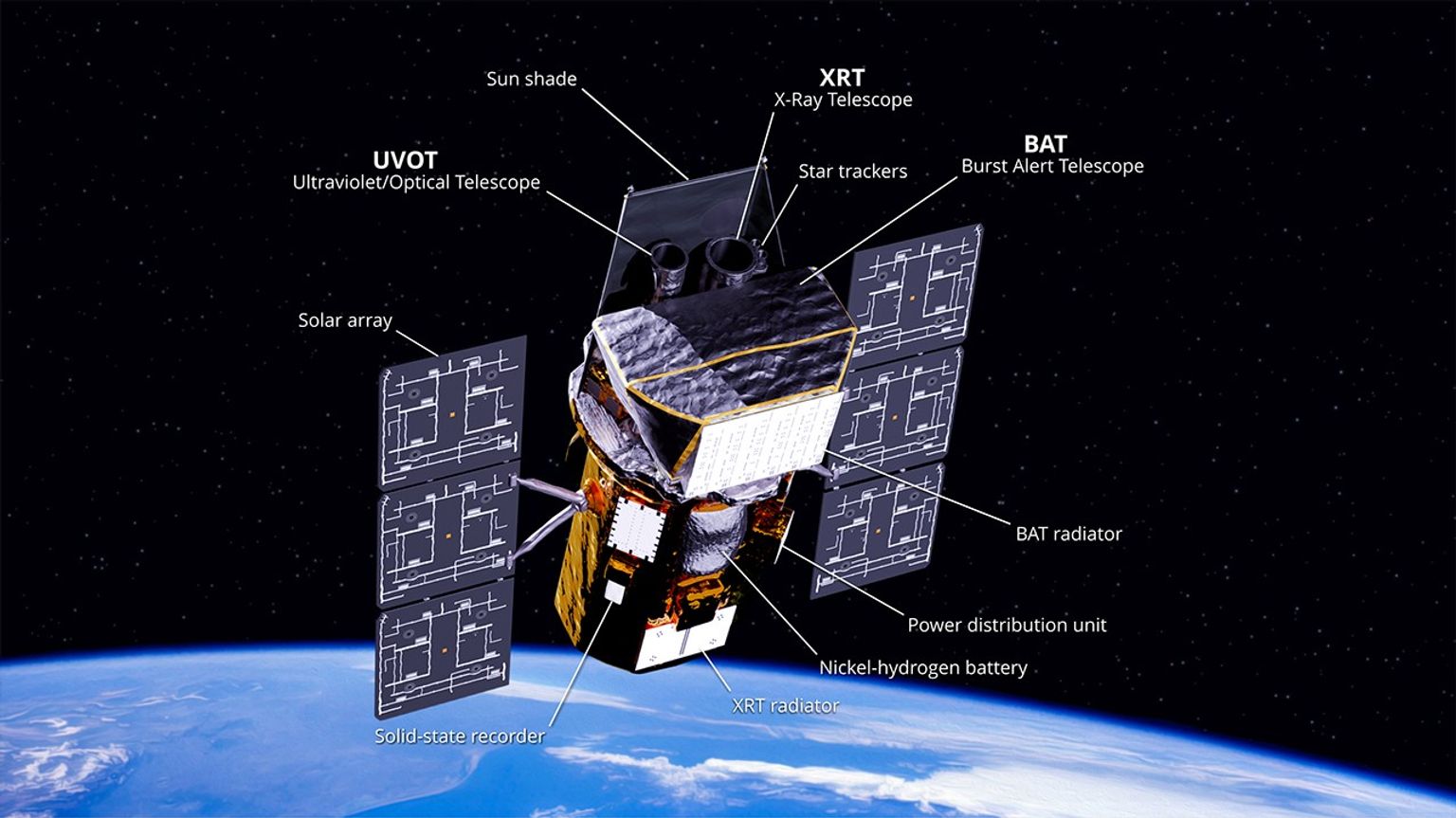
Swift’s scientific payload is a tightly integrated trio. Each instrument hands off to the next in a sequence designed to go from a vague sky location to a precise, multiwavelength picture of a burst in motion.
The first in that chain is the Burst Alert Telescope (BAT) - a wide-field gamma-ray detector covering roughly half the sky at any given moment. BAT uses a coded aperture mask: a patterned sheet of metal that casts a shadow onto a detector plane, allowing the onboard computer to reconstruct where in the sky a gamma-ray source is located. Within 20 seconds of detection, BAT computes a position accurate to within about 3 arcminutes and radios it to the ground. The spacecraft simultaneously begins its autonomous slew.
By the time Swift has repointed - typically 20 to 100 seconds after the initial detection - the X-ray Telescope (XRT) comes online. Built partly from leftover hardware from an earlier mission called JET-X, the XRT operates in the 0.3 to 10 keV energy range and can pin down a burst’s location to within about 3 arcseconds. That’s precise enough to start connecting a burst to a host galaxy, which gives you the redshift, which gives you the distance, which gives you the actual energy involved. This chain of inference is how Swift turned gamma-ray bursts from mysterious flashes into cosmological tools.
The third instrument is the Ultraviolet/Optical Telescope (UVOT), which provides the sharpest position of all - sub-arcsecond accuracy - and captures the burst’s optical and UV afterglow. UVOT was adapted from the Optical Monitor aboard ESA’s XMM-Newton observatory, with upgraded optics and processing. It’s sensitive enough to detect objects fainter than 22nd magnitude, which means it can spot the fading glow of a burst that happened billions of light-years away.
Together, the three instruments cover roughly ten orders of magnitude in photon energy, from optical wavelengths through hard X-rays into gamma rays. That breadth is what made Swift genuinely new. Previous missions could detect bursts, or study their afterglows, but not both in the same pass. Swift does it continuously, automatically, and in near real time.
Short Bursts, Long Answers
Swift’s first burst detection came sooner than expected. On December 17, 2004 - less than four weeks after launch, while the spacecraft was still being commissioned - the BAT triggered on an apparent gamma-ray burst. The team hadn’t yet enabled autonomous slewing, so they couldn’t follow up with the narrow-field instruments. But the detection itself was a good sign.
The first fully operational GRB came on January 17, 2005. Swift caught it, slewed, and observed. By February 1, the mission team declared Swift fully operational and released UVOT’s first-light image.
What followed was a rapid redrawing of what astronomers thought they knew. On May 9, 2005, Swift detected GRB 050509B - a burst lasting just one-twentieth of a second. That made it a “short” GRB, a category that had been poorly understood because no one had ever pinned down an accurate position for one in time to study its afterglow. Swift got there first. The XRT detected an X-ray counterpart, and the host galaxy turned out to be an elliptical - old, with no active star formation. That ruled out the popular theory that all GRBs came from collapsing massive stars. Short bursts, it now appeared, were something else entirely: probably neutron star mergers.
That distinction turned out to be enormously important. Long GRBs (more than two seconds) are associated with the deaths of massive stars and the formation of black holes. Short GRBs, as Swift helped confirm, come from compact object mergers - the same events that produce gravitational waves. When LIGO detected GW170817 in August 2017, a neutron star collision 130 million light-years away, Swift’s UVOT was one of the first instruments to detect the accompanying ultraviolet emission. A mission built to chase gamma-ray bursts had just helped inaugurate multi-messenger astronomy.
Launch
Swift launches on a Delta II 7320 from Cape Canaveral SLC-17A. Nominal mission lifetime: 2 years.
First operational GRB
Swift detects its first gamma-ray burst with full autonomous response enabled.
First short GRB localized
GRB 050509B - first accurate position for a short-duration burst, pointing toward neutron star merger origins.
Supernova caught in real time
Swift observes the X-ray flash at the very start of a supernova in NGC 2770 - the first time a supernova shock breakout had been seen.
1,000th GRB
Swift detects GRB 151027B in the constellation Eridanus, its 1,000th confirmed gamma-ray burst.
Kilonova UV detection
UVOT detects UV emission from AT 2017gfo, the electromagnetic counterpart to gravitational wave event GW170817.
Renamed
NASA renames the mission the Neil Gehrels Swift Observatory, honoring the late principal investigator.
BOAT
Swift and Fermi simultaneously detect GRB 221009A - the Brightest Of All Time, the most energetic GRB ever recorded.
Science operations suspended
With altitude below 400 km and falling fast, Swift suspends most science ops to minimize drag ahead of a planned orbit boost.
A Swiss Army Knife in Low Earth Orbit
Swift was designed as a MIDEX - NASA’s medium-class Explorer program. It was the third MIDEX to fly, after IMAGE and WMAP. Two-year nominal mission, a total cost to NASA of $163 million, a specific scientific question. The usual plan.
What nobody fully anticipated was how useful the combination of rapid response, broad wavelength coverage, and flexible scheduling would turn out to be for things that had nothing to do with gamma-ray bursts. A telescope capable of repointing within 90 seconds and observing across a wide spectral range is a genuinely rare resource, and astronomers noticed. The requests came in from everywhere.
By 2020, Swift was receiving an average of 5.5 target-of-opportunity proposals per day and observing roughly 70 targets daily. The target list had expanded to include supernovae, tidal disruption events (stars being torn apart by supermassive black holes), magnetar flares, active galactic nuclei, cataclysmic variables, and - in a detour nobody anticipated for a gamma-ray mission - comets and asteroids. In 2011, UVOT observed asteroid 2005 YU55 during a close Earth flyby. In 2017, Swift tracked a comet that had dramatically slowed its own rotation rate, the most extreme spin change ever recorded in a comet.
By its 20th anniversary, Swift had observed 1,800 GRBs and 1,400 supernovae. Its data had contributed to more than 6,600 scientific publications. The mission that was supposed to answer one question had quietly become one of the most productive observatories in NASA’s history.
The Man Behind the Name
In January 2018, NASA renamed the mission. It became the Neil Gehrels Swift Observatory.
Cornelis A. “Neil” Gehrels died on February 6, 2017, at age 64, after a battle with pancreatic cancer. He had led the Swift proposal, overseen its development, and served as principal investigator for the duration of the mission, right up until his death. He was also project scientist for the Compton Gamma Ray Observatory, deputy project scientist for Fermi, and project scientist for what’s now called the Nancy Grace Roman Space Telescope when he died. A few days before his death, he was named a 2017 Dan David Prize laureate for the Future Time Dimension in astronomy - he passed away before he could be notified. His family directed the prize money toward what became the Neil Gehrels Prize Postdoctoral Fellowship at the University of Maryland.
Paul Hertz, then director of NASA’s Astrophysics Division, said at the renaming announcement that Gehrels had “ushered in the era of time-domain astronomy.” That framing holds up. Before Swift, studying a transient event - something that appears, changes, and fades quickly - meant scrambling to point a telescope at the right place in time. Coordination between observatories was slow, and the first few minutes or hours of a transient were often simply lost. Swift’s autonomous response changed the economics of that problem: it could guarantee observations within minutes, reliably, every time BAT triggered. A generation of astronomers learned to design science around the assumption that rapid follow-up was possible. That assumption now underpins most of how transient astronomy operates.
That’s the legacy Gehrels built, and the one S. Bradley Cenko - who took over as principal investigator and still holds the position - continues to carry forward.
Falling, Slowly
Here’s where Swift’s story gets complicated for an observatory that was supposed to be long retired by now.
All satellites in low Earth orbit lose altitude over time because the uppermost traces of Earth’s atmosphere exert a small but continuous drag. For Swift, this has been a gradual process since 2004 - it launched to roughly 600 km, and two decades of atmospheric drag had brought it down to around 400 km. Manageable, if slow.
Then the Sun became more active.
Solar activity heats the upper atmosphere and causes it to expand outward, increasing drag on LEO satellites. The current solar maximum has been particularly intense, accelerating Swift’s decay well beyond what anyone anticipated in the mission planning. By late 2025, the observatory’s altitude put it on track for uncontrolled reentry - a 50 percent chance by mid-2026, rising to 90 percent by year’s end. The observatory has no propulsion system. It was never designed to maneuver. Without intervention, the math was clear.
On September 24, 2025, NASA announced it had awarded a $30 million SBIR Phase III contract to Katalyst Space Technologies, a startup based in Flagstaff, Arizona, to perform what would be the first-ever robotic servicing mission to a U.S. government satellite that wasn’t built for servicing. Katalyst’s spacecraft - a low Earth orbit demonstrator of its planned LINK servicing vehicle - will launch aboard a Northrop Grumman Pegasus XL rocket, dropped from an L-1011 aircraft at roughly 39,000 feet, targeting a June 2026 launch window. The unusual launch vehicle choice is driven by Swift’s low-inclination orbit (about 20 degrees), which makes a traditional ground-launched rocket less efficient. Pegasus can be flown to the right latitude and released at the right azimuth to hit the target orbit directly.
The timeline is aggressive. Katalyst has to build, test, and launch within roughly eight months of contract award. Once on orbit, the spacecraft will spend two to three weeks closing in on Swift, inspecting it from standoff distances before attempting capture. Swift was never designed to be serviced - there are no docking interfaces, no handrails, no grapple fixtures - so Katalyst has designed a three-armed robotic capture mechanism based on painstaking study of prelaunch photos and consultations with NASA and Northrop Grumman engineers. If successful, the servicing spacecraft will raise Swift to roughly 550 km, potentially buying another decade or more of science. After releasing the observatory, the Katalyst spacecraft will dive down to burn up in the atmosphere - embracing the very fate it’s trying to spare Swift.
In preparation for the boost attempt, NASA transitioned Swift’s operations on February 11, 2026. The spacecraft stopped performing its autonomous slews - the capability that defines it - and settled into a drag-minimizing orientation. The BAT continues to detect gamma-ray bursts, but Swift can no longer follow up with the XRT and UVOT. For the first time in two decades, the observatory is watching the universe go by without being able to point at any of it.
The View from KeepTrack
Current tracking data puts Swift at approximately 392 km altitude in a 20.6-degree inclination orbit, completing about 15.6 orbits per day. That inclination is the source of most of Swift’s operational quirks: it’s not sun-synchronous, not a standard mid-inclination science orbit. It was chosen to maximize the fraction of the sky accessible to the BAT while maintaining a reasonably stable thermal environment.
You can track Swift in real time using KeepTrack - NORAD ID 28485.
What Comes Next
If the Katalyst mission succeeds, it won’t just save Swift. It will have demonstrated that uncrewed private spacecraft can capture and service satellites that were never designed for it - a capability with obvious applications for commercial operators, defense agencies, and anyone else with aging hardware they’d prefer not to lose.
If it doesn’t succeed, there’s no replacement in the works. No mission currently on the books replicates Swift’s combination of rapid autonomous response, broad spectral coverage, and continuous sky monitoring. The Fermi Gamma-ray Space Telescope covers the high-energy end, but it can’t match Swift’s rapid-slew follow-up or its optical and UV coverage. The two missions have operated as complements for nearly two decades; losing one fundamentally changes what’s achievable for the other.
As principal investigator Cenko told Scientific American: “If you’re successful, the scientific benefit is tremendous. If you’re not successful, obviously that’s not the outcome that we want, but it’s going to reenter sometime this year anyway.”
Swift has detected more than 1,800 gamma-ray bursts, watched a supernova begin in real time, helped confirm that short bursts come from neutron star mergers, contributed to the first multi-messenger astronomical event, and observed the brightest gamma-ray burst ever recorded. It did all of that on a two-year budget.
Sometime this summer, a former passenger airliner will fly out over the ocean, and a small rocket will drop from its belly and fire. If everything works, a 770-pound robot will spend weeks creeping up on a 21-year-old telescope, grab it with three arms, and push it back up to where it started. Nobody’s ever tried anything quite like it. The fact that it’s even being attempted says something about what Swift has meant to the field - and what it would mean to lose it.
References(11)
- Neil Gehrels Swift Observatory - NASA Science Mission Page
- About Swift - NASA Goddard Space Flight Center
- Swift Boost Mission Overview - NASA Science
- NASA Awards Company to Attempt Swift Spacecraft Orbit Boost - NASA, Sept. 2025
- NASA's Swift Mission Transitions Operations to Prep for Orbit Boost - NASA Science Blog, Feb. 2026
- Katalyst Selects Northrop Grumman Pegasus for Swift Rescue Mission - Katalyst Space Technologies
- Inside NASA's Audacious Plan to Save a Doomed Space Telescope - Scientific American, Mar. 2026
- NASA Awards Katalyst Space Contract to Reboost Swift Spacecraft - SpaceNews, Sept. 2025
- NASA Renames Swift in Honor of Neil Gehrels - SpaceNews
- The Swift Mission - Gehrels et al. 2004, ApJ 611
- Cornelis A. 'Neil' Gehrels (1952-2017) - Nature Astronomy Obituary

Theodore Kruczek