· deep dive · 7 min read
Tracking Artemis II in KeepTrack
SLS cleared the tower at 6:35 PM. Now you can follow Orion's entire cislunar trajectory in 3D - from Earth orbit to the far side of the Moon and back.
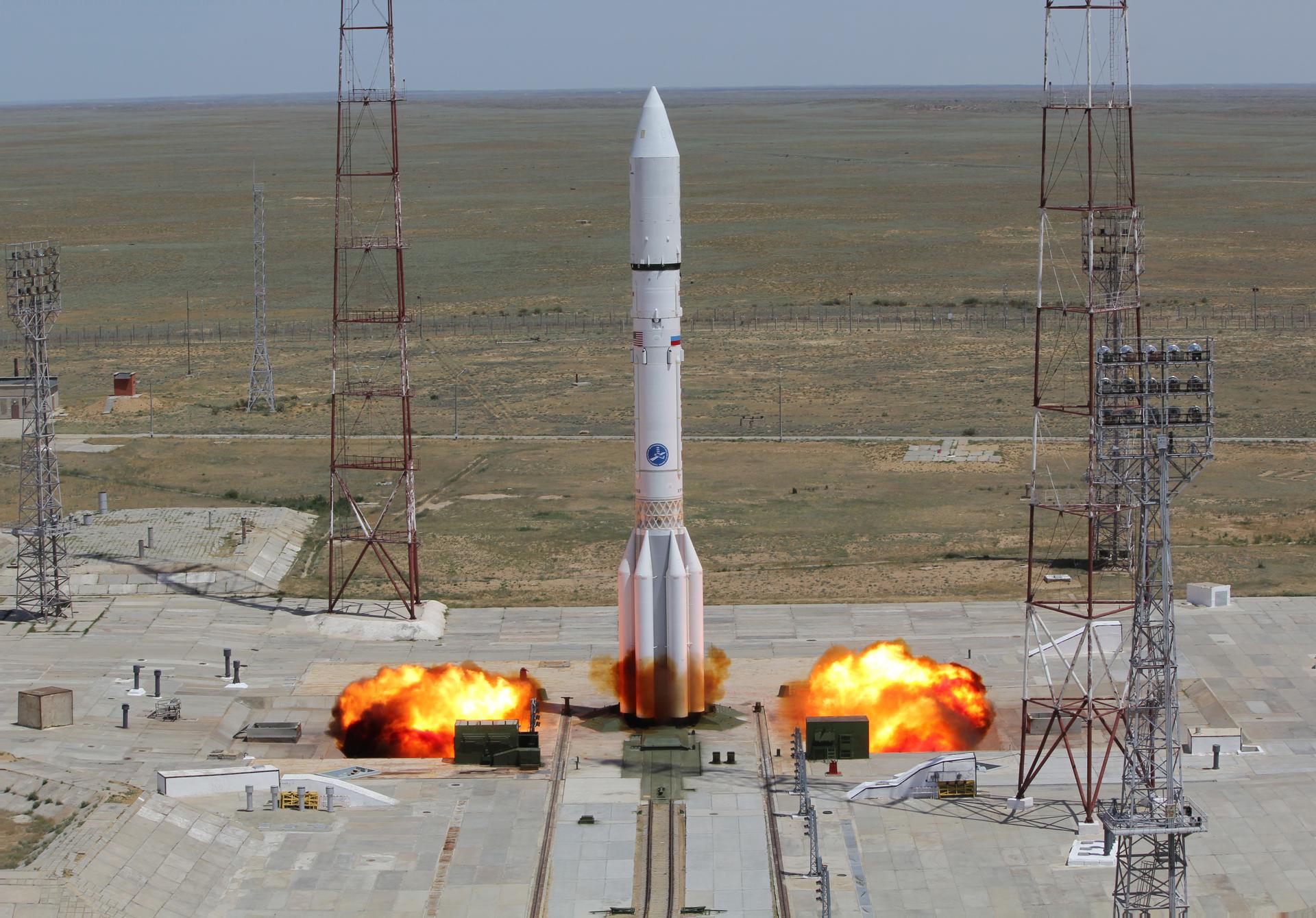
At 6:35 PM EDT on April 1, 2026, the Space Launch System lit up Florida’s Space Coast and sent four astronauts toward the Moon. If you watched the launch, you saw the dramatic part - 8.8 million pounds of thrust, twin solid boosters peeling away at two minutes, core stage separation at eight. What you didn’t see is the part that matters for the next ten days: Orion is now on a trajectory that most tracking tools can’t handle.
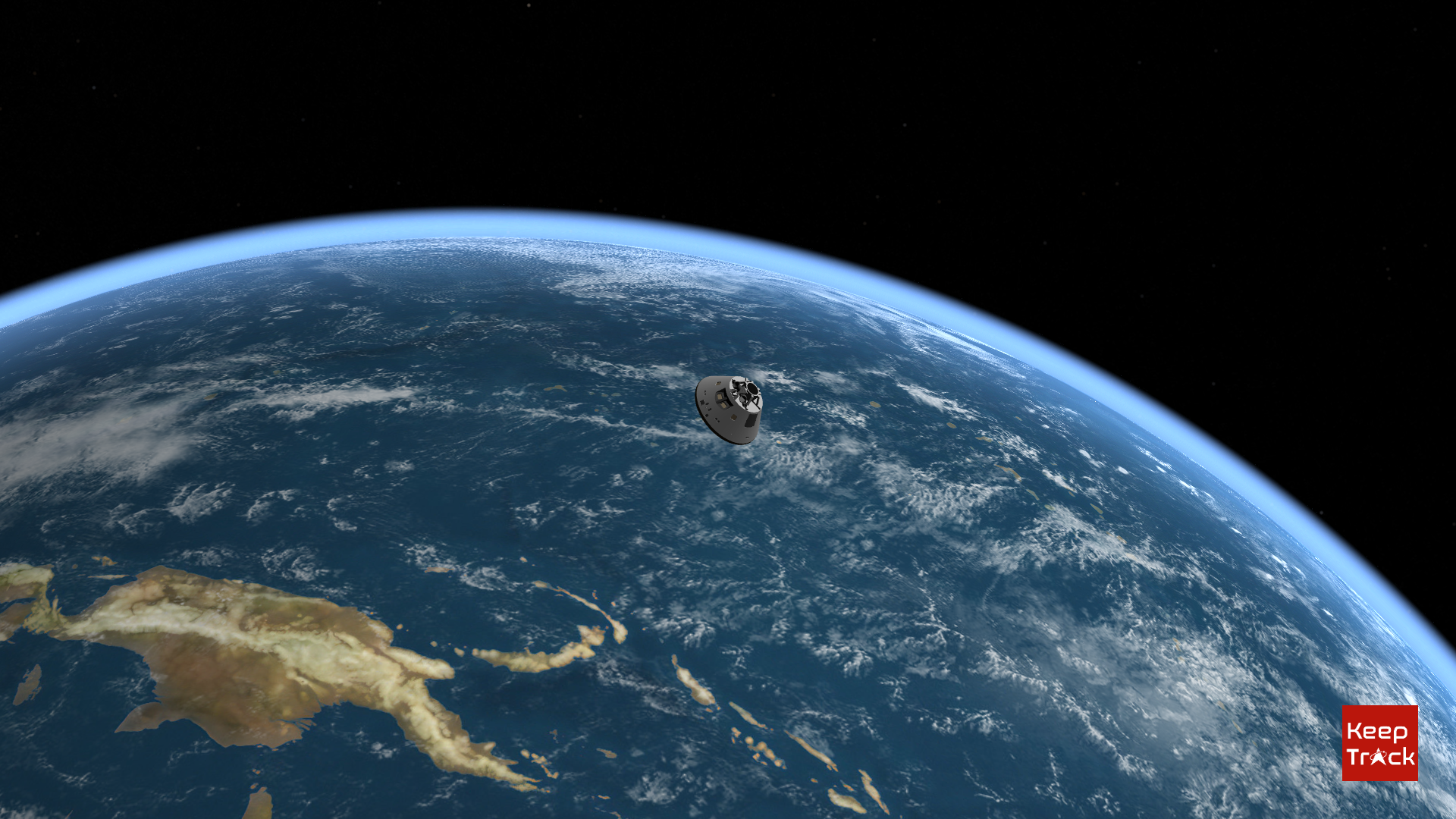
KeepTrack can. As of today, you can follow the Artemis II mission in real time through our Deep Space Missions catalog, visualizing Orion’s full cislunar trajectory in 3D - from its current Earth orbit through translunar injection, around the far side of the Moon, and back to splashdown.
This isn’t a gimmick bolted on for launch day. Cislunar tracking is a new capability in KeepTrack, and Artemis II joins a catalog that includes the Artemis I trajectory, Apollo-era S-IVB upper stages still in deep space, and active interplanetary probes like Lucy and Voyager 1. Open the Deep Space Missions menu and Artemis II is right there, listed under Cislunar Missions alongside its uncrewed predecessor.
Why Cislunar Tracking Is Different
Every Starlink satellite, every ISS pass, every piece of debris in KeepTrack’s catalog follows roughly the same rules. Objects in Earth orbit move on paths described by Keplerian mechanics, propagated forward using the SGP4 model that’s been the industry standard for decades. Feed in a two-line element set, run SGP4, and you get a position accurate enough for most purposes.
Orion doesn’t work that way anymore. Once the Interim Cryogenic Propulsion Stage fires for translunar injection - expected about 25 hours after launch - Orion leaves the domain where Earth’s gravity dominates. From that point forward, its trajectory is shaped by the gravitational pull of both Earth and the Moon simultaneously, with periodic engine burns that change the path at specific waypoints. Standard TLEs and SGP4 can’t model this. The math doesn’t apply.
Cislunar tracking relies instead on state vectors - precise position and velocity snapshots - propagated forward using numerical methods that account for multiple gravitational bodies. NASA publishes Orion’s trajectory as OEM (Orbital Ephemeris Message) data, and KeepTrack pulls that data directly to render the spacecraft’s position and projected path in our 3D environment.
The result is something you can’t get from NASA’s 2D AROW tracker: a spatial sense of where Orion is relative to both Earth and the Moon, with the full trajectory arc visible as a line extending through space. Use KeepTrack’s time controls to scrub forward and backward through the mission - watch the translunar injection burn, fast-forward to the lunar flyby, or jump ahead to reentry. You’re not locked to the current moment. The entire trajectory is available to explore at whatever point in the mission you want. Rotate the view, zoom in on the far-side pass, or pull back to see the full free-return loop from Earth orbit to the Moon and back.
What Actually Happened at Launch
The countdown wasn’t entirely smooth, which is standard for SLS at this point.
The morning started with cryogenic propellant loading - 700,000 gallons of liquid hydrogen and liquid oxygen flowing into the core stage and ICPS beginning around 7:30 AM. By early afternoon, the launch team hit a snag: the Eastern Range identified a communication issue with the flight termination system, the safety mechanism that allows ground controllers to destroy the rocket if it veers off course. Without a functioning FTS, the range stays red and the rocket doesn’t fly.
Engineers devised a workaround using legacy hardware from the Space Shuttle program to verify the system - an unlikely solution that speaks to just how much institutional knowledge is embedded in the LC-39B infrastructure. By 5:15 PM, the FTS issue was resolved. A separate sensor anomaly on the launch abort system’s attitude control motor battery was deemed an instrumentation problem and cleared.
Tanking Begins
Launch director gives 'go' for propellant loading. Transfer line chilldown starts for core stage LH2 and LOX.
FTS Issue Identified
Eastern Range flags communication problem with flight termination system. Engineers develop workaround using Shuttle-era hardware.
Hold Extended
T-10 minute hold extended for final preparations. Weather upgraded to 90% favorable.
Go for Launch
Launch Director Charlie Blackwell-Thompson polls all stations. Unanimous 'go' for terminal count.
Liftoff
SLS clears the tower. Twin SRBs and four RS-25 engines generate 8.8 million pounds of thrust.
Core Stage Separation
Main engine cutoff after ~8 minutes. Core stage separates from ICPS and Orion.
Solar Arrays Deployed
All four solar array wings on the European Service Module lock into place. Orion begins generating its own power.
Weather had cooperated all day, improving from 80% to 90% favorable by late afternoon. The terminal countdown entered its final ten minutes at 6:25 PM after Launch Director Charlie Blackwell-Thompson polled a unanimous “go” across all stations. The ground launch sequencer took control, running through its automated checklist - pressurizing propellant tanks, arming pyrotechnics, switching Orion to internal power.
At T-6.36 seconds, the four RS-25 engines ignited. At T-0, the twin solid rocket boosters lit and 5.75 million pounds of rocket lifted off the pad. Booster separation came at two minutes and nine seconds. The launch abort system jettisoned at three minutes thirteen seconds. Core stage main engine cutoff and separation happened at eight minutes and fourteen seconds, leaving Orion and the ICPS in an initial orbit.
By 6:59 PM, Orion’s four solar array wings had fully deployed - each extending from the European Service Module with a wingspan of roughly 63 feet. The spacecraft was generating its own power and configuring for its time in Earth orbit.
What Happens Next
Orion is currently in a high elliptical orbit, and the next several hours are busy. Two burns - a perigee raise maneuver and an apogee raise burn - will reshape the orbit and position the spacecraft for deep space operations. The crew will then begin a comprehensive systems checkout while still close enough to Earth for a relatively quick abort if something goes wrong.
The critical moment comes roughly 25 hours after launch, when the ICPS fires its RL10 engine for translunar injection. That burn commits the crew to the full ~600,000-mile round trip. After TLI, the crew separates from the spent upper stage and performs the proximity operations demonstration - manually flying Orion back toward the ICPS to test handling characteristics that future missions will need for docking with the Starship lander and other vehicles.
Then it’s a four-day coast to the Moon.
Around Day 6, Orion will pass within approximately 4,100 miles of the lunar surface before swinging around the far side and reaching its maximum distance - roughly 4,700 miles beyond the Moon. At that point, the four crew members will be farther from Earth than any human has ever been, breaking the crewed distance record that Apollo 13 set involuntarily in 1970.
Splashdown is expected around April 11 in the Pacific off San Diego.
Between now and then, KeepTrack lets you explore the full trajectory in 3D - scrub to any moment in the mission, from translunar injection through the far-side flyby and back. It’s one of the only platforms where you can visualize a crewed cislunar trajectory with that kind of control. Worth a look. The last time humans flew this path, the tracking tools were plot boards and grease pencils in a Houston control room. We’ve upgraded.

Theodore Kruczek