· space brief · 7 min read
Space Brief 1 Sep 2025
Today's Space Brief covers the Space Force's AI integration, NASA's lunar nuclear reactor plans, ESA's Flight Ticket Initiative, Martian mantle revelations, and SpaceX's latest Starlink launch.

📄Top Stories
Explore how the Space Force aims to integrate AI into its operations through innovative challenges. Learn about NASA’s ambitious plan to place a nuclear reactor on the Moon by 2030, and the challenges of selecting an ideal location. The European Space Agency’s Flight Ticket Initiative marks a significant step for European space launches, and SpaceX continues to expand its Starlink satellite network with a successful Falcon 9 launch from Florida.
📰Detailed Coverage
Space Force’s AI Ambitions
The U.S. Space Force is amplifying its integration of artificial intelligence (AI) into daily operations. This effort entails a series of “AI Challenges,” which function like hackathons to encourage innovative uses of AI across various military applications. Expected to embed AI solutions into operational frameworks, the initiative demonstrates the increasing importance of AI in optimizing space-based tasks and decision-making processes.
The hackathon-style challenges signify a strategic move to harness AI for enhancing operational capabilities, which could include satellite management and space surveillance improvements. Our web app may soon incorporate AI-driven insights, potentially offering enhanced tracking precision and decision support for users.
Read the full story: SpaceNews
Nuclear Power Prospects on the Moon
NASA is actively pursuing the establishment of a nuclear fission reactor on the Moon by 2030, aiming to provide a robust power source for lunar resource extraction. A significant hurdle remains: choosing the best location on the Moon with considerations of safety, accessibility, and resource proximity, all playing critical roles.
This lunar endeavor reflects a broader strategy to achieve sustainable human presence beyond Earth, necessitating inventive energy solutions. The discussion of energy infrastructures on celestial bodies is essential as humanity looks to extend its reach across the solar system.
Read the full story: Space.com
Flight Ticket Initiative: Testing European Technologies
The European Space Agency (ESA) and the European Commission have announced the first five missions under the Flight Ticket Initiative. This program is set to validate new European technologies in orbit and strengthen the European launch sector. The initial missions will utilize Avio’s Vega-C rockets, propelling European space initiatives forward.
These efforts underline Europe’s commitment to cultivating a competitive space industry. By facilitating technology demonstrations in space, the initiative supports innovation crucial for future satellite deployment and development.
Read the full story: SpaceDaily
Ancient Collisions Preserved in Martian Mantle
New seismic data reveals that Mars’s mantle comprises fragments from cataclysmic planetary collisions that occurred over 4.5 billion years ago. This fresh insight from NASA’s InSight lander paints a more complex picture of Mars’s geologic history, with remnants of these violent events preserved deep beneath the surface.
Understanding Mars’s interior provides valuable context for planetary formation processes and helps refine models predicting seismic activity. This knowledge is integral as we prepare for the challenges of long-term exploration and potential colonization of the Red Planet.
Read the full story: MarsDaily
Starlink Expansion Through Successful Falcon 9 Launch
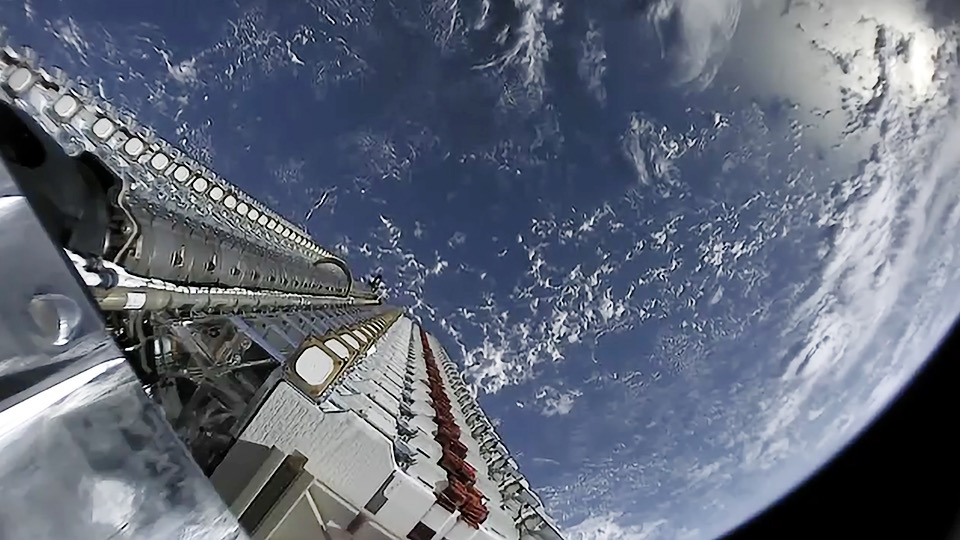
SpaceX has successfully launched 28 Starlink satellites using a Falcon 9 rocket from Cape Canaveral, enhancing its global broadband internet service. This addition to the constellation aims to improve coverage and connectivity, particularly in areas with limited terrestrial internet infrastructure.
SpaceX’s relentless progress in expanding Starlink exemplifies the rapid evolution of satellite technology, contributing directly to improved global communications. This launch further highlights the importance of satellite tracking to monitor and manage an increasingly crowded low Earth orbit environment.
Read the full story: Space.com | SpaceDaily
🛰️Satellite Spotlight
- Satellite Name: COSMOS 2074
- NORAD ID: 20577
- Launch Date: April 20, 1990
- Mission: Navigation and data relay
- Orbit: Low Earth Orbit (LEO)
- Operator: VMF
- Fun Fact: COSMOS 2074 is part of the Soviet Union’s navigation satellite network, providing crucial data relay capabilities since its launch.
Track this satellite in real-time on our web app: Track COSMOS 2074
🌌Space Weather
Next 24 Hours
-
Radio Blackouts Probability
- Minor: 65
- Major: 20
- Risk: None
-
Solar Radiation
- Probability: 10
- Risk: None
-
Geomagnetic Storming
- Scale: 2
- Impact: moderate
- Activity: Moderate
-
Impact Summary
- Next 24 hours: No risk of radio blackouts, no risk of solar radiation storms, moderate geomagnetic activity, and moderate geomagnetic storms expected.
- Geomagnetic outlook: Periods of G2 (Moderate) storming are likely, with a chance for G3 (Strong) storm periods late on 01 Sep due to the anticipated arrival of the 30 Aug asymmetric full halo CME.
- On 02 Sep, periods of G3 (Strong) storming are likely, with a chance for G4 (Severe) storm periods as CME influences continue.
- Radiation outlook: Slight chance for the greater than 10 MeV proton flux to reach S1 (Minor) storm levels through 03 Sep.
- Radio blackout outlook: R1-R2 (Minor-Moderate) radio blackouts are likely, with a slight chance for an X-class flare (R3-Strong or greater) through 03 Sep.
Long Term Forecast
- Forecast of Solar and Geomagnetic Activity 01 September - 27 September 2025: Solar activity is expected to be at low levels, with varying chances for M-class flares (R1-R2/Minor-Moderate events) through 27 Sep.
- The greater than 10 MeV proton flux levels are expected to be slightly enhanced but below the 10 pfu level for 01-03 Sep, with a chance to exceed the 10 pfu threshold on 01-02 Sep as the halo CME from 30 Aug passes Earth.
- Conditions are likely to return to near background levels after 04 Sep, barring any additional strong flare events.
- The greater than 2 MeV electron flux at geosynchronous orbit is expected to be moderate on 01-02 Sep, 15-19 Sep, and 22-27 Sep, with high levels anticipated on 03-14 Sep and 20-21 Sep associated with coronal hole high-speed stream influence.
- Geomagnetic field activity is expected to reach G2 (Moderate) levels on 01 Sep, G3 (Strong) levels on 02 Sep, and active conditions on 03 Sep following the arrival of the halo CME from 30 Aug.
- Active conditions are likely on 06-10 Sep and 15-19 Sep with coronal hole high-speed stream influence, while quiet to unsettled levels are expected on 04-05 Sep, 11-14 Sep, and 20-27 Sep.
🚀Upcoming Space Launches
September 3
- SpaceX Falcon 9:
- Starlink Group 17-8 from Vandenberg Space Force Base, CA, USA (02:33 UTC) A batch of 24 satellites for the Starlink mega-constellation - SpaceX’s project for space-based Internet communication system.
- SpaceX Falcon 9:
- Starlink Group 10-22 from Cape Canaveral Space Force Station, FL, USA (11:06 UTC) A batch of 28 satellites for the Starlink mega-constellation - SpaceX’s project for space-based Internet communication system.
September 4
- SpaceX Falcon 9:
- Starlink Group 10-57 from Kennedy Space Center, FL, USA (11:18 UTC) A batch of 28 satellites for the Starlink mega-constellation - SpaceX’s project for space-based Internet communication system.
September 6
- SpaceX Falcon 9:
- Starlink Group 17-9 from Vandenberg Space Force Base, CA, USA (15:42 UTC) A batch of 24 satellites for the Starlink mega-constellation - SpaceX’s project for space-based Internet communication system.
September 8
- SpaceX Falcon 9:
- Nusantara Lima from Cape Canaveral Space Force Station, FL, USA (00:00 UTC) Nusantara Lima is an Indonesian geostationary communications satellite with a capacity of more than 160 Gbps.
September 10
- SpaceX Falcon 9:
- SDA Tranche 1 Transport Layer B from Vandenberg Space Force Base, CA, USA (00:00 UTC) Classified mission launched by the Space Development Agency (SDA) for Tranche 1 Transport Layer.
September 11
- Russian Federal Space Agency (ROSCOSMOS) Soyuz 2.1a:
- Progress MS-32 (93P) from Baikonur Cosmodrome, Republic of Kazakhstan (13:49 UTC) Progress resupply mission to the International Space Station.
September 15
- SpaceX Falcon 9:
- Cygnus CRS-2 NG-23 from Cape Canaveral Space Force Station, FL, USA (22:00 UTC) This is the 23rd flight of the Northrop Grumman’s uncrewed resupply spacecraft Cygnus and its 22nd flight to the International Space Station under the Commercial Resupply Services contract with NASA.
September 23
- SpaceX Falcon 9:
- IMAP & others from Kennedy Space Center, FL, USA (00:00 UTC) IMAP (Interstellar Mapping and Acceleration Probe) is a NASA mission to study interactions between solar wind and local interstellar medium. The launch also includes several secondary payloads: a small lunar orbiter called Lunar Trailblazer, space weather satellite SWFO-L1, GLIDE mission to study far ultraviolet emission in the exosphere, and a solar sail mission Solar Cruiser.
Note: Launch dates and times are subject to change due to technical or weather considerations.

Maurice Stellarski