· space brief · 5 min read
Space Brief 27 Oct 2025
Today's space highlights include the US Space Force's advanced tracking contract, a milestone in SpaceX's Starlink program, and a new initiative to remove space debris.

📰Top Stories
Vantor Enhances US Space Force’s Space Object Tracking
Vantor has secured a contract with the US Space Force to provide continuous tracking and analysis of high-interest space objects through its high-resolution non-Earth imaging (NEI) technology. This partnership aims to close gaps in ground sensor networks and deliver critical insights about the position, trajectory, and changes in orbit of objects that might pose a threat to US space assets.
Read the full story: Space Daily
SpaceX Surpasses 10,000 Starlink Satellites Launched
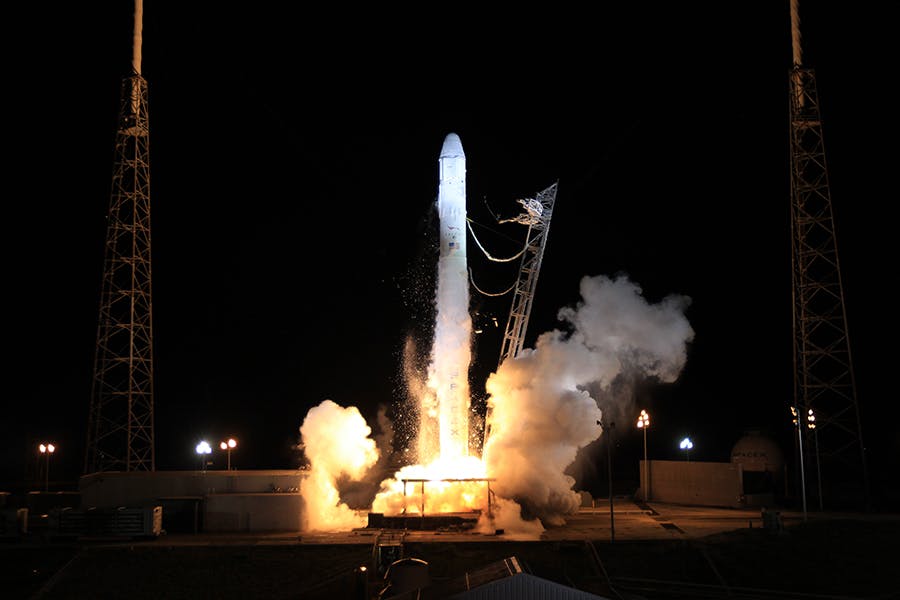
SpaceX has achieved an incredible milestone with its Starlink program, launching over 10,000 satellites into low Earth orbit since 2019. On October 19, the company executed its 131st and 132nd Falcon 9 missions of 2025 from Cape Canaveral, Florida, and Vandenberg, California, respectively.
Read the full story: TESLARATI
H3 Delivers First HTV-X Cargo Spacecraft to ISS
Japan successfully launched the first HTV-X cargo spacecraft, a new generation of freighters bound for the International Space Station with prospects for missions beyond low Earth orbit. This launch marks a significant step in enhancing capabilities for space logistics and operations.
Read the full story: SpaceNews
Kymeta Supplies Satellite Antennas to the U.S. Army
In a pilot program, the US Army’s 4th Infantry Division will utilize Kymeta’s Osprey u8 terminals. These flat-panel satellite antennas are designed for communication with low Earth orbit and geostationary satellites. This initiative promises to enhance military communication capabilities across varied environments.
Read the full story: SpaceNews
ALBATOR Project Targets Space Debris with Ion Beams
The ALBATOR project is exploring the potential of using ion beams to remove space debris from Earth’s orbit. This novel approach aims to tackle the increasing threat posed by orbital debris, promising a safer space environment for future operations.
Read the full story: Space.com
Sentinel-4 Provides Real-Time Air Quality Data
The Copernicus Sentinel-4 mission has begun delivering real-time air pollution maps, providing hourly observations of pollutants across Europe. Based on the Meteosat Third Generation Sounder 1 platform, this initiative represents a leap in environmental monitoring capabilities.
Read the full story: Space Daily
🛰️Satellite Spotlight
- Satellite Name: GLOBALSTAR M057
- NORAD ID: 25943
- Launch Date: October 18, 1999
- Mission: This satellite serves the purpose of communication within the Globalstar system, providing voice and data services globally.
- Orbit: Low Earth Orbit (LEO)
- Operator: Globalstar, Inc.
- Fun Fact: GLOBALSTAR M057 is part of a constellation designed to offer satellite phone services, making communication more accessible in remote areas.
Track this satellite in real-time on our web app: Track GLOBALSTAR M057
🌌Space Weather
Next 24 Hours
-
Radio Blackouts Probability
- Minor: 5
- Major: 1
- Risk: None
-
Solar Radiation
- Probability: 1
- Risk: None
-
Geomagnetic Storming
- Scale: 0
- Impact: none
- Activity: Low
-
Impact Summary
- Next 24 hours: No risk of radio blackouts.
- No risk of solar radiation storms.
- Geomagnetic outlook indicates G1 (Minor) conditions might persist.
- A potential increase to G2 (Moderate) levels is expected on 28-29 Oct due to the influence of a positive polarity coronal hole.
Long Term Forecast
- The forecast indicates moderate solar activity expected from 31 Oct to 15 Nov due to the return of Region 4246.
- Low solar activity levels are predicted from 20 Oct to 30 Oct and 14 Nov to 22 Nov as regions depart visibility.
- No significant proton events are forecasted at geosynchronous orbit through 27 Oct to 22 Nov, though an isolated event might occur depending on Region 4246’s behavior.
- High levels of greater than 2 MeV electron flux are anticipated from 31 Oct to 15 Nov due to influences from recurrent coronal hole high-speed stream (CH HSS).
- Moderate electron flux levels expected on 27-30 Oct and 16 Nov-22 Nov.
- Geomagnetic field activity is predicted to vary from quiet to unsettled levels on specific dates; active conditions may be experienced on 27 Oct and again on 31 Oct and from 07 Nov to 09 Nov.
- G1/G2 conditions are likely on 28-30 Oct, linked to recurrent CH HSS influences and possible weak effects from a CME that left the Sun on 23 Oct.
🚀 Upcoming Space Launches
October 27
- SpaceX Falcon 9:
- Starlink Group 11-21 from Vandenberg SFB, CA, USA (21:12 UTC) A batch of 28 satellites for the Starlink mega-constellation - SpaceX’s project for space-based Internet communication system.
October 28
- Innospace HANBIT-Nano:
- Spaceward from Alcântara Space Center, Federative Republic of Brazil (00:00 UTC) Maiden orbital launch attempt for the South Korean startup Innospace. Onboard this flight are five small satellites from the Brazilian space agency AEB and other partners.
October 29
- SpaceX Falcon 9:
- Starlink Group 10-37 from Cape Canaveral SFS, FL, USA (12:52 UTC) A batch of 29 satellites for the Starlink mega-constellation - SpaceX’s project for space-based Internet communication system.
October 30
- SpaceX Falcon 9:
- Starlink Group 11-23 from Vandenberg SFB, CA, USA (20:06 UTC) A batch of 28 satellites for the Starlink mega-constellation - SpaceX’s project for space-based Internet communication system.
October 31
- CASC Long March 2F/G:
- Shenzhou 21 from Jiuquan Satellite Launch Center, People’s Republic of China (15:34 UTC) Tenth crewed flight to the Chinese space station.
November 2
- SpaceX Falcon 9:
- Bandwagon 4 (Dedicated Mid-Inclination Rideshare) from Cape Canaveral SFS, FL, USA (05:00 UTC) Dedicated rideshare flight to a mid-inclination orbit with dozens of small microsatellites and nanosatellites for commercial and government customers.
- ISRO LVM-3:
- CMS-03 (GSAT-7R) from Satish Dhawan Space Centre, India (11:30 UTC) Communications Satellite for the Indian Navy, providing secure real-time links across the Indian Ocean.
November 4
- ULA Atlas V 551:
- ViaSat-3 F2 (ViaSat-3 EMEA) from Cape Canaveral SFS, FL, USA (03:36 UTC) The ViaSat-3 series of satellites provides more than 1-Terabit per second of network capacity.
- Arianespace Ariane 62:
- Sentinel-1D from Guiana Space Centre, French Guiana (21:03 UTC) Sentinel-1D carries advanced radar technology for all-weather, day-and-night Earth surface imaging.
Note: Launch dates and times are subject to change due to technical or weather considerations.

Maurice Stellarski