· space brief · 5 min read
China's iSpace Raises Record $729M for Reusable Rockets | KeepTrack Space Brief
China's iSpace secures record $729M for reusable rocket development. SpaceX launches Crew-12 and lands booster at new LZ-40 pad. Startup bets on space-based missile defense.

📰Top Stories
Innovative Missile Defense from Orbit
A startup is trailblazing a new path in space-based missile defense by developing interceptors that track and neutralize hypersonic threats with particle clouds shortly before impact. This approach could revolutionize missile defense systems by offering a more dynamic method of threat neutralization from space.
Read the full story: SpaceNews
China’s iSpace Raises Record Funds for Reusable Rockets
Chinese aerospace player iSpace has secured an unprecedented $729 million funding round. These funds aim to invigorate their reusable rocket technology efforts, broadening their industrial capabilities and competitive footprint internationally—a significant boost for the Asian aerospace market.
Read the full story: SpaceNews
SpaceX Successfully Launches Crew-12, Lands Booster at New Pad
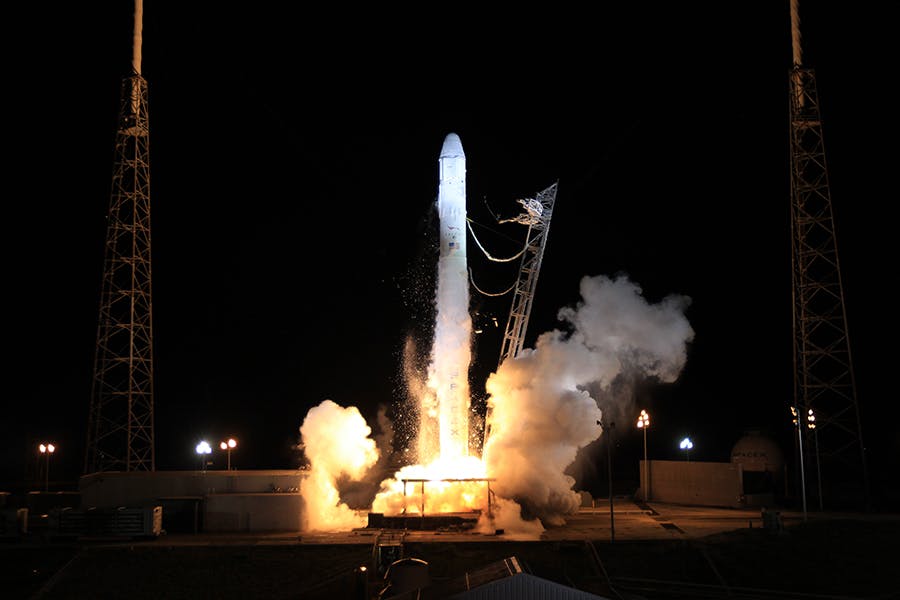
SpaceX has achieved a dual success with the launch of Crew-12 and the successful landing of a Falcon 9 booster at the new LZ-40 pad. This mission marks a milestone in SpaceX’s recovery operations, further solidifying its position as a leader in private space travel and technology.
Read the full story: TESLARATI
Belgium’s European Approach to F-35 Procurement
Belgium moves towards making its defense capabilities more European-centric with plans to acquire additional F-35 jets. By advocating for European components and capabilities, this strategic decision aligns with broader EU defense cooperation goals.
Read the full story: Breaking Defense
Estonian-Saudi Defense Talks Signal Broader Procurement Cooperation
Estonia and Saudi Arabia are laying the groundwork for potential collaborations in defense procurement. This aligns with the strategic approach of tapping into the global market to enhance defense capabilities.
Read the full story: Breaking Defense
Navy Experiments with Unmanned Surface Vessels
In an innovative move, the U.S. Navy plans to pair a medium unmanned surface vessel with the Theodore Roosevelt carrier strike group in its upcoming deployment. This experiment could redefine surface fleet operations by integrating autonomous vehicles.
Read the full story: Breaking Defense
🛰️Satellite Spotlight
- Satellite Name: YUNHAI-2 06
- NORAD ID: 43915
- Launch Date: December 29, 2018
- Mission: The YUNHAI-2 06 satellite is designed for meteorological observation, providing essential data for weather forecasting and environmental monitoring.
- Orbit: Low Earth Orbit (LEO)
- Operator: China Aerospace Science and Technology Corporation (CASC)
- Fun Fact: YUNHAI-2 06 is equipped with solar arrays and batteries for power, showcasing advancements in spaceborne meteorological technology.
Track this satellite in real-time on our web app: Track YUNHAI-2 06
🌌Space Weather
Next 24 Hours
-
Radio Blackouts Probability
- Minor: 10
- Major: 1
- Risk: None
-
Solar Radiation
- Probability: 1
- Risk: None
-
Geomagnetic Storming
- Scale: 0
- Impact: none
- Activity: Low
-
Impact Summary
- Next 24 hours: No risk of radio blackouts.
- No risk of solar radiation storms.
- Geomagnetic outlook indicates G1 (Minor) storming conditions are likely on February 15-16, with isolated G2 (Moderate) storming possible on February 15, primarily due to CIR/CH HSS effects and weak CME interactions.
- Radiation outlook suggests no S1 (Minor) or greater solar radiation storms are expected.
- A slight chance for R1-R2 (Minor-Moderate) radio blackouts exists through February 16.
Long Term Forecast
- Impact Summary
- From February 9 to March 7, solar activity is expected to remain at moderate levels, with M-class (R1-R2, Minor-Moderate) flares anticipated and a chance for X-class (R3-Strong or greater) flares on February 9-10 as Region 4366 transits the western limb.
- From February 11-22, solar activity is expected to lower, with a subsequent increase to moderate to high levels from February 23-28 as Region 4366 returns to visibility.
- Expect the 10 MeV proton flux to reach S1-S2 (Minor-Moderate) levels through February 12, with levels likely dropping below S1 from February 12-22.
- High levels of the greater than 2 MeV electron flux should occur at geosynchronous orbit on February 9-10, February 16-21, and February 24-25, coinciding with CH HSS influences.
- Geomagnetic activity is expected to fluctuate between unsettled and active levels, particularly on February 16-21, February 24-25, and March 5-7, primarily due to recurrent negative polarity CH HSS effects.
🚀Upcoming Space Launches
February 14
- SpaceX Falcon 9 Block 5:
- Starlink Group 17-13 from Vandenberg SFB, CA, USA (22:00 UTC) A batch of 24 satellites for the Starlink mega-constellation - SpaceX’s project for space-based Internet communication system.
February 16
- SpaceX Falcon 9 Block 5:
- Starlink Group 6-103 from Cape Canaveral SFS, FL, USA (05:00 UTC) A batch of 29 satellites for the Starlink mega-constellation - SpaceX’s project for space-based Internet communication system.
February 18
-
SpaceX Falcon 9 Block 5:
- Starlink Group 17-25 from Vandenberg SFB, CA, USA (08:00 UTC) A batch of 25 satellites for the Starlink mega-constellation - SpaceX’s project for space-based Internet communication system.
-
SpaceX Falcon 9 Block 5:
- Starlink Group 10-36 from Cape Canaveral SFS, FL, USA (22:00 UTC) A batch of 29 satellites for the Starlink mega-constellation - SpaceX’s project for space-based Internet communication system. This is the first Starlink launch to feature a Falcon 9 booster landing within The Bahamas waters operationally.
February 21
-
Firefly Aerospace Firefly Alpha:
- Stairway to Seven from Vandenberg SFB, CA, USA (00:20 UTC) Firefly Alpha’s Flight 7 will be a test flight and return-to-flight for the launch vehicle after its April 2025 launch failure. It will test and validate key systems ahead of Firefly’s Block II configuration upgrade.
-
SpaceX Falcon 9 Block 5:
- Starlink Group 17-26 from Vandenberg SFB, CA, USA (20:00 UTC) A batch of 25 satellites for the Starlink mega-constellation - SpaceX’s project for space-based Internet communication system.
February 22
- SpaceX Falcon 9 Block 5:
- Starlink Group 6-104 from Cape Canaveral SFS, FL, USA (02:04 UTC) A batch of 29 satellites for the Starlink mega-constellation - SpaceX’s project for space-based Internet communication system.
February 23
- Rocket Lab HASTE:
- That’s Not A Knife (DART AE) from Wallops Flight Facility, Virginia, USA (20:00 UTC) Payload is a scramjet-powered hypersonic vehicle developed by Australian company Hypersonix.
February 24
- SpaceX Falcon 9 Block 5:
- Starlink Group 6-110 from Cape Canaveral SFS, FL, USA (20:56 UTC) A batch of 29 satellites for the Starlink mega-constellation - SpaceX’s project for space-based Internet communication system.
Note: Launch dates and times are subject to change due to technical or weather considerations.

Maurice Stellarski