· space brief · 7 min read
Second Starlink Satellite Generates Debris; Falcon 9 Booster Flies 34th Mission | KeepTrack Space Brief
Second Starlink satellite malfunctioned on orbit and generated debris within three months of prior event. Falcon 9 booster completed record 34th mission from Cape Canaveral.
Top Stories
Second Starlink Satellite Generates On-Orbit Debris
A second SpaceX Starlink satellite has malfunctioned on orbit and generated debris, according to SpaceNews. The previous such event occurred just over three months ago, making this a recurring pattern worth watching across the constellation.
Two debris-generating anomalies from a single constellation in one quarter raises tracking complexity for operators in low Earth orbit. Use KeepTrack’s debris tracking tools to monitor catalog updates as new objects are cataloged from these events. The glossary entry on breakups explains how fragmentation events get assessed and tracked.
Read the full story: SpaceNews
Falcon 9 Booster Flies Record 34th Mission on Starlink Delivery
A Falcon 9 first stage flew its 34th mission, launching from Space Launch Complex 40 at Cape Canaveral Space Force Station with a Starlink payload. The window opened at 5:15 p.m. EDT (2115 UTC) on March 30.
The 34-flight booster surpasses previous reuse records for the vehicle and adds another batch of Starlink satellites to an already dense LEO shell. New objects from this mission will appear in the catalog within days of launch.
Read the full story: Spaceflight Now
EU Commits $1.7B to Ramp Up European Weapons Production
The European Commission adopted a $1.7 billion work program under the European Defence Industry Programme covering 2026 through 2027. The first round of calls for proposals opened on the EU’s tender portal on Tuesday.
The funding is structured to accelerate industrial capacity across member states — a direct response to sustained demand pressure from the war in Ukraine. Space and defense infrastructure contracts are eligible under the program’s scope.
Read the full story: Breaking Defense
Israel Approves $45B Defense Budget Amid Ongoing Multi-Front War
Israel approved a $45 billion defense budget as fighting continues across multiple fronts following the October 7, 2023 attacks. The budget reflects a sustained shift from low-intensity operations to large-scale conventional and asymmetric warfare.
Space and ISR capabilities have been central to Israel’s operational posture throughout the conflict. Budget expansions at this scale typically accelerate procurement of satellite-based reconnaissance and communications assets.
Read the full story: Breaking Defense
EU Defense Commissioner Discusses Ukraine Energy Strikes on European Missile Tour
EU Defense and Space Commissioner Andrius Kubilius spoke exclusively with Breaking Defense while traveling through Sweden on a European “missile tour.” He described Ukraine’s attacks on Russian oil and gas infrastructure as likely to be “painful” for the Russian economy.
Kubilius’s role covers both defense and space portfolios, making his travel circuit relevant to upcoming EU decisions on space-based surveillance and defense satellite funding tied to the Ukraine conflict.
Read the full story: Breaking Defense
CYBERCOM to Receive First Standardized Defensive Cyber Hunt Kits
US Cyber Command units will receive the first delivery of Joint Cyber Hunt Kits — standardized toolsets for conducting defensive cyber hunt missions. Mike Kushin, President of Defense and Intelligence at the supplying firm, confirmed to Breaking Defense this is the first time CYBERCOM has had standardized kits for this mission type.
Defensive cyber operations increasingly intersect with space asset protection, as ground segment intrusions remain one of the primary vectors for disrupting satellite command and control.
Read the full story: Breaking Defense
Navy Releases Final RFP to Replace T-45 Goshawk Trainer Fleet
The US Navy issued its final request for proposals for the Undergraduate Jet Training System, the program to replace the T-45 Goshawk. The T-45 has been in service since the early 1990s.
The UJTS competition will determine the next carrier-capable jet trainer for naval aviators. While not a space program, the procurement affects contractor bandwidth and DoD budget priorities that overlap with space-adjacent defense programs.
Read the full story: Breaking Defense
Satellite of the Day
Kosmos 516
Kosmos 516 is a Soviet-era military communications satellite launched during the height of the Cold War on November 1, 1972. Built by OKB10 and deployed via a Kosmos 11K65M rocket from Plesetsk Cosmodrome, this spacecraft was part of the Soviet Union’s strategic communications infrastructure. With a launch mass of 60 kg, it represents the relatively compact satellite design philosophy of early 1970s Soviet military space operations.
Operating in a highly inclined orbit of 74.036 degrees, Kosmos 516 was designed to provide secure communications for Soviet military forces across a wide geographic footprint. Its inclination allowed coverage of high-latitude regions, making it particularly valuable for maintaining command and control links with forces in northern theaters. Though decades old, tracking this satellite offers space enthusiasts a tangible connection to the early space age and the parallel military space programs that ran alongside civilian exploration efforts.
| Detail | Value |
|---|---|
| NORAD ID | 06265 |
| Operator | OKB10 (Soviet Union) |
| Launch Date | November 1, 1972 |
| Orbit | High inclination, 74.036° |
| Purpose | Military Communication |
| Status | Active |
Track this satellite in real-time: Track Kosmos 516
Upcoming Space Launches
April 1
-
Russian Space Forces Soyuz 2.1a/Fregat-M: Meridian-M No.21L from Plesetsk Cosmodrome, Russian Federation (02:00–12:00 UTC) Meridian is a series of communications satellites for military and civilian use. Note: Payload identity uncertain.
-
National Aeronautics and Space Administration SLS Block 1: Artemis II from Kennedy Space Center, FL, USA (22:24 UTC) NASA’s Space Launch System rocket will launch an Orion spacecraft on the Artemis II mission — the first crewed flight of the Artemis program. NASA astronauts Reid Wiseman, Victor Glover, and Christina Koch, along with Canadian Space Agency astronaut Jeremy Hansen, will perform a lunar flyby during a roughly 10-day mission. Their capsule, Integrity, is expected to splash down in the Pacific Ocean. This marks a major milestone in NASA’s goal of returning humans to the vicinity of the Moon under the Artemis program. Watch Live
April 2
-
SpaceX Falcon 9 Block 5: Starlink Group 10-58 from Cape Canaveral SFS, FL, USA (11:52 UTC) A batch of 29 Starlink V2 Mini Optimized satellites launching to low Earth orbit. Watch Live
-
SpaceX Falcon 9 Block 5: Starlink Group 17-35 from Vandenberg SFB, CA, USA (23:03 UTC) A batch of 29 Starlink V2 Mini Optimized satellites launching to low Earth orbit. Watch Live
April 3
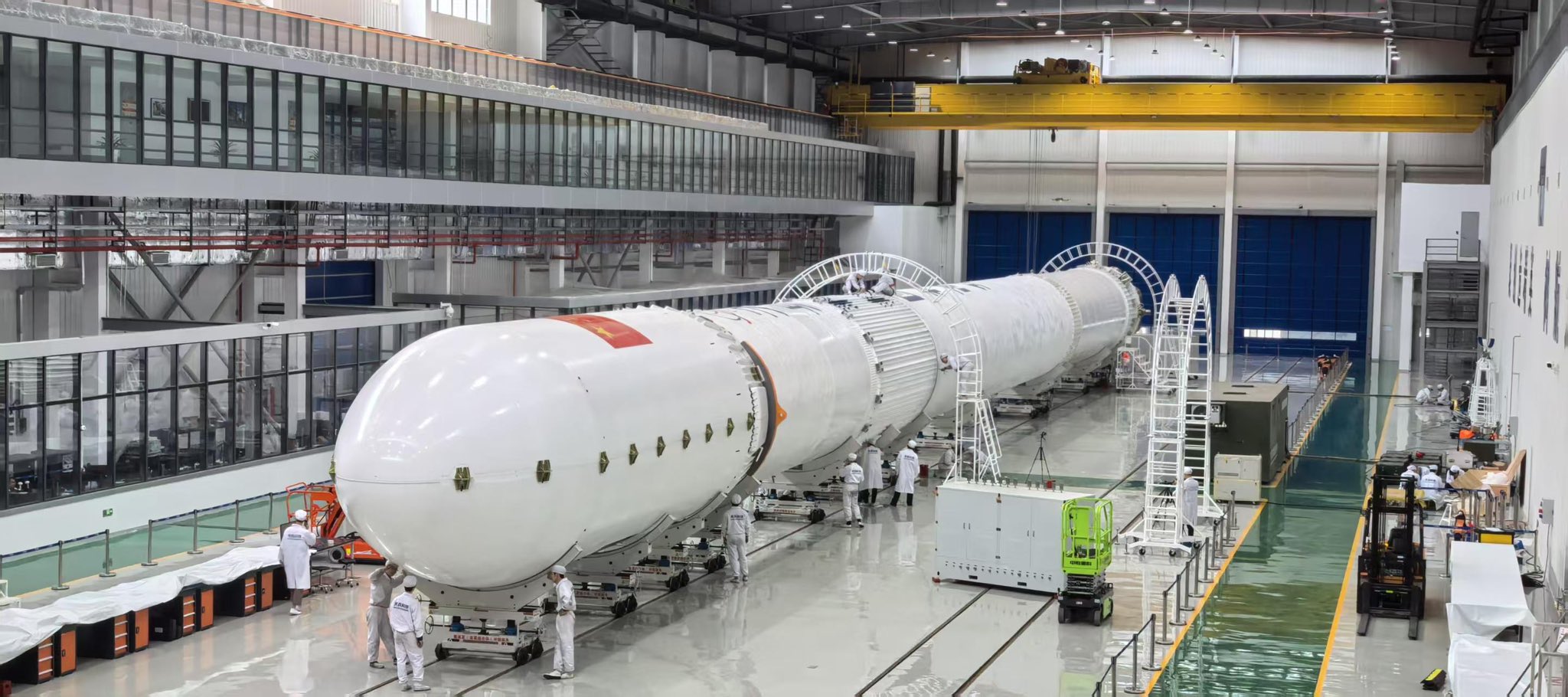
- Space Pioneer Tianlong-3: Demo Flight from Jiuquan Satellite Launch Center, People’s Republic of China (03:52–06:09 UTC) First test launch of Space Pioneer’s Tianlong-3 rocket, a reusable launch vehicle with a 17,000 kg payload capacity to low Earth orbit. Reports indicate this flight may carry a batch of satellites for the SpaceSail/G60/Qianfan LEO communications constellation.
April 4
-
United Launch Alliance Atlas V 551: Amazon Leo (LA-05) from Space Launch Complex 41, Cape Canaveral SFS, FL, USA (05:45–06:14 UTC) The sixth of nine Atlas V rockets purchased by Amazon will deliver another batch of broadband internet satellites for the Amazon Leo (Kuiper) low Earth orbit constellation, aimed at providing high-speed, low-latency connectivity to underserved and remote areas globally. The Atlas V 551 configuration features five solid rocket boosters and a 5-meter payload fairing. Watch Live Launch Preview
-
RKK Energiya Soyuz-5: Demo Flight from Baikonur Cosmodrome, Republic of Kazakhstan (11:00 UTC) Demonstration flight for Russia’s new Soyuz-5 (Irtysh) launch vehicle, carrying a mass simulator. The Soyuz-5 is a two-stage rocket powered by an RD-171MV engine on the first stage and two RD-0124MS engines on the second stage, capable of delivering 17,000 kg to low Earth orbit. It is intended to replace the Zenit-2 and Proton Medium vehicles.
Schedule Changes
- SpaceX Falcon 9 Block 5 | Starlink Group 10-44 has launched successfully and has been removed from the upcoming schedule.
- SpaceX Falcon 9 Block 5 | Transporter 16 (Dedicated SSO Rideshare) has launched successfully and has been removed from the upcoming schedule.
- Kinetica 2 | Demo Flight (Qingzhou Prototype Spacecraft) has launched successfully and has been removed from the upcoming schedule.
Note: Launch dates and times are subject to change due to technical or weather considerations.

Maurice Stellarski