· space brief · 7 min read
Artemis 2 Crew Returns After 50-Year Lunar Milestone | KeepTrack Space Brief
Artemis 2 splashdown marks first crewed lunar flyby since Apollo 17 in 1972. Four astronauts completed historic mission, validating systems for Artemis 3 landing attempt.
Top Stories
Artemis 2 Crew Splashes Down in Pacific — First Humans Beyond Earth Orbit Since 1972
NASA’s Orion capsule splashed down in the Pacific Ocean on April 10, closing out Artemis 2 — the first crewed mission beyond Earth orbit in over 50 years. Four astronauts completed the lunar flyby mission, the farthest humans have traveled from Earth since Apollo 17.
Artemis 2 sets the operational baseline for Artemis 3, which is expected to attempt a crewed lunar landing. All mission-critical systems, including abort and life support hardware, performed through the full mission profile.
Read the full story: Space.com
Space Force Golden Dome Programs Getting Major FY27 Budget Increases
Space Force missile warning and tracking programs are among the biggest winners in the proposed FY27 defense budget. The emerging Space Data Network — built to move space sensor data to ground, air, and sea-based shooters in real time — is also seeing a substantial funding jump.
These programs feed directly into the Golden Dome missile defense architecture. For satellite trackers, this means accelerated deployment of space-based missile warning assets. The Space Data Network, if funded as proposed, would tighten the link between orbital sensor layers and kinetic intercept systems.
Read the full story: Breaking Defense
Moog Hardware Flew on Artemis 2 — Abort and Crew Safety Systems Validated in Flight
Moog Inc. supplied precision motion and fluid control systems aboard Orion for Artemis 2. The company’s hardware supports crew safety functions including abort system actuation — systems that must work on first demand with no margin for failure.
Flying and validating this hardware on a crewed lunar mission is a prerequisite for Artemis 3. Moog’s systems now have a full lunar-distance mission on their operational record.
Read the full story: SpaceNews
DIA Centralizes AI Under New Digital Modernization Accelerator
The Defense Intelligence Agency has stood up a Digital Modernization Accelerator to consolidate its artificial intelligence efforts under one organizational structure. Maj. Gen. Robert Kinney, the DIA’s chief AI officer, is leading the initiative with an explicit push for speed.
For space intelligence specifically, faster AI integration at DIA could affect how space-domain awareness data — including orbital tracking and foreign satellite behavior — gets processed and disseminated across the intelligence community.
Read the full story: Breaking Defense
Trump’s $1.5T Defense Budget Faces Uncertain Path Through Congress
The administration’s $1.5 trillion defense budget request is heading into a difficult legislative environment. Ongoing operations in Iran, approaching midterm elections, and Republican intraparty disagreements all create friction for passage.
Space Force programs tied to Golden Dome and missile warning — several of which received large FY27 increases in the request — depend on this budget moving. A continuing resolution or protracted negotiation would delay procurement timelines across those programs.
Read the full story: Breaking Defense
Golden Dome Needs On-Orbit Servicing Built Into Architecture, Not Bolted On Later
A defense analysis piece argues that on-orbit logistics and satellite servicing must be designed into the Golden Dome constellation from the start, not treated as a later add-on. Resilient missile defense in space requires satellites that can be refueled, repaired, or repositioned on operational timescales.
This is a real gap in current planning. A missile defense constellation that can’t be sustained on-orbit is a target, not a deterrent. The argument aligns with broader Space Force thinking around disaggregated, resilient architectures.
Read the full story: Breaking Defense
Navy Mothballing USS Boise After Prolonged Maintenance Failures
The Navy confirmed it will mothball the submarine USS Boise, ending a years-long effort to return the boat to service after maintenance backlogs kept it sidelined. The decision is framed as part of a data-driven fleet composition review.
USS Boise is a Los Angeles-class attack submarine. Its removal from the active fleet reduces near-term undersea capacity, though the Navy has not specified whether the hull will eventually return to service or be permanently retired.
Read the full story: Breaking Defense
Satellite of the Day
COSMOS 2374
COSMOS 2374, also known as Kosmos-2376, is a Russian GLONASS navigation satellite that launched on October 13, 2000, aboard a Proton-K/DM-2 rocket from the Tyuratam Cosmodrome. As part of Russia’s GLONASS (Global Navigation Satellite System) constellation, this satellite provided critical positioning, navigation, and timing services—making it a counterpart to the U.S. GPS system. The spacecraft features a cylindrical body with two deployable solar arrays and was manufactured by the Polyet facility (POL) for operation by Russia’s Space Forces and Space Agency (VKSR/IACG).
Measuring 4 meters in length with a 7.8-meter solar panel span, COSMOS 2374 was designed for a 3-year operational lifetime. While many GLONASS satellites from this era have since decayed, tracking the remaining operational vehicles in the constellation helps space domain awareness specialists monitor the health and coverage of Russia’s independent navigation system. The satellite’s longevity compared to its design life speaks to robust engineering—a common trait of GLONASS spacecraft.
| Detail | Value |
|---|---|
| NORAD ID | 26566 |
| Operator | VKSR/IACG |
| Country | Russia |
| Launch Date | October 13, 2000 |
| Launch Vehicle | Proton-K/DM-2 |
| Launch Mass | 1,300 kg |
| Purpose | Navigation |
| Inclination | 65.2° |
Track this satellite in real-time: Track COSMOS 2374
Upcoming Space Launches
April 11
-
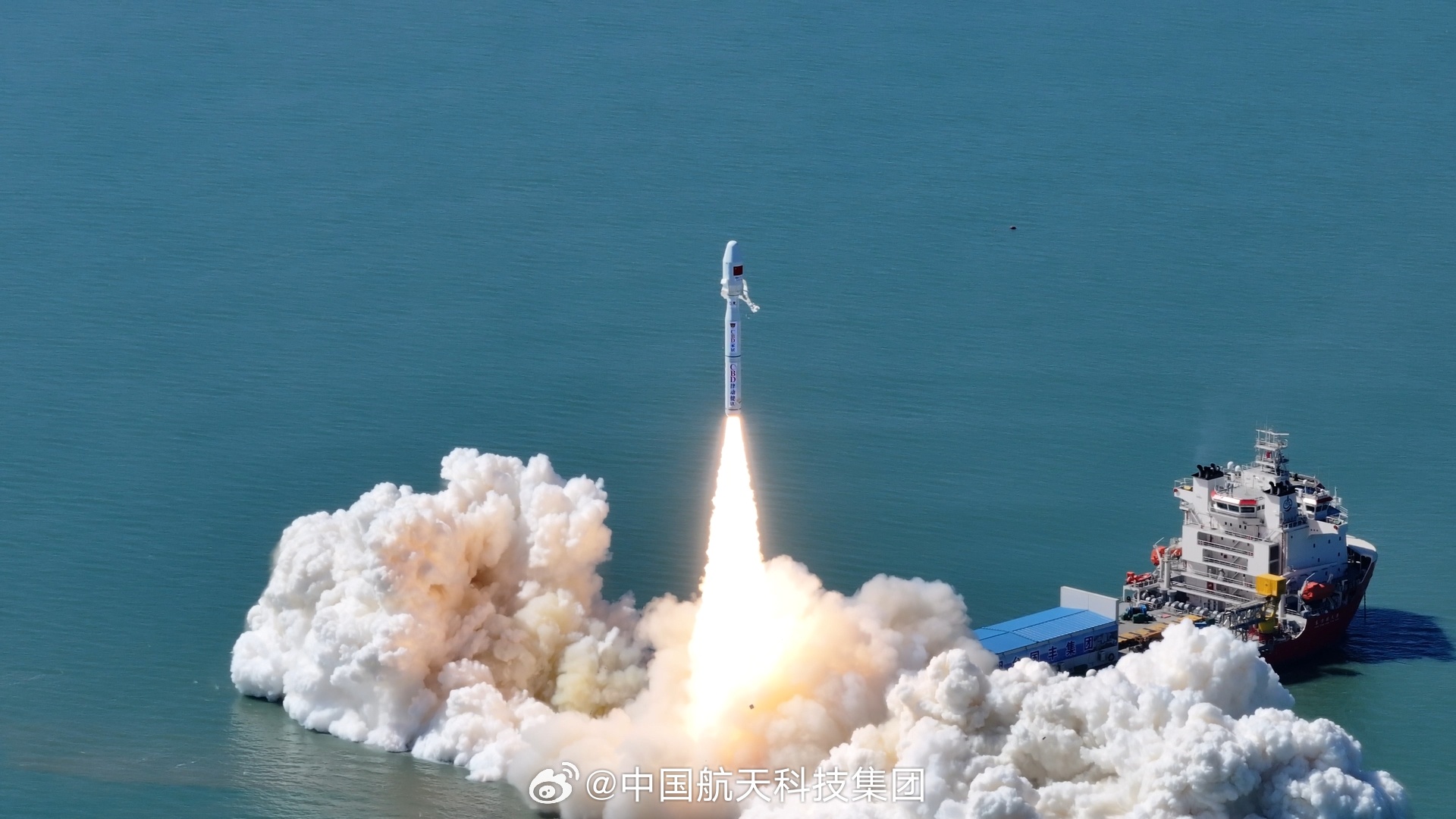
China Rocket Co. Ltd. Smart Dragon 3: Unknown Payload
- Launch from Haiyang Oriental Spaceport (South China Sea launch location 3) (11:22 UTC) A solid-fuel commercial orbital launch vehicle developed by a subsidiary of CASC, lifting off from a sea-based platform. Launch Preview
-
SpaceX Falcon 9 Block 5: Cygnus CRS-2 NG-24 (S.S. Steven R. Nagel)
- Mission from Space Launch Complex 40, Cape Canaveral SFS, FL, USA (11:41 UTC) A SpaceX Falcon 9 rocket will launch a Northrop Grumman Cygnus cargo spacecraft to the International Space Station under NASA’s Commercial Resupply Services program. The spacecraft is named the S.S. Steven R. Nagel, honoring the former NASA astronaut who flew four Space Shuttle missions and accumulated 723 hours in space. Watch Live Launch Preview
April 14
-
CAS Space Kinetica 1: Unknown Payload
- Mission from Launch Area 130, Jiuquan Satellite Launch Center, People’s Republic of China (03:54 UTC) A Chinese solid-propellant light launch vehicle capable of delivering approximately 2 tonnes to low Earth orbit, developed by CAS Space, a subsidiary of the Chinese Academy of Sciences.
-
SpaceX Falcon 9 Block 5: Starlink Group 10-24
- Mission from Space Launch Complex 40, Cape Canaveral SFS, FL, USA (06:13 UTC) A batch of 25 Starlink V2 Mini Optimized satellites to low Earth orbit. Watch Live Launch Preview
April 15
- SpaceX Falcon 9 Block 5: Starlink Group 17-27
- Mission from Space Launch Complex 4E, Vandenberg SFB, CA, USA (02:00 UTC) A batch of 25 Starlink V2 Mini Optimized satellites to low Earth orbit. Watch Live Launch Preview
April 16
- Blue Origin New Glenn: BlueBird Block 2 #2
- Mission from Launch Complex 36A, Cape Canaveral SFS, FL, USA (10:45 UTC) A Blue Origin New Glenn rocket will deploy AST SpaceMobile’s second next-generation BlueBird satellite into low Earth orbit, designed to provide space-based cellular broadband connectivity for commercial and government customers. This will be the third flight of New Glenn to date. Booster recovery intentions have not been announced.
April 17
- China Aerospace Science and Technology Corporation Long March 2D: Unknown Payload
- Mission from Launch Area 94 (SLS-2 / 603), Jiuquan Satellite Launch Center, People’s Republic of China (04:02 UTC) A two-stage Long March 2D carrier rocket launching from Jiuquan. Payload details are not yet disclosed.
April 18
- SpaceX Falcon 9 Block 5: Starlink Group 17-22
- Mission from Space Launch Complex 4E, Vandenberg SFB, CA, USA (14:00 UTC) A batch of 25 Starlink V2 Mini Optimized satellites to low Earth orbit. Watch Live
April 22
- SpaceX Falcon 9 Block 5: Starlink Group 17-14
- Mission from Space Launch Complex 4E, Vandenberg SFB, CA, USA (02:00 UTC) A batch of 25 Starlink V2 Mini Optimized satellites to low Earth orbit. Watch Live
April 23
- Rocket Lab Electron: Kakushin Rising (JAXA Rideshare)
- Mission from Rocket Lab Launch Complex 1, Mahia Peninsula, New Zealand (window TBD) A Japan Aerospace Exploration Agency-manifested rideshare carrying eight small satellites to sun-synchronous orbit, including educational cubesats, an ocean monitoring satellite, a multispectral camera demonstration satellite, and OrigamiSat-2, which features a deployable antenna that unfurls to 25 times its stowed size using origami folding techniques. The payloads were originally planned to fly on a Japanese Epsilon-S rocket before delays redirected them to Electron.
Schedule Changes
- New Launch Added: China Aerospace Science and Technology Corporation Long March 2D carrying an unknown payload has been added to the manifest, scheduled for April 17 at 04:02 UTC from Jiuquan Satellite Launch Center.
- Status Update: SpaceX Falcon 9 Block 5 | Starlink Group 17-21 has been removed from the upcoming launches calendar following a successful launch.
Note: Launch dates and times are subject to change due to technical or weather considerations.

Maurice Stellarski