· space brief · 7 min read
White House Orders Space Nuclear Power by 2028 | KeepTrack Space Brief
White House directs NASA and Pentagon to field space nuclear power systems by 2028, with DoD demonstration required by 2031. Game-changer for military satellite power budgets.
Top Stories
BAE Systems and Lockheed Martin Are Building Refuelable Orbital Warfare Satellites
BAE Systems and Lockheed Martin are developing maneuvering satellites designed for orbital warfare that can be refueled on orbit. That combination — propulsion, maneuverability, and refueling — is specifically intended for contested space environments.
For tracking purposes, maneuvering satellites are harder to maintain accurate TLE predictions for. If these platforms enter service, expect frequent catalog updates as they execute burns that outpace standard propagation models.
Read the full story: SpaceNews
White House Directs NASA, Pentagon, and DOE to Field Space Nuclear Power by 2028
The White House released its National Initiative for American Space Nuclear Power on April 14. It directs NASA, the Pentagon, and the Department of Energy to develop space nuclear power systems with a launch target as early as 2028. A Pentagon demonstration is required by 2031.
The policy calls for parallel design competitions between NASA and DoD, described as “mutually reinforcing.” Space nuclear reactors change the power budget assumptions for military satellites — sustained high-power payloads become viable at orbits where solar generation falls short.
Read the full story: Breaking Defense
Space Force Enters Final Lease Negotiations With Blue Origin for SLC-14 at Vandenberg
U.S. Space Force has authorized final lease negotiations with Blue Origin for Space Launch Complex 14 at Vandenberg Space Force Base. If completed, this gives New Glenn a West Coast launch site, opening polar and sun-synchronous orbits to Blue Origin’s heavy-lift vehicle.
New Glenn currently operates from LC-36 at Cape Canaveral. A Vandenberg pad expands the rocket’s mission profile considerably for national security payloads that require high-inclination orbits.
Read the full story: SpaceNews
Space Force Has Two Months to Lock In Acquisition Portfolio Structure
Space Systems Command is finalizing its acquisition portfolio structure over the next two months, Lt. Gen. Philip Garrant said at the Space Symposium. SSC is also working to hire “several hundreds” of personnel after deep cuts to its acquisition workforce.
The rebuild matters for program timelines. A hollowed-out acquisition corps slows contracting, which delays satellite development and launch schedules across the board.
Read the full story: Breaking Defense
NRO Signals Open-Door Approach to ISR Partnerships
NRO Principal Deputy Director William Adkins said April 14 the agency will work with “government, industry, academia, allies and other partners” to accelerate ISR capability adoption. The statement came at the Space Symposium in Colorado Springs.
The NRO operates the U.S. government’s classified reconnaissance satellite fleet. Expanding partnerships with commercial imagery and signals providers has been a consistent NRO priority as commercial remote sensing resolution and revisit rates have improved.
Read the full story: SpaceNews
Aerospace Corp. Is Training AI on 65 Years of Spacecraft Test Data
Aerospace Corporation CEO Tanya Pemberton, in the role since September, says the FFRDC is using its 65-year archive of spacecraft and component test data to train AI models. The goal is faster anomaly diagnosis and better-informed spacecraft designs.
Aerospace Corp. supports the U.S. government on launch and satellite programs across DoD and the intelligence community. AI-assisted anomaly diagnosis could reduce the time between an on-orbit event and a root cause determination — relevant for any operator trying to understand an unexpected behavior in a tracked object.
Read the full story: SpaceNews
Satellite of the Day
GAOFEN-11 01
GAOFEN-11 01 (Gao Fen 11-01) is a Chinese Earth observation satellite operated by ZLZB and launched on July 31, 2018, from the Taiyuan Satellite Launch Center. Built by the China Academy of Space Technology (CAST), this 3,000 kg spacecraft carries the Jianbing-16 01 payload and operates from a sun-synchronous orbit, making it part of China’s high-resolution Earth observation constellation. The satellite’s near-polar inclination ensures consistent lighting conditions for imaging across the globe, a critical feature for applications ranging from land surveying to disaster assessment.
With an 8-meter solar array span and a compact 2-meter box-shaped body, GAOFEN-11 01 exemplifies modern remote sensing design. The satellite’s sun-synchronous orbit allows it to pass over the same locations at roughly the same local solar time each day, providing consistent illumination angles for multitemporal analysis. This satellite is part of China’s broader Gaofen program, which aims to establish a comprehensive Earth observation capability comparable to other major space powers’ systems.
| Detail | Value |
|---|---|
| NORAD ID | 43585 |
| Operator | ZLZB (China) |
| Launch Date | July 31, 2018 |
| Orbit | Sun-synchronous, 97.14° inclination |
| Purpose | Earth observation |
| Status | Active |
Track this satellite in real-time: Track GAOFEN-11 01
Upcoming Space Launches
April 17
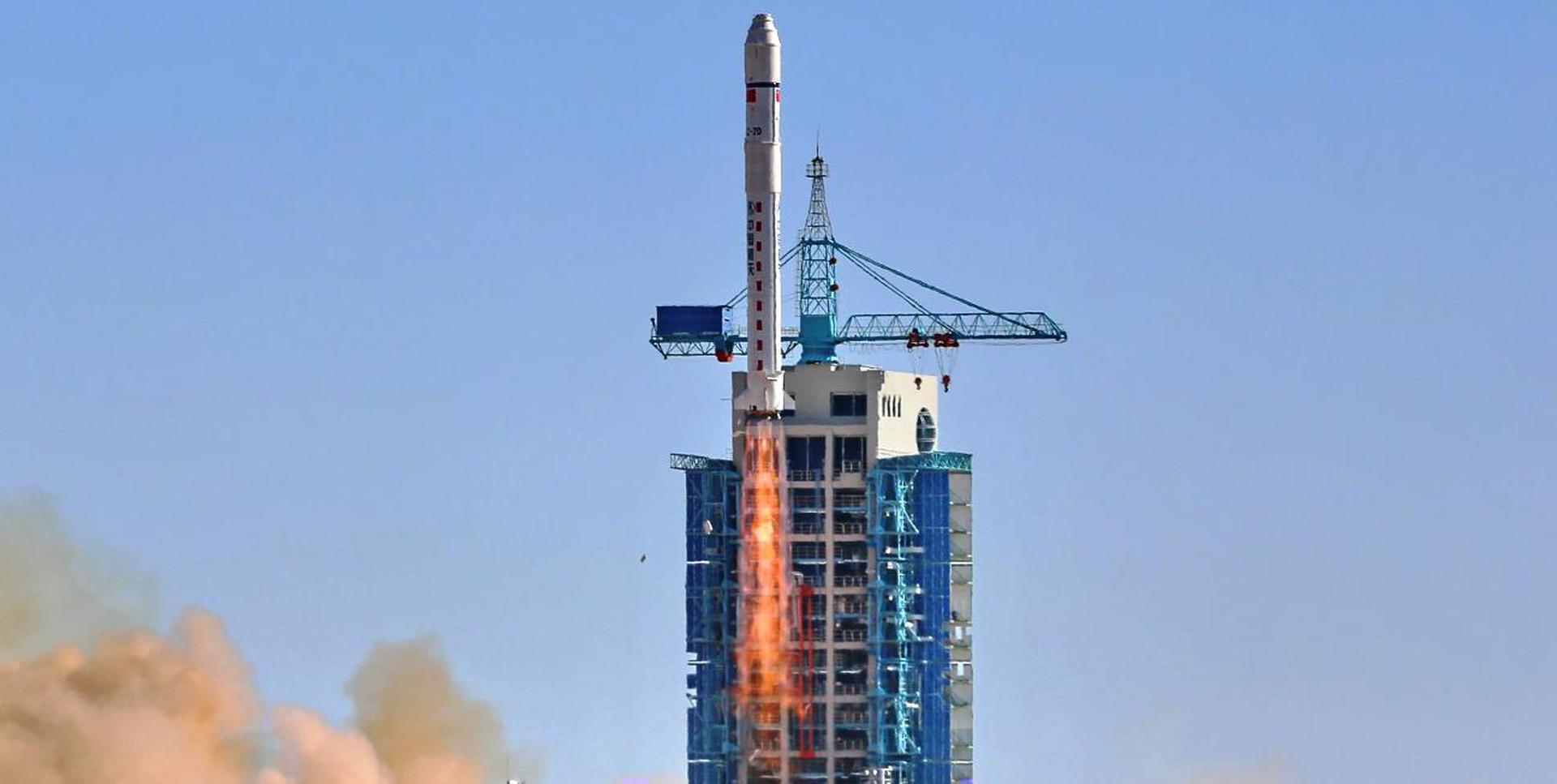
- China Aerospace Science and Technology Corporation Long March 2D: Unknown Payload
- Unknown Payload from Jiuquan Satellite Launch Center, People’s Republic of China (04:02 UTC) Details to be determined. The Long March 2D is a two-stage Chinese orbital carrier rocket capable of delivering up to 3,500 kg to low Earth orbit, with a flight heritage dating back to 1992. Launch Preview
April 18
-
Blue Origin New Glenn: BlueBird Block 2 #2
- BlueBird Block 2 #2 from Cape Canaveral Space Force Station, FL, USA (10:45 UTC) The third-ever flight of New Glenn will deploy AST SpaceMobile’s second next-generation BlueBird satellite into low Earth orbit. The BlueBird constellation is designed to deliver space-based cellular broadband connectivity for both commercial and government customers. Booster recovery intentions have not been confirmed by Blue Origin. Watch Live Launch Preview
-
SpaceX Falcon 9 Block 5: Starlink Group 17-22
- Starlink Group 17-22 from Vandenberg Space Force Base, CA, USA (14:00 UTC) A batch of 29 Starlink V2 Mini Optimized satellites to low Earth orbit. Booster 1080 will attempt its 26th landing on the drone ship Just Read the Instructions. Watch Live Launch Preview
April 20
- SpaceX Falcon 9 Block 5: GPS III SV10
- GPS III SV10 from Cape Canaveral Space Force Station, FL, USA (06:48 UTC) The tenth and final mission in the GPS III series, launching on behalf of the United States Space Force. GPS III satellites provide improved positioning accuracy, stronger anti-jamming capabilities, and enhanced signal reliability for the Global Positioning System constellation operated by the United States Space Force.
April 22
-
SpaceX Falcon 9 Block 5: Starlink Group 17-14
- Starlink Group 17-14 from Vandenberg Space Force Base, CA, USA (02:00 UTC) A batch of 29 Starlink V2 Mini Optimized satellites to low Earth orbit. Booster 1080 will attempt its 26th landing on the drone ship Just Read the Instructions. Watch Live
-
Agency for Defense Development South Korean ADD Solid-Fuel SLV: Demo Flight
- Demo Flight from Sea Launch offshore platform (05:00 UTC) The first orbital full-configuration launch of South Korea’s military small satellite launch vehicle. The vehicle previously completed two sub-orbital stage tests in March and December 2022, and one partial orbital test flight in December 2023. Further details are to be determined. Note: launch vehicle name is provisional.
April 23
- Rocket Lab Electron: Kakushin Rising (JAXA Rideshare)
- Kakushin Rising (JAXA Rideshare) from Rocket Lab Launch Complex 1, Mahia Peninsula, New Zealand (time TBD) A Japan Aerospace Exploration Agency-manifested rideshare carrying eight small satellites to sun-synchronous orbit. Payloads include educational cubesats, an ocean monitoring satellite, a multispectral camera demonstrator, and OrigamiSat-2, which features a deployable antenna that uses origami folding techniques to expand to 25 times its packed size. The satellites were originally planned to launch on a Japanese Epsilon-S rocket before being transferred to Electron following Epsilon-S test failures. The eight satellites are: MAGNARO-II, KOSEN-2R, WASEDA-SAT-ZERO-II, FSI-SAT2, OrigamiSat-2, Mono-Nikko, ARICA-2, and PRELUDE.
April 25
-
SpaceX Falcon 9 Block 5: Starlink Group 17-16
- Starlink Group 17-16 from Vandenberg Space Force Base, CA, USA (14:00 UTC) A batch of 25 satellites for the Starlink mega-constellation. Watch Live
-
Russian Federal Space Agency (ROSCOSMOS) Soyuz 2.1a: Progress MS-34 (95P)
- Progress MS-34 (95P) from Baikonur Cosmodrome, Republic of Kazakhstan (22:21 UTC) An uncrewed Progress resupply mission to the International Space Station.
Schedule Changes
- New Launch Added: SpaceX Falcon 9 Block 5 | Starlink Group 17-16 has been added to the manifest, scheduled for April 25 at 14:00 UTC from Vandenberg Space Force Base.
- Launch Successful – Removed from Calendar: SpaceX Falcon 9 Block 5 | Starlink Group 10-24 has been marked as Launch Successful and removed from the upcoming schedule.
- Launch Successful – Removed from Calendar: SpaceX Falcon 9 Block 5 | Starlink Group 17-27 has been marked as Launch Successful and removed from the upcoming schedule.
Note: Launch dates and times are subject to change due to technical or weather considerations.

Maurice Stellarski