· space brief · 7 min read
Space Force Terminates GPS OCX Contract; Final GPS III Launches | KeepTrack Space Brief
Pentagon cancels RTX's OCX ground control program after testing failures. SpaceX launches final GPS III satellite same day, leaving IIIF transition uncertain.
Top Stories
Space Force Terminates RTX’s OCX GPS Ground Control Contract
The Pentagon has cancelled the Operational Control Segment (OCX) program, the next-generation ground control system for GPS satellites. The decision follows years of testing failures and cost growth. RTX (Raytheon Technologies) held the contract. The Space Force will instead continue operating the current ground system, which is managed by Lockheed Martin.
OCX was meant to support both existing GPS III satellites and the incoming GPS IIIF constellation. With that program gone, the path to full GPS IIIF operational capability now depends on whatever ground architecture replaces it — a question the Space Force hasn’t fully answered publicly yet.
Read the full story: SpaceNews
SpaceX Launches Final GPS III Satellite for U.S. Space Force
The last GPS III satellite lifted off from Space Launch Complex 40 at Cape Canaveral Space Force Station on April 21 at 0653 UTC aboard a SpaceX Falcon 9. This closes out the GPS III production block before the Space Force transitions to GPS IIIF, which carries upgraded anti-jamming and M-code capabilities.
Ten GPS III satellites were built by Lockheed Martin. With the OCX termination announced the same day, the transition to IIIF operations now faces added ground-system uncertainty. You can track the GPS constellation via KeepTrack’s satellite browser.
Read the full story: Spaceflight Now
Space Force Stands Up Cislunar Acquisition Task Force
U.S. Space Force has launched a cislunar acquisition task force focused on building out procurement frameworks for the Earth-Moon region, with NASA’s future lunar base in mind. The effort signals the Space Force is moving from concept development toward actual contracting in cislunar space.
Running parallel, the Air Force Research Laboratory is preparing to launch Oracle Prime — an experimental cislunar domain awareness satellite — in 2027. Oracle Prime will be one of the first U.S. government assets designed specifically to monitor activity in cislunar space, a region currently beyond the reach of most ground-based tracking infrastructure.
Read the full story: Breaking Defense
SpaceX Logs 600th Falcon 9 Booster Landing on Starlink Mission
A Falcon 9 carrying 25 Starlink satellites launched from Vandenberg Space Force Base on April 19, with booster B1097 completing the 600th first-stage landing in SpaceX’s history. The mission was Starlink Group 17-22.
The 600-landing mark reflects the operational tempo SpaceX has maintained since introducing reusability in 2015. Individual boosters now routinely fly 20-plus missions. Booster reuse directly enables the cadence behind Starlink’s ~7,000-satellite active constellation.
Read the full story: Space.com
Navy Pushes Medium Unmanned Surface Vehicles and Updates F/A-XX Timeline at Sea Air Space
Day one of the Navy League’s Sea Air Space conference surfaced updates on two fronts: the F/A-XX next-generation carrier-based fighter program received a revised timeline, and multiple vendors showcased Medium Unmanned Surface Vehicles (MUSVs). Specific F/A-XX schedule details were discussed on the conference floor but weren’t fully disclosed in initial reporting.
The MUSV push reflects the Navy’s accelerating interest in unmanned surface platforms for distributed maritime operations. Several defense contractors were showing hardware and concepts, suggesting the acquisition pipeline for that class of vessel is moving toward maturity.
Read the full story: Breaking Defense
Satellite of the Day
GALAXY 17
GALAXY 17 (G-17) is a commercial communication satellite operated by INTELD and launched on May 4, 2007, aboard an Ariane 5ECA rocket from French Guiana. Manufactured by Thales, this satellite was designed to provide broad coverage for telecommunications services across North America and beyond. Equipped with 24 Ku-band and 24 C-band transponders, Galaxy 17 represents the kind of workhorse platform that powers much of the commercial satellite communication infrastructure we rely on daily.
With a designed lifetime of 15 years and an initial launch mass of 4,107 kg, Galaxy 17 exemplifies early-2000s satellite design philosophy—reliable, multi-band capability in a robust package. The satellite’s Box + 2 Panel configuration with deployed solar arrays spanning 36.9 meters provides ample power for sustained operations in geostationary orbit. Today, nearly two decades after launch, Galaxy 17 remains a key asset in tracking space domain awareness efforts, offering valuable data on long-lived communication satellite operations.
| Detail | Value |
|---|---|
| NORAD ID | 31307 |
| Operator | INTELD (US) |
| Launch Date | May 4, 2007 |
| Orbit | Geostationary, 2.83° inclination |
| Purpose | Communication |
| Manufacturer | Thales |
| Launch Vehicle | Ariane 5ECA |
Track this satellite in real-time: Track GALAXY 17
Upcoming Space Launches
April 22
- Rocket Lab HASTE | Bubbles:
- Bubbles from Wallops Flight Facility, Virginia, USA (00:00–05:00 UTC) A sub-orbital launch under Rocket Lab’s Hypersonic Accelerator Suborbital Test Electron (HASTE) program. The HASTE variant of the Electron rocket serves as a suborbital testbed for hypersonics research. Details TBD.
April 23
-
SpaceX Falcon 9 Block 5 | Starlink Group 17-14:
- Starlink Group 17-14 from Vandenberg Space Force Base, CA, USA (02:00–06:00 UTC) A batch of 25 Starlink V2 Mini Optimized satellites to low Earth orbit. Booster B1100, flying for its eighth time, will land on drone ship Of Course I Still Love You in the Pacific Ocean. Watch Live
-
Rocket Lab Electron | Kakushin Rising (JAXA Rideshare):
- Kakushin Rising from Rocket Lab Launch Complex 1, Mahia Peninsula, New Zealand (03:09 UTC) A Japan Aerospace Exploration Agency rideshare mission launching aboard Rocket Lab’s two-stage Electron small-lift launch vehicle to sun-synchronous orbit.
April 24
- China Aerospace Science and Technology Corporation Long March 2D | Unknown Payload:
- Unknown Payload from Xichang Satellite Launch Center, People’s Republic of China (06:25–06:46 UTC) A Long March 2D (Chang Zheng 2D) launch carrying an undisclosed payload. The two-stage rocket is primarily used for LEO and SSO satellite deployments. Details TBD.
April 25
-
Agency for Defense Development South Korean ADD Solid-Fuel SLV | Demo Flight:
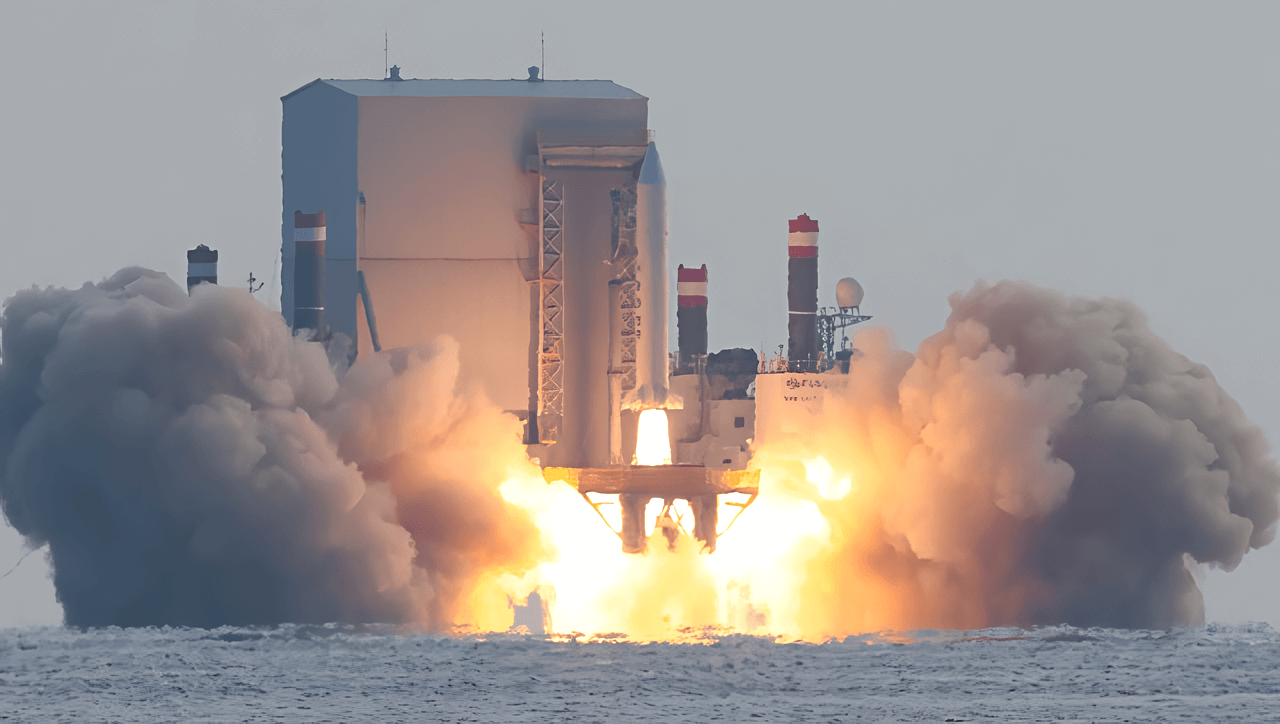
- Demo Flight from Sea Launch Offshore Platform (05:00–09:00 UTC) The first orbital full-version launch of South Korea’s military small satellite launch vehicle, following two sub-orbital stage tests in 2022 and one orbital test flight without the second stage in December 2023. Launch vehicle name is provisional.
-
Russian Federal Space Agency (ROSCOSMOS) Soyuz 2.1a | Progress MS-34 (95P):
- Progress MS-34 (95P) from Baikonur Cosmodrome, Republic of Kazakhstan (22:21 UTC) An uncrewed Progress cargo resupply spacecraft mission launching from the Baikonur Cosmodrome.
April 26
- SpaceX Falcon 9 Block 5 | Starlink Group 17-16:
- Starlink Group 17-16 from Vandenberg Space Force Base, CA, USA (14:00–18:00 UTC) A batch of 25 Starlink V2 Mini Optimized satellites to low Earth orbit. Booster B1100, flying for an eighth time, will land on drone ship Of Course I Still Love You in the Pacific Ocean. Watch Live
April 27
- SpaceX Falcon Heavy | ViaSat-3 F3 (ViaSat-3 Asia-Pacific):
- ViaSat-3 F3 from Kennedy Space Center, FL, USA (14:21–15:46 UTC) The third in the ViaSat-3 series of Ka-band geostationary communications satellites, targeting the Asia-Pacific region. Each ViaSat-3 class satellite is expected to deliver more than 1 terabit per second of network capacity, with the ability to dynamically direct capacity to customer locations. Launched by SpaceX’s powerful Falcon Heavy, derived from the Falcon 9 with two additional side boosters. Watch Live
April 28
- United Launch Alliance Atlas V 551 | Amazon Leo (LA-06):
- Amazon Leo (LA-06) from Cape Canaveral Space Force Station, FL, USA (00:52–01:21 UTC) The seventh of nine Atlas V rockets purchased by Amazon, this mission will deliver 29 broadband internet satellites to low Earth orbit for the Amazon Leo (Kuiper) constellation, aimed at providing high-speed, low-latency connectivity to underserved and remote areas globally. The Atlas V 551 is powered by a Russian-built RD-180 engine on its first stage and an RL10 engine on its Centaur upper stage. Watch Live
Schedule Changes
- New launch added: China Aerospace Science and Technology Corporation Long March 2D carrying an unknown payload has been added to the manifest, scheduled for April 24 at 06:25 UTC from Xichang Satellite Launch Center.
- New launch added: SpaceX Falcon Heavy carrying ViaSat-3 F3 (ViaSat-3 Asia-Pacific) has been added to the manifest, scheduled for April 27 at 14:21 UTC from Kennedy Space Center.
- Status update: SpaceX Falcon 9 Block 5 | GPS III SV10 has progressed from Go for Launch to Launch in Flight and has been excluded from the calendar as the launch is underway.
- Status update: Russian Federal Space Agency Soyuz 2.1a | Progress MS-34 (95P) has been confirmed, moving from To Be Confirmed to Go for Launch.
- Status update: United Launch Alliance Atlas V 551 | Amazon Leo (LA-06) has received a firm launch date, moving from To Be Determined to Go for Launch.
Note: Launch dates and times are subject to change due to technical or weather considerations.

Maurice Stellarski