· space brief · 8 min read
Falcon Heavy Launches ViaSat-3 F3, Debuts Dual Landing Zones | KeepTrack Space Brief
Falcon Heavy completed its 12th flight launching ViaSat-3 F3 from Kennedy Space Center on April 27, marking the first simultaneous use of Landing Zones 2 and 40 for booster recovery.

Top Stories
Falcon Heavy Flies for 12th Time, Debuts Dual Landing Zone Configuration
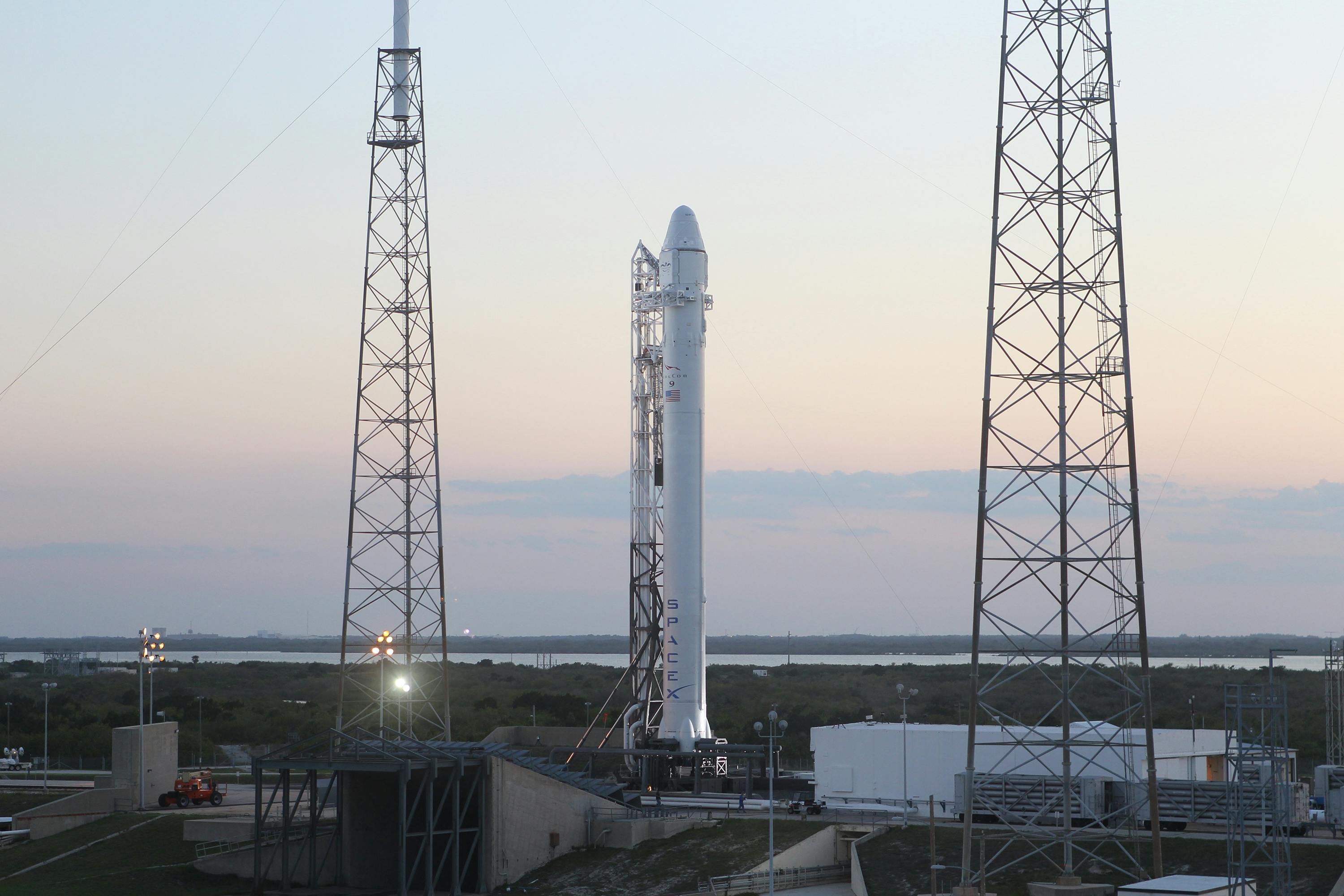
Falcon Heavy launched ViaSat-3 F3 from LC-39A at Kennedy Space Center on April 27, with liftoff at 1421 UTC. This is the rocket’s first flight in 18 months and its 12th overall. The mission marks the first time SpaceX simultaneously used Landing Zone 2 and Landing Zone 40 for booster recovery.
ViaSat-3 F3 is the third and final satellite in Viasat’s next-generation broadband constellation. Falcon Heavy is the only currently operational rocket capable of lifting the payload to its target orbit. Once catalogued, you’ll be able to track the satellite directly in KeepTrack.
Read the full story: Spaceflight Now
FCC Denies SpaceX Direct-to-Device Spectrum Request — For Now
The FCC rejected SpaceX’s bid for spectrum access that would enable Starlink to connect directly to unmodified smartphones. The ruling is not permanent, but it blocks SpaceX from moving forward on that path without further regulatory action.
The direct-to-device market is contested. SpaceX, AST SpaceMobile, and others are all pursuing spectrum allocations that would let satellites serve as cell towers for standard handsets. A denial at the FCC level forces SpaceX to either refile, appeal, or pursue alternative spectrum bands.
Read the full story: Teslarati
NASASpaceFlight Breaks Down the ViaSat-3 F3 Mission Profile
NASASpaceFlight published a full pre-launch breakdown of the ViaSat-3 F3 mission, covering Falcon Heavy’s return after its 18-month stand-down. The piece details the vehicle configuration and what Viasat needs from the final satellite to complete its global Ka-band network.
The two previous ViaSat-3 satellites had separate issues — ViaSat-3 Americas suffered a reflector anomaly that severely degraded capacity after reaching orbit. This third satellite, targeting the Asia-Pacific region, is critical to Viasat’s commercial recovery.
Read the full story: NASASpaceFlight
Curiosity Finds New Organic Compounds on Mars
NASA’s Curiosity rover has detected additional organic molecules on Mars, adding to the body of chemical evidence from Gale Crater. The compounds don’t confirm life, but they confirm Mars preserved complex carbon chemistry across billions of years.
Curiosity has been operating on Mars since 2012 and continues to function well past its original two-year design life. These findings feed directly into sample return mission planning and the broader question of where on Mars to prioritize future surface access.
Read the full story: NASASpaceFlight
2026 Breakthrough Prize Awards $18M+ Across Physics and Space Science
The 2026 Breakthrough Prize distributed more than $18 million across disciplines including dark matter research, quantum physics, gene editing, and nonlinear mathematics. The awards recognize fundamental research, not applied technology development.
Dark matter detection remains one of the core unsolved problems with direct implications for satellite sensor design and space-based physics experiments. Several active and planned missions are built around testing competing dark matter models.
Read the full story: Space.com
Satellite of the Day
CGSTL Earth Observation Satellite (51846)
This Chinese Earth observation satellite operates as part of CGSTL’s remote sensing mission, launched aboard a Chang Zheng 8 rocket from the Wenchang Space Launch Center in late February 2022. With a launch mass of 43 kg, it’s a relatively compact satellite designed for Earth imaging and environmental monitoring. The satellite’s sun-synchronous orbit at 97.36° inclination positions it perfectly for consistent lighting conditions across imaging passes—a key advantage for comparison of Earth observation data over time.
The mission contributes to China’s growing constellation of remote sensing assets used for land surveying, disaster response, and environmental assessment. Its lightweight design and efficient launch on the Chang Zheng 8 demonstrate the continued development of China’s medium-lift launch capabilities. For space domain awareness enthusiasts, this satellite represents the increasing accessibility of space-based Earth observation technology to a broader range of operators.
| Detail | Value |
|---|---|
| NORAD ID | 51846 |
| Operator | CGSTL (China) |
| Launch Date | February 27, 2022 |
| Orbit | Sun-synchronous, 97.36° inclination |
| Purpose | Earth observation |
| Status | Active |
Track this satellite in real-time: Track CGSTL Earth Observation Satellite (51846)
Upcoming Space Launches
April 27
- SpaceX Falcon Heavy:
- ViaSat-3 F3 (ViaSat-3 Asia-Pacific) from Kennedy Space Center, FL, USA (14:21 UTC) A SpaceX Falcon Heavy rocket will launch Viasat’s third and final satellite in its three-satellite series into geosynchronous transfer orbit. The two side boosters, B1072 (second flight) and B1075 (22nd flight), will return to Landing Zone 2 and Landing Zone 40 at Cape Canaveral Space Force Station, while the core booster will be expended. The Falcon Heavy can lift up to 63,800 kg to low Earth orbit, making it one of the most capable operational rockets in the world. Watch Live
April 28
- United Launch Alliance Atlas V 551:
- Amazon Leo (LA-06) from Space Launch Complex 41, Cape Canaveral SFS, FL, USA (00:52 UTC) This mission will deploy 29 broadband internet satellites for Amazon’s Project Kuiper low Earth orbit constellation. It marks the seventh of nine Atlas V rockets contracted by Amazon for the constellation’s initial deployment. The Atlas V 551 configuration features a 5-meter fairing and five solid rocket boosters, providing the heavy-lift capability needed for this batch of satellites. Watch Live
April 30
-
Arianespace Ariane 64:
- Amazon Leo (LE-02) from Ariane Launch Area 4, Guiana Space Centre, French Guiana (08:08 UTC) An Arianespace Ariane 6 rocket in its four-booster “64” configuration will launch a batch of broadband internet satellites for Amazon’s Project Kuiper low Earth orbit constellation. The Ariane 64 variant is capable of delivering up to 21,650 kg to low Earth orbit and represents one of Europe’s most powerful expendable launch vehicles.
-
RKK Energiya Soyuz-5:
- Demo Flight from 45/1, Baikonur Cosmodrome, Republic of Kazakhstan (time TBD) Demonstration flight of Russia’s new Soyuz-5 (Irtysh) launch vehicle, carrying a mass simulator payload. The Soyuz-5 is intended to replace the Zenit-2 and Proton Medium rockets and is powered by an RD-171MV engine on its first stage, capable of delivering 17,000 kg to low Earth orbit. This test will validate the vehicle ahead of future operational missions. Launch Preview
-
LandSpace Zhuque-2E:
- Unknown Payload from Launch Area 96A, Jiuquan Satellite Launch Center, People’s Republic of China (time TBD) A LandSpace Zhuque-2E rocket — an enhanced variant of the methane-fueled Zhuque-2 featuring upgraded TQ-12A first stage engines and a new TQ-15A second stage engine — will carry an as-yet-undisclosed payload. The Zhuque-2E can lift up to 6,000 kg to a 200 km low Earth orbit.
-
Russian Federal Space Agency (ROSCOSMOS) Soyuz 2.1b:
- 16 x Rassvet-3 from Plesetsk Cosmodrome, Russian Federation (time TBD) A Soyuz 2.1b rocket will launch a batch of 16 Rassvet-3 communications satellites for the Byuro-1440 (Bureau 1440) constellation, which aims to provide broadband high-speed internet access across Russia. Note: individual payload identities are uncertain.
-
SpaceX Falcon 9 Block 5:
- Starlink Group 17-36 from Space Launch Complex 4E, Vandenberg SFB, CA, USA (02:00 UTC) A batch of 25 Starlink V2 Mini Optimized satellites bound for low Earth orbit. Booster B1088 will fly for the 15th time and target a landing on the drone ship Of Course I Still Love You in the Pacific Ocean. Watch Live
-
China Aerospace Science and Technology Corporation Long March 10B:
- Demo Flight from Commercial LC-2, Wenchang Space Launch Site, People’s Republic of China (time TBD) First test launch of the Long March 10B, a reusable medium-to-heavy lift vehicle derived from the Long March 10A’s first stage core. The rocket uses seven YF-100 series kerosene/liquid oxygen engines on its first stage and a single YF-219 methane/liquid oxygen engine on its second stage. The first stage is designed for downrange recovery via an arrestor-net barge using grid fins.
-
China Aerospace Science and Technology Corporation Long March 7A:
- Unknown Payload from Pad 201, Wenchang Space Launch Site, People’s Republic of China (time TBD) Details of the payload are currently undisclosed.
-
Russian Space Forces Angara 1.2:
- Kosmos (Unknown Payload) from 35/1, Plesetsk Cosmodrome, Russian Federation (time TBD) An Angara 1.2 rocket will launch an unknown satellite or satellites for the Russian military under the Kosmos designation. The Angara 1.2 uses a single Universal Rocket Module core stage and can lift up to 3,700 kg to low Earth orbit.
May 1
- SpaceX Falcon 9 Block 5:
- Starlink Group 10-38 from Space Launch Complex 40, Cape Canaveral SFS, FL, USA (17:33 UTC) A batch of 29 satellites for SpaceX’s Starlink broadband internet mega-constellation. Watch Live
May 3
- SpaceX Falcon 9 Block 5:
- CAS500-2 & Others from Space Launch Complex 4E, Vandenberg SFB, CA, USA (06:59 UTC) A rideshare mission to sun-synchronous orbit carrying multiple payloads, including the South Korean CAS500-2 Earth observation satellite (capable of 0.5 m panchromatic and 2 m multispectral imagery) operated by the Korea Aerospace Research Institute, as well as Pelican-7, -8, and -9 — three high-resolution commercial imaging smallsats from Planet Labs intended to augment its existing Earth observation fleet. Watch Live
Schedule Changes
- New launch added: SpaceX Falcon 9 Block 5 | Starlink Group 10-38, now scheduled for 2026-05-01 at 17:33 UTC from Cape Canaveral Space Force Station, FL, with status Go for Launch.
- New launch added: SpaceX Falcon 9 Block 5 | CAS500-2 & Others, now scheduled for 2026-05-03 at 06:59 UTC from Vandenberg SFB, CA, with status Go for Launch.
- SpaceX Falcon 9 Block 5 | Starlink Group 17-16 has been removed from the upcoming launches calendar following a successful launch.
- RKK Energiya Soyuz-5 | Demo Flight has had its status downgraded from To Be Confirmed to To Be Determined, reflecting increased uncertainty around its readiness date.
Note: Launch dates and times are subject to change due to technical or weather considerations.

Maurice Stellarski