


· space brief · 7 min read
Space Force Eyes 1,000 Launches by 2031, New Site Required | KeepTrack Space Brief
Space Force projects ~1,000 launches between FY2027–FY2031, averaging 200 annually. DAF study concludes new launch site is "probably" required to absorb cadence.
Top Stories
DAF Study Says New Launch Site ‘Probably’ Required to Handle ~1,000 Space Force Launches by 2031
Lt. Gen. David Miller, Space Force deputy for Strategy, Plans, Programs and Requirements, told an audience Tuesday that the service alone is projecting roughly 1,000 launches between FY2027 and FY2031. A Department of the Air Force study concluded a new launch site is “probably” required to absorb that cadence.
Current infrastructure at Vandenberg and Cape Canaveral is already under strain from commercial and government traffic. If that 1,000-launch figure holds, it averages 200 government launches per year — roughly double the recent annual pace. Where a new site gets sited, and which vehicles use it, will have direct implications for orbital debris density across multiple orbital regimes.
Read the full story: Breaking Defense
Space Force USSF-23 Mission to Demo In-Space Refueling and Satellite Servicing at GEO in 2027
The Space Force is targeting 2027 for USSF-23, a mission that will launch vehicles to demonstrate propellant transfer and satellite servicing in geostationary orbit. No vehicle selection or contractor has been publicly named yet.
GEO servicing changes the calculus on satellite longevity — a successfully refueled spacecraft can extend its operational life by years, reducing replacement launch requirements. For tracking purposes, servicing vehicles operating in GEO introduce new resident space objects that require cataloging and monitoring. KeepTrack users can filter GEO objects using the satellite catalog to watch this region as 2027 approaches.
Read the full story: SpaceNews
US Military Test-Fires Unarmed ICBM from Vandenberg on May 20
The U.S. military conducted an unarmed Minuteman III intercontinental ballistic missile test launch from Vandenberg Space Force Base on May 20, 2026. These tests are routine verification of the land-based nuclear deterrent leg but draw attention each time given the trajectory profiles involved.
Vandenberg ICBM tests follow a southwest trajectory over the Pacific toward Kwajalein Atoll. Observers and tracking systems occasionally pick up the reentry vehicle during terminal phase. The test generates no persistent orbital objects.
Read the full story: Space.com
Pentagon CTO Emil Michael Pushes for Fast Acquisition Decisions to Stop Dragging Small Vendors
Pentagon CTO Emil Michael said his approach to tech acquisition is “fast yeses and fast nos,” explicitly calling out multi-year procurement processes as damaging to smaller companies. He is pushing for quicker vendor decisions across DoD buying channels.
For the space and satellite sector, where many of the most capable new suppliers are small or mid-sized firms, faster DoD acquisition cycles could accelerate fielding of on-orbit capabilities — including sensor payloads, communications hardware, and ground software like space situational awareness tools.
Read the full story: Breaking Defense
The ‘Cardinality Wall’: Why LEO Constellation Scale Is Breaking Standard Data Infrastructure
SpaceNews outlines a data architecture problem emerging as LEO constellations scale into the thousands: standard databases and telemetry pipelines weren’t built to handle the volume and query complexity that comes with tracking that many simultaneous spacecraft. The piece frames this as a “cardinality wall” — a point where conventional tools degrade under the weight of high-dimensionality time-series data.
This is directly relevant to space situational awareness. As catalogs like Space-Track grow and commercial constellations add hundreds of satellites per year, tools that process TLE data at scale face the same ceiling. KeepTrack currently renders thousands of objects simultaneously — the underlying data pipeline challenge described here applies to anyone doing real-time SSA at constellation scale.
Read the full story: SpaceNews
NORTHCOM Commander: Southern Border Is a Live Test Environment for Counter-Drone Tech
Gen. Guillot stated that through JIATF 401, the U.S. military is actively inviting defense industry partners to demonstrate counter-drone capabilities at the southern border. He described the border environment as a “sandbox” for testing systems against real adversary drone activity.
The operational feedback loop here is faster than most formal acquisition programs. Technologies validated at the border — RF jamming, kinetic intercept, directed energy — are likely candidates for broader DoD adoption, including potential integration with space-based surveillance layers that cue ground-based counter-UAS systems.
Read the full story: Breaking Defense
Satellite of the Day
ASTRA 1E
ASTRA 1E is a direct broadcasting satellite that has been serving European audiences since its launch on October 19, 1995, aboard an Ariane 42L rocket from French Guiana. Operated by SES (Société Européenne des Satellites), this Hughes HS-601 bus spacecraft was designed to deliver television and multimedia content across Europe with either 24 or 30 Ku-band transponders depending on its configuration. With a launch mass of 3,010 kg and solar arrays spanning 26.2 meters when fully deployed, ASTRA 1E represented cutting-edge broadcast satellite technology in the mid-1990s, built to operate for 15 years in geostationary orbit.
Nearly three decades after launch, ASTRA 1E remains a notable piece of space heritage in the heavily-trafficked geostationary belt. The satellite’s longevity—far exceeding its original design life—speaks to the robust engineering of the HS-601 platform and the reliability of SES’s satellite fleet. For satellite trackers and space domain awareness enthusiasts, ASTRA 1E is a prime example of how commercial communication satellites form the backbone of modern broadcasting infrastructure, with many European viewers still benefiting from SES’s ASTRA constellation today.
| Detail | Value |
|---|---|
| NORAD ID | 23686 |
| Operator | SES (Luxembourg) |
| Launch Date | October 19, 1995 |
| Orbit | Geostationary, 11.47° inclination |
| Purpose | Communication (Direct Broadcasting) |
| Status | Active |
Track this satellite in real-time: Track ASTRA 1E
Upcoming Space Launches
May 21
-
SpaceX Falcon 9 Block 5:
- Starlink Group 10-31 from Cape Canaveral Space Force Station, FL, USA (09:26 UTC) A batch of 24 Starlink V2 Mini Optimized satellites launching to low Earth orbit. Watch Live Launch Preview
-
SpaceX Starship:
- Flight 12 from Orbital Launch Pad 2, SpaceX Starbase, TX, USA (22:30 UTC) The 12th integrated flight of Starship-Super Heavy and the first launch of a version 3 rocket, using Ship 39 and Booster 19. SpaceX will not attempt to catch the Super Heavy booster at the launch site. Ship 39 will deploy 20 Starlink simulator satellites along the suborbital flight path, including two designed to relay imagery of the Starship heat shield upon deployment. Watch Live Launch Preview
May 22
- Rocket Lab Electron:
- Viva La StriX (StriX Launch 9) from Rocket Lab Launch Complex 1B, Mahia Peninsula, New Zealand (09:30 UTC) The ninth Electron mission for Japanese Earth observation company Synspective, deploying a StriX Synthetic Aperture Radar (SAR) satellite into a circular 572 km orbit at 44.8 degrees inclination.
May 24
-
SpaceX Falcon 9 Block 5:
- Starlink Group 17-37 from Space Launch Complex 4E, Vandenberg Space Force Base, CA, USA (14:00 UTC) A batch of 24 Starlink V2 Mini Optimized satellites launching to low Earth orbit. Watch Live Launch Preview
-
China Aerospace Science and Technology Corporation Long March 2F/G:
- Shenzhou 23 from Launch Area 91 (SLS-1 / 921), Jiuquan Satellite Launch Center, People’s Republic of China (14:58 UTC) The 23rd flight of China’s crewed Shenzhou program, launched aboard a human-rated Long March 2F/G rocket. The Shenzhou program placed the first Chinese citizen into orbit in 2003 and remains China’s primary crewed spaceflight vehicle.
May 25
- SpaceX Falcon 9 Block 5:
- Starlink Group 10-47 from Space Launch Complex 40, Cape Canaveral Space Force Station, FL, USA (11:41 UTC) A batch of 24 Starlink V2 Mini Optimized satellites launching to low Earth orbit. Watch Live Launch Preview
May 26
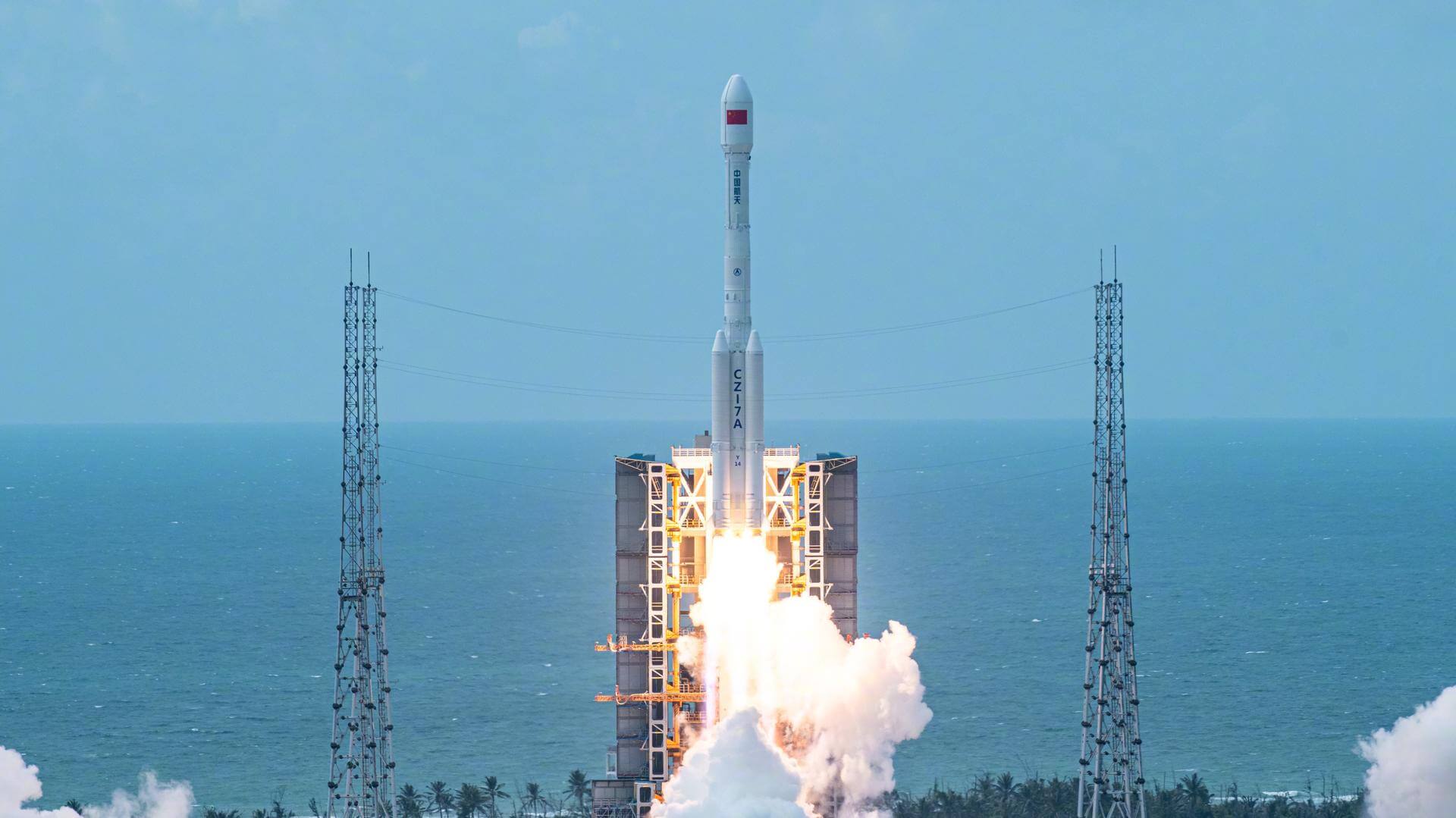
- China Aerospace Science and Technology Corporation Long March 7A:
- Unknown Payload from Launch Pad 201, Wenchang Space Launch Site, People’s Republic of China (16:00 UTC) Payload and mission details to be confirmed.
May 28
- SpaceX Falcon 9 Block 5:
- Starlink Group 17-41 from Space Launch Complex 4E, Vandenberg Space Force Base, CA, USA (14:00 UTC) A batch of 24 Starlink V2 Mini Optimized satellites launching to low Earth orbit. Watch Live
May 29
-
SpaceX Falcon 9 Block 5:
- Starlink Group 10-53 from Space Launch Complex 40, Cape Canaveral Space Force Station, FL, USA (11:52 UTC) A batch of 29 Starlink satellites launching to low Earth orbit. Watch Live
-
United Launch Alliance Atlas V 551:
- Amazon Leo (LA-07) from Space Launch Complex 41, Cape Canaveral Space Force Station, FL, USA (23:33 UTC) A United Launch Alliance Atlas V rocket will deploy 29 Amazon Kuiper broadband internet satellites to low Earth orbit. This is the penultimate Atlas V mission booked by Amazon as part of the company’s effort to build a low Earth orbit satellite internet constellation serving underserved and remote areas globally.
May 31
- Rocket Lab Electron:
- The Grain Goddess Provides (iQPS Launch 7) from Rocket Lab Launch Complex 1, Mahia Peninsula, New Zealand (00:00 UTC) A Synthetic Aperture Radar Earth observation satellite for Japanese Earth imaging company iQPS.
Schedule Changes
- New launch added: SpaceX Falcon 9 Block 5 | Starlink Group 10-53 has been added to the manifest, scheduled for 29 May 2026 at 11:52 UTC from Space Launch Complex 40, Cape Canaveral Space Force Station, FL, USA.
Note: Launch dates and times are subject to change due to technical or weather considerations.

Maurice Stellarski


