· space brief · 8 min read
Blue Origin's New Glenn Gantry Damaged; SpaceX Wins $4.16B Space Force Contract | KeepTrack Space Brief
Blue Origin's LC-36 gantry damaged in blast; CEO targets end-2026 return. SpaceX awarded $4.16B Space Force contract for airborne threat tracking satellites.
Top Stories
New Glenn’s Pad 36 Gantry Damaged in Blast, Blue Origin Targets Year-End Return
Blue Origin CEO Dave Limp confirmed overnight that a blast at Launch Complex 36, Cape Canaveral Space Force Station, damaged the main support gantry. Propellant tanks and a nearby processing hangar came through intact. The gantry can be repaired in place, Limp said, and Blue Origin is targeting a return to flight before the end of 2026.
The grounding affects New Glenn’s manifest at a time when the vehicle is competing for national security launch contracts. Any extended stand-down at LC-36 will shift pressure to other pads and providers. Watch New Glenn’s flight history and orbital objects via KeepTrack as the program works toward resumption.
Read the full story: Spaceflight Now
SpaceX Awarded $4.16 Billion Space Force Contract for Airborne Target Tracking Satellites
The U.S. Space Force awarded SpaceX $4.16 billion to develop and operate satellites capable of tracking airborne threats anywhere on Earth. The contract adds a new mission category to SpaceX’s growing national security portfolio alongside its existing Starshield and launch work.
Satellites built under this contract will contribute to missile warning and tracking architecture. Once objects are cataloged, users on KeepTrack will be able to monitor orbital parameters for any publicly trackable assets in this constellation. The capability is directly relevant to theater missile defense and real-time targeting pipelines.
Read the full story: Space.com
NRO Nominee Roger Mason Calls for Clearer Government Demand Signals to Industry
Roger Mason, nominated to lead the National Reconnaissance Office, told his confirmation hearing that private investment is reshaping the space intelligence market faster than government acquisition processes can absorb. He said the NRO needs to send clearer demand signals to commercial providers to keep pace.
Mason’s framing reflects a structural tension: commercial imaging, RF, and hyperspectral constellations are proliferating, but without committed government offtake agreements, many operators face uncertain revenue. His confirmation, if approved, will influence how NRO contracts are structured over the next several years.
Read the full story: SpaceNews
AI and Commercial Contracts Dominated GEOINT 2026 Discussion
Breaking Defense’s GEOINT 2026 coverage highlights two converging pressures on intelligence agencies: integrating AI into geospatial analysis workflows, and managing an expanding roster of commercial satellite providers under contract. Explainability — whether analysts can understand and justify AI-generated outputs — emerged as a central operational concern.
For satellite trackers, the trend matters. More commercial ISR constellations mean more objects in orbit, more orbital regimes to monitor, and more demand for the kind of precise catalog data that KeepTrack surfaces. Tracking commercial imaging satellites is already possible through the platform’s sensor and object search tools.
Read the full story: Breaking Defense
Army’s Chief Data Officer: AI Is Lowering the Bar for Exploiting Network Vulnerabilities
The U.S. Army’s chief data officer said new AI capabilities are reducing the technical skill required to find and exploit gaps in the Army’s unified network. The warning came in a public statement focused on the defensive implications of adversaries using AI-assisted cyber tools.
The concern applies directly to space ground systems. Satellite command-and-control networks, telemetry links, and mission data infrastructure are all part of the unified network architecture that adversaries could probe. As AI tools proliferate, the attack surface for space-adjacent systems grows alongside it.
Read the full story: Breaking Defense
Israel’s Defense Exports Hit Record $19 Billion in 2025, Missile and Air Defense Lead
Israel’s Ministry of Defense announced that defense exports reached $19 billion in 2025, a record figure. Missile, rocket, and air defense systems accounted for 29% of total deal volume, the largest single category.
Elevated demand for air and missile defense systems has downstream effects on space-based early warning and tracking requirements. Countries purchasing Israeli missile defense systems often seek complementary space-based sensor support, which feeds into the broader market that contractors and government buyers in KeepTrack’s user base operate within.
Read the full story: Breaking Defense
Satellite of the Day
FLOCK 4Q-20
FLOCK 4Q-20 is a 3U CubeSat technology demonstration satellite operated by Planet Labs PBC (PLAN) and launched on November 11, 2023, aboard a SpaceX Falcon 9 rocket from Vandenberg Space Force Base. This tiny satellite—measuring just 0.3 meters long and weighing a mere 5.7 kilograms—carries a Dove imaging payload designed to capture Earth observation data. Despite its diminutive size, the FLOCK 4Q-20 is part of Planet’s larger Flock constellation, which aims to provide frequent, high-resolution imagery of our planet.
As a member of the Flock 4 generation, this CubeSat operates in a sun-synchronous orbit and is expected to maintain operations for two to three years. The satellite’s lightweight design and standardized form factor make it an ideal platform for rapid deployment and cost-effective space missions. For satellite tracking enthusiasts and space domain awareness professionals, FLOCK 4Q-20 represents the democratization of Earth observation—bringing commercial remote sensing capabilities within reach of organizations worldwide while demonstrating the viability of CubeSat-based imaging systems.
| Detail | Value |
|---|---|
| NORAD ID | 58313 |
| Operator | Planet Labs PBC (US) |
| Launch Date | November 11, 2023 |
| Orbit | Sun-synchronous, 97.36° inclination |
| Purpose | Earth observation / imaging technology demonstration |
| Status | Active |
Track this satellite in real-time: Track FLOCK 4Q-20
Upcoming Space Launches
June 3
-
SpaceX Falcon 9 Block 5: Starlink Group 10-43
- From Space Launch Complex 40, Cape Canaveral Space Force Station, FL, USA (08:02 UTC) 29 Starlink V2 Mini Optimized satellites launching to low Earth orbit. Watch Live Launch Preview
-
SpaceX Falcon 9 Block 5: Starlink Group 17-47
- From Space Launch Complex 4E, Vandenberg Space Force Base, CA, USA (14:00 UTC) 29 Starlink V2 Mini Optimized satellites launching to low Earth orbit. Watch Live Launch Preview
June 4
-
China Aerospace Science and Technology Corporation Long March 6A: Unknown Payload
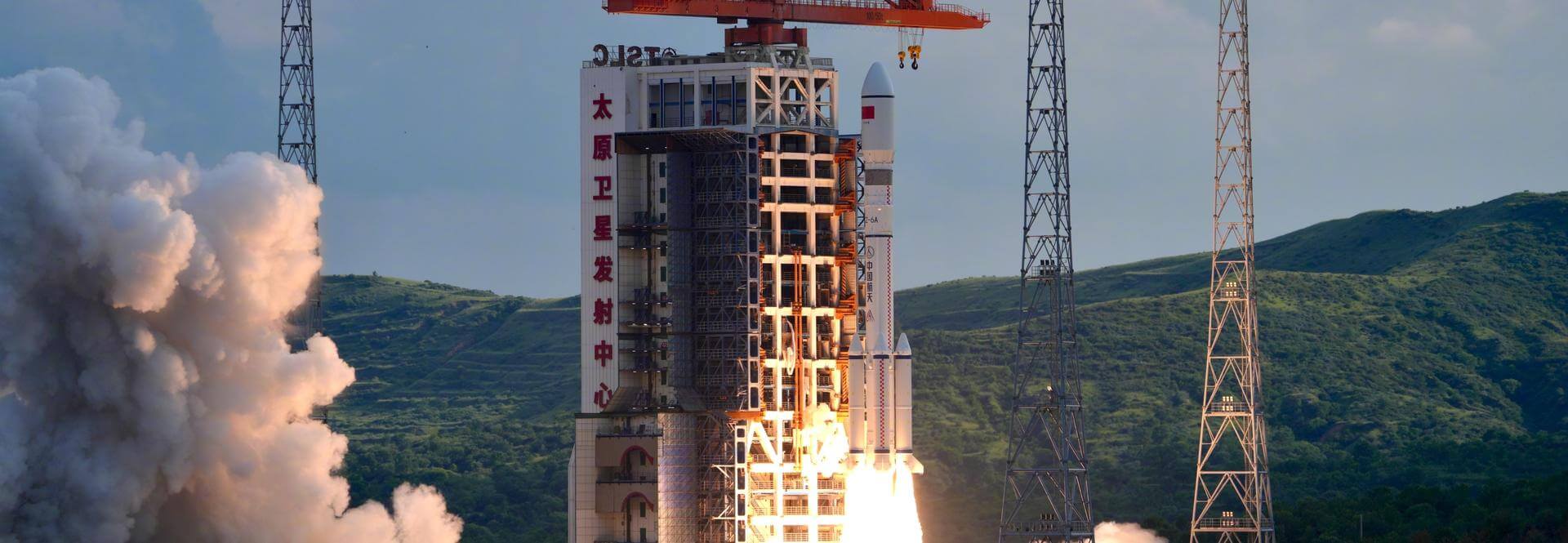
- From Launch Complex 9A, Taiyuan Satellite Launch Center, People’s Republic of China (11:31 UTC) Likely carrying SpaceSail Polar Orbit LEO communication satellites. The Long March 6A is China’s first rocket with solid rocket boosters, featuring two YF-100 engines on the first stage augmented by four solid rocket boosters, developed by the Shanghai Academy of Spaceflight Technology. First launched in March 2022 from Taiyuan’s newly built Complex 9A. Launch Preview
-
Blue Origin New Glenn: Amazon Leo (LN-01)
- From Launch Complex 36A, Cape Canaveral Space Force Station, FL, USA (17:21 UTC) 48 satellites for Amazon Leo (formerly Project Kuiper), a planned 3,276-satellite broadband internet mega-constellation in low Earth orbit. Satellites will be distributed across 98 orbital planes at altitudes of 590–630 km, providing high-speed, low-latency connectivity to underserved and remote regions worldwide. New Glenn is a reusable 7-meter-diameter two-stage rocket by Blue Origin.
June 5
- China Aerospace Science and Technology Corporation Long March 8: Unknown Payload
- From Commercial LC-1, Wenchang Space Launch Site, People’s Republic of China (06:25 UTC) Likely carrying SpaceSail Polar Orbit LEO communication satellites. The Long March 8 is capable of delivering up to 5,000 kg to a 700 km Sun-synchronous orbit, based on the Long March 7 first stage and a liquid-hydrogen upper stage derived from the Long March 3A family. It has been operational since its maiden flight in December 2020. Launch Preview
June 7
- SpaceX Falcon 9 Block 5: Starlink Group 10-35
- From Space Launch Complex 40, Cape Canaveral Space Force Station, FL, USA (10:30 UTC) 29 Starlink V2 Mini Optimized satellites launching to low Earth orbit. Watch Live Launch Preview
June 8
- Agency for Defense Development South Korean ADD Solid-Fuel SLV: Demo Flight
- From ADD Offshore Launch Platform, Sea Launch (05:00 UTC) Demonstration flight of South Korea’s Agency for Defense Development solid-fuel space launch vehicle to low Earth orbit. Launch Preview
June 10
-
Indian Space Research Organization GSLV Mk II: GISAT-1A (EOS-05)
- From Satish Dhawan Space Centre Second Launch Pad, Satish Dhawan Space Centre, India (Time TBD) GISAT-1A is an Indian geostationary earth observation satellite designed to provide continuous imaging of the Indian subcontinent and enable rapid monitoring of natural hazards and disasters. The GSLV Mk II is India’s largest operational launch vehicle, featuring an indigenous cryogenic upper stage and four liquid strap-on boosters.
-
China Rocket Co. Ltd. Smart Dragon 3: Unknown Payload
- From Haiyang Offshore Launch Location, Haiyang Oriental Spaceport (00:30 UTC) Details to be confirmed. Smart Dragon 3 is a solid-fuel commercial orbital rocket developed by a subsidiary of the state-owned China Aerospace Science and Technology Corporation, first launched in December 2022.
-
Mitsubishi Heavy Industries H3-30: H3-30 Test Flight
- From Yoshinobu Launch Complex LP-2, Tanegashima Space Center, Japan (00:53 UTC) Test flight of the H3-30 configuration featuring three LE-9 first-stage engines and no solid rocket boosters. The mission carries a dummy primary payload (Vehicle Evaluation Payload 5 / VEP-5) alongside five small hitchhiker satellites: PETREL, STARS-X, BRO-22, VERTECS, and HORN-L/R. The H3 is an expendable liquid-propellant rocket developed jointly by Mitsubishi Heavy Industries and JAXA.
-
China Aerospace Science and Technology Corporation Long March 5: Unknown Payload
- From Launch Complex 101, Wenchang Space Launch Site, People’s Republic of China (06:00 UTC) Details to be confirmed. The Long March 5 is China’s heavy-lift launch vehicle capable of delivering up to 25,000 kg to low Earth orbit, roughly matching the capability of American EELV heavy-class vehicles such as the Delta IV Heavy. It uses non-hypergolic liquid propellants and first flew in November 2016.
-
SpaceX Falcon 9 Block 5: Starlink Group 17-44
- From Space Launch Complex 4E, Vandenberg Space Force Base, CA, USA (14:00 UTC) 29 Starlink V2 Mini Optimized satellites launching to low Earth orbit. Watch Live
Note: Launch dates and times are subject to change due to technical or weather considerations.

Maurice Stellarski