


· space brief · 6 min read
Roman Space Telescope Arrives at KSC for August 30 Falcon Heavy Launch | KeepTrack Space Brief
NASA's $4.3B Nancy Grace Roman Space Telescope arrived at Kennedy Space Center for 70 days of prelaunch processing ahead of its August 30 Falcon Heavy launch.
Top Stories
NASA’s $4.3B Roman Space Telescope Arrives at KSC, Targets August 30 Falcon Heavy Launch
The Nancy Grace Roman Space Telescope arrived at NASA’s Kennedy Space Center in Florida and begins roughly 70 days of prelaunch processing. Launch is scheduled no earlier than August 30 on a SpaceX Falcon Heavy. The observatory carries a $4.3 billion price tag and is NASA’s next flagship astrophysics mission after Webb.
Roman is designed to survey wide swaths of sky in infrared — a very different operational profile from Hubble or Webb. Once on orbit, it will be trackable as a high-value asset in an orbit to be confirmed at launch.
Read the full story: Spaceflight Now
SpaceX’s Starfall Capsule Targets In-Space Manufacturing — Details Still Scarce
SpaceX is preparing to launch a disk-shaped spacecraft called Starfall, described as a reentry vehicle aimed at in-space manufacturing applications. No publicly confirmed launch date or NORAD ID is available yet. The capsule’s disk geometry suggests a design optimized for controlled reentry with a recoverable payload.
No existing commercial reentry vehicle has established a reliable market for in-space manufacturing returns. If Starfall flies and recovers successfully, it would be worth watching for its catalog entry and reentry track.
Read the full story: Teslarati
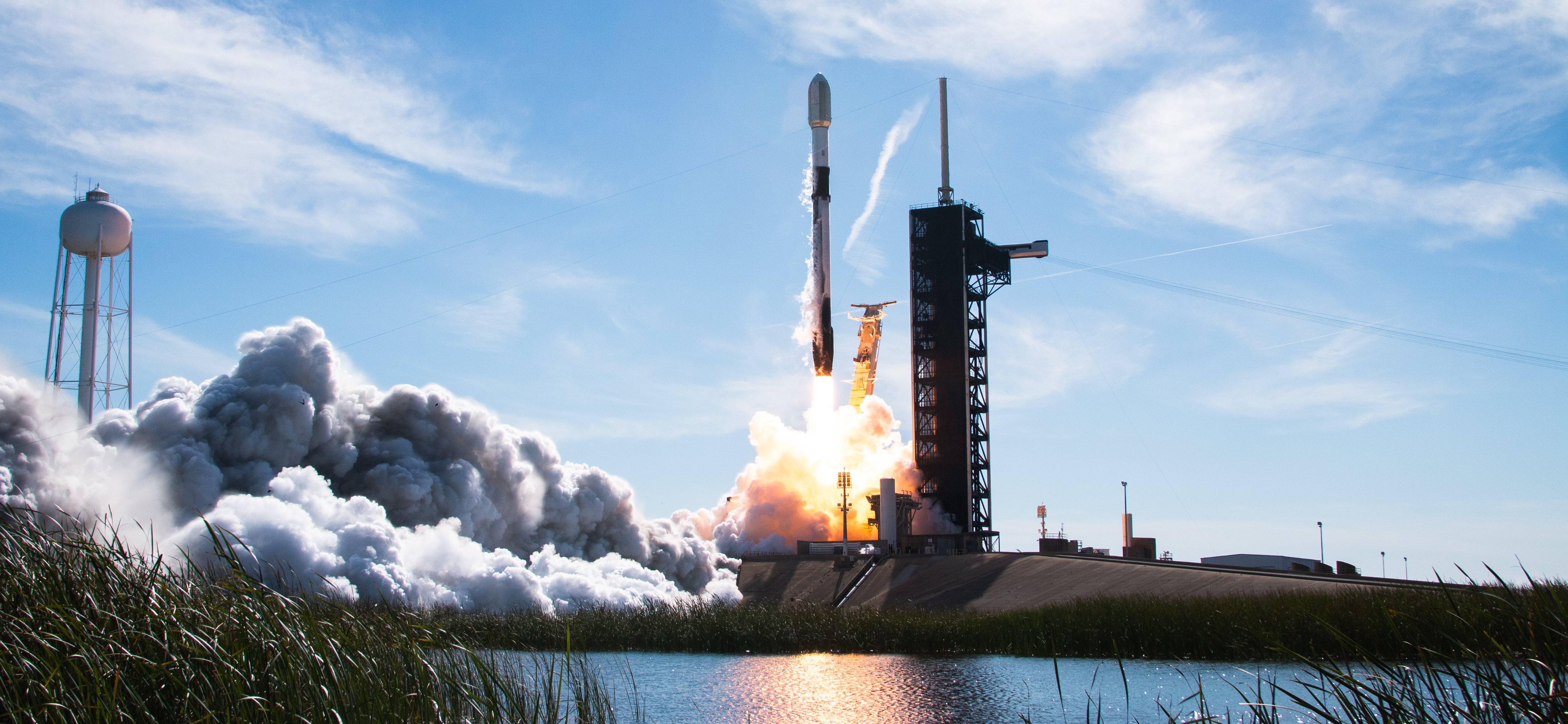
Falcon 9 Lofts 24 Starlink Satellites from Vandenberg, Booster B1063 Flies Again
A Falcon 9 carrying 24 Starlink satellites lifted off from Vandenberg Space Force Base on June 21, 2026. The mission, designated Starlink 17-28, used booster B1063. Landing was on the drone ship Of Course I Still Love You.
The new satellites join the growing Group 17 shell in low Earth orbit. You can browse the full Starlink constellation in KeepTrack by filtering on Starlink in the satellite search.
Read the full story: Space.com
Galactic Center Gamma-Ray Excess Still Unexplained — Dark Matter Not Ruled Out
A new study on the Galactic Center Excess — an unexplained gamma-ray emission from the core of the Milky Way — has failed to eliminate self-annihilating dark matter as the source. The emission has been debated for years, with competing explanations including unresolved millisecond pulsars and dark matter annihilation products.
The result does not confirm dark matter; it narrows what can be excluded. Future gamma-ray observatories may be able to distinguish between source candidates by resolving the emission’s spatial and spectral structure more precisely.
Read the full story: Space.com
Satellite of the Day
COSMOS 2287
COSMOS 2287, also known as Kosmos-2287, is a Russian GLONASS navigation satellite launched on August 11, 1994, aboard a Proton-K/DM-2 rocket from Tyuratam Space Center. Manufactured by Information Satellite Systems Reshetnev (now RSC Energia), this satellite was built for the Russian Aerospace Forces (VKS) to serve as part of Russia’s global navigation constellation—the GLONASS system, which provides positioning and timing data similar to GPS. The satellite measures approximately 4 meters in length with a 7.8-meter solar panel span and carried a dry mass of about 1,200 kg at launch.
Nearly three decades after launch, COSMOS 2287 remains a notable piece of space history in the GLONASS constellation story. Its design featured 3-axis stabilization, deployable solar arrays, and batteries to sustain operations for its planned three-year mission lifetime. The satellite carried the Uragan No. 67L navigation payload, contributing to Russia’s independent positioning capabilities during the mid-1990s when GLONASS was still building out its full constellation of satellites. Today, it continues to be tracked by space surveillance networks as an active orbiting asset.
| Detail | Value |
|---|---|
| NORAD ID | 23203 |
| Operator | VKS (Russian Aerospace Forces) |
| Launch Date | August 11, 1994 |
| Orbit | GLONASS (19,100 km altitude, 65.4° inclination) |
| Purpose | Navigation |
| Status | Active |
Track this satellite in real-time: Track COSMOS 2287
Upcoming Space Launches
June 23
-
China Aerospace Science and Technology Corporation Long March 7A:
- Unknown Payload from Wenchang Space Launch Site, People’s Republic of China (02:02 UTC) Details to be announced.
-
SpaceX Falcon 9 Block 5:
- Project Starfall Demonstration Mission from Space Launch Complex 40, Cape Canaveral SFS, FL, USA (10:43 UTC) SpaceX will launch its new Starfall re-entry vehicle demonstrator aboard a Falcon 9. Starfall is a cylindrical capsule roughly 3.1 meters in diameter and capable of carrying up to 1,000 kg of payload, designed to re-enter and recover in the Pacific Ocean. Up to two Starfall spacecraft may be aboard this mission. Watch Live Launch Preview
June 25
- SpaceX Falcon 9 Block 5:
- Starlink Group 17-45 from Space Launch Complex 4E, Vandenberg SFB, CA, USA (02:48 UTC) A batch of 24 Starlink V2 Mini Optimized satellites to low Earth orbit. Booster B1063 will land on drone ship Of Course I Still Love You in the Pacific Ocean on its 33rd flight. Watch Live
June 27
- Northrop Grumman Space Systems Pegasus XL:
- Swift Boost Mission from Air launch to orbit, Kwajalein Atoll (09:00 UTC) Contracted by NASA under the Small Business Innovation Research Phase 3 contract, Katalyst Space Technologies’ LINK servicing spacecraft will rendezvous with and attach to NASA’s Neil Gehrels Swift Observatory to re-boost its orbit. The mission aims to demonstrate on-orbit servicing capability while extending Swift’s science lifetime studying gamma-ray bursts and high-energy astrophysics. The Pegasus XL is an air-launched rocket dropped from a carrier aircraft at approximately 12,000 meters altitude.
June 28
- SpaceX Falcon 9 Block 5:
- Starlink Group 17-40 from Space Launch Complex 4E, Vandenberg SFB, CA, USA (14:00 UTC) A batch of 24 Starlink V2 Mini Optimized satellites to low Earth orbit. Booster B1063 will land on drone ship Of Course I Still Love You in the Pacific Ocean on its 33rd flight. Watch Live
June 30
-
Rocket Lab Electron:
- Ten Owl Of Ten (StriX Launch 10) from Rocket Lab Launch Complex 1, Mahia Peninsula, New Zealand (TBD) Earth observation mission for Synspective, continuing the StriX synthetic aperture radar satellite constellation. Launch Preview
-
SpaceX Falcon 9 Block 5:
- Globalstar 2-R Mission 1 (x 9) from Space Launch Complex 40, Cape Canaveral SFS, FL, USA (TBD) SpaceX will launch nine Globalstar HIBLEO-4 replenishment satellites to low Earth orbit. This is the first of two dedicated Falcon 9 launches to refresh the HIBLEO-4 fleet. Booster B1090 will target drone ship A Shortfall of Gravitas in the Atlantic Ocean on its 12th flight. Watch Live Launch Preview
-
Rocket Lab Electron:
- The Grain Goddess Provides (iQPS Launch 7) from Rocket Lab Launch Complex 1, Mahia Peninsula, New Zealand (TBD) Synthetic aperture radar Earth observation satellite for Japanese Earth imaging company iQPS.
-
China Rocket Co. Ltd. Smart Dragon 3:
- Unknown Payload from Haiyang Oriental Spaceport (TBD) Details to be announced. Smart Dragon-3 is a commercial solid-fuel orbital rocket developed by a subsidiary of CASC.
Schedule Changes
- SpaceX Falcon 9 Block 5 | Starlink Group 17-28 has been removed from the upcoming launch calendar following a successful launch. The mission status changed from Go for Launch to Launch Successful.
Note: Launch dates and times are subject to change due to technical or weather considerations.

Maurice Stellarski


