· space terms · 6 min read
Ka-Band
The high-frequency slice of the radio spectrum where modern broadband satellites live - narrow beams, fast data, and the inconvenient habit of being absorbed by rain.
If the radio spectrum were a highway system, C-band would be the empty interstate across Wyoming - wide lanes, easy driving, and nothing in the way. Ka-band is the crowded downtown toll road. Narrow lanes. Lots of traffic. Expensive tolls. And anything that makes the road wet, foggy, or snowy will make traffic grind to a halt. In exchange, if you can use it, you move an astonishing amount of data through it.
Ka-band is the slice of the electromagnetic spectrum between roughly 26.5 and 40 GHz. It sits just above the older Ku-band and just below the higher-frequency Q-band and V-band. In satellite communications, the typical allocations are 27.5-30.0 GHz for the uplink (ground to space) and 17.7-20.2 GHz for the downlink (space to ground) - though the exact boundaries vary by ITU region and regulatory body. At these frequencies, radio waves are only about a centimeter long, which has dramatic consequences for everything about how the link works.
The Technical Bits
Every radio link has a fundamental tradeoff between bandwidth, antenna size, and noise. Higher frequencies carry more potential bandwidth (which is why fiber optics at hundreds of terahertz can push petabits), but they also demand more precise hardware and are more easily scattered by the atmosphere.
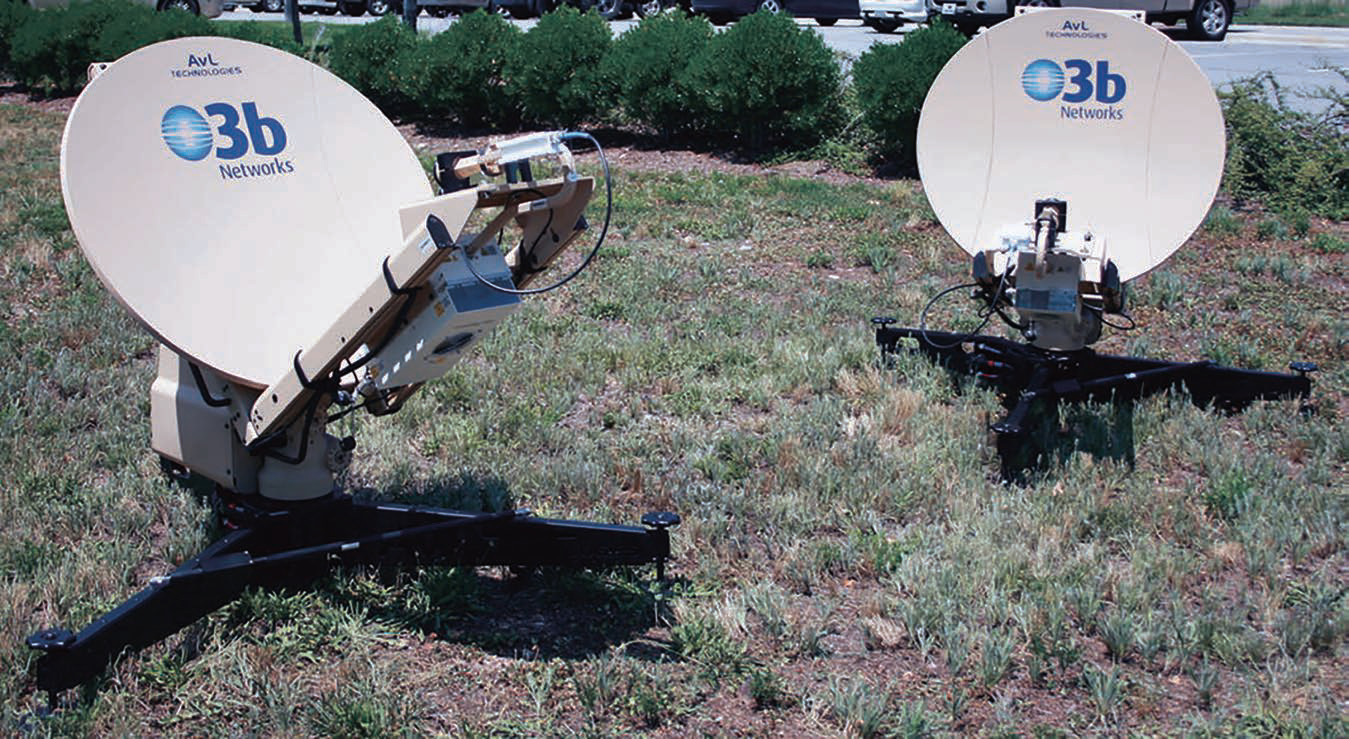
Ka-band sits in the sweet spot between those forces. The short wavelength lets you build compact, high-gain antennas that produce very narrow beams - a 1-meter Ka-band antenna has a beamwidth of roughly 1 degree, while a C-band antenna of the same size would be nearly 6 degrees wide. A narrow beam has two enormous advantages: you can concentrate more power toward the user, and you can reuse the same frequency in nearby spots on the ground without interference. Modern Ka-band satellites use hundreds or thousands of spot beams, each covering a small geographical area, and the system can reuse the same frequencies in non-adjacent beams to multiply effective capacity.
The challenge is the atmosphere. Water vapor and oxygen both absorb Ka-band signals more than they do signals at Ku or C band. Worse, raindrops are roughly the same size as Ka-band wavelengths, which is the worst-case geometry for scattering. “Rain fade” at Ka-band can reduce link availability by 10-20 decibels during heavy rainfall. Engineers compensate with adaptive coding and modulation - the modem downgrades the data rate automatically when the signal weakens - but sustained rain can still cause brief outages.
Why It Matters
Ka-band is the engine of the modern satellite broadband business. Starlink, OneWeb, Viasat, Hughes, Telesat, Eutelsat Konnect, and Kuiper all operate primarily in Ka-band for user links. The reason is capacity. Older Ku-band satellites could deliver a few tens of Gbps of aggregate throughput across their footprints. Modern Ka-band high-throughput satellites deliver hundreds of Gbps, and the largest systems now exceed a terabit per second per spacecraft.
The narrow-beam approach also enables flexible service. A Ka-band satellite with an electronically steerable array can shift capacity to where demand is: more beams over a cruise ship route during tourist season, more beams over a disaster zone after a hurricane, more beams over rural markets while their nighttime population is online. This is what people mean when they say modern satellites are “software-defined.”
The military uses Ka-band for the same reasons plus one more: directionality. A narrow beam is harder to intercept or jam because an adversary has to be inside the beam footprint to receive it. The U.S. Department of Defense’s Wideband Global SATCOM (WGS) system uses Ka-band for high-capacity military links, and the Advanced Extremely High Frequency (AEHF) constellation pushes into even higher frequencies for protected strategic communications.
The Tradeoffs
Rain is the obvious cost, but it is not the only one. Ka-band pointing is tight. Because the beams are narrow, small pointing errors translate into big capacity losses. Satellite-to-ground links require precision attitude control on the spacecraft and accurate antenna pointing on the ground. Terminals need good GPS or inertial references, and on moving platforms (ships, aircraft, cars) they need actively tracked antennas.
Equipment is more expensive than older bands. Ka-band modems, amplifiers, LNBs, and reflectors require tighter manufacturing tolerances. In the early 2010s, a Ka-band user terminal cost two to three times what a Ku-band terminal cost. Starlink’s flat-panel phased-array user terminals brought Ka-band hardware costs down dramatically, but the underlying microwave components are still more demanding to manufacture than Ku-band equivalents.
Spectrum is also getting crowded. The ITU has allocated Ka-band for both fixed-satellite services and mobile-satellite services, and the rapid growth of LEO mega-constellations has triggered regulatory disputes between operators about which user classes deserve protected access. The FCC has been wrestling with how to balance Starlink, Kuiper, and Viasat in the same Ka-band allocations over the U.S. since 2020.
Fun Fact Space Nerds Might Not Know
The “Ka” in Ka-band does not stand for “kilo” or “kelvin” or any other K word. The original IEEE radar designation scheme used “K” for a band originally centered around 20-25 GHz. When engineers realized that water vapor absorption near 22 GHz made the center of this original K band almost useless, they split it: the lower half became “Ku” (K-under) and the upper half became “Ka” (K-above). So “Ka” is short for “K-above,” literally just a geographical label in the spectrum.
Looking Forward
Ka-band capacity is growing fast, and the constellation arms race is the reason. Starlink’s Gen 2 satellites each carry roughly 10x the capacity of Gen 1, Amazon’s Kuiper is targeting similar per-satellite numbers when deployment accelerates, and China’s Guowang and Qianfan systems have both filed for Ka-band allocations in the same orbital shells. The International Telecommunication Union spectrum coordinating meetings have become far more contentious than they were a decade ago, as the same slice of spectrum is being requested by operators representing many millions of users worldwide.
The push is also extending into higher bands. Q-band (33-50 GHz) and V-band (50-75 GHz) promise even more capacity but with even worse rain fade. Several operators have filed for V-band gateway links as a way to free up Ka-band for user traffic. The engineering challenge is immense - V-band components are still expensive and experimental - but the economic pull is strong enough that large constellations are placing big bets on it.
For KeepTrack users, Ka-band is invisible in the orbital catalog itself (satellites don’t glow in the radio spectrum), but the operational signature is easy to spot. Any LEO satellite cluster at around 550 km altitude, in inclinations between 53 and 97 degrees, is almost certainly part of a Ka-band broadband constellation. Zoom into Starlink, Kuiper Phase 1, OneWeb, or Iridium Next in the catalog, and you are looking at the physical infrastructure of the Ka-band ecosystem.
References(5)
- IEEE Standard Letter Designations for Radar-Frequency Bands - IEEE 521-2019
- Ka-Band Spectrum Allocations - ITU Radio Regulations 2020
- Rain Attenuation at Ka-Band - ITU-R Recommendation P.618-13
- SpaceX Starlink Gen 2 FCC Filing - FCC IBFS File SAT-MOD-20200417-00037
- Satellite Communications - Timothy Pratt, 3rd Edition, 2019

Theodore Kruczek