· today in space history · 7 min read
The Day Superpowers Shared Space
Exactly 52 years ago today, the Soviet Union launched Soyuz 13 - a scientific mission that marked the first time American astronauts and Soviet cosmonauts orbited Earth simultaneously. Armed with a revolutionary ultraviolet telescope, Pyotr Klimuk and Valentin Lebedev would discover elements never before seen in distant nebulae.
The three members of Skylab 4 were in the middle of a three-month mission studying the effects of long-duration spaceflight on the human body. As they inadvertently photographed Earth - accidentally catching Area 51 in one of their images - they got news from back home: they were sharing the cosmos with another set of human souls. Skylab unintentionally overlapped with a different scientific mission (though the spacecraft never rendezvoused), carried out by a two-man crew aboard Soyuz 13, launched exactly 52 years ago today.
The Soviet Soyuz
Soyuz (Russian for “Union”) was a series of spacecraft designed by the Soviet Space Program and created by the Korolev Design Bureau. Initially tasked with sending a man to the moon, the ships were crafted with docking and long-term crew survival in mind.
The average Soyuz ship was composed of three modules, supplied with a generous amount of couches to support a three-person crew during launch and landing. These modules would stay together for launch and orbit, with only the descent module surviving re-entry. This seemingly simplistic design survived past its first launch in 1967 and is still used to carry trios of astronauts to the ISS - with current re-entry of the spacecraft being affectionately described as a car crash at best.
Soyuz got off to a rough start, failing its mission of besting America in reaching the pale surface of the moon, costing the Soviet Union the space race. Its name remains soaked in blood: cosmonaut Vladimir Komarov died on the very first crewed launch of Soyuz after the parachute failed to unfurl during deorbiting, and three other cosmonauts died in 1971 on Soyuz 11. No longer in a race for the moon and not looking to turn the program into military reconnaissance, the series of future Soyuz spacecraft pivoted to being used as shuttles to dock astronauts to space stations.
The Orion Layout
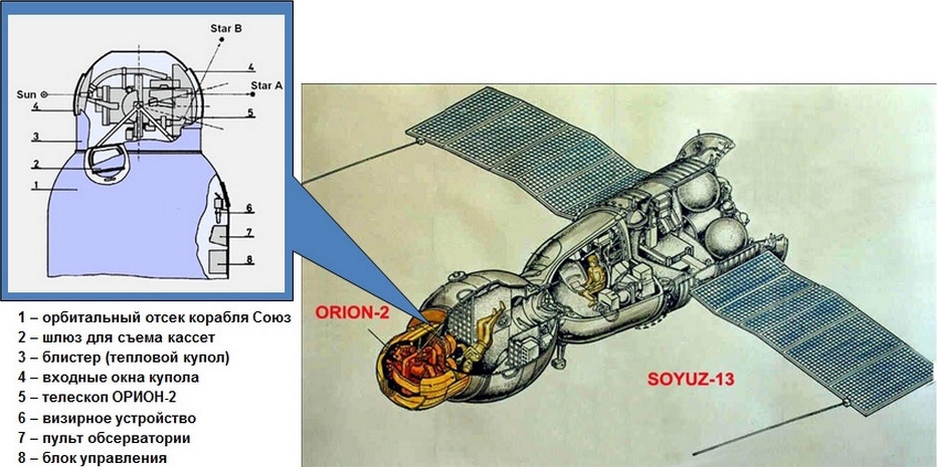
The venture of Soyuz 13 (codename Kavkaz, meaning “Caucasus”) was one of the steps in the rebranding of Soviet space initiatives, following up on the uplifting success of Soyuz 12. This launch aimed to fly and operate Orion-2, a telescope with three spectrographs used for ultraviolet stellar photography.
The three-module spacecraft design described earlier had to be modified to accommodate the telescope. Because this flight did not have a docking objective, the docking mechanism was sacrificed for the telescope, which was mounted under an unpressurized thermal cupola. The telescope had shutters that could open and close it for observation, and it could be maneuvered to point at targets by the crew. These changes limited the amount of time Soyuz could spend in orbit to ten days.
Crew Selection Drama
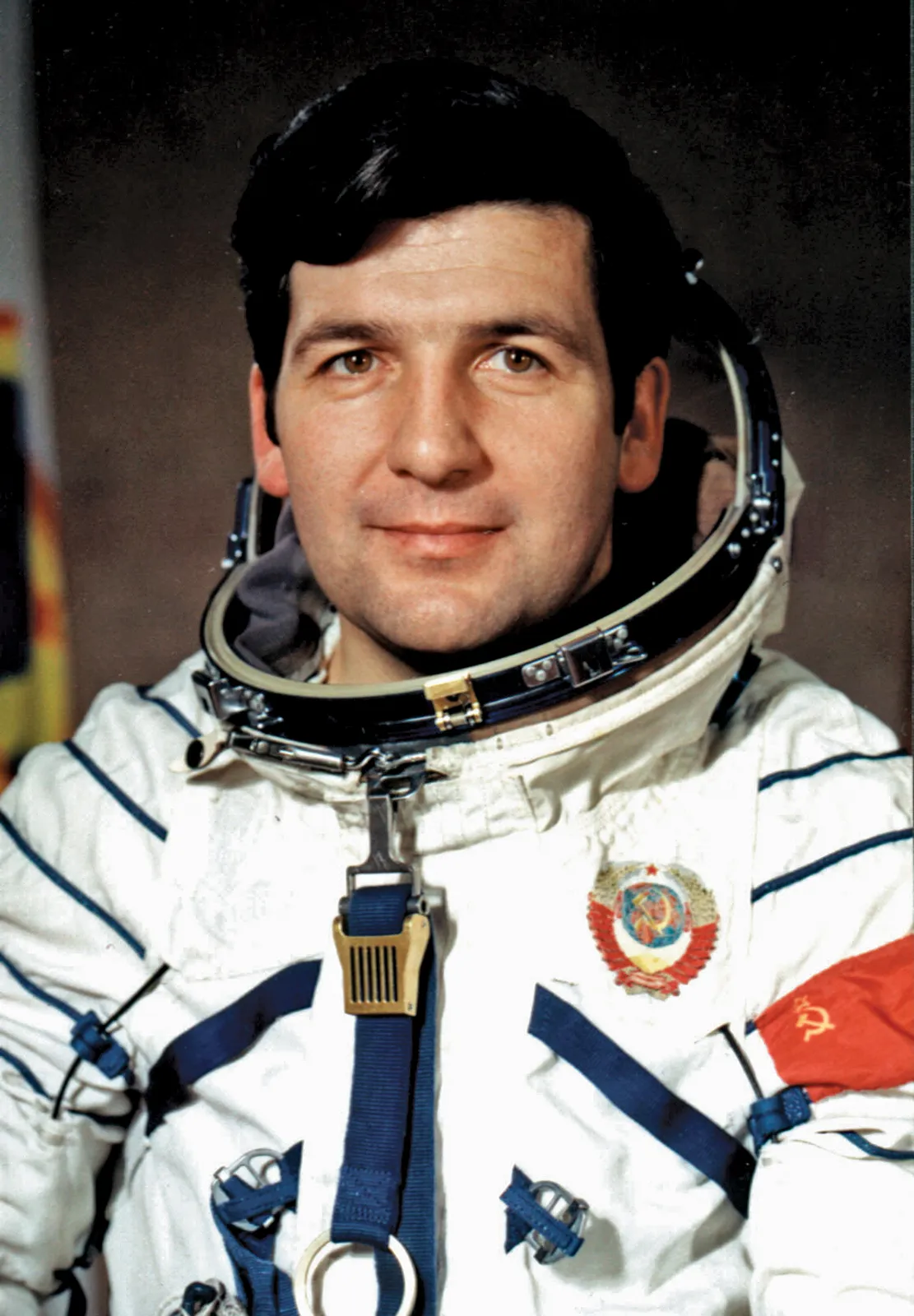
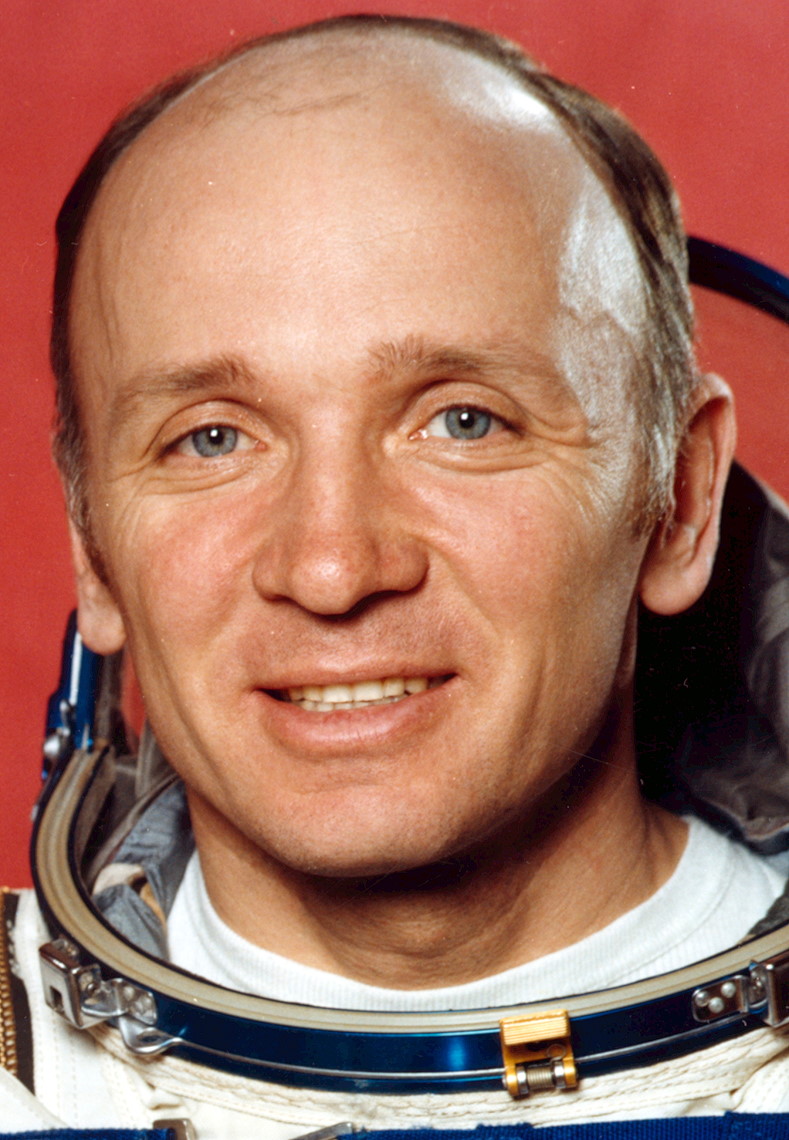
The precedent for space crews in the Soviet Union was that commander roles were filled by military pilots. The initial crew selection for the two pairs of cosmonauts was unusual - consisting of a mix of military and civilian personnel, which was rare at the time. A rearrangement of roles ended with the two crews of Lev Vorobyov (military pilot) paired with Valery Yazdovsky (civilian engineer), and Pyotr Klimuk (military pilot) with Valentin Lebedev.
An issue arose between Vorobyov and Yazdovsky, who had conflicting personalities. Lebedev commented on this, saying that “Each of them was conscientious in their training, but when these people were brought together in one crew, their strengths turned into ambitions that began to hinder their teamwork. They went down the path of ‘tug-of-war,’ trying to figure out who was more important in the crew and disregarding each other’s opinions.”
Klimuk and Lebedev were appointed the primary crew after it was deemed that Vorobyov and Yazdovsky were unable to work together. The latter pair would never receive another chance to see the stars.
Cabbage and Space Photography
The 48-meter rocket, propped up on the Baikonur Cosmodrome in Kazakhstan, was ready for launch. Lebedev, however, was not. He had caught a cold during the farewell ceremony a few days prior. Although he took his fever medication responsibly, he also took a shot of alcohol right before boarding the spacecraft. Okay, no one really flew under the influence - the alcohol was used to mask the medication he had taken so as to not be pulled from the flight due to medical concerns. At 11:55 UTC on December 18, 1973, Soyuz 13 tore through the atmosphere with a liftoff thrust of 4,456 kilonewtons. The rocket was set to circle Earth in its low orbit, with a hefty list of objectives set before the crew for the week-long flight.
Medical experiments studying the brain were conducted to see how blood flow to the organ varies before and after physical strain. An ecological experiment also took place, analyzing protein harvested in cabbage growing in space using the Oasis-2 closed ecology system - reportedly yielding 30 times the original biomass. These experiments took up a good chunk of the cosmonauts’ time, but still served as a side piece to the observations made with Orion-2. The crew conducted 16 observation sessions in total, capturing tens of thousands of spectra of various stars.
The spectrographs gathered from this mission were nothing short of extraordinary. The first ultraviolet reading of IC 2149 (a planetary nebula in the constellation Auriga) was recorded, discovering the presence of aluminum and titanium within - elements not previously observed in objects of that type. Earth’s atmosphere and surface conditions were also studied with a multispectral camera; these findings were used to analyze the effects of pollution on the environment.
A silicon star and a group of dim stars near Capella were all discovered during this mission, and a new system for classifying these celestial objects was proposed based on the ultraviolet spectrogram data. Mission reports concluded that the data collected in just a few days of the mission was enough to keep scientists busy analyzing it for ten years.
The crew landed safely in Kazakhstan amid a snowstorm on December 26 after orbiting Earth 127 times.
Launch
Soyuz 13 lifts off from Baikonur at 11:55 UTC
Scientific Operations
16 observation sessions with Orion-2; 10,000+ stellar spectra captured
Landing
Safe touchdown 200 km SW of Karaganda amid heavy snowstorm
Scientific Victory
The flight was an all-around scientific success. Technologically speaking, the modifications on the spacecraft were a first for the Soviet Space Program. The usage of a telescope, solar panels, and the detachment of a docking module were hard to pull off.
The ship was controlled from the Kaliningrad Mission Control Center - just the second Soyuz spacecraft to go through this new facility after Soyuz 12 three months earlier. The very same facility’s modern control rooms are currently keeping a watchful eye on the Russian segment of the ISS.
The space explorers on the ship would go on to have successful careers after the flight. They both stuck with the Soyuz program, with Klimuk commanding Soyuz 18 and Soyuz 30, setting a new Soviet endurance record by spending 63 days aboard Salyut 4 on the former mission. He shared his knowledge by training young cosmonauts at the Yuri Gagarin Cosmonaut Training Center, and his career expanded past space when he served as an advisor to the president of Belarus.
Lebedev shattered the Soviet record set by his crewmate by spending 211 days in space aboard Salyut 7, conducting over 300 scientific experiments. He continued an extensive and rigorous career in science by authoring textbooks and directing the scientific Geoinformation Center of the Russian Academy of Sciences.
A hopeful tale of scientific observation rooted in photography of celestial details unseen to the naked eye, Soyuz 13 remains a bright chapter in space history - and a reminder that even at the height of Cold War tensions, the cosmos was big enough for both superpowers to explore.

Mariana Mokhova