· today in space history · 12 min read
The Day the Soviets Built a World in Orbit
Forty years ago today, the USSR launched a 20-ton aluminum cylinder into low Earth orbit and called it 'Peace.' Over the next 15 years, Mir would host 104 people from 12 countries, survive a fire and a collision, and quietly teach humanity how to live in space.
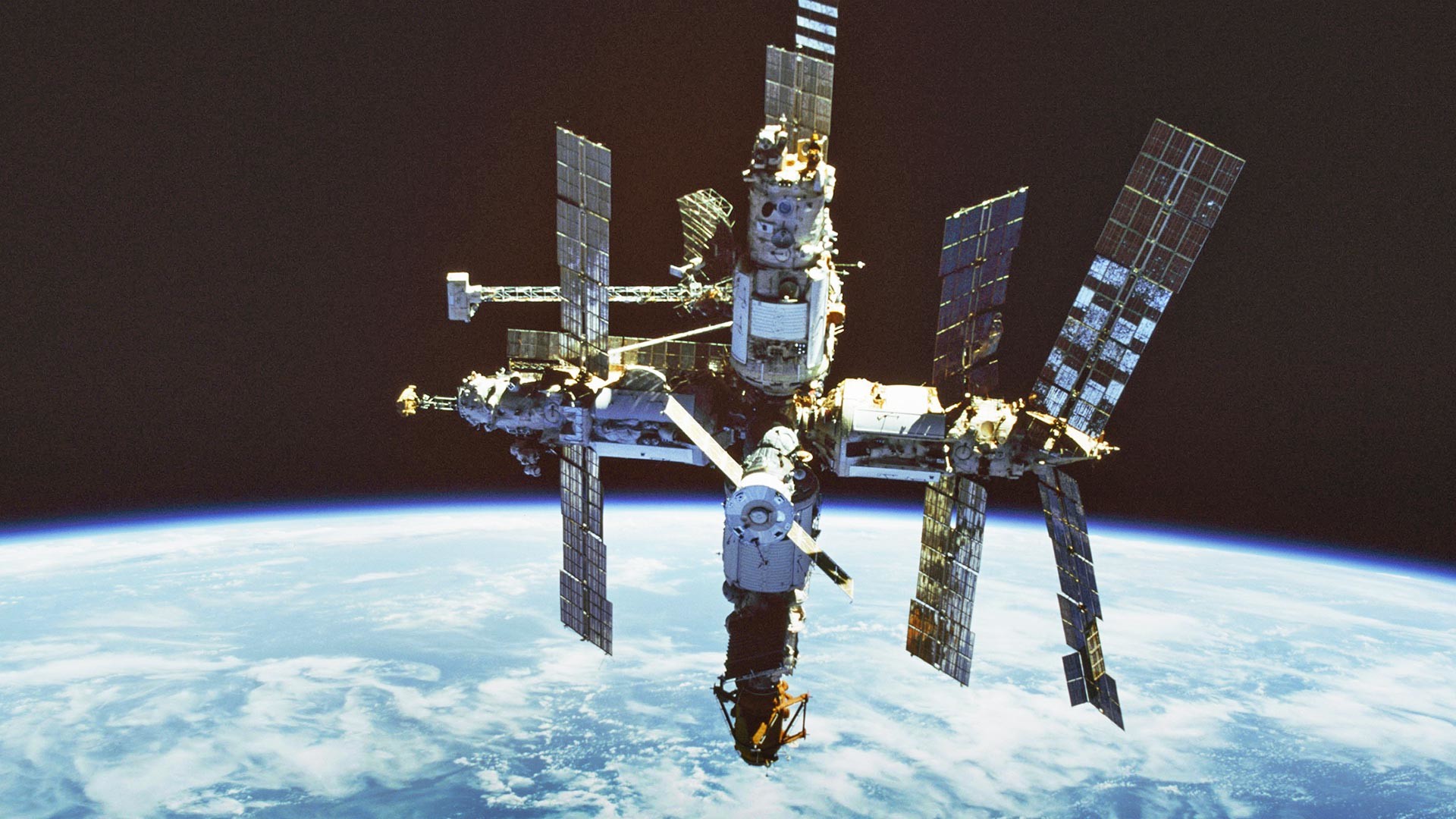
Mir is the Russian word for both “world” and “peace.” It was a fitting name for what the USSR was about to launch - not just a space station, but a diplomatic statement bolted to a Proton rocket. The massive conglomerate of astrophysics equipment, life support systems, and cramped living quarters designed to host human life for months at a time left the pad at Baikonur Cosmodrome in Kazakhstan exactly 40 years ago today, on February 19, 1986.
What went up that day was just the beginning - the base block, or core module, of what would become a much larger orbital complex. It carried the essentials: living quarters, life support, communications, and a control center. Enough to keep the lights on and the air breathable while the Soviets figured out the rest.
The launch itself almost didn’t happen on schedule. A first attempt on February 16 was scrubbed when spacecraft communications failed. Three days later, at 21:28 UTC, the Proton-K rocket successfully delivered the 20-ton core module into a 172-by-301-kilometer orbit, meeting a political deadline set by the upcoming 27th Communist Party Congress. Just nine minutes after liftoff, the module achieved orbit and unfurled its antennas and two solar arrays, beginning what would become a 15-year operational life - three times longer than its five-year design specification.
That’s the Soviet space program in a nutshell: build it tough, launch it under political pressure, and watch it outlive everyone’s expectations.
The Anatomy of Mir
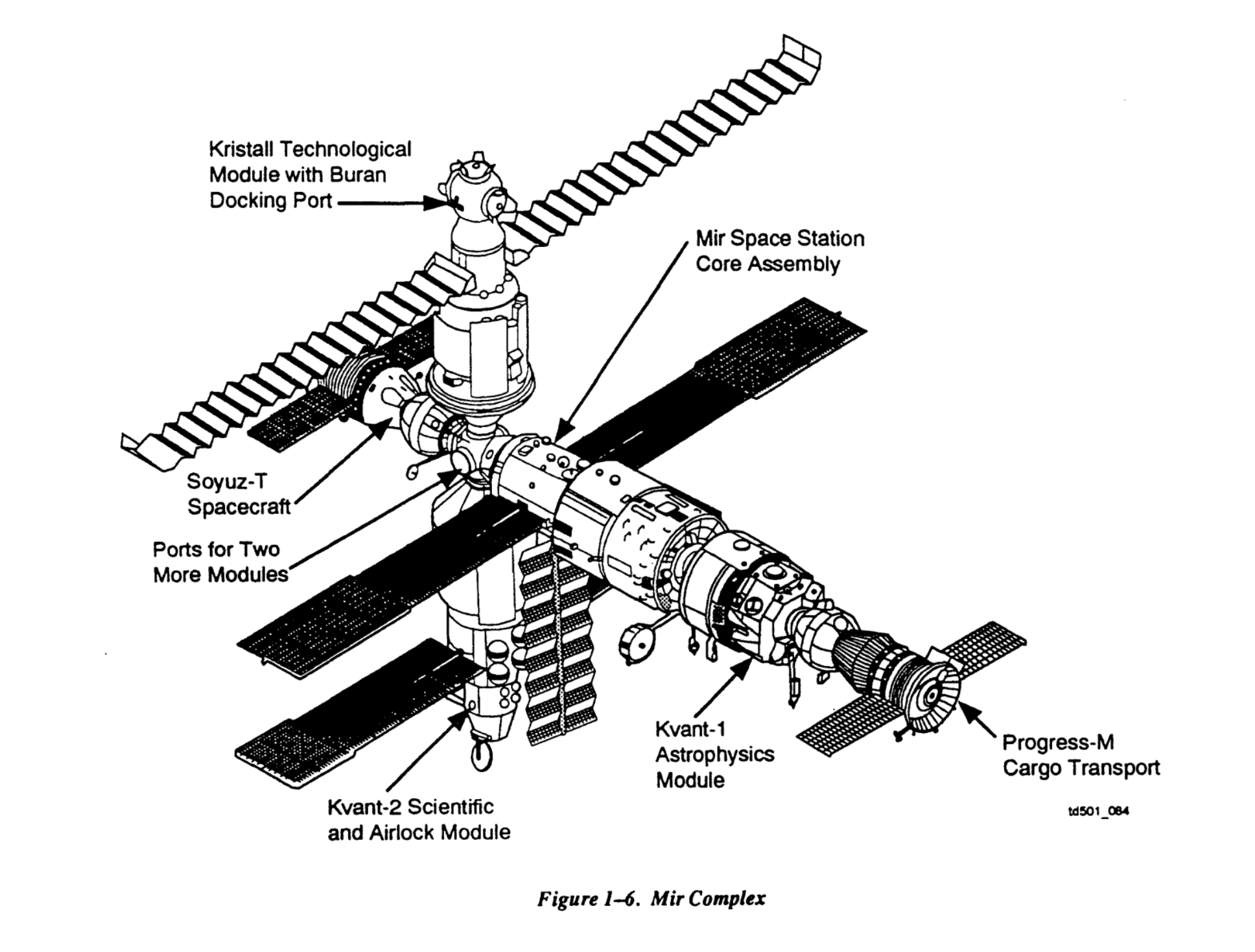
Mir was the third generation of Soviet space stations, and it represented a genuine leap forward from the Salyut program that preceded it. Where Salyut stations had limited docking ports - typically just two, one at each end - Mir introduced a revolutionary modular design. The core module featured six docking ports: one aft, one forward axial, and four radial ports arranged in a spherical compartment at the forward end. This meant Mir could grow.
And grow it did. Over the next decade, five expansion modules were added to the core, each launched independently on its own Proton-K rocket. Kvant-1 arrived in March 1987, carrying instruments for astrophysics experiments - X-ray telescopes and ultraviolet detectors pointed at the cosmos. Kvant-2 followed in 1989, and its addition gave the station an unbalanced L-shape that looked a bit like someone had parked a bus perpendicular to another bus. But that awkward geometry came with a critical upgrade: an airlock that enabled EVA (Extravehicular Activity) capability, making complex spacewalks and the deployment of external scientific equipment far more practical.
Kristall docked in 1990, bringing materials science experiments and, crucially, a docking port that would later be modified to receive American Space Shuttles. Spektr arrived in 1995, carrying remote sensing instruments for Earth observation - though its origins were far more secretive, having started life as part of a classified military program codenamed “Oktant” that included experimental optical telescopes and even launchers for artificial targets. Priroda, the final major module, was installed in 1996 for Earth remote sensing.
Spektr’s story would take a dramatic turn in June 1997, when the Progress M-34 cargo spacecraft slammed into one of its solar arrays during a manual docking test using the TORU remote control system. Commander Vasily Tsibliev was guiding Progress toward the station via a video monitor, but the telemetry data he needed to gauge the spacecraft’s speed and distance had been switched off as part of the test protocol. By the time he could see Progress in his monitor, it was coming in far too fast to stop. The impact punctured Spektr’s hull, and the crew - Tsibliev, flight engineer Alexander Lazutkin, and NASA astronaut Michael Foale - felt the pressure change in their ears almost immediately, accompanied by a loud hissing. Foale initially retreated to the Soyuz escape capsule, then returned when he realized his crewmates were fighting to save the station rather than evacuating. Lazutkin, with Foale’s help, managed to sever the power cables routed through Spektr’s hatchway and seal the module before the entire station depressurized. Mir lost roughly half its electrical power in the process. Spektr was never reopened to shirtsleeve access again.
Getting There and Back
The workhorse spacecraft that ferried crews to Mir was the Soyuz - specifically the upgraded Soyuz-T and later the Soyuz-TM variants. These were essentially space taxis: three-person capsules composed of an orbital module, descent module, and instrumentation module that stayed together for launch and orbital operations, with only the descent module surviving the fiery return through Earth’s atmosphere. Current cosmonauts still ride updated versions of this basic design to the ISS, and the re-entry experience is affectionately described by those who’ve endured it as something between a car crash and a tumble down a rocky hillside.
Because Soyuz was specialized for crew transport, a different vehicle was needed for hauling cargo. Enter Progress - an uncrewed variant derived from the Soyuz design, with the descent module replaced by additional cargo space and fuel tanks. Progress spacecraft are still in service today, regularly delivering supplies to the ISS. The lineage runs directly from Mir to the present.
Life Aboard the Station
Mir was, in many ways, the first real orbital home. Over 100 people lived and worked there across its 15 operational years, with stays lasting up to six months for principal expedition crews. The station was small - the core module was roughly 13 meters long and 4 meters in diameter, about the size of a railway carriage - and every system had to work around the fundamental challenge of keeping humans alive in a place that was trying very hard to kill them.
The life support systems were ingenious, if occasionally unappetizing. The Elektron system performed electrolysis on reclaimed water to generate breathable oxygen, supplemented by solid-fuel oxygen generators - perchlorate canisters that produced oxygen through chemical reaction. (These canisters would later be implicated in a serious fire aboard the station in February 1997, when one burned uncontrollably for about 14 minutes, spraying molten metal and filling the station with thick smoke. The crew extinguished it without injuries, but the incident led to significant safety improvements.) Urine was collected, sanitized, vaporized, and distilled through the water reclamation system. Teeth were brushed twice a day with a specially designed electric toothbrush that used forced water and suction to manage debris in microgravity. Nail clippings and hair were carefully suctioned to a deodorizer to keep them from floating into equipment or, worse, someone’s lungs.
These details might sound mundane, but they mattered enormously. Grooming routines weren’t just about hygiene - they were psychological anchors. The daily procedures grounded the crew in an environment where even gravity didn’t. Mir’s designers understood this. The station was divided into distinct areas for work and living, with privacy cabins and sleeping bags velcroed to the walls. Recreation space was provided, though most of the crew’s waking hours were consumed by experiments, maintenance, and the one non-negotiable daily task: exercise, essential to prevent the bone density loss and muscle atrophy that microgravity inflicts on the human body.
Penguin Suits and Cuban Boots
Keeping astronauts healthy in space went well beyond prevention through hygiene. Mir carried radiation monitoring equipment and emergency medical supplies, backed by a robust bioscientific research program that produced some genuinely creative solutions to the problem of bodies slowly deteriorating in zero gravity.
Core Module Launched
Proton-K delivers the 20-ton base block to orbit from Baikonur Cosmodrome
First Crew Arrives
Kizim and Solovyov dock Soyuz T-15, becoming Mir's first occupants for 51 days
Kvant-1 Docks
First expansion module adds astrophysics research capability
First Year in Space
Titov and Manarov return after 366 days, setting a new endurance record
Polyakov Returns After 438 Days
Sets the single-spaceflight endurance record that still stands today
Progress-Spektr Collision
Progress M-34 crashes into Spektr module during manual docking test, puncturing the hull
Controlled Deorbit
Mir makes its final descent, with surviving fragments falling into the South Pacific
Several specialized garments were designed to counteract different aspects of physical deterioration. The “Penguin” suit - and yes, that was its actual name - applied a passive load on antigravity muscle groups, including lower limb extensors, trunk extensors, and hip extensors. Cosmonauts wore it 12 to 16 hours a day, essentially turning every waking moment into a low-grade workout. The “Chibis” suit took a different approach, applying negative pressure to the lower body to counteract the upward fluid shift that occurs in microgravity, helping maintain proper blood distribution and cardiovascular conditioning. These were worn for about 20 minutes once every four days.
Then there was the “Cuban boot” - a device that applied pressure to the soles of the feet to simulate the sensation of standing. This wasn’t just about comfort; the pressure helped reduce spatial disorientation and motion sickness by giving the vestibular system a familiar reference point. Head restraints - essentially caps with cords attached to the shoulders - further reduced unwanted head movement that could trigger nausea.
None of this was glamorous. But it worked well enough to keep people functional in space for months and, in one extraordinary case, well over a year.
The People Who Called Mir Home
The cosmonauts Leonid Kizim and Vladimir Solovyov were the first humans to set foot inside Mir. Launched aboard Soyuz T-15 on March 13, 1986, they docked with the station two days later and spent 51 days bringing its systems online, unloading Progress cargo vehicles, and generally turning a cold, dark cylinder into a functioning space station. Their mission was remarkable for another reason: instead of heading straight home, they undocked from Mir and flew their Soyuz to the older Salyut 7 station, co-orbiting some 4,000 kilometers away. They spent 50 days there performing spacewalks, retrieving experiments, and testing a girder construction device before returning to Mir with 400 kilograms of equipment - including, reportedly, a guitar. It remains the only station-to-station crew transfer in history.
Mir’s second long-duration crew arrived in February 1987: Yuri Romanenko and Alexander Laveykin aboard Soyuz TM-2. Romanenko would go on to set an endurance record of 326 days, broken the following year by Vladimir Titov and Musa Manarov, who launched in December 1987 and didn’t come home until December 1988 - 366 days later. During that year in orbit, they conducted some 2,000 experiments across meteorology, psychology, and space technology, hosted visiting crews, performed EVAs to repair solar arrays and telescopes, and returned to Earth alongside French astronaut Jean-Loup Chrétien.
But the undefeated record belongs to Valeri Polyakov, a physician-cosmonaut who spent 438 consecutive days aboard Mir between January 1994 and March 1995. Polyakov had volunteered for the marathon mission specifically to prove that humans could survive a round-trip to Mars and still function on arrival. When he landed, he insisted on walking from the Soyuz capsule to a nearby chair under his own power - a deliberate demonstration that long-duration spaceflight didn’t have to leave you incapacitated. His record still stands.
A Bridge Between Worlds
Mir’s guest list read like a United Nations roll call. Abdul Ahad Momand from Afghanistan visited in 1988 as part of the Intercosmos program, spending nine days aboard the station and becoming the first Afghan in space - a mission freighted with political symbolism during the Soviet-Afghan War. Klaus-Dietrich Flade from Germany flew in 1992. Toyohiro Akiyama, a Japanese journalist, became the first commercial space traveler when he visited in 1990. Jean-Loup Chrétien from France made multiple visits. Helen Sharman from England arrived in 1991, becoming the first Briton in space.
All told, 104 people from 12 countries visited Mir during its operational life, conducting thousands of experiments in fields ranging from astrophysics to materials science to human physiology. The station hosted 28 long-duration expeditions and 77 spacewalks. Anatoli Solovyev alone completed 16 EVAs from Mir, totaling over 78 hours outside the station - a spacewalking record.
But Mir’s most lasting contribution may have been diplomatic rather than scientific. In the years following the collapse of the Soviet Union, the station became a bridge between former Cold War adversaries. The Shuttle-Mir program of the 1990s brought American astronauts aboard for extended stays, and the operational lessons learned - about docking procedures, life support integration, crew coordination across language barriers, and the sheer logistics of running a multinational space station - directly informed the design and operation of the International Space Station.
Mir’s modular construction philosophy became the blueprint for the ISS. Systems tested aboard Mir are still in use in long-duration spaceflight today. China’s Tiangong and Tianhe space stations also trace their design heritage back to Mir’s architecture.
The station was deliberately deorbited on March 23, 2001, guided to its final descent by a Progress spacecraft. Its surviving fragments fell into the South Pacific, ending 15 years of operations that had far exceeded every original expectation. Mir had lasted three times longer than its five-year design specification, survived a fire that nearly filled the station with toxic smoke and a hull breach that came perilously close to forcing evacuation, and hosted more people than any previous spacecraft.
It had also proved something that no amount of theoretical planning could: that humans from different countries, speaking different languages, trained in different traditions, could live and work together in a tin can hurtling around the Earth at 27,700 kilometers per hour. That lesson - more than any individual experiment or endurance record - is what made the International Space Station possible.
For a station named “Peace,” it delivered.
References(8)
- 35 Years Ago: Launch of Mir Space Station's First Module - NASA History
- Mir Space Station Overview - Britannica
- Mir FAQs: Facts and History - European Space Agency
- Soyuz T-15 Mission Details - Wikipedia
- Valeri Polyakov Obituary: Cosmonaut Who Logged Longest Space Mission - Space.com
- Progress Collision with Spektr Module - NASA System Failure Case Studies
- Vladimir Titov and Musa Manarov 366-Day Mission - UPI Archives
- Mir Space Station - Wikipedia

Mariana Mokhova