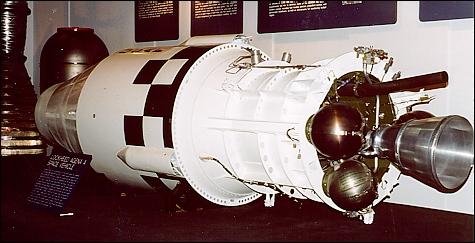
· today in space history · 11 min read
The Bomb That NASA Built by Accident
An overlooked thermostat, eight hours of overheating on a Florida launch pad, and 200,000 miles of coasting through deep space. Then Oxygen Tank No. 2 tore itself apart, and three men had to figure out how to come home alive in a spacecraft designed to land on the Moon.
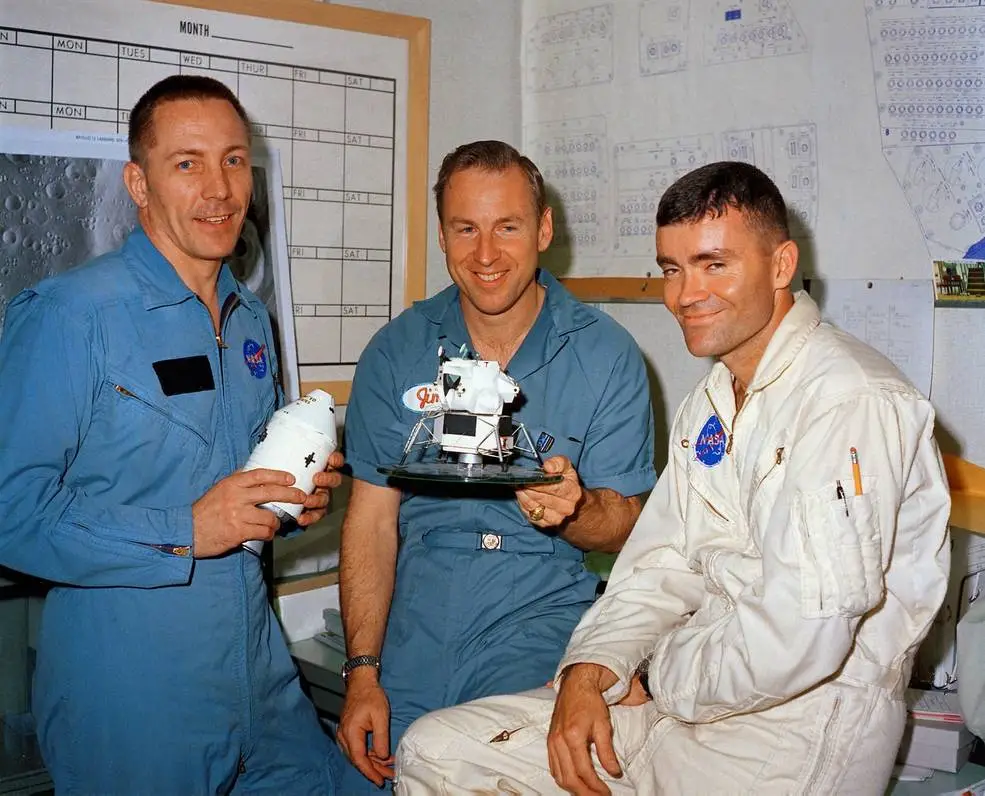
At 9:08 PM Central Standard Time on April 13, 1970, astronaut Jack Swigert flipped a switch in the service module of the spacecraft Odyssey, 200,000 miles from Earth. The switch activated a set of fans inside Oxygen Tank No. 2, a routine procedure that had been performed on every Apollo mission without incident. The fans were supposed to stir the supercritical oxygen inside the tank to prevent stratification and give the quantity sensors an accurate reading.
Instead, damaged electrical wires inside the tank sparked. The spark ignited Teflon insulation that had been baked into brittleness by an event nobody remembered: eight hours of overheating during a ground test at Kennedy Space Center four weeks earlier. The fire raised the pressure inside the sealed tank until, sixteen seconds after Swigert flipped the switch, the tank ruptured. The explosion blew out an entire panel of the service module, severed fuel cell lines, and began venting Oxygen Tank No. 1 into the vacuum of space.
Twenty-six seconds after the bang, Swigert keyed his microphone. “Okay, Houston, we’ve had a problem here.”
Commander Jim Lovell repeated it for clarity: “Houston, we’ve had a problem. We’ve had a Main B Bus undervolt.”
It was a staggeringly composed way to announce that three human beings were now dying in the most isolated place anyone had ever been - farther from home than any crew before or since. Their spacecraft was bleeding out and there was no rescue ship within a quarter-million miles.
The Bomb on the Launch Pad
The story of Apollo 13’s near-catastrophe doesn’t begin in space. It begins five years earlier, in a Beech Aircraft factory in Boulder, Colorado, where the oxygen tanks for the Apollo service module were manufactured.
In 1965, NASA had upgraded the command and service module’s electrical system from 28 volts to 65 volts DC for ground power operations at Kennedy Space Center. The modification touched virtually every component except the thermostatic safety switches inside the oxygen tank heaters. Those switches, built by Beech Aircraft, were rated for 28 volts. At 65 volts, they would weld themselves shut instead of opening to cut power when temperatures climbed too high. Nobody caught the oversight. The discrepancy was documented nowhere in the engineering change records. It simply fell through the cracks.
The specific tank that would fly on Apollo 13, designated O2 Tank No. 2 (serial number 10024XTA0009), had its own troubled history. It had originally been installed in the service module for Apollo 10. During a modification at the North American Rockwell factory in Downey, California, a shelf holding the tank was accidentally dropped about five centimeters. Inspections showed no obvious damage, but the jolt likely loosened a fill tube inside the tank. The tank was removed from Apollo 10’s service module and eventually reassigned to Apollo 13.
Then came the countdown demonstration test at Kennedy Space Center, beginning March 16, 1970, less than a month before launch. As part of the standard procedure, the cryogenic tanks were filled with liquid oxygen and then drained. Oxygen Tank No. 1 emptied normally. Tank No. 2 would not drain. The loosened fill tube was almost certainly the culprit, but rather than pull the tank and delay the mission by weeks, engineers decided to boil off the remaining oxygen using the tank’s internal heaters.
The heaters ran for eight hours on 65-volt ground power. The thermostatic switches, rated for 28 volts, welded shut almost immediately. Without the switches to limit temperature, the heaters drove the internal temperature above 540 degrees Celsius, nearly 1,000 degrees Fahrenheit. The Teflon insulation on the internal wiring charred and cracked. The temperature gauge on the control panel, designed to read only up to 29 degrees Celsius, showed nothing unusual. The technician monitoring the procedure saw only normal readings.
When the boil-off was complete, Oxygen Tank No. 2 was certified flight-ready. Nobody knew it was a bomb.
A Crew Assembled in Haste
The crew that rode this bomb into space wasn’t even the crew that had trained for the mission. Commander Jim Lovell was one of the most experienced astronauts alive. He had flown Gemini 7, Gemini 12, and Apollo 8, the first mission to orbit the Moon. Fred Haise, the lunar module pilot, was a rookie making his first spaceflight. But the command module pilot was supposed to be Ken Mattingly, not Jack Swigert.
Apollo 13 launched without incident on April 11, 1970, at 2:13 PM Eastern from Pad 39A at Kennedy Space Center, the same pad that had launched Apollo 11 nine months earlier. The only anomaly during ascent was a premature shutdown of the center engine on the S-II second stage, caused by pogo oscillations, longitudinal vibrations in the engine’s thrust structure. The remaining four engines burned longer to compensate. Lovell, who had already orbited the Moon on Apollo 8, was relaxed. The mission was proceeding normally. The crew was scheduled to enter the lunar module Aquarius the next day for a routine inspection.
At 55 hours, 54 minutes, and 53 seconds into the mission, Swigert stirred the tanks.
Four Days in the Lifeboat
The explosion crippled the service module so thoroughly that the command module Odyssey, the only part of the spacecraft with a heat shield capable of surviving reentry, had only about fifteen minutes of battery power remaining. Those batteries were the crew’s sole means of surviving reentry. They could not be wasted.
Flight Director Gene Kranz made the call that would define the mission: power down Odyssey completely and transfer the crew to the lunar module Aquarius. Aquarius had its own oxygen supply, its own batteries, its own life support. It had been designed to keep two men alive on the surface of the Moon for 33 hours. Now it would need to keep three men alive for nearly four days on a quarter-million-mile detour around the Moon.
The problems cascaded immediately. Aquarius was designed for two crew members, not three. Its lithium hydroxide canisters, which scrubbed carbon dioxide from the cabin air, would be exhausted long before the crew could reach Earth. Odyssey had plenty of spare canisters, but they were square. Aquarius’s receptacles were round. On the ground, engineers improvised a jury-rigged adapter using materials available aboard the spacecraft: cardboard from procedure manuals, plastic bags, and duct tape. The crew built the device - later nicknamed “the mailbox,” from instructions read up by Mission Control. It worked.
Launch from Pad 39A
Apollo 13 lifts off from Kennedy Space Center. Center engine shuts down early due to pogo oscillations; four remaining engines compensate.
Oxygen Tank Explosion
Swigert stirs O2 Tank No. 2 at 55:54:53 mission elapsed time. Tank ruptures 16 seconds later. Service module panel blown off; O2 Tank No. 1 begins venting.
Crew Transfers to Aquarius
Odyssey powered down to preserve reentry batteries. Lovell, Swigert, and Haise move to the lunar module, designed for two people.
Closest Approach to the Moon
Apollo 13 passes 254 km above the lunar far side - the farthest humans have ever been from Earth at 400,171 km. A PC+2 burn adjusts the trajectory for a faster return.
Splashdown in the Pacific
Odyssey splashes down within sight of USS Iwo Jima. All three crew members recovered safely.
Water was the other crisis. Aquarius’s cooling system used water as a working fluid, and the spacecraft was consuming it faster than the timeline allowed. Mission Control ordered the crew to cut water rations to six ounces per person per day, about one-fifth of normal intake. The temperature in the cabin, with most systems powered down, dropped to near freezing. Condensation formed on every surface. The windows fogged. The crew, exhausted and dehydrated, could see their breath.
Navigation was another challenge. The explosion had released a cloud of debris that surrounded the spacecraft, making it impossible to sight navigation stars against the glittering backdrop of venting oxygen and insulation fragments. Lovell used the Sun as a reference instead, manually aligning the spacecraft for the critical engine burns that would thread them onto a trajectory that intersected the Pacific Ocean recovery zone.
The Farthest Humans Have Ever Been
At 12:21 AM on April 15, Apollo 13 passed behind the Moon at an altitude of 254 kilometers above the far side. At that moment, the crew was 400,171 kilometers from Earth - farther than any human being has ever traveled, before or since. It is a record that stands fifty-six years later, one that nobody intended to set and nobody particularly wants to break.
Two hours after closest approach, with the spacecraft now on the return leg, Lovell fired Aquarius’s descent engine for four minutes and 23 seconds - the PC+2 burn, so named because it occurred two hours after pericynthion (closest approach to the Moon). The burn shifted their splashdown point from the Indian Ocean to the Pacific and shortened the return time by nine hours. Without it, the crew would likely not have survived. The lithium hydroxide supply and battery power would have run out.
I sometimes catch myself staring at the Moon, remembering the changes of fortune in our long voyage, thinking of the thousands of people who worked to bring the three of us home. I look up at the Moon and wonder, when will we be going back, and who will it be?
The final crisis came during reentry. After jettisoning the service module and getting their first look at the damage (which shocked even Lovell), the crew powered up Odyssey’s batteries, separated from Aquarius, and plunged into the atmosphere. The communications blackout was expected to last three minutes and ten seconds. It lasted over four and a half minutes. In Mission Control, the silence stretched past the expected acquisition time, and for eighty-seven agonizing seconds, nobody knew whether the heat shield had held.
Then Swigert’s voice crackled through: “Okay, Joe.” The command module was intact. At 1:07 PM Eastern on April 17, 1970, 142 hours and 54 minutes after launch, Odyssey splashed down in the South Pacific within sight of the recovery ship USS Iwo Jima. All three crew members were alive.
The Investigation and Its Lessons
The Apollo 13 Review Board, chaired by Edgar Cortright, director of NASA’s Langley Research Center, traced the failure to the 28-volt thermostat switches that had been overlooked during the 65-volt upgrade five years earlier. The board identified a cascading chain of failures: the overlooked thermostat specification, the dropped tank shelf at Downey, the stuck drain tube, and the decision to boil off oxygen with the heaters rather than replace the tank. Any one of these links, broken, would have prevented the accident.
NASA implemented sweeping changes to the oxygen tank design: a third tank was added to the service module, the internal wiring was changed from Teflon to stainless steel conduit, the heaters were removed entirely from the redesigned tanks, and thermostatic switches were upgraded to handle the correct voltage. The fan motors were also redesigned with stainless steel leads. No similar failure occurred on any subsequent Apollo mission.
Why “Successful Failure” Understates It
Apollo 13 is commonly called NASA’s “successful failure,” and the phrase has become so familiar that it’s lost its edge. What happened between April 11 and April 17, 1970, was not a feel-good story about teamwork, though the teamwork was extraordinary. It was a story about institutional failure: a thermostat specification lost in a bureaucratic transition five years before the mission, a damaged tank passed from one spacecraft to another because replacing it was inconvenient, a ground test procedure that cooked the tank’s wiring because nobody thought to check whether the gauges could actually read the temperatures involved.
That three men survived owes everything to the engineering margins built into the Apollo system and to the extraordinary competence of the people in Mission Control who improvised solutions in real time. But the accident itself was preventable at half a dozen points. The Review Board was blunt about this: the failure was not caused by a random malfunction but by a specific, traceable chain of human decisions.
Gene Kranz, the lead flight director during the crisis, later made this the centerpiece of his leadership philosophy. “Failure is not an option,” the phrase that became the title of his memoir, was not spoken during the mission. It was an attitude reconstructed in retrospect, a distillation of what the people in that room believed they were doing as they worked through the night to bring the crew home. The real lesson of Apollo 13 is simpler and harder: the failure had already happened, on a launch pad in Florida, weeks before anyone realized it. What happened in space was the consequence. What happened in Mission Control was the recovery.
Fifty-six years later, every spacecraft designer, every mission planner, every systems engineer who works on human spaceflight knows the story of the 28-volt thermostat and the 65-volt power supply. It is the canonical example of how a small oversight, compounded by time and circumstance, can cascade into catastrophe - and of how the right people, given enough information, can sometimes pull a crew back from the edge.
References(11)
- Apollo 13: Mission Details - NASA
- Detailed Chronology of Events Surrounding the Apollo 13 Accident - NASA History
- Apollo 13 Accident - NASA NSSDCA
- Apollo 13 Flight Journal - Day 6: The Blackout, Splashdown and Recovery - NASA History
- 50 Years Ago: Apollo 13 Crew Returns Safely to Earth - NASA History
- What Caused the Apollo 13 Accident? - Space.com
- Apollo 13 - The Planetary Society
- Apollo 13: Facts, Timeline & Movie - History.com
- A Case Study of the Failure on Apollo 13 - NASA Technical Reports Server
- Apollo 13 Oxygen Tank Explodes - History.com, This Day in History
- 13 MORE Things That Saved Apollo 13 - Universe Today

Theodore Kruczek