· today in space history · 9 min read
The Rocket That Refused to Sink
On April 18, 2014, a Falcon 9 first stage did something no orbital rocket had ever done before. It fired its engines on the way down, steered itself through the atmosphere using grid fins that did not yet exist, and touched the Atlantic Ocean softly enough to survive the impact. Nobody recovered it. The data was the whole point.
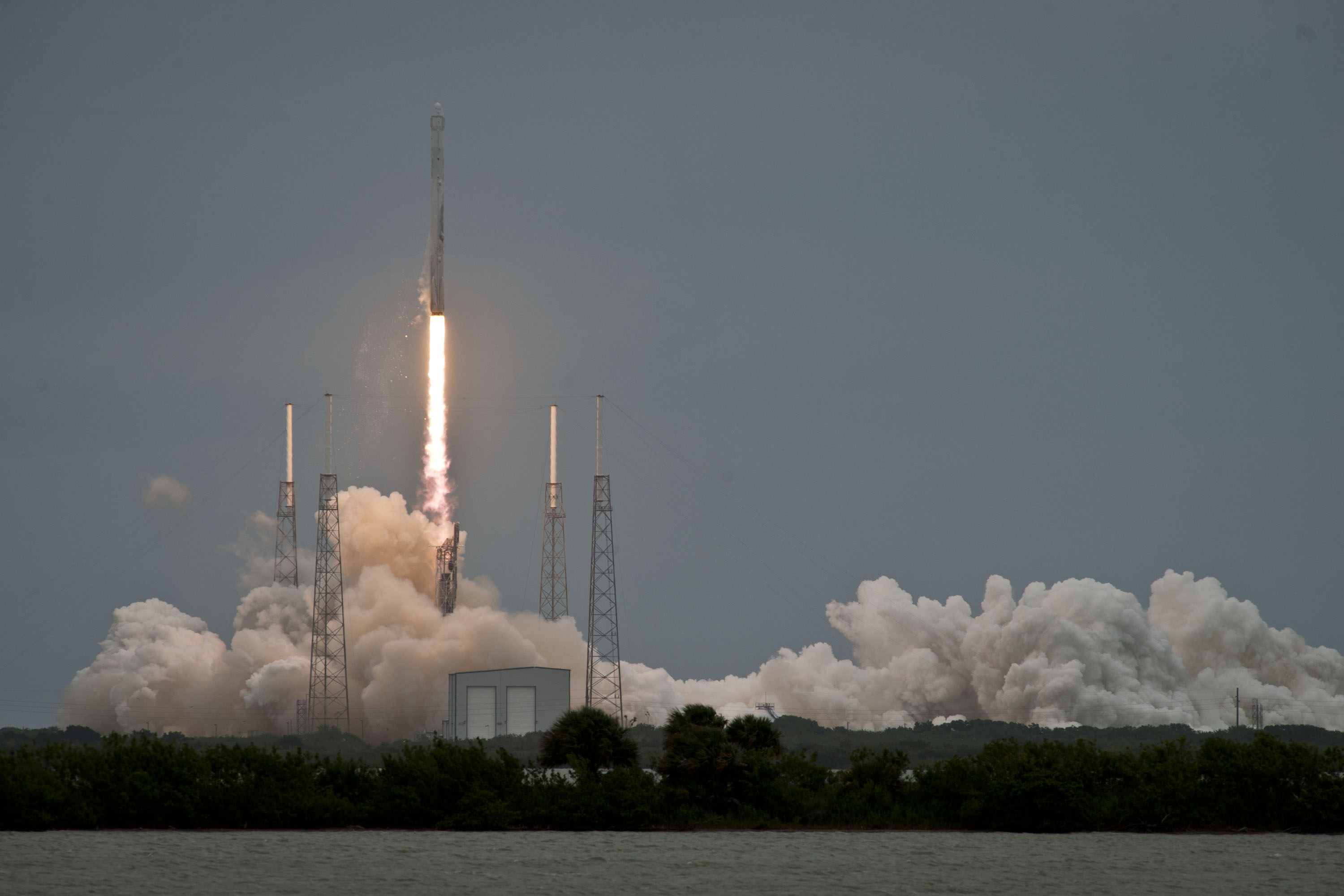
At 3:25 p.m. Eastern on April 18, 2014, a Falcon 9 lifted off from Cape Canaveral carrying a Dragon capsule stuffed with 2,268 kg of ISS cargo. A minute and forty seconds later, the rocket crossed through max-Q, the region where aerodynamic stress peaks. Another minute after that, the first stage shut down, separated from the upper stage, and began to fall back toward Earth.
It had done its job. It was expended hardware. A thirty-story steel cylinder full of residual propellant and instrumentation, destined for the same fate as every orbital booster in the history of spaceflight - breakup, burnup, and a debris splash somewhere downrange. But on this particular Friday, somebody at SpaceX had decided the rocket should try to land.
What happened over the next ten minutes changed the economics of space access. The stage reignited three of its nine Merlin engines, slowed itself against the airstream, reoriented tail-first, and fired again at the water’s surface. It did not survive the ocean - in reality it broke apart in the heavy seas within minutes. But it hit that ocean vertical, under control, at a velocity survivable hardware could absorb. The telemetry came back crisp. And SpaceX had, for the first time in human history, flown a liquid-fueled orbital rocket from launch pad through a controlled soft touchdown.
The Flight Nobody Was Supposed to Notice
The primary mission that day was CRS-3, the third operational cargo resupply flight to the International Space Station under NASA’s $1.6 billion Commercial Resupply Services contract. Dragon carried 150 experiments, a replacement spacesuit, laundry, and a pair of HD cameras that would later be mounted on the station’s exterior.
None of that is what mattered.
$60M
Price per Falcon 9 launch in 2014
Competitors charged three to five times more. The first-stage recovery program was an attempt to push that number below $30M. It eventually did.
SpaceX had been publicly promising reusable rockets for years. Elon Musk had stood at press conferences starting in 2011 showing videos of a cartoon Falcon 9 flying down from space and landing on its tail, and almost nobody in the aerospace establishment took it seriously. Reusable orbital rockets had been tried before, with gigantic programs and enormous budgets, and none of them had worked. The Space Shuttle was supposed to be reusable. It was, barely, and it turned out to cost more per flight than the expendable rockets it replaced. DC-X was a hopper. VentureStar was a PowerPoint. The ESA had briefly studied a reusable second stage for Ariane and shelved it. Every serious aerospace engineer knew that the mass penalty of carrying landing fuel, landing legs, and the associated guidance hardware destroyed the case for reuse on any reasonable payload.
SpaceX was not persuaded.
What Made This Flight Different
The April 18 Falcon 9 was different from the eight that had flown before it in one specific way. It had not one but two critical pieces of hardware the earlier vehicles lacked: deployable landing legs and the beginnings of a guidance system capable of flying the stage down through the dense atmosphere. The legs were bolted to the base of the first stage before launch, folded flat. The guidance system was a beta version of what SpaceX would later rely on for every operational first-stage landing.
The legs deployed during descent, as planned. A “soft landing” at sea was the test. The entire goal of the flight - as far as SpaceX’s landing engineers were concerned - was to fire a three-engine entry burn, reorient the stage, throttle down a single engine at the surface, touch the water vertically, and collect enough telemetry to understand how the control laws had performed.
The burn sequence went like this. About a minute after stage separation, at roughly 80 km altitude and Mach 10, the first stage performed a “flip maneuver,” rotating so the engines faced the direction of travel. Grid fins had not yet been installed on Falcon 9 boosters - those would debut the following year - so the stage relied on the cold-gas reaction control system thrusters and its own engine gimbaling to hold attitude. Three Merlin 1D engines relit in what became known as the “reentry burn,” slowing the stage through the thick lower atmosphere.
The stage coasted down to around 6 km. A single Merlin relit for the “landing burn,” starting at the throttle level Musk had engineered into the engines specifically to allow hovering at the end of a mission - a capability nobody had bothered to build into a Merlin for any other reason. The engine throttled down as altitude dropped. The single deployable leg assemblies unfolded. The stage passed through 1 km with a measured descent rate and almost vertical orientation.
At zero altitude, the booster touched the Atlantic. “Data upon Falcon 9 booster post-mission recovery at sea was successfully received,” Musk tweeted that evening. The rocket broke apart in rough seas within a few minutes, but it had proven the point. The guidance had worked. The throttling had worked. The legs had deployed. The physics of propulsively landing an orbital rocket were real.
The Reaction
Traditional aerospace was not convinced. The consensus view in 2014, expressed to varying degrees in every industry publication, was that SpaceX had demonstrated a neat technical trick with no commercial future. The mass of the landing hardware cut into performance. The refurbishment costs would be enormous. The airlines-of-space model did not work because the stresses of launch and reentry were nothing like flight through benign cruise altitudes.
Tory Bruno, CEO of United Launch Alliance, said publicly that reuse would only make economic sense at very high launch rates - more than twelve a year from a single booster design. His competitors on Russian, European, and Japanese launch teams agreed. Within a year, however, a specific tone began creeping into aerospace commentary: not “it will never work” but “we’ll see if it ever works reliably.”
From Ocean to Droneship to Land
CRS-3 soft touchdown
Falcon 9 first stage performs the first successful controlled vertical touchdown on water. Booster breaks apart in heavy seas after vertical impact.
CRS-5 droneship attempt
First drone ship landing attempt on 'Just Read the Instructions.' Stage hits the deck but fails due to depleted hydraulic fluid in the grid fins.
CRS-6 droneship attempt
Stage reaches the drone ship vertically but tips over after touchdown. Closer, still not a landing.
Orbcomm-2 land landing
First successful Falcon 9 first stage landing, at Landing Zone 1, Cape Canaveral. The problem was publicly declared solved.
SES-10 refly
First reflight of a Falcon 9 booster. Same stage that flew the CRS-8 mission. End of the expendable-only orbital era.
Starship IFT-3
Starship performs its first soft splashdown in the Indian Ocean, demonstrating propulsive reentry control for a fully reusable super-heavy vehicle.
Between April 2014 and December 2015, SpaceX tried the landing four more times at sea. Each attempt failed in a different way. Each failure produced telemetry that made the next attempt more successful. By early 2016, the drone ships were catching boosters with regularity. By 2017, SpaceX was re-flying them.
What the Data Actually Showed
The value of the April 18 flight was not the rocket that broke apart in the Atlantic. It was what the rocket had proved on the way down.
The stage had been exposed to structural loads, thermal conditions, and plume-surface interactions that nobody in the industry had instrumented before. SpaceX had installed cameras, sensors, strain gauges, and pressure transducers throughout the vehicle. The data told engineers that: the stage could survive the reentry burn without tearing itself apart; its center of gravity behaved close to what the models predicted; the landing legs deployed cleanly; and the navigation closed on a virtual landing pad with accuracy far better than anyone had dared to expect.
That last point was the hinge. If a rocket can navigate to an open-ocean spot within a few hundred meters of target, it can navigate to a drone ship. If it can do that, it can navigate to a land pad. And if it can navigate to a land pad, the economic case for reuse stops being theoretical.
What It Cost
The CRS-3 mission cost roughly $133 million to NASA under the commercial resupply contract, of which approximately $60 million was the launch vehicle itself. By 2024, SpaceX had launched over 250 Falcon 9 boosters to orbit and recovered more than 180, reusing some individual vehicles twenty times or more. A 2023 analysis by Payload Space estimated the marginal cost of a reused Falcon 9 launch at less than $20 million - a fraction of what a new vehicle cost a decade earlier.
No single flight was responsible for that transformation. The program consumed thousands of engineers, billions of dollars, and a willingness to absorb public failures that no publicly traded aerospace company would have tolerated. But the April 18 flight was the first time all of the pieces came together in sequence and produced the telemetry needed to prove the architecture was physically sound.
The Legacy
The industry that existed on April 17, 2014 is not the industry that exists today. In 2014, the commercial launch market was dominated by expendable vehicles built to Cold War-derived specifications. Payload cost per kilogram to LEO averaged around $10,000. Launch cadence for the United States was fewer than thirty flights a year across all providers. In 2025, Falcon 9 alone flew over 130 missions, and the averaged cost per kilogram to LEO has fallen by roughly an order of magnitude for payloads riding Starlink-class rideshares.
Every major aerospace power has now started a reusable rocket program. China’s Long March 12A, Europe’s Themis demonstrator, Blue Origin’s New Glenn, Rocket Lab’s Neutron, Isar Aerospace’s Spectrum, and the Russian Amur rocket concept all trace their architectural decisions back to what SpaceX demonstrated over the Atlantic on April 18.
We’re talking a factor of 100 reduction in the cost of spaceflight, if fully and rapidly reusable rockets can be built.
It has not been a factor of 100 yet. It has been closer to a factor of 10, and the cheapest flights are still flying on hardware derived directly from that day’s test. But the trajectory is clear, and the Falcon 9 first stage that fell into the ocean on April 18, 2014 is the physical origin point of that trajectory.
Why It Still Matters
Twelve years later, the ability of a stage to navigate propulsively from space to a point on Earth’s surface is no longer exotic. It is routine. Starship has now soft-landed its second stage in the Indian Ocean and caught its booster at the launch tower. Blue Origin has recovered New Glenn boosters at sea. Chinese state-owned and private companies have tested hop vehicles and grasshoppers. A generation of launch engineers has been trained on the assumption that what goes up should come back.
None of that was obvious when a slightly dinged-up Falcon 9 core fell into the Atlantic on a Friday afternoon in the middle of a cargo mission nobody was watching. The data on that vehicle’s descent was the most valuable thing SpaceX produced that year, and the industry has been rebuilding itself around what that data proved ever since.
References(8)
- SpaceX-3 CRS Mission Press Kit - NASA, April 2014
- SpaceX Falcon 9 Soft-Lands in Atlantic - Space.com, April 2014
- Falcon 9 Reusability Data Released - SpaceX company blog, May 2014
- Musk Tweets on CRS-3 Recovery - April 18, 2014
- How SpaceX Has Changed the Launch Market - Payload Space, 2023
- Reusable Launch Vehicles - Office of Commercial Space Transportation Report, FAA 2017
- SpaceX Falcon 9 First-Stage Recovery Analysis - Journal of Spacecraft and Rockets, 2018
- Commercial Resupply Services Program Overview - NASA OIG Audit Report IG-18-016

Theodore Kruczek