· today in space history · 9 min read
The Pentagon's Mystery Spaceplane Takes Off
On April 22, 2010, an Atlas V lifted off from Cape Canaveral carrying a reusable robotic spaceplane so secret that the Air Force would not even confirm its mission duration. It came back 224 days later, lighter, quieter, and more operational than anyone outside Washington had expected. Fifteen years later, the X-37B is still flying, and the military still will not say what it does.
At 7:52 p.m. Eastern on April 22, 2010, an Atlas V rocket roared off Launch Complex 41 at Cape Canaveral carrying a payload under the innocuous designation “USA-212.” The payload was covered in ground-hugging fog. The fairing had been sealed since before rollout. Observers on the perimeter of the Cape could see the vehicle rise into a clear Florida evening, but nobody outside a small circle inside the Pentagon, Boeing, and the Air Force could have told you exactly what rode the rocket that night.
Forty-five minutes later, a robotic spacecraft separated from the Atlas V’s Centaur upper stage into a circular orbit inclined 40 degrees to the equator at an altitude of roughly 410 kilometers. Ground-based amateur satellite observers, working from TLE patterns rather than official announcements, confirmed its presence within 48 hours. It was clearly a spaceplane. It was clearly experimental. And judging by its orbital parameters, it was clearly designed to come back.
The Orbital Test Vehicle program was formally transferred from DARPA to the U.S. Air Force in 2004 and handed to the Rapid Capabilities Office. That bureaucratic position - outside normal acquisition channels - is part of why the X-37B has remained one of the most opaque military space programs in U.S. history.
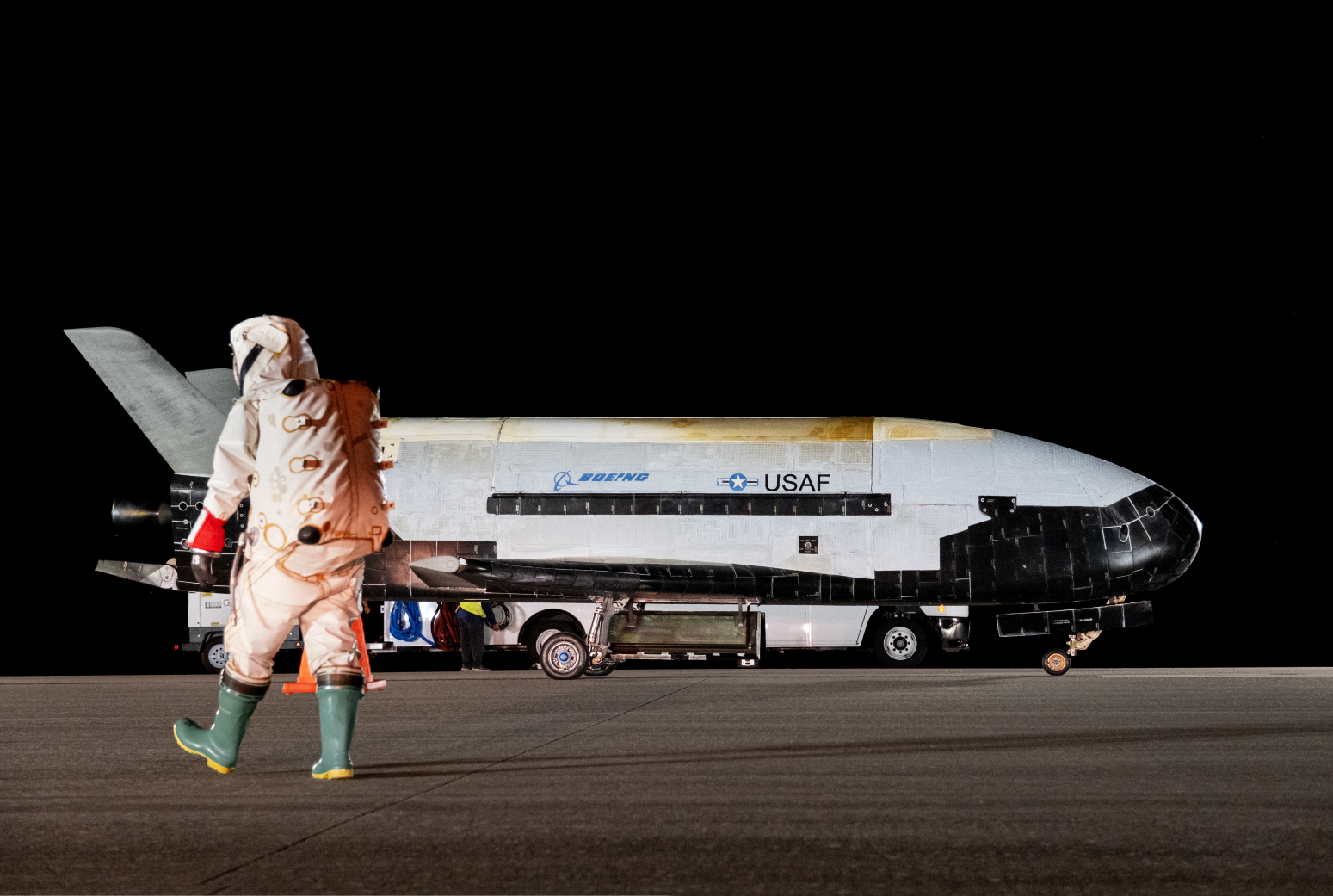
The spacecraft was the X-37B, a reusable autonomous winged vehicle built by Boeing Phantom Works. It was roughly one-quarter the size of the Space Shuttle orbiter but shared the same basic planform. It had no crew, no launch escape system, no human-rated interior, and no payload bay doors large enough to carry anything most people would recognize as a satellite. What it had was a 2.1 by 1.2 meter internal payload bay, a set of solar arrays stowed inside it, a hypergolic propulsion system, and the heritage of a twenty-year research program into reusable spaceplanes that had survived three transfers between NASA, DARPA, and the Air Force.
Two Decades of Programs That Almost Happened
The X-37 traces its lineage to the NASA-funded X-37 Approach and Landing Test Vehicle of 1999. The original intent was a smaller sibling of the X-33 VentureStar program - a technology demonstrator for reusable orbital launch vehicles. When VentureStar was canceled in 2001 after Lockheed Martin’s composite hydrogen tanks failed testing, the X-37 was left orphaned. NASA transferred the program to DARPA in 2004. DARPA transferred it to the Air Force in 2006. Boeing continued to build it through all three transfers, quietly refining the design.
By the time OTV-1 launched in 2010, the X-37B was no longer an experimental program in any meaningful sense. It was an operational military spacecraft with a mission set the Air Force would describe in public only as “space technology demonstration” and “risk reduction for future space technology.”
The spacecraft’s capability set is known in broad strokes but not in detail. It carries an autonomous reentry guidance system. It can deploy and retrieve small payloads. It has a reaction control system that allows extensive orbital maneuvering. It lands horizontally on a conventional runway (Vandenberg’s 12,000-foot strip, and later Kennedy Space Center’s Shuttle Landing Facility) after an autonomous reentry from orbit. And it can stay in space, unserviced, for years at a time.
What OTV-1 Actually Did
The 224-day mission that began on April 22, 2010 landed at Vandenberg Air Force Base on December 3, 2010. The Air Force released a single official photograph of the landing: the X-37B, still steaming slightly from reentry heat, rolling to a stop on the runway under a gray California dawn. Ground crew in containment suits approached the vehicle. No reporters were permitted within a kilometer.
Amateur satellite observers had tracked the vehicle through most of its mission. The public observations showed the spacecraft in a nearly circular orbit at an altitude of 410-420 km, performing periodic small orbit adjustments and occasionally dropping into lower orbits where atmospheric drag would be high. The observational community - including Ted Molczan, Bob Christy, and others who have tracked classified military satellites for decades - noted that the vehicle appeared to be operating in orbital regimes consistent with passive remote sensing, but nothing about the observations ruled out electronic signals intelligence, communications relays, or purely engineering tests.
What the vehicle did not do was rendezvous with any other known spacecraft. Skeptics had speculated that the X-37B was designed to approach, inspect, or potentially disable foreign satellites. The 2010 mission showed no evidence of that. The orbit was low enough that any satellite with similar parameters would have been visible to international tracking, and no such co-orbital relationships were ever observed.
The Secrecy Debate
The X-37B’s combination of real-world visibility and official silence created a persistent tension in the space community. Every time OTV-1 (and later OTV-2, OTV-3, OTV-4, OTV-5, OTV-6, OTV-7, OTV-8) launched, professional journalists and amateur observers would publish approximate orbital parameters within days. The Air Force would issue press releases containing minimal technical detail. International coverage would speculate wildly. Chinese and Russian media would accuse the U.S. of building a space weapon. The Air Force would decline to respond in detail.
The whole theme here is being able to bring something back and inspect it, and that gives us a better insight into how well our technologies work up there.
Payton’s 2010 framing - the X-37B as a technology truck, not a spy tool - has been the Air Force’s consistent messaging. Whether it is the whole truth is a question the program has never answered. Some operational missions have hosted publicly identified payloads (such as the Advanced Structurally Embedded Thermal Spreader for the Air Force Research Laboratory, or the Air Force’s Heatshield Materials Exposure experiment). Other payloads remain classified.
The Long Missions
The missions have gotten longer. OTV-1 flew for 224 days. OTV-2 (launched March 2011) flew for 469 days. OTV-3 flew for 675 days. OTV-4 flew for 717 days. OTV-5 flew for 780 days. OTV-6, launched in May 2020, flew for 908 days before landing in November 2022. OTV-7, which launched in December 2023, was still in orbit through 2025.
Each mission has added capabilities. OTV-2 demonstrated the first autonomous runway landing at Vandenberg. OTV-3 demonstrated the first reuse of an X-37B (the same vehicle that had flown OTV-1). OTV-5 launched on a Falcon 9 instead of an Atlas V, demonstrating launch-provider flexibility. OTV-6 carried a service module for the first time, effectively doubling the spacecraft’s payload volume. OTV-7 demonstrated a new maneuver pattern in a highly eccentric orbit - the first time an X-37B had been observed outside low Earth orbit.
OTV-1 launch
First X-37B flight on Atlas V. 224-day mission. Autonomous landing at Vandenberg on December 3, 2010.
OTV-2 launch
Second X-37B flight. 469 days in orbit. Autonomous runway landing.
OTV-3 launch
First X-37B reuse: same vehicle that flew OTV-1. 675 days in orbit.
OTV-4 launch
First X-37B mission to carry publicly identified experiments including Hall-effect thruster tests. 717 days.
OTV-5 launch
First X-37B launch on SpaceX Falcon 9. 780 days in orbit.
OTV-6 launch
First mission with service module, expanding payload capacity. 908 days - longest flight to date.
OTV-7 launch
First X-37B launch on Falcon Heavy. Highly eccentric orbit. First time the vehicle operated outside LEO.
The operational tempo matters. The X-37B is no longer a technology demonstrator. It is a reusable orbital asset that has been spending roughly one-third of the last fifteen years in space, carrying classified and unclassified payloads through a series of mission profiles that have progressively stretched what a reusable spaceplane can do.
What the Program Has Actually Proven
The X-37B program has demonstrated a set of capabilities that were genuinely uncertain in 2010.
First, it proved that fully autonomous reusable spaceflight works at operational scale. No human has ever flown on an X-37B. Every landing - now several dozen across the fleet - has been autonomous, runway-based, and reliably successful. The thermal protection tiles, derived from the Shuttle program but updated with modern bonding techniques, have survived repeated reentries with routine maintenance rather than tile-by-tile replacement.
Second, it proved that the Air Force could operate a long-duration orbital asset without constant public oversight. Every X-37B mission has been planned, executed, and concluded with minimal disclosure. The vehicle has flown in view of international tracking networks without ever creating an incident serious enough to force disclosure. Whatever its payloads do, they do so without generating publicly visible operational signatures.
Third, it established that the hardware can be trusted. The Space Shuttle required a standing army of roughly 9,000 people to process each vehicle between flights. The X-37B is processed with a team numbering in the tens. Whether this efficiency ratio generalizes to crewed vehicles is a different question, but the basic thesis - that reusable orbital spacecraft can operate on an aircraft-like maintenance cycle - has been proven for at least this class of robotic missions.
Where Things Stand Now
As of April 2026, the X-37B program has conducted seven completed missions and one still in flight (OTV-8, launched August 2025, still operating at the time of this writing). Boeing’s role has remained quiet but central: each vehicle is maintained in El Segundo, California, and Huntington Beach for inspection and refurbishment between missions. The U.S. Space Force, which absorbed operational responsibility for the program from the Air Force in 2019, continues to publish minimal mission-specific detail.
Internationally, the program’s most direct echo is China’s Shenlong spaceplane, which first flew in September 2020 and has conducted four publicly observed orbital missions since then. Shenlong is smaller than X-37B and its mission pattern is even more opaque, but its existence confirms that at least one other nation has chosen to match the X-37B’s basic capability set rather than dismiss it. The Chinese vehicle has released sub-satellites during its missions in ways that have alarmed Western SSA analysts.
The X-37B itself is not new anymore. It is a mature military space asset with a fifteen-year operational record, a well-understood maintenance cycle, and a mission tempo that suggests it is economically viable for whatever the Pentagon is using it for. What remains classified is why any of this was built.
Why It Still Matters
The X-37B is important for three reasons that go beyond what any single mission accomplishes.
It is the clearest existing example of an operational reusable military spacecraft. Every discussion of future military spaceplanes, orbital servicing vehicles, rapid-response satellite replacement systems, or crewed military orbital platforms starts from a baseline set by this vehicle’s actual flight record.
It demonstrates the asymmetry of orbital transparency. Ground-based tracking networks can see the vehicle’s orbit, trajectory, and general operational pattern. They cannot see what it is doing inside its payload bay. The gap between “where” and “what” is the core of modern space domain awareness - and the X-37B program has been demonstrating that gap, continuously, for fifteen years.
And it reframes how people think about classified space capability. The Cold War model was that military space assets were single-mission, launch-and-forget platforms. The X-37B is the counter-model: a reusable, maneuvering, autonomous vehicle that can be reconfigured between missions and operate for years without dedicated ground support. That model is what the next generation of military spacecraft will look like, and OTV-1 is where it started.
References(8)
- X-37B Orbital Test Vehicle Program Overview - U.S. Air Force Fact Sheet, 2015
- OTV-1 Launch Press Kit - United Launch Alliance, April 2010
- X-37B Completes Seventh Mission - Space Force Press Release, 2024
- The X-37B and the Militarization of Space - Secure World Foundation, 2020
- Boeing X-37B Orbital Test Vehicle - Boeing Phantom Works Overview, 2010
- Molczan, T. - Orbital Observations of USA-212 (OTV-1), SeeSat-L archives, 2010
- Chinese Shenlong Spaceplane - SpaceNews Coverage, 2020-2024
- The Reusable Space Shuttle and Its Successors - Smithsonian Air & Space Magazine Archive

Theodore Kruczek