· today in space history · 11 min read
GOES-G | The Day a Weather Satellite Exploded Over the Atlantic
Forty years ago today, a Delta 3914 lifted off Cape Canaveral with a weather satellite the country could not afford to lose. Seventy-one seconds later, its main engine cut off. Ninety-one seconds in, the range safety officer pressed his button. The third domino of a brutal 1986 had fallen.
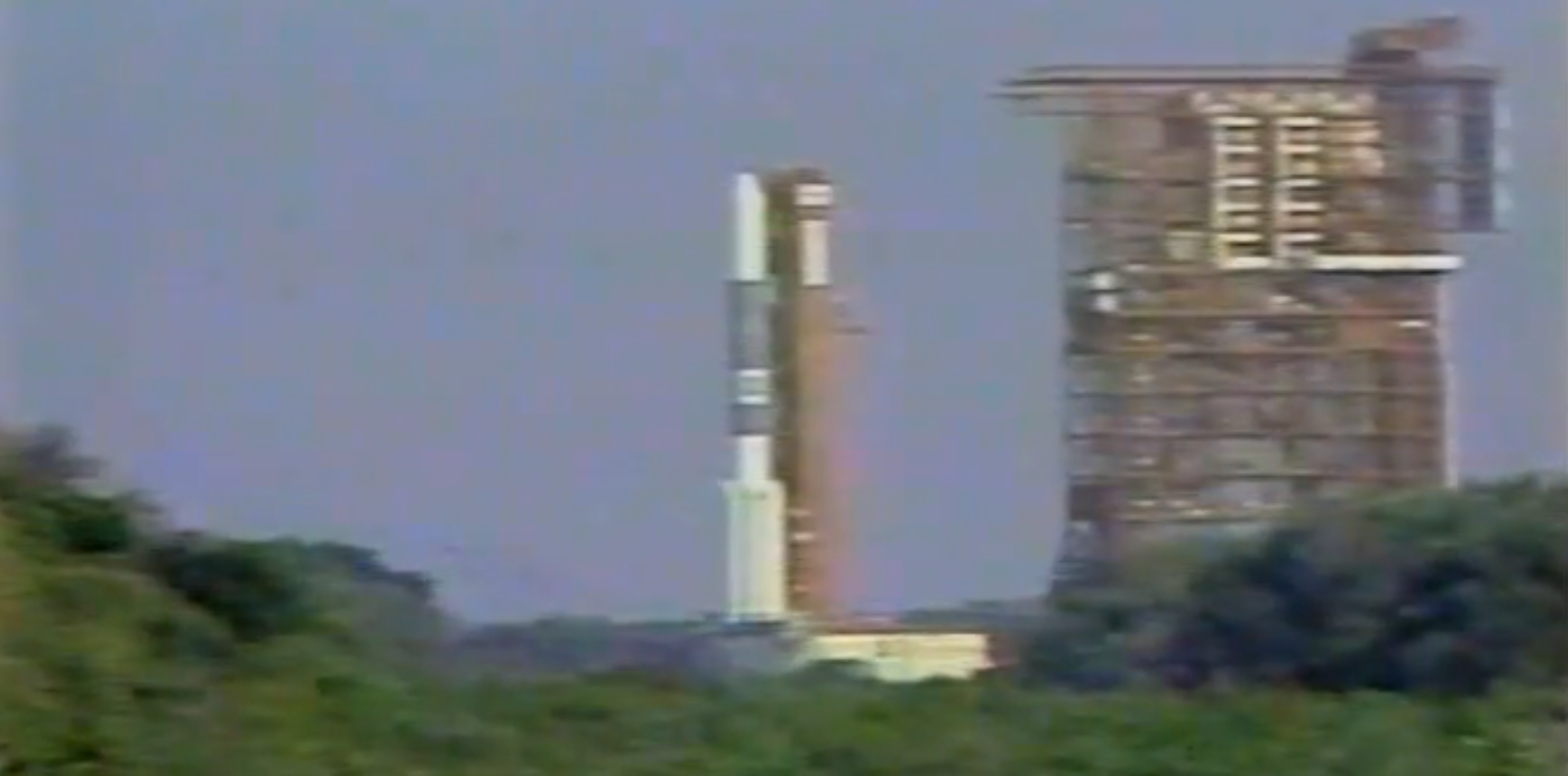
The pad crew at Launch Complex 17A had every reason to feel calm on the evening of May 3, 1986. The Delta family had been launching satellites out of Cape Canaveral for nearly a quarter of a century. The vehicle on the pad that Saturday, a Delta 3914 with a Hughes-built weather satellite mated to its third stage, was the latest member of a rocket lineage that had quietly become the most reliable orbital launcher in the Western world. Two engineers later told reporters they could have set their watches by the countdown.
The country, however, was not calm. The space shuttle Challenger had broken apart over the Atlantic ninety-five days earlier. A Titan 34D carrying a classified reconnaissance payload had exploded above Vandenberg fifteen days earlier, raining flaming solid-rocket fragments across the California coastline. Each loss had been catalogued, mourned, and then, in the way that Cold War America did such things, queued behind the next one. The Delta launch on the evening of May 3 was supposed to be the calm thing. The thing that worked. The thing that reminded the country its launch fleet still functioned.
At 6:18 PM Eastern Daylight Time, the Delta lifted off, climbed cleanly through the first sixty seconds of flight, and then, with no warning to anyone watching, switched itself off.
178
Successful Delta flights before GOES-G
The Delta family was the most reliable launcher in the Western world heading into May 1986. The 179th flight ended at T+91 seconds, and the entire fleet was grounded within the week.
The 71-Second Flight
The first stage of a Delta 3914 burned a kerosene derivative called RP-1 with liquid oxygen, fed through a single Rocketdyne RS-27 main engine. The RS-27 was old hardware in 1986, a direct descendant of the H-1 engine that had powered the Saturn IB. It had flown well over a hundred times without losing a vehicle to a propulsion failure. Engineers spoke of it the way machinists speak of a lathe that has been running since their grandfathers’ shift.
For the first seventy seconds, the GOES-G ascent looked nominal. Telemetry showed chamber pressure, mixture ratio, and steering angles all where they belonged. The vehicle was about thirteen kilometers downrange and climbing through the lower stratosphere. The ground crew watching from the firing room would have been settling into the relaxed posture that comes after the visible exhaust plume disappears into the upper atmosphere.
At T+71 seconds, the chamber pressure on the RS-27 collapsed. The main engine, by every available indication, simply quit.
The vehicle, no longer thrusting against gravity, kept climbing on momentum for a few more seconds and then began to arc back. Within the next twenty seconds the Delta had begun to tumble, structural loads exceeding what an aerodynamically loaded rocket can survive. At T+91 seconds, the range safety officer at Cape Canaveral sent the destruct command. The vehicle exploded in a yellow-orange flower that the recovery boats would later trace across roughly fifty square miles of Atlantic Ocean. No debris reached land. No one was injured.
GOES-G, the satellite that was supposed to take up station over the Atlantic and watch hurricanes form, fell into the same ocean it had been built to monitor.
A Year of Disasters
What happened over the Atlantic on May 3 was not, on its own, a catastrophe. Launch vehicles fail. Satellites are insured. Programs absorb the loss and reschedule. But May 3 was the third such loss in ninety-five days, and it landed in a country that had already used up its margin for absorbing them.
Challenger (STS-51L)
The space shuttle breaks apart 73 seconds into flight after a solid rocket booster O-ring fails. Seven astronauts are lost. The shuttle fleet is grounded indefinitely.
Titan 34D-9
A Titan 34D carrying a KH-9 HEXAGON reconnaissance satellite explodes seconds after liftoff from Vandenberg. The Air Force loses its last large-format film-return spy satellite and grounds the Titan 34D fleet.
Delta 3914 / GOES-G
The most reliable rocket in the US fleet fails at T+71 seconds when its main engine shuts down. NOAA loses its planned GOES-East replacement. The Delta fleet is grounded for review.
GOES-7 launches
After nearly ten months of redesign, requalification, and review, a Delta 3914 successfully delivers GOES-7 to geostationary transfer orbit. Operational US weather coverage of the Atlantic basin is restored.
By the second week of May, every American expendable launcher capable of placing a meaningful payload on orbit was either grounded or under formal review. The shuttle was indefinitely down. The Titan 34D was grounded pending an investigation that would not clear it for return to flight until late 1988. The Delta, the workhorse, the one program everyone had counted on to keep the lights on, was now under a stand-down of its own. The Atlas-Centaur fleet, which had its own troubles ahead, was the only major US launcher still flying, and only barely.
For a brief and astonishing window in the spring of 1986, the United States, the country that had landed people on the Moon, had effectively no way to put a large satellite into orbit. Defense planners spoke of it later as the moment they understood, viscerally, what an over-consolidated launch portfolio actually felt like.
What NOAA Lost
The Geostationary Operational Environmental Satellite system, GOES, is the backbone of US weather forecasting east of the Pacific. It is what tells a National Hurricane Center forecaster in Miami that a tropical wave coming off the African coast has begun to organize. It is what gives the Storm Prediction Center the cloud-top temperature data that distinguishes a developing supercell from a passing rain shower. It is what turns the abstraction of an approaching front into the moving spiral of cloud you see on a television screen.
In the spring of 1986, the GOES constellation had two operational birds: GOES-5 in the eastern slot at 75 degrees west longitude, and GOES-6 in the western slot at 135 degrees west. GOES-5 was failing. Its visible-light imager had degraded to the point where forecasters were using it only for backup imagery, and its prime mission instrument, the VISSR, was on borrowed time. GOES-G, the satellite on the Delta on May 3, was supposed to replace it. Once on station, it would have been redesignated GOES-7 and would have given NOAA a healthy two-satellite constellation again.
Instead, GOES-5 limped along. By July it was effectively dead. NOAA was operating the entire continental US, the Atlantic basin, and a meaningful slice of South America with a single working geostationary weather satellite, GOES-6, parked over the Pacific. To cover the East Coast, controllers periodically slewed GOES-6 eastward to a compromise position roughly over the central United States, sacrificing some Pacific coverage to keep the Atlantic visible during hurricane season.
It was, in the words of a NOAA technical history written years later, the most degraded period of US weather satellite coverage since the founding of the program.
The 1986 hurricane season was, by historical accident, a relatively quiet one. The 1987 season was nearly so. Forecasters who lived through that window have noted, sometimes ruefully, that the country got away with the GOES gap because the weather happened to cooperate. A harder season would have made the cost of the May 3 failure visible in evacuations missed, warnings issued late, and lives lost.
The European Lifeline
The story of US weather satellite coverage after GOES-G does not end with GOES-7’s arrival in February 1987. The constellation healed for a few years, but the underlying fragility was structural, not transient. Satellites age. Replacements slip. The next gap was already on its way.
In 1989, GOES-6 finally died. GOES-7 was promptly slewed eastward to cover the more critical Atlantic basin, leaving the Pacific without a dedicated US geostationary weather satellite. The next-generation GOES-NEXT program, which would eventually produce GOES-8, was running years late and well over budget. NOAA was once again, in the most literal sense, out of weather satellites.
What happened next would have been almost unthinkable a decade earlier. The European Space Agency, which operated its own geostationary weather constellation called Meteosat, agreed to lend the United States a satellite. Meteosat-3, which had been retired from its prime mission slot at zero degrees longitude, was incrementally drifted west, first to 50 degrees west and then ultimately to 75 degrees west, the same orbital slot GOES-G had been built to fill. The arrangement was called the Meteosat Atlantic Data Coverage mission, or MADC, and it ran from 1991 through 1995, when GOES-8 finally arrived to take over.
It was the first time in the history of space-based weather forecasting that one space agency had handed another agency an active operational satellite to cover an entire continent’s worth of forecasting. It worked. It was, in retrospect, also a quiet diplomatic coup, the kind of cooperation that gets cited in textbooks on international science policy and that very few people outside of the meteorological community ever notice. The aftershocks of May 3, 1986 are part of the reason it happened.
The Investigation
The Delta failure investigation board convened within days of the loss and worked through the summer of 1986. The vehicle’s destruction had scattered debris across the seafloor, but enough of the first stage’s electrical bay had been recovered, and enough telemetry had been transmitted before the engine cutoff, to reconstruct what happened.
The cause traced to a single component: a solenoid-actuated relay in the engine cutoff system, part of what Delta engineers called the Nominal Inflight Redundant System. The relay, by design, was supposed to fire only on receipt of a deliberate cutoff command from the vehicle’s flight computer. On the night of the launch, a momentary electrical short developed in the engine power unit. The short produced a transient voltage that the cutoff relay interpreted as a legitimate command. The relay closed. The main engine, doing exactly what it had been built to do when commanded to stop, shut down.
The system that had been added to make the rocket safer had killed it.
The fix, once understood, was almost embarrassingly simple. The cutoff circuit was redesigned with additional inhibits to prevent transient voltages from triggering a spurious command. New inspection procedures were imposed across the Delta inventory. Wiring harnesses that had been considered acceptable under the previous regime were reworked to a tighter standard. And the broader lesson, that a redundant safety system can itself become the failure mode, was absorbed into the discipline of launch vehicle design in ways that still echo today.
GOES-7 launched successfully on February 26, 1987, on a Delta 3914 of the same configuration that had failed ten months earlier. It went on to operate for thirteen years, far beyond its original design life, eventually becoming the satellite that was loaned to South American forecasting agencies after its US service ended.
An engineering organization that does not understand its own redundancy paths does not actually have redundancy. It has the comforting illusion of redundancy, which is more dangerous than no redundancy at all.
What Stayed With Us
Forty years on, the Delta 3914 is a museum artifact. Its descendant, the Delta II, flew its first mission in February 1989 and went on to compile one of the finest reliability records in the history of orbital flight. The broader Delta family, through the Delta III and Delta IV variants, kept flying until the Delta IV Heavy retired in 2024. Hundreds of missions. Thousands of payloads. A spine of American spaceflight that May 3, 1986 nearly broke and ultimately did not.
The institutional memory of that spring matters more than the vehicle itself. The triple failure of Challenger, Titan 34D-9, and Delta 3914 forced the United States to rebuild a launch industry that had quietly atrophied under the assumption that the shuttle would do everything. The decision to push commercial payloads back onto expendable rockets, the funding for what became the Delta II and the Atlas II, the renewed investment in launch range safety procedures, the re-emergence of a policy conversation about the strategic value of multiple launch providers, all of it traces back to the spring when the country lost three rockets in three months and discovered that it had no Plan B.
The weather satellite story has a similar shape. The GOES program survived 1986, recovered to GOES-7, weathered the late-1980s gap with European help, and is today represented by the GOES-R series, four spacecraft so capable that the imagery from a single one of them surpasses what the entire 1986 constellation could produce in a year. But the system is still a small one. Two operational satellites cover the Western Hemisphere. There are no spares already on station. Every gap is, in some real sense, a gamble against the weather.
The hard lesson of GOES-G is that the things we think of as bedrock infrastructure, the satellite imagery on a forecaster’s screen, the rocket that has worked one hundred and seventy-eight times in a row, the space program of a great power, are all narrower than they look. They depend on small components, on small decisions, on the absence of small electrical shorts in places no one has thought to look. The night of May 3, 1986 is the kind of anniversary worth keeping not because anyone died but because what was lost was a piece of confidence the country had not realized it was carrying. The picture of Earth’s weather on the evening news was a fragile thing, and on that Saturday evening forty years ago, for ninety-one seconds and then ten months, it almost went dark.

Theodore Kruczek