· today in space history · 11 min read
Hayabusa | The Crippled Falcon That Carried an Asteroid Home
Sixteen years ago today, a fireball tore across the Australian outback. Most of it was a dying Japanese spacecraft burning up after a seven-year ordeal. The bright dot racing ahead of the wreckage was a capsule holding the first grains of an asteroid ever returned to Earth.
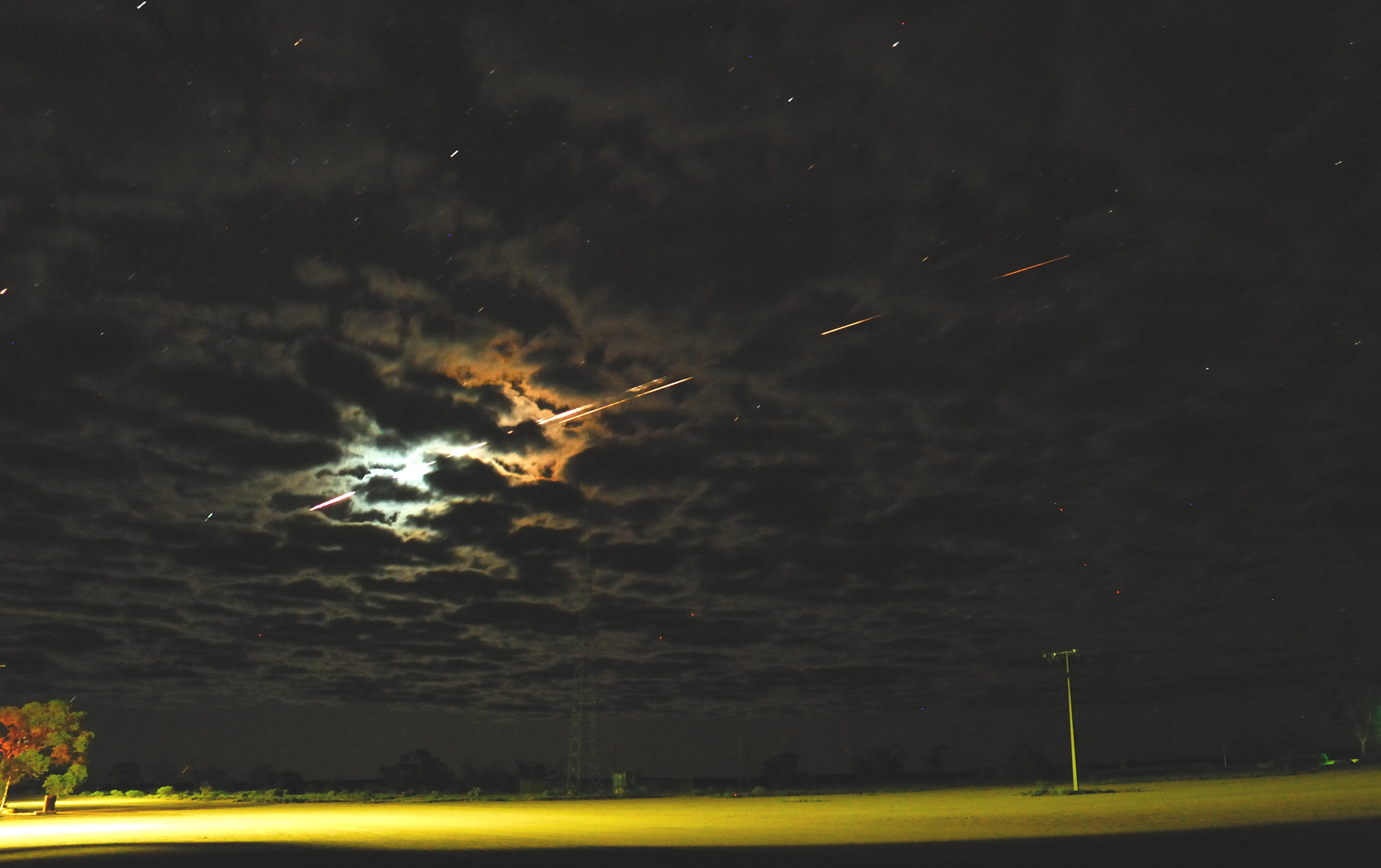
Just before 11 p.m. local time on June 13, 2010, a NASA DC-8 flying laboratory cruised over the South Australian desert with its windows full of cameras. The scientists aboard were waiting for a streak of light that the rest of the country could see from their backyards. When it came, it was not one light but two. A long, ragged fireball broke into glowing fragments and fanned out across the sky, the death of a spacecraft that had spent seven years trying to get home. Running just ahead of the burning wreckage was a single bright point that did not break apart. That point was a capsule the size of a wok, and inside it, against nearly every expectation, were the first physical pieces of an asteroid ever brought back to Earth.
The spacecraft was called Hayabusa, Japanese for peregrine falcon. By the time it reached the Woomera Test Range that night, almost everything that could go wrong on a deep-space mission had gone wrong on this one. Its engines had failed, its attitude-control wheels had seized, it had sprung a fuel leak, and it had once gone silent for seven weeks while controllers in Sagamihara wondered whether they would ever hear from it again. That it arrived at all, on a trajectory precise enough to drop a capsule into a recovery zone in the outback, is one of the great salvage stories in the history of spaceflight.
The mission belonged to the Japan Aerospace Exploration Agency, and to a stubborn project manager named Junichiro Kawaguchi who refused to let it die. What follows is the story of how a small, underpowered technology demonstrator limped across the inner solar system and back, and why the dust it carried mattered far more than its troubled hardware ever suggested.
A Cheaper Way to Touch an Asteroid
Hayabusa began life under the unglamorous name MUSES-C, an engineering testbed rather than a flagship science mission. Its real purpose was to prove a handful of technologies Japan wanted for the future. It would test long-duration ion propulsion, autonomous navigation near a small body, a touch-and-go sampling method, and a high-speed atmospheric reentry. Visiting an asteroid and grabbing a sample was, in a sense, the exam that would test all of those systems at once.
It launched on May 9, 2003, atop an M-V solid rocket from the Uchinoura Space Center and was renamed Hayabusa once it was safely in space. The target was a sliver of rock named 25143 Itokawa, a near-Earth asteroid only about 535 meters long, christened for Hideo Itokawa, the engineer often called the father of Japanese rocketry. Itokawa is an S-type asteroid, the most common kind in the inner asteroid belt, which made it an attractive thing to sample. Scientists had long suspected that S-type asteroids were the parent bodies of the ordinary chondrite meteorites that dominate collections on Earth, but no one had ever held a piece of one to prove it.
Hayabusa’s propulsion was its headline experiment. Rather than chemical thrusters, it carried four xenon ion engines that produced a whisper of thrust, equivalent to the weight of a coin resting on your palm, but could run for thousands of hours on very little propellant. Ion drives trade brute force for patience, building up enormous velocity changes over months of continuous firing. They are now common on commercial and deep-space craft, but in 2003 a multi-year interplanetary cruise on ion power alone was a genuine gamble.
The gamble started badly. A large solar flare in late 2003 degraded the spacecraft’s solar cells, cutting the power available to the ion engines and forcing controllers to stretch out the cruise. Hayabusa reached Itokawa on September 12, 2005, roughly three months behind its original schedule, and slipped into formation a few tens of kilometers from the asteroid. It did not orbit so much as hover, holding station against the feeble gravity of a body it outweighed by very little.
Trouble Before the Landing
The asteroid Hayabusa found was stranger than anyone expected. Itokawa had almost no impact craters and looked instead like a loose pile of boulders and gravel held together by its own weak gravity, a so-called rubble pile. There was little smooth terrain to land on, and the sampling plan assumed a relatively flat touchdown spot. Mission planners scrambled to pick a target among the rocks.
Then the hardware began to fail. Hayabusa steadied itself in space using three reaction wheels, spinning flywheels that let it point without burning fuel. One wheel failed at the end of July 2005, before the craft even arrived. A second failed on October 2, leaving Hayabusa with a single working wheel and forcing controllers to hold its attitude using chemical thrusters, burning through propellant they had hoped to save for the trip home.
In November the spacecraft tried to deploy MINERVA, a tiny hopping robot meant to bounce across the surface and send back close-up images. It was released at the wrong moment, drifted away from the asteroid instead of toward it, and was lost to space. The mission’s luck was not improving.
Two Touchdowns and a Silence
The sampling itself was supposed to be quick and clever. Hayabusa would descend, touch the surface for an instant, fire a small metal pellet into the ground, and catch the spray of ejected debris in a horn-shaped collector before climbing away. On November 19, 2005, the spacecraft made its first descent. A sensor detected an obstacle and the autonomous system aborted the firing sequence, but Hayabusa actually settled onto the surface and rested there for roughly half an hour before controllers coaxed it back up. It was the first time a spacecraft had ever lifted off again from a body other than the Moon.
A second attempt followed on November 25. Telemetry suggested Hayabusa touched down and rose again, but later analysis indicated the sampling pellets probably never fired. No one could say with confidence whether the collector held anything at all. Hope rested on a thin possibility. The disturbance of touching down might have kicked grains of regolith up into the horn on its own.
Days after that second touchdown, the situation turned critical. A chemical thruster leak sent Hayabusa tumbling, and on December 8, 2005, contact was lost entirely. For seven weeks the spacecraft was silent, drifting and spinning somewhere near Itokawa while controllers broadcast commands into the void. A faint beacon was finally detected on January 23, 2006, and the spacecraft began responding to commands a few days later. Hayabusa had survived, but it was badly wounded, low on fuel and missing the orbital window for a prompt return. The trip home would have to wait three years.
Launch
Hayabusa lifts off on an M-V rocket as the MUSES-C technology demonstrator.
Arrival at Itokawa
Reaches the asteroid three months late after solar-cell damage saps the ion engines.
Touchdowns
Two descents to the surface; the sampling pellets likely never fire.
Lost contact
A fuel leak sends the craft tumbling and silent for seven weeks.
Engine rescue
Controllers improvise a working ion engine from the healthy halves of two dead ones.
Reentry
Hayabusa burns up over Woomera; the sample capsule lands safely.
The Long Way Home
Nursing Hayabusa back toward Earth meant running ion engines that were never designed to last this long. By late 2009 the wear was catching up. On November 4, an engine shut down on a fault, and for a few weeks the spacecraft had no working thruster capable of the long burn it still needed to make its rendezvous with Earth.
The fix that saved the mission was a piece of improvisation that has since become legend among ion-propulsion engineers. Each ion engine paired an ion-generating section with a separate neutralizer that balanced the spacecraft’s electrical charge. Different units had failed in different halves. On November 19, 2009, JAXA announced that controllers had cross-wired two crippled engines, feeding the ion beam from one unit through the still-healthy neutralizer of another, and coaxed a single functioning thruster out of the wreckage of two. It was enough. Hayabusa resumed its burn and lined up for home.
The main reason we were able to continue operation of the ion engines was that no matter what crisis arose, no one gave up.
By the spring of 2010, Hayabusa was a husk. Only a fraction of its batteries still held charge, its reaction wheels were gone, and its attitude was held together with the last of its chemical propellant and the patience of its controllers. None of that mattered for the final act. The job now was to aim the whole spacecraft at a precise point above Australia and release the sample capsule a few hours before reentry, so that the capsule, protected by its own heat shield, could survive the fire that would consume everything else.
Thirteen Seconds and a Parachute
On June 13, 2010, Hayabusa released the 40-centimeter return capsule and then followed it down. At about 13:51 UTC the main spacecraft slammed into the upper atmosphere and disintegrated in the long fireball the DC-8 crew photographed, a deliberate cremation after seven years and billions of kilometers of travel. The capsule, shielded and aimed, rode out the searing hypervelocity plunge, deployed its parachute, and beaconed from the scrub of the Woomera Prohibited Area.
Recovery teams located the capsule that evening and retrieved it the next morning, June 14. For Kawaguchi and the team that had refused to give up on the spacecraft for seven years, the moment carried a weight that went beyond engineering.
1,534 Grains
The capsule was flown to the JAXA curation facility, where the central question remained unanswered. Had Hayabusa actually collected anything? The sample container was opened with extreme care, and at first there was little to see. Then, painstaking work with a small spatula and electron microscopes began turning up particles, most of them smaller than the width of a human hair.
In the end, researchers recovered roughly 1,534 grains of rock. Analysis confirmed they had come from Itokawa, not from contamination on Earth, and that was the result the science community had been waiting decades for. Published in the journal Science in 2011, the work showed that the mineral makeup of the Itokawa grains matched a class of stony meteorites called LL chondrites. It was the direct, physical proof that ordinary chondrites, the most common meteorites found on Earth, come from S-type asteroids. A link that had been argued from telescopes and statistics was now confirmed by particles you could put under a microscope.
The grains told a second story too. Their thermal and shock history suggested Itokawa was assembled from the shattered interior of a once-larger asteroid, a rubble pile reborn from a catastrophic collision. The desert-recovered dust was, in effect, a sample of the building blocks of the inner solar system.
The Falcon’s Legacy
Hayabusa’s value was never really its science return, which was tiny in raw mass. It was the proof of concept. A modest spacecraft, hammered by failure after failure, had still managed to reach an asteroid, touch it, and bring a piece of it home. Every sample-return mission that followed stood on that demonstration. JAXA launched Hayabusa2 in 2014, which delivered samples from the asteroid Ryugu in December 2020 with almost none of the original’s drama. NASA’s OSIRIS-REx parachuted samples of asteroid Bennu into the Utah desert in 2023. What Hayabusa proved was possible has become, if not routine, then at least repeatable.
There is a reason the image at the top of this article is the spacecraft burning rather than the capsule landing. Hayabusa flew itself into the atmosphere to deliver its cargo, and that final fireball over Woomera is the most honest picture of the whole mission: a machine that gave everything it had, including itself, to bring back a handful of dust. Sixteen years later, those grains are still being studied, and the falcon that carried them remains one of the most improbable success stories ever flown.
References(10)
- Asteroid Explorer HAYABUSA (MUSES-C) Reentry - JAXA Press Release, June 2010
- Hayabusa Re-entry Observation - NASA
- About the Hayabusa Mission - NASA Astromaterials Curation
- Bringing HAYABUSA Back to Earth - JAXA, Junichiro Kawaguchi
- The Age of Solar System Exploration - JAXA, Junichiro Kawaguchi
- Hayabusa: Troubled Sample-Return Mission - Space.com
- Hayabusa's coming home - The Planetary Society
- Junichiro Kawaguchi, Hayabusa Program Manager - SpaceNews
- Nakamura et al. - Itokawa Dust Particles: A Direct Link Between S-Type Asteroids and Ordinary Chondrites, Science, 2011
- The Science Special Edition on HAYABUSA Research Reports - JAXA Press Release, 2011

Theodore Kruczek