· x report · 5 min read
Starlink Hits 10,000 Active Satellites in Orbit | KeepTrack X Report
SpaceX crossed 10,000 simultaneous active Starlink satellites in LEO on March 17, 2026, less than seven years after its first operational launch.

Latest Developments
SpaceX crossed a landmark threshold this week, placing its 10,000th simultaneously active Starlink satellite into low Earth orbit following back-to-back Falcon 9 launches on March 16–17. The milestone was achieved in under seven years from the first operational Starlink deployment, underscoring the program’s relentless cadence. With 11,558 satellites launched to date, 10,047 currently in orbit, and 10,037 confirmed working, the constellation has now eclipsed the five-figure active mark with capacity still growing. The same week saw a packed global launch manifest featuring Falcon 9, RFA’s Spectrum, and Rocket Lab’s Electron vehicles all scheduled to fly.
Space Safety
The current Starlink conjunction environment presents a moderate risk picture with five MODERATE-risk events identified over a four-day period (March 20-23, 2026), though no HIGH-risk conjunctions are currently assessed. The most significant conjunction involves STARLINK-5669 and the operational IXPE spacecraft on March 21 at 07:36 UTC, with a collision probability of 0.39 and minimum range of only 13 meters. Concurrent with these conjunction concerns, nine Starlink satellites are predicted to reenter within the next five days, with decay windows ranging from 420 to 2,880 minutes, representing a manageable but notable flux of debris returns to the atmosphere.
| Risk | Starlink Sat | Other Object | Status | Min Range (km) | Rel Speed (km/s) | Max Prob | Time of Closest Approach |
|---|---|---|---|---|---|---|---|
| MODERATE | STARLINK-5669 | IXPE | Operational | 0.013 | 5.546 | 0.3947 | Mar 21, 07:36 UTC |
| MODERATE | STARLINK-35876 | GEOSCAN 1 (RS92S1) | Operational | 0.013 | 14.267 | 0.3332 | Mar 21, 15:14 UTC |
| MODERATE | STARLINK-1559 | STARLINK-35492 | Operational | 0.033 | 8.743 | 0.2431 | Mar 22, 19:22 UTC |
| MODERATE | STARLINK-11129 | OBJECT AX | Non-operational | 0.025 | 7.191 | 0.1491 | Mar 23, 19:54 UTC |
| MODERATE | STARLINK-32162 | YAM-7 | Operational | 0.024 | 11.693 | 0.1337 | Mar 20, 10:21 UTC |
| LOW | STARLINK-30408 | FLOCK 4G-3 | Operational | 0.033 | 6.976 | 0.0968 | Mar 21, 15:02 UTC |
| LOW | STARLINK-34566 | NETSAT-1 | Operational | 0.029 | 12.633 | 0.0929 | Mar 21, 15:48 UTC |
| LOW | STARLINK-1934 | STARLINK-36325 | Operational | 0.070 | 5.727 | 0.0748 | Mar 18, 20:17 UTC |
| LOW | STARLINK-33608 | FLOCK 4G-5 | Partially Operational | 0.034 | 12.228 | 0.0688 | Mar 19, 00:29 UTC |
| LOW | STARLINK-32403 | CZ-6A DEB | Non-operational | 0.035 | 13.529 | 0.0576 | Mar 22, 06:19 UTC |
| Satellite | NORAD ID | Predicted Decay | Window (min) | Inclination | Lat | Lon |
|---|---|---|---|---|---|---|
| STARLINK-1712 | 46581 | Mar 17, 20:54 UTC | 420 | 53.0° | -10.6° | 97.5° |
| STARLINK-36858 | 68021 | Mar 17, 23:15 UTC | 1,440 | 97.3° | -25.6° | 40.3° |
| STARLINK-3050 | 49180 | Mar 18, 15:26 UTC | 1,440 | 70.0° | -68.2° | 75.1° |
| STARLINK-1587 | 46157 | Mar 18, 22:43 UTC | 1,380 | 53.0° | -53.1° | 280.4° |
| STARLINK-31299 | 59080 | Mar 20, 02:52 UTC | 2,880 | 43.0° | 38.5° | 29.4° |
| STARLINK-1955 | 47556 | Mar 20, 14:45 UTC | 2,880 | 53.0° | -48.0° | 105.9° |
| STARLINK-4057 | 53269 | Mar 20, 15:07 UTC | 2,880 | 53.2° | -52.6° | 356.9° |
| STARLINK-6201 | 56486 | Mar 20, 22:36 UTC | 2,880 | 70.0° | -20.9° | 110.7° |
| STARLINK-30559 | 58039 | Mar 22, 17:30 UTC | 2,880 | 53.1° | 28.0° | 33.0° |
Detailed Coverage
SpaceX Crosses 10,000 Active Starlink Satellites — A Milestone Seven Years in the Making
The Starlink 17-24 mission, lifting off from California at 10:19 p.m. PDT on March 16, delivered the batch of satellites that pushed the active constellation count past 10,000 for the first time. SpaceX accomplished this benchmark fewer than seven years after the May 2019 launch of its first 60 operational Starlink satellites, a pace of growth that has no precedent in commercial or government spaceflight history.
For satellite trackers and collision-avoidance analysts, crossing the 10,000 active threshold is more than symbolic. The density of operational objects in the 340–560 km shell now demands continuous, high-fidelity tracking, and even minor maneuvering activity across the fleet generates thousands of conjunction alerts per week. KeepTrack users monitoring Shell 4 and Shell 5 populations will notice the updated object counts reflected in real time as the newly launched vehicles complete orbit raising.
Read the full story: Spaceflight Now
St. Patrick’s Day Double-Launch Adds 54 More Starlink V2 Mini Satellites
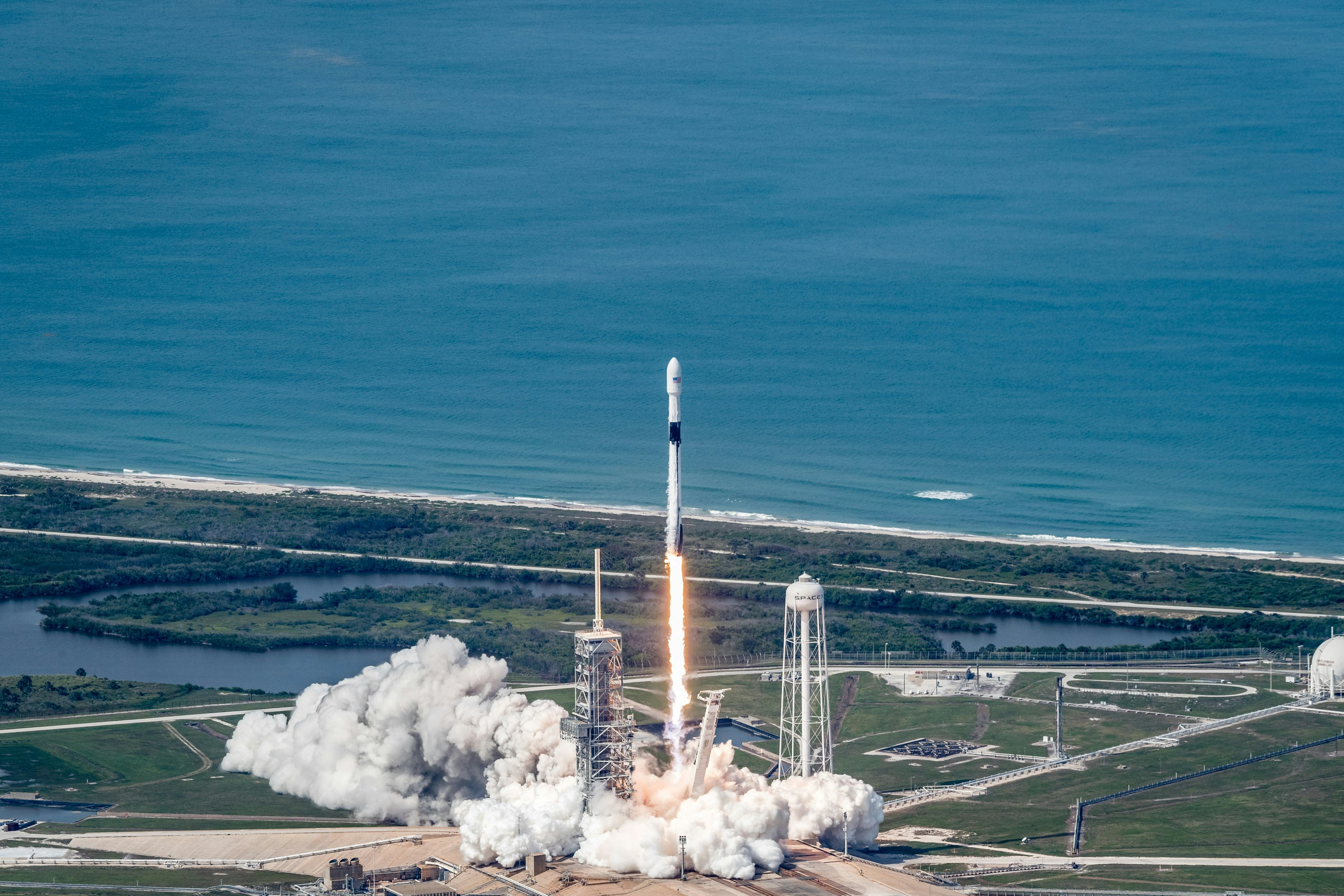
SpaceX did not pause to celebrate the 10,000-satellite milestone — a second Falcon 9 lifted off from Cape Canaveral Space Force Station’s Pad 40 at 9:27 a.m. EDT on March 17, carrying 29 Starlink V2 Mini satellites on the Starlink 10-46 mission. Combined with the prior night’s California launch, SpaceX placed roughly 54 additional satellites into LEO within a single calendar day.
The V2 Mini platform carries approximately four times the throughput of the original V1 design and is a key driver of the network’s capacity expansion into underserved maritime, aviation, and direct-to-cell markets. The rapid back-to-back launch cadence also demonstrates SpaceX’s ability to sustain simultaneous east- and west-coast operations — a logistical capability that significantly compresses the timeline for reaching higher constellation densities.
Read the full story: Spaceflight Now
Space.com Video Coverage: Watching the 10,000th Active Satellite Reach Orbit
Space.com provided video documentation of both March 17 Falcon 9 launches, capturing the dual-launch day that formally pushed Starlink past the 10,000 active satellite mark. The coverage offered viewers a rare side-by-side look at how SpaceX’s two primary launch sites — Vandenberg Space Force Base in California and Cape Canaveral in Florida — operate in near-simultaneous fashion to sustain constellation growth.
The visual record is particularly valuable for public understanding of what a 10,000-satellite constellation actually looks like in practice: not a single dramatic event, but an incremental accumulation of 25-to-29 satellite batches deployed dozens of times per year. Analysts tracking on-orbit object populations can cross-reference the video timelines with TLE update windows to identify newly catalogued objects from each batch.
Read the full story: Space.com
Busy Week Ahead: Nine Global Launches Scheduled, Including Spectrum and Electron
The week of March 16 is shaping up as one of the most active launch weeks of 2026, with nine missions on the manifest across multiple providers and continents. Alongside SpaceX’s Falcon 9 flights, RFA’s Spectrum rocket and Rocket Lab’s Electron vehicle are both scheduled to attempt launches, representing a significant test of the emerging multi-provider commercial launch market.
For constellation analysts, a high-tempo multi-launcher week creates compounding tracking complexity — each successful deployment adds new objects to an already dense LEO environment, while any failure or abnormal orbit insertion can scatter debris or place objects in unplanned trajectories. KeepTrack users are advised to monitor TLE refresh cycles closely during periods of elevated launch activity to ensure conjunction screening remains current.
Read the full story: NASASpaceFlight
Constellation Status
There have been no changes to the Starlink constellation since the last check. The constellation currently consists of 11,558 total launched satellites, with 10,047 in orbit, 10,037 of which are operational, and 1,511 that have decayed from orbit.
- Total Launched: 11558
- Total On Orbit: 10047
- Total Working: 10037
Track Starlink satellites in real-time: Track Starlink

B1049