· x report · 5 min read
SpaceX Files Confidential IPO at $1.75T Valuation | KeepTrack X Report
SpaceX confidentially files for a record-breaking IPO targeting a $1.75T valuation and $80B raise, while a Starlink satellite breaks apart in orbit.

Latest Developments
SpaceX has made a landmark move toward the public markets, confidentially filing for what analysts are calling a potentially record-breaking IPO targeting a staggering $1.75 trillion valuation and an $80 billion capital raise — figures that would dwarf any previous market debut. The filing arrives as Starlink continues its explosive growth trajectory, now counting 10,153 satellites in orbit with 10,144 confirmed operational, underpinning the financial thesis driving investor enthusiasm. On a more cautionary note, a separate incident this week saw a Starlink spacecraft break apart in orbit, captured in striking imagery by a tracking satellite and raising fresh questions about debris generation from the now 11,695-satellite-strong constellation. Together, these stories frame a pivotal moment for SpaceX: extraordinary commercial ambition set against the growing operational and environmental responsibilities of managing the world’s largest satellite network.
Space Safety
The current Starlink conjunction and reentry picture presents elevated operational risk through early April 2026. One HIGH-risk conjunction has been identified: STARLINK-1434 and STARLINK-31166 are forecast to reach minimum range of 18 meters on Apr 1, 2026 at 14:08 UTC with a maximum collision probability of 1.0, representing a critical avoidance scenario. Additionally, four MODERATE-risk events are tracked involving Starlink assets, while nine Starlink satellites are currently under reentry prediction with decay epochs spanning April 2-5, 2026.
| Risk | Starlink Sat | Other Object | Status | Min Range (km) | Rel Speed (km/s) | Max Prob | Time of Closest Approach |
|---|---|---|---|---|---|---|---|
| HIGH | STARLINK-1434 | STARLINK-31166 | Operational | 0.018 | 9.933 | 1.0000 | Apr 1, 14:08 UTC |
| MODERATE | STARLINK-2745 | STARLINK-35532 | Operational | 0.023 | 1.101 | 0.3939 | Apr 5, 18:33 UTC |
| MODERATE | STARLINK-30172 | LEMUR-2-DEMBITZ | Operational | 0.013 | 14.290 | 0.3196 | Apr 7, 06:19 UTC |
| MODERATE | STARLINK-35359 | FENGYUN 1C DEB | Non-operational | 0.014 | 14.970 | 0.2705 | Apr 5, 19:07 UTC |
| MODERATE | STARLINK-2745 | STARLINK-35532 | Operational | 0.052 | 1.099 | 0.1273 | Apr 6, 14:09 UTC |
| LOW | STARLINK-34407 | CZ-4C DEB | Non-operational | 0.027 | 14.178 | 0.0851 | Apr 7, 14:34 UTC |
| LOW | STARLINK-1222 | STARLINK-36841 | Operational | 0.060 | 11.367 | 0.0791 | Apr 1, 21:28 UTC |
| LOW | STARLINK-1017 | STARLINK-6253 | Operational | 0.067 | 8.857 | 0.0732 | Apr 4, 18:15 UTC |
| LOW | STARLINK-34355 | SITRO-AIS 20 | Operational | 0.030 | 15.034 | 0.0518 | Apr 5, 16:29 UTC |
| LOW | STARLINK-1458 | STARLINK-37021 | Operational | 0.071 | 14.130 | 0.0423 | Apr 7, 21:46 UTC |
| Satellite | NORAD ID | Predicted Decay | Window (min) | Inclination | Lat | Lon |
|---|---|---|---|---|---|---|
| STARLINK-1971 | 47572 | Apr 2, 03:42 UTC | 720 | 53.0° | -34.4° | 285.2° |
| STARLINK-4407 | 53196 | Apr 2, 03:50 UTC | 120 | 97.6° | 22.5° | 118.5° |
| STARLINK-5024 | 53901 | Apr 2, 06:28 UTC | 1440 | 53.2° | 18.1° | 210.5° |
| STARLINK-4361 | 53493 | Apr 2, 15:10 UTC | 600 | 97.6° | 82.4° | 95.7° |
| STARLINK-1765 | 46344 | Apr 3, 02:26 UTC | 1440 | 53.0° | -5.2° | 133.1° |
| STARLINK-4461 | 53503 | Apr 4, 09:28 UTC | 2880 | 97.6° | 55.4° | 260.8° |
| STARLINK-4404 | 53195 | Apr 4, 10:22 UTC | 1440 | 97.6° | -31.0° | 12.4° |
| STARLINK-11331 [DTC] | 61537 | Apr 4, 19:38 UTC | 2880 | 53.1° | 11.5° | 343.4° |
| STARLINK-1820 | 46717 | Apr 5, 13:57 UTC | 2880 | 53.0° | -41.5° | 299.7° |
Detailed Coverage
Starlink Satellite Breaks Apart in Orbit, Captured by Tracking Satellite
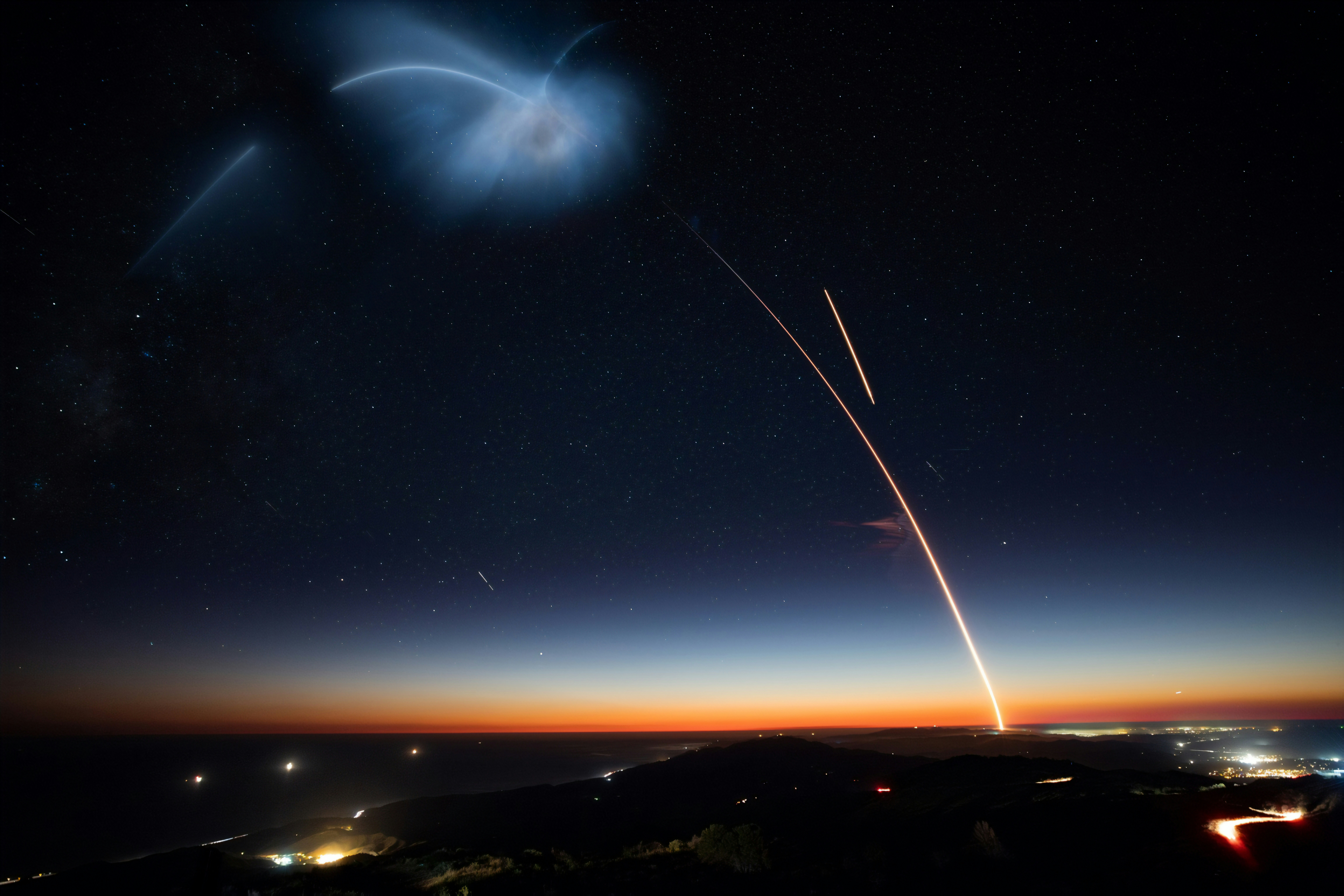
A Starlink spacecraft was imaged by an orbital tracking satellite in the moments before it broke apart, producing one of the more striking pieces of space photography seen in recent months. The incident highlights the dual-edged reality of operating a mega-constellation at Starlink’s scale: with over 10,000 active satellites in low Earth orbit, even a small percentage of anomalous breakups can contribute meaningfully to the debris environment that threatens all orbital operators.
The cause of the breakup has not been publicly confirmed by SpaceX, and it remains unclear whether the event was a controlled or uncontrolled fragmentation. Satellite trackers and debris-monitoring organizations will be watching closely to determine how many trackable objects were generated and what orbital bands they occupy, particularly given Starlink’s densely populated shell altitudes.
Read the full story: Space.com
SpaceX Confidentially Files for IPO That Could Rewrite the Record Books
SpaceX has taken its most concrete step yet toward going public, submitting a confidential IPO filing with the SEC that sources say targets a $1.75 trillion valuation and an $80 billion capital raise — either figure alone would rank among the largest in stock market history. The move is driven in large part by Starlink’s rapid monetization, which has transformed what was once a speculative broadband venture into a cash-generating global internet provider with millions of subscribers across consumer, maritime, aviation, and government segments.
Reports also indicate the filing is intertwined with a prospective merger with xAI, Elon Musk’s artificial intelligence company, which would add a significant technology dimension to SpaceX’s public market narrative. Industry observers note that a successful IPO at this scale could be a watershed moment for the commercial space sector broadly, unlocking new capital flows and setting valuation benchmarks that ripple across the entire industry.
Read the full story: TESLARATI
Space Leaders See SpaceX IPO as Watershed Moment for the Industry
Beyond the raw financial figures, the SpaceX IPO filing is being received by space industry insiders as a symbolic and structural turning point for commercial space as an asset class. For years, the sector has struggled to attract mainstream institutional capital at scale, with most space companies remaining privately held or going public through SPAC vehicles that often disappointed investors — making a successful SpaceX debut on traditional exchanges potentially transformative for how Wall Street prices space risk and opportunity.
SpaceNews reports that the confidential nature of the filing, standard practice for large IPOs under the JOBS Act, suggests SpaceX is still in early stages and may target a mid-2026 public debut depending on market conditions. Should the offering proceed at anywhere near the rumored valuation, it would not only be the largest IPO in history but would also place Starlink’s satellite infrastructure at the center of a publicly traded entity scrutinized by millions of retail and institutional investors worldwide.
Read the full story: SpaceNews
Constellation Status
The Starlink constellation has remained stable since the last check, with no new launches or orbital changes recorded. As of April 2, 2026, SpaceX maintains 11,695 total launched satellites, of which 10,153 remain in orbit and 10,144 are operational, while 1,542 have decayed from their orbits.
- Total Launched: 11695
- Total On Orbit: 10153
- Total Working: 10144
Track Starlink satellites in real-time: Track Starlink

B1049