· x report · 5 min read
Falcon Heavy Returns After 18-Month Hiatus | KeepTrack X Report
SpaceX's Falcon Heavy flew for the first time in 18 months on April 29, while Starlink hit 51 Falcon 9 launches in 2026 with 10,280 satellites working.

Latest Developments
SpaceX marked a significant week with the return of Falcon Heavy after an 18-month stand-down, a milestone captured in striking detail by orbital imaging satellites. On the constellation front, the Starlink 17-36 mission — SpaceX’s 51st Falcon 9 launch of 2026 — added another 24 satellites to a network now numbering 10,280 operational spacecraft out of 10,296 in orbit across 11,877 total launched. Meanwhile, NASA’s lunar ambitions absorbed a fresh blow as Artemis 3 officially slipped to late 2027, with both Starship and Blue Moon lander delays threatening to push the first crewed Moon landing since Apollo to 2028 or beyond.
Space Safety
The Starlink conjunction threat picture for early-to-mid April 2026 presents a moderate overall risk environment with no HIGH-risk events currently flagged, though four MODERATE-risk conjunctions warrant continued monitoring. The highest-probability event involves STARLINK-33563 and COSMOS 2251 DEB (a non-operational debris object) on Apr 13, 2026 at 21:44 UTC with a 39.7% collision probability. Concurrently, 11 Starlink satellites are predicted to reenter Earth’s atmosphere between May 1-4, 2026, with decay windows ranging from 1 to 2,880 minutes; none are flagged as high-interest objects, indicating nominal end-of-life operations.
| Risk | Starlink Sat | Other Object | Status | Min Range (km) | Rel Speed (km/s) | Max Prob | Time of Closest Approach |
|---|---|---|---|---|---|---|---|
| MODERATE | STARLINK-33563 | COSMOS 2251 DEB | Non-operational | 0.012 | 11.318 | 0.3973 | Apr 13, 21:44 UTC |
| MODERATE | STARLINK-5601 | DELTA 1 DEB | Non-operational | 0.014 | 8.499 | 0.3479 | Apr 11, 06:26 UTC |
| MODERATE | STARLINK-33680 | FLOCK 4G-17 | Operational | 0.024 | 12.627 | 0.1287 | Apr 9, 13:55 UTC |
| MODERATE | STARLINK-35339 | THEA | Operational | 0.022 | 14.110 | 0.1272 | Apr 11, 01:33 UTC |
| LOW | STARLINK-32841 | YAOGAN-43 01D | Operational | 0.038 | 9.497 | 0.0672 | Apr 11, 14:30 UTC |
| LOW | STARLINK-36431 | WT 1B | Unknown | 0.052 | 1.153 | 0.0450 | Apr 14, 13:45 UTC |
| LOW | STARLINK-32376 | OBJECT AD | Operational | 0.046 | 11.243 | 0.0441 | Apr 12, 08:38 UTC |
| LOW | STARLINK-30245 | SL-19 R/B | Non-operational | 0.037 | 14.371 | 0.0441 | Apr 7, 16:55 UTC |
| LOW | STARLINK-35657 | ION SCV-008 | Operational | 0.041 | 13.969 | 0.0390 | Apr 12, 19:09 UTC |
| LOW | STARLINK-31383 | TEVEL2-7 | Operational | 0.038 | 14.746 | 0.0384 | Apr 8, 19:55 UTC |
| Satellite | NORAD ID | Predicted Decay | Window (min) | Inclination | Lat | Lon |
|---|---|---|---|---|---|---|
| STARLINK-30189 | 57430 | May 1, 07:49 UTC | 1 | 43° | -41.9° | 227.9° |
| STARLINK-2238 | 48584 | May 1, 20:00 UTC | 1 | 53° | 30.0° | 106.6° |
| STARLINK-1832 | 46780 | May 2, 04:13 UTC | 1,080 | 53° | -46.3° | 20.6° |
| STARLINK-32730 | 62447 | May 2, 17:20 UTC | 1,440 | 53.2° | -7.7° | 312.8° |
| STARLINK-4349 | 53044 | May 3, 03:10 UTC | 2,880 | 97.6° | 7.1° | 233.8° |
| STARLINK-1799 | 46699 | May 3, 11:24 UTC | 2,880 | 53° | 53.1° | 338.1° |
| STARLINK-33906 | 63785 | May 3, 17:50 UTC | 2,880 | 43° | 1.7° | 327.6° |
| STARLINK-1975 | 47573 | May 4, 08:47 UTC | 2,880 | 53° | 31.9° | 59.0° |
| STARLINK-31761 | 59615 | May 4, 08:48 UTC | 2,880 | 43° | 0.6° | 57.9° |
| STARLINK-1567 | 46038 | May 4, 09:28 UTC | 2,880 | 53.1° | -52.4° | 105.6° |
| STARLINK-5228 | 54180 | May 4, 16:52 UTC | 2,880 | 53.2° | -47.2° | 277.3° |
Detailed Coverage
Falcon Heavy Roars Back: Satellite Imagery Captures Stunning Launch From Orbit
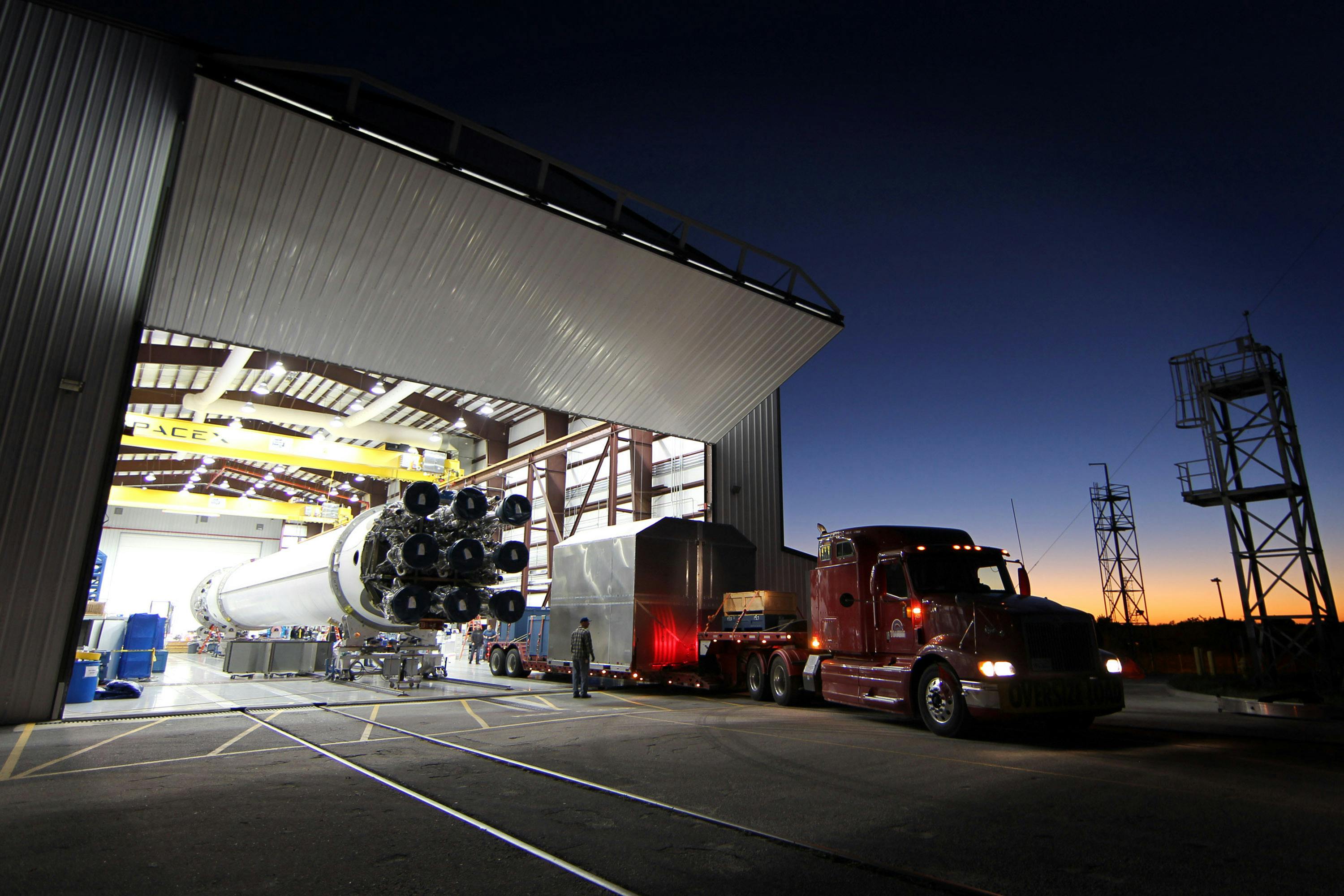
SpaceX’s workhorse heavy-lift vehicle made its long-awaited return on April 29, completing its first flight in 18 months and reminding the industry that the world’s most powerful operational rocket is still very much in the game. The launch drew immediate attention not only for its rarity but for the perspective it offered — a sharp-eyed Earth-observation satellite captured the Falcon Heavy’s ascent from orbit, producing imagery that showcased the rocket’s distinctive triple-booster exhaust plume against the curvature of the planet.
The 18-month gap between flights underscored how infrequently Falcon Heavy missions materialize compared to the relentless cadence of Falcon 9, but also how SpaceX maintains readiness across its fleet. The satellite photos serve as a reminder that low Earth orbit is now dense enough with tracking and imaging assets that virtually no launch goes unobserved — a dynamic with growing implications for launch transparency and space situational awareness.
Read the full story: Space.com
51st Falcon 9 of 2026: Starlink 17-36 Lifts Off From Vandenberg
SpaceX added another 24 Starlink satellites to its constellation on April 29 with the Starlink 17-36 mission, lifting off from Space Launch Complex 4E at Vandenberg Space Force Base at 7:42:49 pm PDT. The mission marked the company’s 51st Falcon 9 launch of 2026, a pace that, if sustained, would push the annual total well past last year’s record. With 10,296 Starlink satellites now in orbit and 10,280 confirmed working, the constellation continues to operate at remarkable efficiency with fewer than 20 non-functional spacecraft on-orbit.
From a tracking standpoint, each new Vandenberg-launched batch populates the high-inclination orbital shells that extend Starlink’s coverage toward the poles, filling gaps that lower-inclination launches from Florida cannot address. Observers monitoring conjunction data will note the steady accumulation of objects in these shells adds complexity to space traffic management, even as SpaceX’s deorbit compliance record remains a closely watched metric.
Read the full story: Spaceflight Now
Artemis 3 Slips to Late 2027 as Starship and Blue Moon Fall Behind Schedule
NASA has officially pushed Artemis 3 — the mission intended to return humans to the lunar surface for the first time since 1972 — to no earlier than late 2027, with a crewed Moon landing now unlikely before 2028. The delay stems from two simultaneous development lags: SpaceX’s Starship Human Landing System has yet to demonstrate the orbital refueling and lunar descent capabilities required for certification, while Blue Origin’s Blue Moon lander faces its own schedule pressures as a competing option.
The slip is significant not only for NASA’s exploration timeline but for SpaceX, which has staked considerable prestige and contract value on Starship’s HLS role. Every month of delay increases political and budgetary scrutiny on a program already operating under a changed fiscal environment. For Starlink watchers, the Artemis context matters too — Starship’s development trajectory directly influences SpaceX’s capacity to conduct next-generation Starlink launches using the V3 architecture, meaning lunar ambitions and broadband expansion are more intertwined than they might appear.
Read the full story: Space.com
Constellation Status
No changes have been recorded in the Starlink constellation since the last check. As of April 23, 2026, the constellation remains stable with 11,877 satellites launched, 10,296 currently in orbit, 10,280 operational, and 1,581 decayed.
- Total Launched: 11877
- Total On Orbit: 10296
- Total Working: 10280
Track Starlink satellites in real-time: Track Starlink

B1049