· x report · 4 min read
Starship Flight 12 Targeting Mid-May with Revised Trajectory | KeepTrack X Report
SpaceX eyes a mid-May Starship Flight 12 launch with a revised trajectory, while Falcon 9 adds 29 more Starlink satellites to a 10,280-working constellation.
Latest Developments
SpaceX is targeting mid-May for Starship’s twelfth integrated flight test, with revised trajectory plans signaling meaningful changes from prior missions as the program pushes toward full reusability. On the Starlink front, the Starlink 10-38 mission successfully deployed 29 satellites from Cape Canaveral on May 1, continuing the steady cadence that has built the constellation to 10,280 operational satellites out of 10,296 in orbit across 11,877 total launched. Meanwhile, investor and industry attention is broadening beyond the constellation itself, with analysts examining the longer-term opportunity in orbital data center infrastructure that ventures like SpaceX are positioning to enable.
Space Safety
The current Starlink conjunction threat landscape shows four moderate-risk events concentrated within a six-day window in mid-April 2026, with the highest-risk conjunction involving STARLINK-33563 and COSMOS 2251 DEB at 0.012 km minimum range and 39.7% collision probability. No HIGH-risk conjunctions are currently flagged in the SOCRATES dataset; however, the prevalence of moderate-risk events with non-operational debris objects warrants continued monitoring. Additionally, TIP predictions indicate 10 Starlink satellites with imminent reentry decay epochs spanning May 1–4, 2026, with decay windows ranging from 1 minute to 2,880 minutes (48 hours), reflecting varying degrees of prediction uncertainty.
| Risk | Starlink Sat | Other Object | Status | Min Range (km) | Rel Speed (km/s) | Max Prob | Time of Closest Approach |
|---|---|---|---|---|---|---|---|
| MODERATE | STARLINK-33563 | COSMOS 2251 DEB | Non-operational | 0.012 | 11.318 | 0.3973 | Mon, 13 Apr 2026 21:44:26 UTC |
| MODERATE | STARLINK-5601 | DELTA 1 DEB | Non-operational | 0.014 | 8.499 | 0.3479 | Sat, 11 Apr 2026 06:26:32 UTC |
| MODERATE | STARLINK-33680 | FLOCK 4G-17 | Operational | 0.024 | 12.627 | 0.1287 | Thu, 09 Apr 2026 13:55:36 UTC |
| MODERATE | STARLINK-35339 | THEA | Operational | 0.022 | 14.110 | 0.1272 | Sat, 11 Apr 2026 01:33:34 UTC |
| LOW | STARLINK-32841 | YAOGAN-43 01D | Operational | 0.038 | 9.497 | 0.0672 | Sat, 11 Apr 2026 14:30:11 UTC |
| LOW | STARLINK-36431 | WT 1B | Unknown | 0.052 | 1.153 | 0.0450 | Tue, 14 Apr 2026 13:45:48 UTC |
| LOW | STARLINK-32376 | OBJECT AD | Operational | 0.046 | 11.243 | 0.0441 | Sun, 12 Apr 2026 08:38:10 UTC |
| LOW | STARLINK-30245 | SL-19 R/B | Non-operational | 0.037 | 14.371 | 0.0441 | Tue, 07 Apr 2026 16:55:26 UTC |
| LOW | STARLINK-35657 | ION SCV-008 | Operational | 0.041 | 13.969 | 0.0390 | Sun, 12 Apr 2026 19:09:57 UTC |
| LOW | STARLINK-31383 | TEVEL2-7 | Operational | 0.038 | 14.746 | 0.0384 | Wed, 08 Apr 2026 19:55:14 UTC |
| Satellite | NORAD ID | Predicted Decay | Window (min) | Inclination | Lat | Lon |
|---|---|---|---|---|---|---|
| STARLINK-2238 | 48584 | May 01, 20:00 UTC | 1 | 53.0° | 30.0° | 106.6° |
| STARLINK-1832 | 46780 | May 02, 04:13 UTC | 1,080 | 53.0° | -46.3° | 20.6° |
| STARLINK-32730 | 62447 | May 02, 17:20 UTC | 1,440 | 53.2° | -7.7° | 312.8° |
| STARLINK-4349 | 53044 | May 03, 03:10 UTC | 2,880 | 97.6° | 7.1° | 233.8° |
| STARLINK-1799 | 46699 | May 03, 11:24 UTC | 2,880 | 53.0° | 53.1° | 338.1° |
| STARLINK-33906 | 63785 | May 03, 17:50 UTC | 2,880 | 43.0° | 1.7° | 327.6° |
| STARLINK-1975 | 47573 | May 04, 08:47 UTC | 2,880 | 53.0° | 31.9° | 59.0° |
| STARLINK-31761 | 59615 | May 04, 08:48 UTC | 2,880 | 43.0° | 0.6° | 57.9° |
| STARLINK-1567 | 46038 | May 04, 09:28 UTC | 2,880 | 53.1° | -52.4° | 105.6° |
| STARLINK-5228 | 54180 | May 04, 16:52 UTC | 2,880 | 53.2° | -47.2° | 277.3° |
Detailed Coverage
SpaceX Eyes Mid-May Window for Starship Flight 12 with Revised Trajectory
SpaceX is preparing to return Starship to the skies with Flight 12 potentially just weeks away, following regulatory filings and airspace notices that point to a mid-May launch window. The mission is expected to feature a revised flight trajectory compared to previous attempts, a detail that suggests SpaceX engineers have implemented meaningful changes to the vehicle’s ascent profile or landing approach in response to lessons learned from Flights 10 and 11.
For satellite trackers and constellation watchers, a successful Starship flight remains critical to SpaceX’s long-term ambitions — the vehicle is slated to eventually launch next-generation Starlink V3 satellites in batch deployments far larger than current Falcon 9 missions can achieve. Every flight that advances Starship’s maturity brings that high-density deployment cadence closer to reality.
Read the full story: NASASpaceFlight
Falcon 9 Rings in May Day with 29-Satellite Starlink 10-38 Deployment
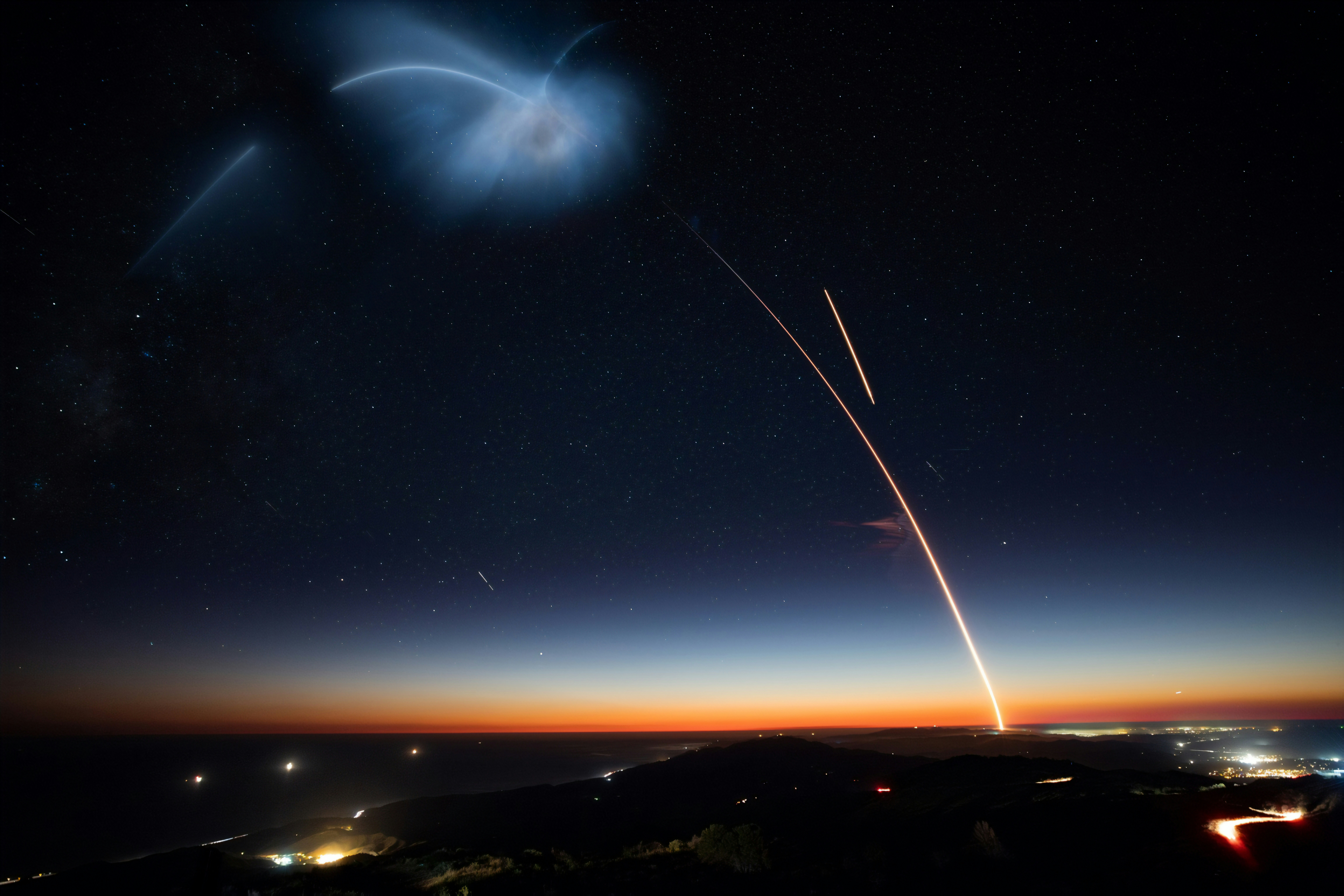
SpaceX opened May with a smooth Falcon 9 launch from Pad 40 at Cape Canaveral Space Force Station, lifting off at 2:06:10 p.m. EDT on May 1 carrying 29 Starlink broadband satellites on the Starlink 10-38 mission. The deployment adds to a constellation now standing at 10,296 satellites in orbit, of which 10,280 are actively working — a testament to the high operational efficiency SpaceX has maintained across the shell.
The booster’s recovery and the mission’s routine execution underscore how thoroughly Falcon 9 has industrialized LEO access. With Starship still in development, Falcon 9 remains the sole workhorse sustaining Starlink’s incremental growth, and missions like 10-38 keep the network’s capacity and redundancy creeping steadily upward ahead of any future V3 generation expansion.
Read the full story: Spaceflight Now
Orbital Data Centers: The Investment Opportunity Forming Behind the Hype
While SpaceX’s proposed orbital computing infrastructure remains years from operational reality, analysts and investors are already mapping the secondary opportunities it could unlock — from edge AI processing to sovereign cloud alternatives for governments unwilling to rely on terrestrial hyperscalers. SpaceNews reports that capital attention is beginning to shift toward ventures positioned to sit on top of orbital data center capacity once it exists, even as the underlying platforms are still in early conceptual stages.
For Starlink observers, the relevance is direct: SpaceX has floated the idea of integrating computing nodes into future satellite generations, which would transform the constellation from a pure connectivity play into a distributed processing network. If that vision advances, the orbital mechanics and slot-management challenges tracked by tools like KeepTrack would become as important to enterprise IT planners as they currently are to space situational awareness analysts.
Read the full story: SpaceNews
Constellation Status
There have been no changes to the Starlink constellation since the last check. The constellation currently consists of 11,877 total launched satellites, with 10,296 remaining in orbit, of which 10,280 are operational, while 1,581 have decayed from orbit.
- Total Launched: 11877
- Total On Orbit: 10296
- Total Working: 10280
Track Starlink satellites in real-time: Track Starlink

B1049