· deep dive · 10 min read
Integrity Comes Home
Six minutes and eighteen seconds of radio silence at 24,661 mph, and then the parachutes appeared. The heat shield question everyone had been asking for three years finally has a preliminary answer - though the full inspection report is still weeks away.
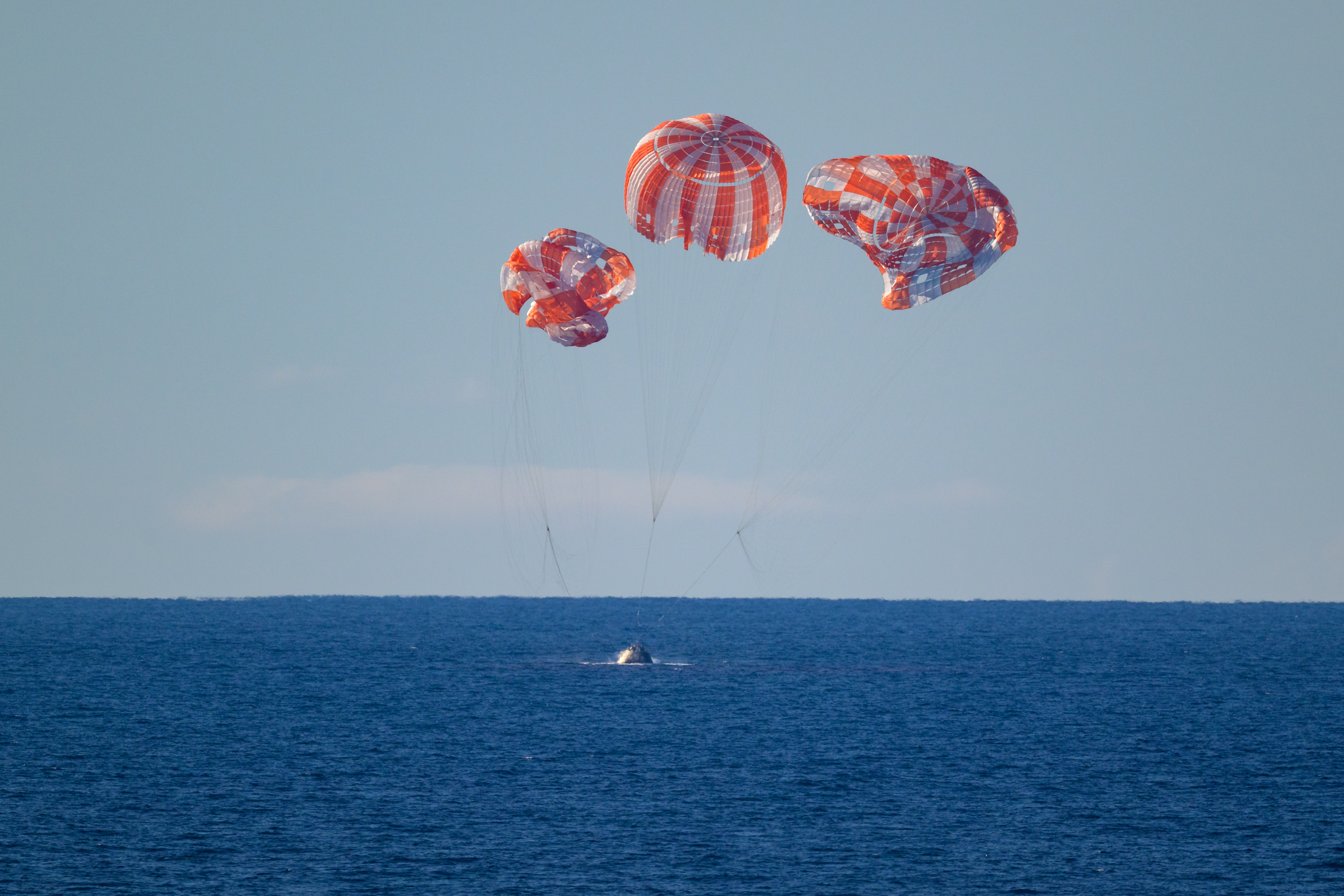
At 7:49 PM Eastern on April 10, 2026, mission controllers in Houston lost all signal from Orion. This was by design. When a spacecraft enters the atmosphere at 24,661 miles per hour, the compressed air ahead of the capsule heats to roughly 5,000 degrees Fahrenheit and forms a plasma sheath that radio waves can’t penetrate. For six minutes and eighteen seconds, Mission Control watched a blank telemetry screen and waited.
What nobody on the ground could confirm for those six minutes was whether the heat shield was doing its job.
That question had been hanging over the Artemis program for three years - ever since post-flight inspections of Artemis I’s Orion capsule revealed that large chunks of the Avcoat ablative material had broken away during that uncrewed mission’s December 2022 reentry. The material was supposed to char and erode in a controlled fashion, carrying thermal energy away from the spacecraft. Instead, over 100 locations showed deep gouges where Avcoat blocks had simply fallen off. NASA spent two years investigating, concluded the root cause was insufficient permeability in the material, and made a calculated decision: rather than replace the Artemis II heat shield - which had already been built and installed before Artemis I even flew - they would change the reentry profile instead.
Instead of the skip reentry used on Artemis I, where the capsule dips into the atmosphere, bounces out, then enters again, Orion would fly a direct, steeper entry. This reduced the time at peak heating and was supposed to prevent the gas-accumulation cycle that caused the chunking. It imposed higher g-forces on the crew, but the engineering analysis said it was the safer option for the shield. The Flight Readiness Review had voted unanimously “go” on March 12. Not everyone was convinced.
At 7:55 PM, the signal came back. Drogue parachutes had deployed at approximately 25,000 feet. Three main parachutes, each 116 feet in diameter, spread open over the Pacific. At 8:07 PM Eastern, Orion splashed down approximately 40 miles off the coast of San Diego. Mission Control called it a “perfect bullseye splashdown.” Orion program manager Howard Hu, aboard USS John P. Murtha and waiting with two heat shield specialists for this moment, told reporters in the hours that followed that initial visual inspections showed “no obvious issues” with the heat shield.
“No obvious issues” is not a full exoneration - the capsule won’t undergo detailed analysis until it reaches Kennedy Space Center - but it was a sentence a lot of people needed to hear.
The Recovery
Navy divers had been staged about a nautical mile from the predicted splashdown point. Standard procedure after an Orion splashdown requires a 30-to-45-minute hold while fumes from the reaction control system’s hydrazine-based thrusters dissipate around the capsule. Hydrazine is toxic enough that nobody approaches the vehicle until air monitoring confirms it’s safe. While they waited, Orion floated upright - the capsule’s geometry and ballast are designed for this, which simplified the recovery considerably compared to the uprighting operations that followed some Apollo splashdowns.
Once the all-clear came, divers moved in to install a stabilization collar and extraction raft around the forward hatch. A pair of MH-60S Sea Hawk helicopters hovered overhead. One by one, each crew member was assisted through the hatch, placed in a rescue basket, and hoisted up. Jeremy Hansen was first out, waving to the recovery crew and walking unaided to the medical bay. Victor Glover followed on his own feet, which was notable given the mission’s duration - ten days of microgravity does a number on the cardiovascular system, and post-flight walking is rarely as effortless as astronauts make it appear in press conference footage.
All four crew members were aboard USS John P. Murtha within roughly two hours of splashdown. NASA described them as in “good health.” Commander Wiseman radioed from the ship that everyone was doing well. Given everything the mission had thrown at the crew - the toilet malfunctions on Days 1 and 3, the heat shield uncertainty, ten days in a capsule the size of a large van roughly 250,000 miles from the nearest hospital - “doing well” seemed like appropriate understatement.
The crew was expected to fly back to Johnson Space Center on April 11 for the standard post-mission medical battery: cardiovascular workups, bone density scans, neurological assessments, and the rehabilitation program that begins reacquainting a returning astronaut’s body with a gravity field it hasn’t fully experienced in over a week.
ESM Separation
Orion separates from the European Service Module, which burns up separately in the atmosphere. Orion reorients heat shield-forward for atmospheric entry.
Entry Interface / Blackout Begins
Orion hits the upper atmosphere at approximately 400,000 feet altitude. Plasma forms around the capsule, cutting off all radio communication with Mission Control.
Signal Restored
Telemetry returns to Mission Control after six minutes eighteen seconds of blackout. Drogue parachutes confirmed deployed at approximately 25,000 feet.
Main Parachutes Deploy
Three 116-foot parachutes open, slowing Orion from several hundred mph to approximately 17 mph for water impact.
Splashdown
Orion splashes down ~40 miles off San Diego. Mission Control: 'Welcome home, Integrity. A perfect bullseye splashdown.'
Hatch Opens
Navy divers clear hazardous fumes and open the hatch. Jeremy Hansen exits first, walking unaided to the recovery raft.
Crew Aboard USS John P. Murtha
All four astronauts are on the recovery ship and begin post-mission medical evaluations. All reported in good health.
What Got Broken
The record that Artemis II set on April 6, during the lunar flyby, had stood for 56 years. At maximum distance, the four crew members were 252,756 miles from Earth - approximately 4,111 miles farther from home than any human had ever been. The previous record belonged to the crew of Apollo 13, and it wasn’t a triumph of planning. Lovell, Swigert, and Haise reached that distance in April 1970 because an oxygen tank had exploded in their service module and they had no choice about the trajectory. Their record was accidental. The Artemis II crew broke it on purpose.
The 53-year gap between the last humans to leave low Earth orbit and these four is a number that generates a lot of reflection, and most of it is warranted. There are engineers working on Artemis IV - the mission that will attempt a lunar landing - who were in grade school when Gene Cernan climbed back into the lunar module in December 1972 and became, without knowing it, the last person to stand on the Moon. An entire generation of the aerospace workforce has spent careers in the space industry without ever supporting a crewed mission beyond the International Space Station’s 400-kilometer orbit. Artemis II changed that.
The crew diversity records are historical too, and worth stating plainly: Victor Glover became the first Black person to travel beyond low Earth orbit. Christina Koch became the first woman to leave low Earth orbit. Jeremy Hansen became the first non-American - and the first Canadian - to reach cislunar space. These firsts should have happened sooner than 2026. The Apollo program’s crews were selected from a pool that was narrowed by institutional design, not by the scarcity of qualified candidates. The fact that it took another half-century to broaden the roster is a statement about the pace of institutional change.
The path to the lunar surface is open. This time, we returned to stay.
Glover’s position on this is worth noting. In the lead-up to launch, he was characteristically direct: “I’m proud of what this means. But I’m on this crew because of what I’ve done, not what I represent.” Both things are true simultaneously, and he went to the Moon and back on April 1, becoming the farthest-traveled Black person in human history. That he’d find the framing somewhat beside the point doesn’t make the milestone any less real for the people watching.
The Shield, Still Under Examination
The Orion capsule is in transit back to Kennedy Space Center’s Landing and Recovery Operations facility, where technicians will spend weeks doing the kind of analysis that simply isn’t possible on a recovery ship in the Pacific. The inspection will map every square inch of the Avcoat surface with visual documentation, use ultrasonic and X-ray equipment to detect internal cracking, measure char depths across the entire heat shield face, and compare every measurement against the pre-flight baseline.
Hu had specifically positioned heat shield specialists aboard USS John P. Murtha so the initial evaluation could begin within hours of recovery rather than days. The fact that those specialists didn’t flag major visible damage in their first look is a reasonable signal - but the Artemis I heat shield also looked survivable from a distance before detailed scans revealed the extent of the internal damage. The data will be the data.
If the inspection confirms that the direct-entry profile produced controlled, predictable ablation rather than large-chunk separation, it closes the most consequential open question in the Artemis program since the heat shield investigation began. NASA will have a verified reentry profile for crewed lunar returns. The Avcoat concern shifts from an unresolved design risk to a solved parameter.
If the inspection finds significant damage despite the modified profile, NASA faces a harder conversation before Artemis IV - the mission that would carry two astronauts to a lunar surface landing and require another full-speed reentry afterward. The heat shield design for that vehicle incorporates material changes to improve Avcoat permeability, but the performance of the Artemis II shield under the direct-entry loads will either validate or complicate those design assumptions.
What Comes Next
The mission’s ten days generated data across nearly every system aboard Orion. The AVATAR organ-on-a-chip investigation - which used biological microdevices to study how the deep-space radiation environment and microgravity affect human tissue - will take months to fully analyze. The Orion Artemis II Optical Communications System, which tested laser-based data transmission between the spacecraft and Earth, has preliminary results that program managers described in pre-splashdown briefings as promising; if it performs as hoped, future Artemis missions could transmit high-definition video from the lunar surface rather than the compressed feeds that have been the norm since the Apollo era.
Every sensor on the spacecraft also logged the thermal, radiation, and systems performance data that mission planners for Artemis III, IV, and beyond will need. The toilet will get its own post-flight review - the Universal Waste Management System’s malfunctions on Days 1 and 3 generated specific engineering data about the Dual Fan Separator and the overboard vent line’s behavior in deep-space thermal conditions. Collins Aerospace will be studying that data closely. Artemis IV requires a toilet that works reliably for an extended lunar surface mission, not one that needs capsule reorientation to thaw a frozen pipe.
The broader Artemis timeline, per the restructuring NASA administrator Jared Isaacman announced in February, places Artemis III as a low-Earth-orbit systems test in 2027 and Artemis IV - the first crewed lunar landing - in early 2028. Artemis II’s successful return, if the heat shield inspection confirms the initial assessment, gives that schedule something it has lacked since the program was revived: hardware evidence that the architecture actually works. Before April 10, “early 2028 lunar landing” was a planning target built on Artemis I data and analytical models. After April 10, it’s a planning target built on a vehicle that flew four humans to the Moon and back, at 24,661 miles per hour through the atmosphere, without losing anyone.
Fifty-three years is a long time for a species to stay this close to home. For nine days, four people changed that. If the engineering holds, and the budgets hold, and the institutional momentum from this mission carries into the next, others will follow them out there.
The countdown to Artemis IV is, in some sense, already running.
References(12)
- Splashdown! Artemis 2 Astronauts Return to Earth - Space.com
- NASA Welcomes Record-Setting Artemis II Moonfarers Back to Earth - NASA
- Artemis II Flight Day 10 Re-Entry Live Updates - NASA
- NASA's Artemis II Crew Eclipses Record for Farthest Human Spaceflight - NASA
- Artemis II Astronauts Splash Down off California's Coast - CNN
- USS John P. Murtha to Support NASA's Artemis II Mission - U.S. Navy
- Artemis II Crew Splashes Down Near San Diego - CBS News
- Highlights: Artemis II Astronauts Splash Down Safely - NBC News
- NASA Confident Artemis 2 Heat Shield Will Protect Crew During Re-Entry - Spaceflight Now
- Navy Divers, Ship Recover Artemis II Crew After Splashdown - Task & Purpose
- NASA Identifies Cause of Artemis I Orion Heat Shield Char Loss - NASA (December 2024)
- Artemis II Mission Overview - NASA

Theodore Kruczek