· deep dive · 9 min read
Etlaq Spaceport
The Middle East's first commercial spaceport is building launch heritage one rocket at a time. How Oman is positioning Duqm as a global launch hub - and what the 2025 delays tell us about the real pace of spaceport development.

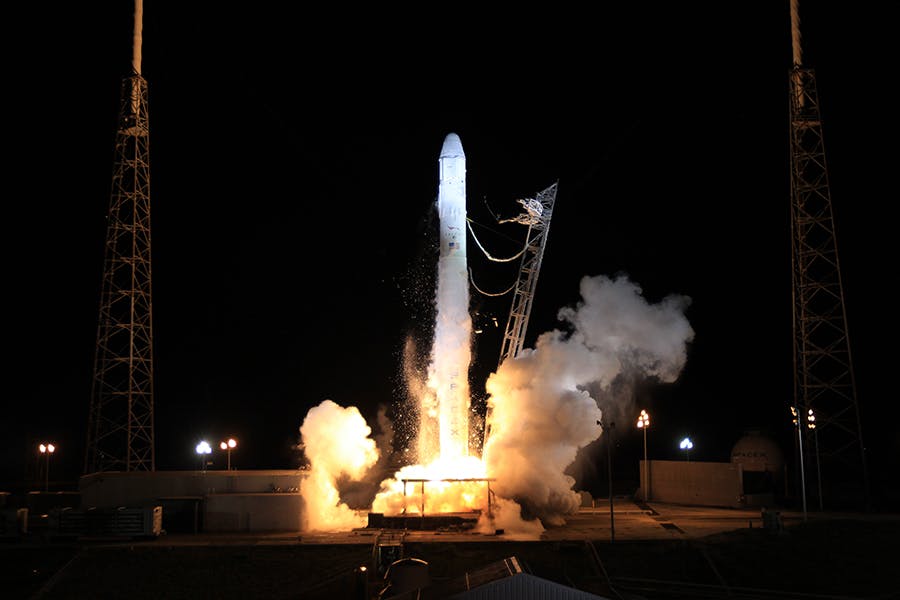
In December 2024, a rocket called Duqm-1 lifted off from Oman’s southeastern coast, marking the Middle East and North Africa’s first commercial spaceport launch. It wasn’t orbital - the 6.5-metre rocket reached 140 kilometers altitude, crossing the Kármán line on a suborbital trajectory. But it was the beginning of something deliberately methodical: Oman’s plan to build a “national space launch heritage” before anyone expects orbital operations. The strategy is unconventional. It might also be brilliant.
His Highness Sayyid Azzan bin Qais Al Said, founder and CEO of the National Aerospace Services Company (NASCOM) and Etlaq Spaceport, calls it the Genesis Programme. The name evokes both biblical creation and Oman’s maritime history - a nation of navigators and seafarers now looking upward instead of across the waves. As Sayyid Azzan puts it: “You don’t become a spaceport by announcing orbital capability. You become a spaceport by launching rockets, learning lessons, and building competence incrementally.”
It’s a refreshingly honest approach in an industry where announcements routinely outpace achievements. The decision to focus on suborbital and experimental launches before pursuing orbital capability demonstrates operational realism - building competence before betting big. The suborbital focus also positions Etlaq to pivot if full orbital operations don’t materialize. If commercial orbital launches don’t come together as planned, they can still operate as a valuable suborbital launch and testing facility. Whether this reflects strategic brilliance or prudent hedging is impossible to know from the outside, but it’s worth noting that the business model doesn’t require orbital success to survive.
The 2025 Launch Manifest: Plans vs. Reality
Etlaq announced an ambitious five-launch manifest for 2025. As of December 2025, the reality has been more complicated:
Duqm-1 Success
First commercial launch from MENA region. 6.5m rocket reached 140km altitude.
UNITY-1 Delayed
UK-based Advanced Rocket Technologies' Horus-4 encountered heavy winds on April 28, then landing leg deployment issues on May 4. Rescheduled to Q3.
Duqm-2 No Ignition
Stellar Kinetics' Kea-1 completed ground ops but a COTS valve actuator issue prevented launch on July 13.
Remaining Missions
Duqm-3 (October), Ambition-3 (November), Duqm-4 (December) still scheduled, outcomes uncertain.
PLD Space Orbital Attempt
First Miura 5 orbital launch planned from Etlaq.
This isn’t necessarily alarming. The stated purpose of the Genesis Programme was to learn, and delays teach as much as successes. But Oman launched Duqm-1 in December 2024 to prove capability, and since then the 2025 manifest has experienced significant friction. The operational cadence they’re trying to establish is proving harder to achieve than initial schedules suggested.
These suborbital and experimental launches still require tracking attention even when nothing reaches orbit. Rockets crossing the Kármán line generate radar signatures, and international launches from an unfamiliar location benefit from observational practice. The 2025 delays reduce this tracking experience but don’t eliminate the need to monitor Duqm as an emerging launch point.
PLD Space: The European Connection
The February 2025 announcement that Spain’s PLD Space would operate from Etlaq transformed the facility from regional curiosity to potential European launch alternative. The agreement brings the Miura 5 orbital rocket to Omani soil starting 2027.
PLD Space needs multiple spaceports to meet their manifest of 30 flights by 2030. They’re already building at the Centre Spatial Guyanais in French Guiana. Etlaq becomes their second site, with a third location expected to be announced in the coming year.
The possibility of European launch activity finding a home in Oman is genuinely interesting, but significant European investment in Middle Eastern space facilities deserves some skepticism. The broader region has experienced periodic conflict, and there’s real concern about launching valuable satellites from an area where geopolitical tensions could theoretically result in a rocket being misidentified as a ballistic missile. Even if Oman itself remains stable, regional conflict could delay logistics, disrupt supply chains, and postpone launches indefinitely. European customers need to weigh geographic advantages against these operational risks. Etlaq probably won’t replace Kourou - it’s more likely to provide diversification and customer proximity options rather than becoming Europe’s primary launch site.
Geographic Advantages
Etlaq’s location at Duqm on Oman’s southeastern coast offers genuine orbital mechanics benefits:
Equatorial Proximity: At 18 degrees north latitude, Etlaq offers better fuel efficiency for geostationary and low-inclination orbits than higher-latitude sites. Every kilogram of propellant saved translates to additional payload capacity or reduced launch costs.
Ocean Downrange: The Arabian Sea provides safe splash-down zones for spent stages and abort scenarios. Rockets launch eastward over open ocean with no populated areas in immediate flight paths.
Logistics: Duqm has port facilities, industrial zones, and existing infrastructure supporting Oman’s non-petroleum economic development strategy. The nearby commercial airport and deepwater port provide critical logistical capabilities for satellite missions.
Three Launch Complexes
Etlaq’s master plan includes three distinct launch complexes serving different vehicle classes. LC1 handles heavy-lift rockets with full payload processing, vehicle integration, and mission control - flagship infrastructure designed for the largest missions. LC2 targets medium-class vehicles like Miura 5, with high-efficiency pads optimized for rapid turnaround and constellation deployment. LC3, with two pads, focuses on Electron-class and smaller rockets, incorporating an Engine Test Facility and suborbital support for development and testing.
This tiered approach allows Etlaq to serve multiple market segments simultaneously. Small satellite operators don’t compete for pad time with heavy-lift missions. Development testing doesn’t block commercial operations.
The Regional Context
Etlaq isn’t just building a business - it’s building a sector. Oman’s broader space ambitions include developing domestic expertise, creating high-skilled jobs, and diversifying the economy beyond hydrocarbons.
The MOU signed between Oman’s Ministry of Transport, Communications, and Information Technology and NASCOM grants the company “Qualified Entity” status for building and operating spaceports - a formal recognition of Oman’s ambitions to become a regional hub for space services and applications. SatMENA’s ground station services agreement ensures communication support for upcoming launches.
Regional partnerships extend beyond Oman’s borders. Kuwait Space Rockets’ Ambition-3 launch demonstrates Gulf cooperation. UK, European, and New Zealand companies are already contracted. The positioning is explicitly international rather than nationalist.
This matters for tracking operations because Etlaq’s customer base will be diverse. Expect varying rocket designs, mission profiles, and operational cadences from different providers. The catalog additions won’t be uniform “Etlaq launches” - they’ll be heterogeneous missions from international customers using shared infrastructure.
Risk Assessment
How should we evaluate Etlaq’s trajectory? The honest answer involves significant uncertainty but identifiable strengths.
| Factor | Type | Assessment |
|---|---|---|
| Genesis Programme philosophy | Strength | Realistic, incremental development approach |
| Government backing | Strength | Integrated with Oman Vision 2040 economic strategy |
| European partner (PLD Space) | Strength | Major launch provider committed for 2027 |
| Geography & weather | Strength | 18°N latitude, 300+ clear days/year |
| International partnerships | Strength | UK, EU, NZ, Kuwait companies contracted |
| Regulatory framework | Strength | 45-day launch approval process established October 2025 |
| Orbital track record | Risk | No orbital launches demonstrated yet |
| Miura 5 status | Risk | PLD Space rocket hasn’t reached orbit yet |
| Regional stability | Moderate Risk | Oman stable, broader region uncertain |
| 2025 launch delays | Risk | Operational challenges not yet resolved |
| Commercial demand | Risk | Viability depends on customer materialization |
Geopolitical Risk (Moderate): Oman has been stable, but the broader Middle East has experienced periodic conflict for decades. Satellite customers may be nervous about launching from a region where logistics disruptions or misidentification of launch vehicles remain theoretical possibilities. This risk doesn’t doom Etlaq, but it likely limits its ceiling as a European alternative.
In terms of timeline confidence: the 2025 suborbital and demonstration launches have been partially achieved with significant delays. The first PLD Space orbital attempt in 2027 carries moderate confidence, depending heavily on Miura 5 development progress. Sustained orbital operations in 2028-2029 have lower near-term confidence, though that should improve over time as capabilities mature.
Net assessment: Etlaq is pursuing a credible development path, but the 2025 delays indicate operational reality is harder than initial schedules suggested. The Genesis Programme’s incrementalism reduces risk of spectacular failure while building genuine capability. The 2027 orbital target remains achievable if PLD Space’s Miura 5 development stays on track.
Tracking Considerations
For those monitoring global launch activity, Etlaq introduces several factors worth noting:
New Launch Location: Southeastern Oman represents a new geographic origin point for tracked objects. Trajectories from Duqm differ from established sites; coverage planning should account for Arabian Sea initial orbits.
Diverse Vehicle Types: Multiple rocket designs from multiple countries mean varied TLE characteristics. Don’t assume uniformity.
Phased Tracking Requirements: Suborbital missions in 2025-2026 generate tracking practice without catalog additions. Orbital missions starting 2027 will require full characterization.
Launch Cadence Reality Check: The original expectation of 5+ suborbital missions in 2025 has not materialized as planned. Adjust near-term expectations accordingly, while keeping 2027 orbital targets on the radar.
Regional Coordination: Oman’s Civil Aviation Authority established a formal spaceflight framework in October 2025, with 45-day launch approval cycles. International coordination for airspace and maritime safety follows established patterns.
The 2027 Inflection Point
Everything changes if PLD Space successfully reaches orbit from Etlaq in 2027. The facility transforms from “interesting experiment” to “operational spaceport.” European customers gain a non-European alternative. Middle Eastern operators have a regional option for the first time.
The alternative scenario - continued delays or Miura 5 failures - doesn’t necessarily doom Etlaq. The Genesis Programme explicitly prepares for orbital operations rather than betting everything on a single rocket. Other providers could fill the gap. But timelines would slip, and competitive pressure from established sites would intensify.
For tracking operations, 2027 deserves a calendar flag. If PLD Space delivers, Etlaq becomes a routine catalog contributor relatively quickly. If not, recalibrate expectations for 2028-2029.
Conclusion
Etlaq represents something genuinely new: a major commercial spaceport emerging in a region that previously had none. The development philosophy is mature - building competence through deliberate practice rather than hoping for breakthrough success. The European partnership with PLD Space provides a near-term orbital pathway. The geographic advantages are real.
The risks are equally real. Neither Etlaq nor PLD Space has reached orbit. The 2025 manifest has experienced significant delays. Regional considerations may limit European enthusiasm for Middle Eastern launch alternatives. But the foundation being laid appears solid, even if the timeline has proven more challenging than initial announcements suggested.
Oman’s seafaring heritage taught them that you don’t become a maritime power overnight. You build ships, train sailors, establish ports, and accumulate experience over generations. They’re applying the same logic to space. The Genesis Programme might sound like marketing, but it describes a genuinely patient approach to capability development.
Add Duqm to the map. By 2027, it might be contributing regular entries to the catalog - but don’t be surprised if that timeline slips another year.
References(8)
- PLD Space Picks Oman's Etlaq Spaceport - Via Satellite
- PLD Space MIURA 5 to Launch from Etlaq Spaceport in 2027 - TLP Network
- Etlaq Spaceport to Launch Five Rockets in 2025 - Muscat Daily
- Etlaq Spaceport Releases 2025 Launch Schedule - Payload
- Duqm-2 Launch Aborted Due to Technical Glitch - Oman Observer
- Unity-1 Press Release - Advanced Rocket Technologies
- Oman Set for Launch as Regulator Announces Spaceflight Framework - Etlaq
- Etlaq Spaceport Official Website

Theodore Kruczek