· space brief · 8 min read
Rocket Lab Locks 5-Launch Neutron Deal, Q4 2026 Debut | KeepTrack Space Brief
Rocket Lab secures five-launch Neutron contract ahead of Q4 2026 first flight. Medium-lift reusable rocket scheduled for recovery ops on mission two.

Top Stories
Rocket Lab Signs Five-Launch Neutron Deal, First Flight Still Q4 2026
Rocket Lab announced a five-launch contract for its Neutron rocket while maintaining a no-earlier-than Q4 2026 debut target. The schedule slipped earlier this year after a first stage tank test failure. The first Neutron flight won’t attempt reuse — recovery is planned for the second flight, using a landing barge.
Neutron is designed as a medium-lift reusable vehicle targeting the commercial and government payload market. The five-launch deal gives Rocket Lab its first confirmed Neutron manifest before the rocket has flown.
Read the full story: Spaceflight Now
NASA and Space Force to Launch Ring Current Mission This Month
NASA, in partnership with the U.S. Space Force, plans to launch a space weather mission later in May to study Earth’s ring current — a toroidal belt of energetic charged particles circling the planet. The ring current intensifies during geomagnetic storms and can disrupt satellites, GPS, and power grids.
Understanding the ring current’s source and dynamics directly affects space situational awareness. Satellite operators use geomagnetic storm forecasts to anticipate drag changes in low Earth orbit; better ring current data improves those models. Users tracking objects in KeepTrack can monitor orbital decay effects during storm events using the app’s propagation tools.
Read the full story: Space.com
Space Force Acquisition Chief: Industry Can’t Keep Up With Award Speed
Space Force acquisition head Garrant told an industry audience that his office is ready to award and execute contracts “at speeds that have never been seen before” — but flagged production and delivery bottlenecks as the binding constraint. The concern is that accelerated acquisition timelines are running ahead of the industrial base’s ability to manufacture and field hardware.
This gap matters for satellite tracking. Delays between award and on-orbit delivery create uncertainty in catalog updates and launch schedules. If production lags persist, planned constellation expansions may slip without public notice.
Read the full story: SpaceNews
Pentagon CTOs Say AI Code-Patching Tools Like Mythos Are Just the Beginning
Pentagon CTO Emil Michael and Cyber Policy chief Katie Sutton told reporters that Mythos — an AI tool capable of patching vulnerable code at superhuman speed — is the first of a broader generation of similar systems. Both officials pushed back on framing Anthropic’s involvement as unique, positioning Mythos as a proof-of-concept rather than a one-off procurement.
The comments suggest DoD is moving toward AI-assisted cyber defense as a standard capability rather than a special program. Satellite ground systems and command-and-control networks are among the infrastructure classes that would benefit most from automated vulnerability patching.
Read the full story: Breaking Defense
Satellite of the Day
Kosmos 112
Launched by the Soviet Union on April 23, 1971, Kosmos 112 was a military communications satellite operated by OKB10, the design bureau responsible for Soviet space systems. Part of the prolific Kosmos program—the USSR’s catch-all designation for government and military space missions—this satellite served dual purposes: relaying military communications and performing store-dump operations, a technique for transmitting stored data collected during orbital passes. With a launch mass of 800 kg and a cylindrical design, Kosmos 112 represented the Soviet Union’s commitment to maintaining robust military space infrastructure during the height of the Cold War.
The satellite operates in a highly inclined orbit typical of Soviet military reconnaissance and communications platforms, allowing it to cover high-latitude regions including Soviet territory. More than five decades after launch, Kosmos 112 remains trackable, making it one of the oldest actively cataloged satellites in orbit—a testament to both Soviet engineering and the long operational lifespans of well-designed space hardware.
| Detail | Value |
|---|---|
| NORAD ID | 05174 |
| Operator | OKB10 (Soviet Union) |
| Launch Date | April 23, 1971 |
| Orbit | High inclination, 74.04° |
| Purpose | Military Communication, store dump |
| Status | Active |
Track this satellite in real-time: Track Kosmos 112
Upcoming Space Launches
May 11
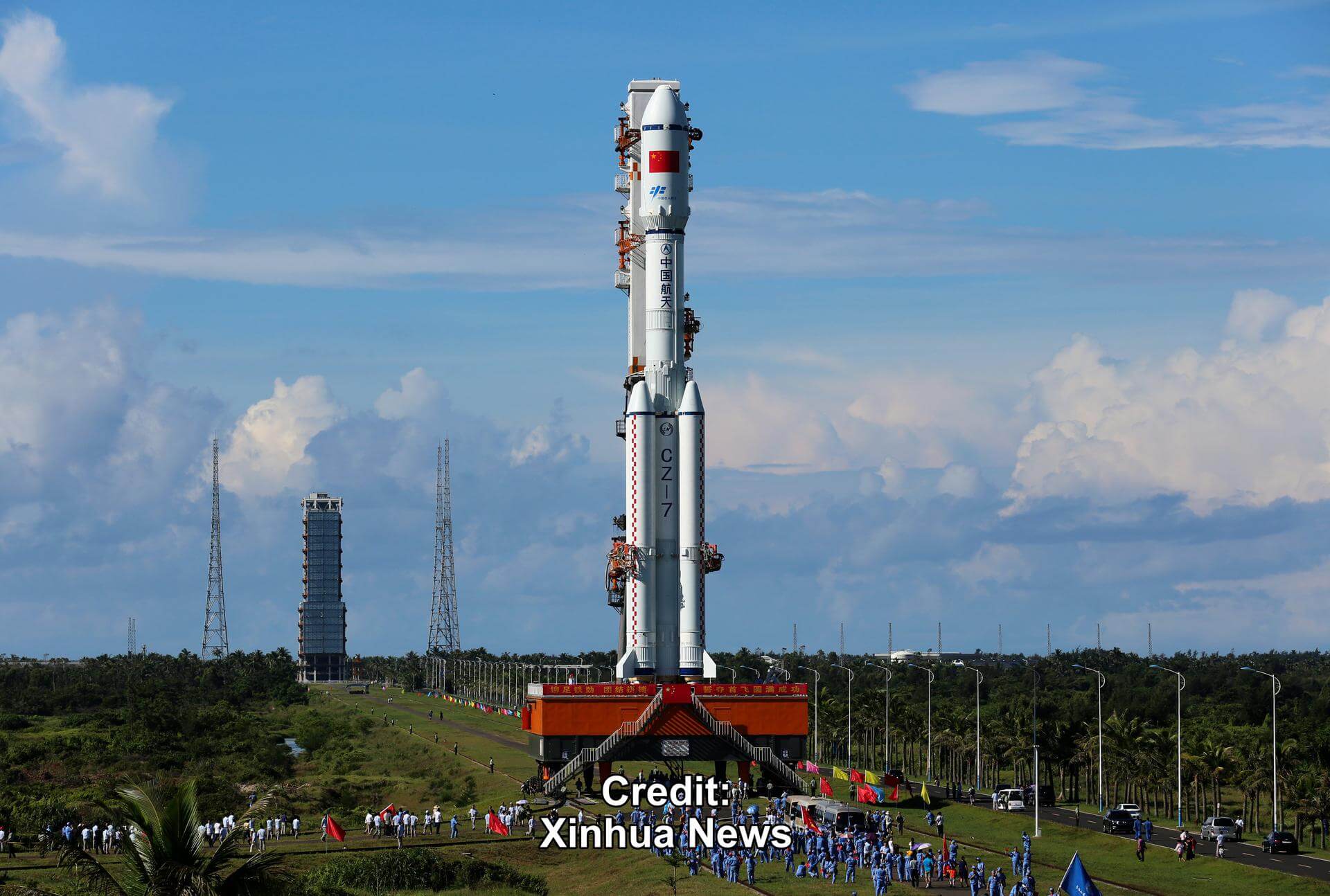
- China Aerospace Science and Technology Corporation Long March 7 | Tianzhou-10:
- Tianzhou-10 from Wenchang Space Launch Site, People’s Republic of China (00:05 UTC) Ninth cargo delivery mission to the Chinese space station. Launch Preview
May 11–12
- SpaceX Falcon 9 Block 5 | NROL-172:
- NROL-172 from Vandenberg Space Force Base, CA, USA (22:28 UTC) A SpaceX Falcon 9 rocket will launch the NROL-172 mission for the National Reconnaissance Office — the 12th mission supporting the agency’s proliferated architecture, believed to consist of Starshield satellites. Booster B1103 will target a landing on the drone ship Of Course I Still Love You in the Pacific Ocean. Watch Live
May 12
-
SpaceX Falcon 9 Block 5 | Dragon CRS-2 SpX-34:
- Dragon CRS-34 from Cape Canaveral Space Force Station, FL, USA (23:16 UTC) A SpaceX Falcon 9 rocket will launch NASA’s 34th Commercial Resupply Services mission to the International Space Station. The Dragon spacecraft (tail number C209, flying for a sixth time) will deliver thousands of pounds of science experiments and supplies, arriving at the station after a roughly 38-hour transit. Watch Live
-
China Aerospace Science and Technology Corporation Long March 6A | Unknown Payload:
- Unknown Payload from Taiyuan Satellite Launch Center, People’s Republic of China (11:49 UTC) Details to be determined. The Long March 6A is China’s first rocket to feature solid rocket boosters, augmenting its liquid-fueled core stage.
May 13
- LandSpace Zhuque-2E | Unknown Payload:
- Unknown Payload from Jiuquan Satellite Launch Center, People’s Republic of China (02:52 UTC) Details to be determined. Zhuque-2E is an enhanced methane/liquid oxygen medium-lift rocket developed by LandSpace, featuring upgraded TQ-12A first-stage engines and a new TQ-15A second-stage engine with a moveable nozzle.
May 15
- SpaceX Falcon 9 Block 5 | Starlink Group 17-37:
- Starlink Group 17-37 from Vandenberg Space Force Base, CA, USA (14:00 UTC) A SpaceX Falcon 9 rocket will launch a batch of 24 Starlink V2 Mini Optimized satellites into low Earth orbit. Booster B1097, flying for a ninth time, will land on Of Course I Still Love You in the Pacific Ocean. Watch Live Launch Preview
May 15–16
- SpaceX Starship | Flight 12:
- Starship Flight 12 from SpaceX Starbase, TX, USA (22:30 UTC) The 12th integrated flight test of SpaceX’s Starship-Super Heavy vehicle, and the first flight of a version 3 rocket. The mission will use Ship 39 and Booster 19 on a suborbital trajectory. Starship is SpaceX’s fully reusable super heavy-lift launch vehicle capable of lifting up to 100,000 kg to low Earth orbit.
May 19
-
Avio S.p.A Vega-C | Solar wind Magnetosphere Ionosphere Link Explorer (SMILE):
- SMILE from Ariane Launch Area 1 (ELV), Guiana Space Centre, French Guiana (03:52 UTC) A joint mission between the European Space Agency and the Chinese Academy of Sciences, SMILE will study how Earth responds to the solar wind using four science instruments, improving our understanding of solar storms, geomagnetic storms, and space weather. The spacecraft deploys 57 minutes after liftoff into a highly elliptical orbit for a planned three-year mission. Vega-C is a 35-metre, 210-tonne single-body rocket featuring a P120C solid first stage also used as boosters on the Ariane 6. Watch Live
-
SpaceX Falcon 9 Block 5 | Starlink Group 17-42:
- Starlink Group 17-42 from Vandenberg Space Force Base, CA, USA (02:11 UTC) A SpaceX Falcon 9 rocket will launch a batch of 24 Starlink V2 Mini Optimized satellites into low Earth orbit. Booster B1097 will land on Of Course I Still Love You in the Pacific Ocean. Watch Live
May 21
- Indian Space Research Organization GSLV Mk II | GISAT-1A (EOS-05):
- GISAT-1A (EOS-05) from Satish Dhawan Space Centre Second Launch Pad, Satish Dhawan Space Centre, India (03:15 UTC) GISAT-1A is an Indian geostationary Earth observation satellite designed to provide continuous imaging of the Indian subcontinent and enable rapid monitoring of natural hazards and disasters. It will be launched by the GSLV Mk II, India’s largest operational launch vehicle, which uses an indigenous cryogenic upper stage.
May 22
-
United Launch Alliance Atlas V 551 | Amazon Leo (LA-07):
- Amazon Leo (LA-07) from Space Launch Complex 41, Cape Canaveral Space Force Station, FL, USA (00:00 UTC) A United Launch Alliance Atlas 5 rocket will launch 29 Amazon Kuiper broadband internet satellites into low Earth orbit. This is the penultimate Atlas 5 mission booked by Amazon for its constellation, which aims to provide high-speed, low-latency connectivity to underserved and remote areas globally.
-
Rocket Lab Electron | Viva La StriX (StriX Launch 9):
- Viva La StriX from Rocket Lab Launch Complex 1, Mahia Peninsula, New Zealand (09:30 UTC) The ninth Electron mission for Japanese Earth observation company Synspective, delivering a StriX synthetic aperture radar satellite to a 572 km circular orbit at 44.8 degree inclination.
May 31
- Rocket Lab Electron | The Grain Goddess Provides (iQPS Launch 7):
- The Grain Goddess Provides from Rocket Lab Launch Complex 1, Mahia Peninsula, New Zealand (00:00 UTC) A synthetic aperture radar Earth observation satellite for Japanese Earth imaging company iQPS.
Schedule Changes
- Long March 7 | Tianzhou-10: Status updated from To Be Confirmed to Go for Launch.
- LandSpace Zhuque-2E | Unknown Payload: Status updated from To Be Determined to Go for Launch.
- Indian Space Research Organization GSLV Mk II | GISAT-1A (EOS-05): Newly added to the manifest with a To Be Confirmed status, targeting May 21 at 03:15 UTC from Satish Dhawan Space Centre, India.
Note: Launch dates and times are subject to change due to technical or weather considerations.

Maurice Stellarski