· deep dive · 18 min read
Falcon Heavy Returns | A Six-Ton Bet on Geostationary Broadband
Falcon Heavy flew for the first time in eighteen months on April 29, 2026, expending its center core to push Viasat's final ViaSat-3 satellite toward geostationary orbit. The mission is a flagship rocket doing what only it can still do, for an operator betting six tons of high-throughput hardware on a market Starlink is rapidly redefining.
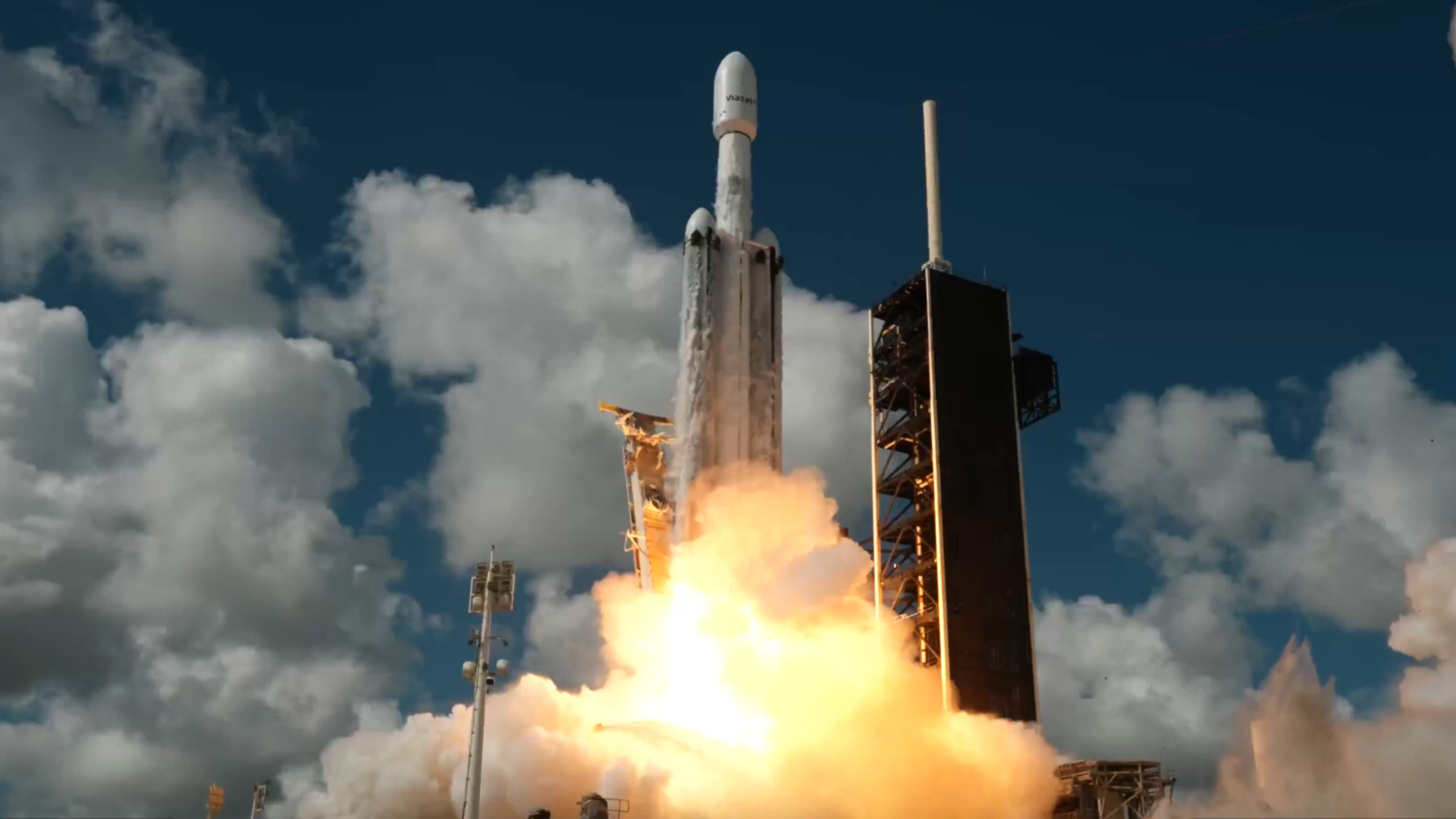
At 10:13 a.m. Eastern on April 29, 2026, the largest operational rocket on Florida’s Space Coast lit twenty-seven Merlin engines simultaneously and lifted off Pad 39A under a hard blue sky. The vehicle was Falcon Heavy. The payload was a single satellite. The crowd along the causeway was thinner than it would have been a few years ago, because by 2026, Falcon Heavy is no longer the rocket that draws crowds. Starship does that now, in Texas, with deeper booms and bigger explosions and a presence in the cultural imagination that Falcon Heavy briefly held in 2018 and slowly lost.
The launch had been delayed two days by a stalled offshore weather system. When it finally happened, it ended a silence that had stretched eighteen months. The previous Falcon Heavy mission - GOES-U for NOAA, then Europa Clipper for NASA in October 2024 - sat on the manifest as the most recent reminders that this vehicle still existed. Between Europa Clipper and ViaSat-3 F3, Falcon Heavy did not fly at all. The pad was used for Falcon 9 Crew Dragon missions instead. The side boosters waited in the Horizontal Integration Facility. The center core for this mission, expended into the Atlantic at the end of its single flight, had been built specifically for high-energy missions like this one and had no future beyond it.
Falcon Heavy’s twelfth flight was, in nearly every respect, a vehicle doing exactly what it was designed to do. Two side boosters, both veterans of multiple previous missions, returned to Cape Canaveral Space Force Station and landed simultaneously at LZ-1 and LZ-2 in the kind of coordinated descent that defined Falcon Heavy’s brief reign as the most theatrical rocket on Earth. The center core throttled deep, kept burning, and was discarded. The upper stage carried Viasat’s final ViaSat-3 satellite - 6.6 metric tons of high-throughput Ka-band hardware destined for the Asia-Pacific region - into a supersynchronous transfer orbit above geostationary altitude.
The mission worked. The booster came home. The satellite separated. And yet the moment carried an unmistakable weight of transition - a flagship rocket doing what only it can still do, for a satellite operator betting six tons of geostationary hardware on a market that Starlink has spent the last five years redefining.
ViaSat-3 F3
SpaceXEighteen Months of Silence
Falcon Heavy was supposed to be SpaceX’s workhorse for the second half of the 2010s. When Elon Musk first described the vehicle publicly, he framed it as the direct competitor to United Launch Alliance’s Delta IV Heavy: an American heavy-lift rocket that would carry the largest national security payloads, push interplanetary probes onto fast trajectories, and eventually take humans to Mars. The first flight in February 2018 carried a Tesla Roadster on a heliocentric trajectory toward the asteroid belt and made the kind of internet-breaking impression that few launches before or since have managed.
Then it almost stopped flying. The second Falcon Heavy mission did not happen for fourteen months. The third followed two months after that. The vehicle entered a strange operational rhythm where it would launch in clusters - two or three flights inside a few months - and then disappear for a year or more. By the time the twelfth flight happened in April 2026, the eight-year cumulative cadence had averaged barely 1.5 launches per year.
The reasons for the slow cadence are not mysterious. Falcon Heavy is expensive to integrate - three boosters cross-strapped together, a vertical integration capability that did not exist when the vehicle was first envisioned, and a payload class that increasingly competes with cheaper alternatives. Most missions that need a rocket bigger than Falcon 9 either no longer exist (commercial GEO comsats have been shrinking, not growing) or have been migrated onto other vehicles. Vulcan Centaur picked up the National Security Space Launch contracts that were once the natural home for Falcon Heavy. Starship is being positioned as the future answer for everything beyond low Earth orbit. The middle of the manifest - the heavy GEO payloads, the direct-to-GEO insertions, the high-energy escape trajectories - is the niche Falcon Heavy still owns, but that niche has gotten smaller every year.
Flight 1: Tesla Roadster
Demonstration mission. Side boosters land at Cape Canaveral; center core fails its drone ship landing.
Flight 2: Arabsat-6A
First commercial Falcon Heavy. All three boosters recovered for the first time.
Flight 3: STP-2
Department of Defense rideshare. 24 satellites to multiple orbits.
Flight 4: USSF-44
Direct-to-GEO insertion for the U.S. Space Force. Center core expended.
Flight 5: USSF-67
Second classified Space Force GEO mission.
Flight 6: ViaSat-3 F1
First ViaSat-3 satellite to GTO. Antenna failure in orbit weeks later.
Flight 7: Psyche
NASA mission to the metal asteroid 16 Psyche. Falcon Heavy's first interplanetary science payload.
Flight 8: USSF-52
X-37B spaceplane to a higher-energy orbit than previous flights.
Flight 9: GOES-U
Final GOES-R series weather satellite for NOAA.
Flight 10: Europa Clipper
NASA flagship to Jupiter. Center core expended for high-energy injection.
Flight 11: USSF GEO
Final 2024 mission. Vehicle then dormant for eighteen months.
Flight 12: ViaSat-3 F3
Return to flight. Side boosters recovered; center core expended.
The vehicle is not retiring. SpaceX continues to list Falcon Heavy on its product page, continues to maintain the vertical integration capability at LC-39A, and continues to bid on missions that exceed Falcon 9’s lift capacity. But the manifest beyond ViaSat-3 F3 is thin. A handful of NSSL Phase 3 missions, a possible Gateway Lunar HALO module launch, and a small set of NRO and commercial GEO opportunities. Maybe one or two flights per year through the late 2020s. Then, if Starship reaches the operational maturity SpaceX is targeting, the rationale for keeping Falcon Heavy active narrows further.
Falcon Heavy is not dead. It is the rocket SpaceX flies when no other option fits the mission profile - and right now, ViaSat-3 F3 is exactly that mission. The question is how many times that sentence will be true between now and Starship’s first commercial GEO contract.
A Six-Ton Bet on the Wrong Orbit
ViaSat-3 F3 is the third and final satellite in Viasat’s flagship high-throughput constellation. The first, F1, launched in April 2023 and was supposed to deliver roughly a terabit per second of capacity over the Americas. The second, F2, covers Europe, the Middle East, and Africa. F3, now en route to geostationary orbit, is the Asia-Pacific node. Together, the three satellites were designed to provide global Ka-band coverage with frequency reuse architecture that would multiply Viasat’s per-satellite throughput by roughly an order of magnitude over the previous ViaSat-2 generation.
The F3 spacecraft is built on Boeing’s 702MP+ HP bus, an evolution of the 702 platform that has carried high-power commercial payloads to GEO for over two decades. It launched at 6.6 metric tons - heavy by modern commercial GEO standards, where most operators have spent the last decade pushing toward smaller, all-electric platforms. The 702MP+ HP is a hybrid: chemical propulsion for the initial GTO-to-GEO transfer phase, and Hall-effect thrusters for station-keeping and orbit refinement once on station.
That mass is the reason Falcon Heavy was the only viable U.S. launch option. Falcon 9 can deliver about 8.3 metric tons to a standard geostationary transfer orbit in expendable mode, but ViaSat-3 F3 was not flying to a standard GTO. The mission profile called for a supersynchronous transfer orbit - apogee well above the 35,786 km of geostationary altitude - so that the satellite could use its onboard propulsion more efficiently to circularize. The higher the apogee at separation, the less delta-V the satellite needs to spend reaching its operational slot, and the more propellant it has left over for its operational lifetime. For a 6.6-ton spacecraft expected to operate for fifteen years, every kilogram of propellant matters.
~1 Tbps
ViaSat-3 F3 Designed Capacity
Roughly equivalent to the entire ViaSat-2 satellite multiplied tenfold, focused over the Asia-Pacific region with Ka-band spot beams and frequency reuse.
Falcon Heavy with an expended center core can throw roughly 26.7 metric tons to a standard GTO. For supersynchronous insertions of payloads in the 6-7 ton class, that translates into apogees significantly above geostationary altitude - exactly what ViaSat-3 needs. The center core was always going to be expended on this mission. The mass margins simply were not there with a recoverable boostback profile, and Viasat’s contract priced the mission around a configuration that maximized injection energy.
After separation, the satellite will spend several months drifting downward from its supersynchronous apogee while its Hall-effect thrusters circularize the orbit. By late summer 2026, if everything works, F3 will be on station at its assigned Asia-Pacific slot, deploying its mesh reflector antennas and beginning the on-orbit testing campaign. Service entry is targeted for the back half of 2026.
That last phrase - “if everything works” - is doing more work than it usually does in commercial satellite launches. Because this is the second Falcon Heavy ViaSat-3 attempt, and the first one did not work.
What Went Wrong With F1, And What’s Different Now
ViaSat-3 F1 launched on Falcon Heavy in April 2023. The launch itself was nominal. The satellite separated cleanly into its supersynchronous transfer orbit. The orbit-raising campaign began as planned. And then, weeks later, during the deployment of the satellite’s primary mesh reflector antenna, something went wrong.
Viasat disclosed the anomaly in July 2023. The company stated that an unexpected event had occurred during reflector deployment and that initial assessments indicated the issue would have a “material impact on the performance of the F1 satellite.” Subsequent analysis revealed that the antenna had not deployed to its full operational configuration, severely degrading the satellite’s beam-forming capability. The full terabit-per-second capacity F1 was designed to deliver became permanently unreachable. Viasat ultimately recorded a non-cash impairment charge of roughly $730 million tied to the F1 anomaly and worked through insurance recovery for a portion of the loss.
The reflector itself was supplied by a subcontractor - Northrop Grumman’s Astro Aerospace, the same general lineage of large unfurlable mesh reflectors that has flown on dozens of GEO missions over the past three decades. Mesh reflectors are mechanically complex; they unfold from a stowed launch configuration into precision parabolic surfaces tens of feet in diameter, and they have to do it once, in vacuum, with no opportunity for ground intervention. When they fail, they fail in ways that are difficult to recover from.
An unexpected event occurred with the deployment of the antenna reflector that may materially impact the performance of the ViaSat-3 F1 satellite. Viasat and the reflector’s manufacturer are conducting a rigorous review of the development and deployment of the affected reflector to determine its impact and root cause.
What is different about F3 is harder to know from public information. Viasat has stated that lessons learned from the F1 investigation have been incorporated into F2 (which launched in 2024 and reached operational status without comparable issues) and F3. The reflector hardware has reportedly been modified, the deployment sequence has been revised, and additional ground testing was conducted before flight. None of that is the kind of detail that gets disclosed in press releases. What is clear is that F2 deployed successfully and is operational over EMEA, which gives Viasat a working data point that the post-F1 design changes have flown and worked.
For investors and customers, the F3 deployment will be the moment of truth. If the antenna unfurls cleanly and on-orbit testing confirms designed throughput, Viasat finally has the global ViaSat-3 architecture it has been promising since 2016 - a decade behind the original schedule, but operational. If it does not, the company faces a second consecutive flagship satellite anomaly in three years, and the strategic case for continuing to invest in geostationary HTS as a growth platform becomes much harder to defend.
HTS in a Starlink World
The strategic backdrop for ViaSat-3 is not the same as it was when the program was conceived. When Viasat ordered the three-satellite constellation in 2016, the dominant assumption in the satellite broadband industry was that high-throughput geostationary satellites would be the architecture that finally delivered economically viable broadband from space. The math seemed to work: a single satellite at GEO could cover an entire continent, frequency reuse via spot beams could push aggregate throughput into the terabit range, and the per-bit economics could compete with terrestrial fiber in markets that fiber would never reach.
Then Starlink happened. Between 2019 and 2026, SpaceX deployed more than 7,000 LEO broadband satellites, demonstrated that a low-Earth-orbit mega-constellation could deliver consumer broadband at fiber-comparable speeds and latencies, and built a subscriber base that has eclipsed every traditional satellite operator combined. The fundamental advantage of LEO over GEO for broadband is latency: a Starlink user sees roughly 50 to 100 milliseconds of round-trip latency, while a GEO user sees roughly 600 milliseconds for the simple reason that the signal has to travel 35,786 kilometers each way. For interactive applications - video calls, gaming, web browsing with modern javascript-heavy front ends - the difference is the difference between usable and frustrating.
| Satellite | Operator | Launch | Approx. Capacity | Coverage |
|---|---|---|---|---|
| EchoStar XIX (Jupiter 2) | Hughes / EchoStar | 2016 | ~220 Gbps | Americas |
| EUTELSAT KA-SAT | Eutelsat | 2010 | ~90 Gbps | Europe |
| ViaSat-2 | Viasat | 2017 | ~300 Gbps | Americas |
| Inmarsat-6 F1 | Inmarsat (Viasat) | 2021 | Ka + L-band | Indian Ocean / Asia |
| SES-17 | SES | 2021 | ~200 Gbps | Americas, transoceanic |
| Jupiter 3 / EchoStar XXIV | Hughes / EchoStar | 2023 | ~500 Gbps | Americas |
| ViaSat-3 F1 | Viasat | 2023 | ~1 Tbps designed | Americas (degraded) |
| ViaSat-3 F2 | Viasat | 2024 | ~1 Tbps designed | EMEA |
| ViaSat-3 F3 | Viasat | 2026 | ~1 Tbps designed | Asia-Pacific |
This does not make GEO HTS obsolete. It makes the addressable market different than what Viasat originally projected. The use cases where geostationary high-throughput still wins are the ones where latency is not the binding constraint and where wide-area continuous coverage with predictable beam patterns matters more than peak speed. In-flight wifi for commercial aviation is one - airlines value the ability to plan capacity around fixed regional beams that match flight corridors, and the additional latency is acceptable for a passenger streaming service. Maritime broadband is another, where ships traverse predictable shipping lanes and consistent coverage over open ocean is more valuable than minimum latency. Enterprise broadband for fixed sites in remote regions, government and military fixed-site connectivity, and broadcast video distribution all remain legitimate GEO use cases.
The Inmarsat acquisition, which Viasat closed in 2023, was a strategic response to exactly this market reshaping. By absorbing Inmarsat, Viasat gained the global L-band safety services franchise (a regulated, low-throughput, high-margin business that Starlink does not directly compete in), additional Ka-band GEO capacity, and a more diverse customer mix weighted toward maritime and aviation rather than residential broadband. The combined fleet, with ViaSat-3 F3 added, is one of the largest and most capable GEO HTS portfolios in the industry - just deployed into a market that has shifted under it.
For a deeper look at how high-throughput satellites work and where their architecture sits in the broader broadband landscape, see our explainer on HTS terminology and architecture.
The Boosters That Came Home
Set the strategic questions aside for a moment, because the launch itself was the kind of visual spectacle that makes Falcon Heavy worth watching even when its operational rationale is contracting. Two side boosters - tail numbers that have flown on multiple previous Falcon Heavy and Falcon 9 missions, refurbished and recertified between flights - separated from the center core about two and a half minutes into the climb, performed boostback burns to reverse their downrange trajectory, and re-entered the atmosphere on a path that brought them back to Cape Canaveral Space Force Station.
About eight minutes after liftoff, both boosters lit their landing engines and descended toward LZ-1 and LZ-2, the two paved circles a few miles south of the launch pad. The simultaneous landing - synchronized to within seconds - is an artifact of the trajectory mechanics rather than deliberate choreography, but the visual effect is what made Falcon Heavy iconic in 2018 and what still draws spectators along the causeway today. Two thirty-story rocket stages descending in parallel, firing their landing engines in unison, settling onto adjacent concrete pads. Then the double sonic boom, delayed by the speed-of-sound lag, arriving over the Cape several seconds later.
The center core was a different story. For high-energy missions like ViaSat-3 F3, Europa Clipper, and the heavier USSF GEO missions, the center core does not have enough propellant left after side-booster separation to perform a boostback burn and reach a recovery zone. It continues burning for a longer duration, transferring more energy to the upper stage, and is then discarded into the Atlantic. SpaceX has, in earlier missions, attempted center-core recovery via drone ship landing, but for the highest-energy mission profiles that path is not available. ViaSat-3 F3 was always going to expend its core. The vehicle was specifically optimized for a configuration where every kilogram of fuel and every newton-second of impulse went into pushing the upper stage and payload to higher injection energy.
The expendable center core is one of the quiet economics of Falcon Heavy that gets less attention than the recovery footage. SpaceX’s core advantage in commercial launch has always been first-stage reuse, and Falcon Heavy missions that require core expenditure sacrifice that advantage on the most expensive single component of the vehicle. The economics still work because the missions that demand a Falcon Heavy with an expended center core are the ones where customers are willing to pay for the additional capability, but it shrinks the margin on a vehicle that already operates infrequently. Every expended center core is, in some sense, a reminder that Falcon Heavy is the inverse of Falcon 9: a rocket that occasionally has to throw away its most valuable hardware to deliver the missions only it can fly.
What’s Left for Falcon Heavy
The manifest beyond ViaSat-3 F3 is the question that hangs over the program. A few NSSL Phase 3 missions remain on contract for the late 2020s, mostly classified Space Force payloads that need direct-to-GEO insertion or other high-energy profiles that exceed Vulcan’s capacity envelope. There is a possibility that the Gateway Lunar HALO module - the foundational habitation element of NASA’s planned cislunar space station - will fly on Falcon Heavy, though that mission has been repeatedly delayed and could yet migrate to Starship if the latter reaches operational status on the relevant timeline. A handful of NRO and commercial GEO contracts round out the public manifest. None of it suggests a vehicle returning to a higher cadence; all of it suggests a vehicle settling into a niche role for the missions that genuinely need it.
The longer-term question is what happens when Starship begins flying commercial GEO missions in earnest. Starship’s lift capacity, even in early operational configurations, exceeds Falcon Heavy’s by a wide margin, and the vehicle is being designed with reusability and rapid turnaround as core operating principles rather than the special-case behavior they are on Falcon Heavy. If Starship reaches the cadence and reliability SpaceX is targeting - and that “if” is doing real work, given Starship’s development trajectory through 2025 and 2026 - then Falcon Heavy’s remaining niche evaporates. The high-energy missions move to Starship. The expensive expended-core configurations become unnecessary. The vertical integration capability at LC-39A gets repurposed.
That transition is at least several years away, probably longer. Starship has not yet completed an operational commercial GEO mission. Its crew rating timeline for Artemis remains the binding schedule constraint on the program, and commercial broadband customers are unlikely to commit flagship payloads to a vehicle that is still in active development. In the meantime, Falcon Heavy continues to occupy the gap between Falcon 9’s reusable workhorse role and Starship’s eventual super-heavy-lift role. ViaSat-3 F3 is what missions in that gap look like in 2026: heavy, infrequent, mission-critical, and very expensive.
The most important Falcon Heavy mission of the late 2020s may not yet be on the manifest. NSSL Phase 3 awards continue through the decade, and the subset of payloads that exceed Vulcan’s capacity will fall to Falcon Heavy or to Starship. How many of those missions are willing to commit to Starship before it is operationally proven will determine how busy Falcon Heavy stays.
For Viasat, the ViaSat-3 F3 launch closes a chapter that began nearly a decade ago. The three-satellite constellation is, finally, complete. Whether F3 deploys cleanly, whether it delivers anything close to the terabit-per-second capacity it was designed for, and whether the global HTS architecture Viasat has spent more than a billion dollars building can compete in a market increasingly defined by LEO mega-constellations - those are the questions that will define the company’s next five years. The launch itself is the easy part. The orbit-raising campaign will take months. The antenna deployment is the moment everyone in the industry will be watching for. Service entry is targeted for late summer 2026.
Looking Up
Falcon Heavy lifted off on a clear morning, dropped two boosters back onto Florida concrete, and threw a six-ton communications satellite onto a trajectory above geostationary altitude. The mission worked. The vehicle still works. The launch cadence remains thin, the manifest beyond this flight remains uncertain, and the commercial GEO market that historically drove Falcon Heavy’s largest payloads continues to contract under pressure from LEO broadband.
But on April 29, 2026, none of that mattered for ten minutes. A 1,420-ton stack of aluminum, carbon fiber, and kerosene lit twenty-seven engines, lifted, separated, landed, and delivered. Whatever Falcon Heavy becomes in the second half of the decade - whether it flies twice a year or once every two years, whether Starship absorbs its niche by 2030 or never quite manages to - the rocket on the pad on Tuesday morning was still the heaviest American launcher operating in 2026, and it still did the only thing it has ever needed to do: take payloads that nothing else can take, and put them where nothing else can put them.
You can track ViaSat-3 F3 in KeepTrack as it executes its months-long orbit-raising maneuver toward geostationary slot, and watch the satellite drift down from supersynchronous apogee toward its operational position over the Asia-Pacific. The catalog also includes the side boosters’ parent vehicle and every previous Falcon Heavy upper stage that remains in Earth orbit - a small archaeology of a flagship rocket’s twelve flights, scattered across orbits that tell the story of where SpaceX has been pointing its biggest rocket for the last eight years.
References(9)
- Viasat Confirms Successful Launch and Initial Signal Acquisition of ViaSat-3 F3 - Viasat, April 2026
- SpaceX launches Falcon Heavy on Wednesday after 18 month hiatus - NASASpaceFlight.com, April 2026
- Falcon Heavy launches final ViaSat-3 terabit-class satellite - SpaceNews, April 2026
- ViaSat-3 F3 - NextSpaceflight Mission Details
- Boeing Delivers Powerful Satellite Platform to Viasat - Boeing Mediaroom, 2023
- Viasat Completes Acquisition of Inmarsat - Viasat, May 2023
- Falcon Heavy - SpaceX
- Viasat Provides Status Update on ViaSat-3 Americas Satellite - Viasat, July 2023
- Liftoff! NASA's Europa Clipper Sails Toward Ocean Moon of Jupiter - NASA Jet Propulsion Laboratory, October 2024

Theodore Kruczek