· deep dive · 19 min read
GPS III SV10 | The Last of Its Kind, and the First of What Comes Next
On April 21, 2026, the tenth and final GPS Block III satellite reached medium Earth orbit aboard a SpaceX Falcon 9. Named for Hedy Lamarr, the actress whose 1942 frequency-hopping patent underpins modern GPS, SV10 closes a procurement that took eight years to deliver hardware and opens the optical-crosslink era that will define the constellation's next decade.
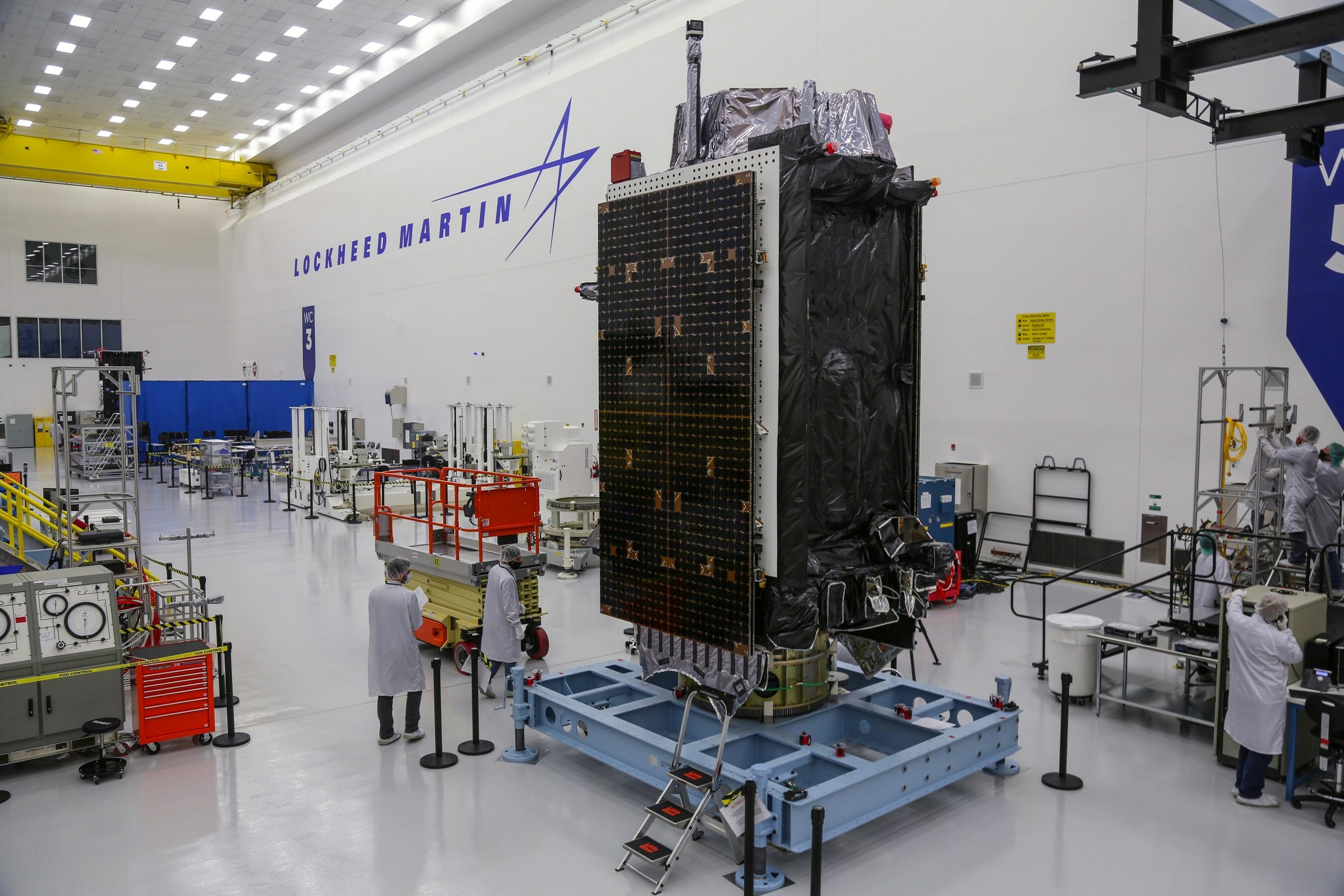
At 2:53 a.m. Eastern Daylight Time on April 21, 2026, a SpaceX Falcon 9 lifted off from Space Launch Complex 40 at Cape Canaveral carrying a 9,000-pound satellite that almost nobody outside the navigation community had ever heard of. The launch had been delayed by a day - weather in the booster recovery zone scrubbed the original April 20 attempt - but the conditions on the second try were nearly perfect. The first stage came home to a droneship in the Atlantic. The upper stage carried its passenger out toward a transfer orbit and then released it on its way to a circular slot some 20,200 kilometers above the equator, where, over the coming weeks, Space Force operators will guide it into one of the six orbital planes that make up the Global Positioning System.
The satellite is GPS III Space Vehicle 10. The mission identifier is GPS III-8. The constellation slot is one of the last operational gaps in the Block III procurement. And the spacecraft itself - per a Lockheed Martin tradition that has slowly evolved from naming satellites after astronauts, scientists, and signal pioneers - is named “Hedy Lamarr.”
That naming is the kind of detail that only registers if you know what Lamarr did when she was not on a soundstage. Most people remember her, if at all, as one of the most photographed faces of the 1930s and 1940s. The smaller circle of people who work on radio frequency engineering, secure communications, or satellite navigation know her instead as the co-inventor, with composer George Antheil, of frequency-hopping spread spectrum - U.S. Patent 2,292,387, granted in August 1942. That patent is the genealogical ancestor of nearly every modern jam-resistant communication system. The fact that the last GPS Block III satellite carries her name, four days after the Pentagon cancelled the ground system that was supposed to operationalize the very anti-jam capabilities her patent prefigured, is either a bureaucratic accident or one of the more pointed pieces of symbolism the Space Force has ever attached to a launch.
SV10 is therefore two things at once. It is the closing of a hardware program that began with a 2008 Lockheed Martin contract and ran longer than the Manhattan Project. And it is the opening of a new era for the constellation, because tucked into its payload bay is something no GPS satellite has ever flown before: an optical crosslink demonstration terminal - a laser communications package that will let SV10 talk directly to other satellites without bouncing the conversation through a ground station. That demonstration is the bridge to GPS IIIF, the next-generation block, where laser crosslinks will go from technology demonstration to baseline architecture.
GPS III SV10 (Hedy Lamarr)
active”Hedy Lamarr” and the Strange Loop of GPS Lineage
Before Hedy Lamarr was a defense inventor, she was Hedwig Eva Maria Kiesler, born in Vienna in 1914. Her first husband, Friedrich Mandl, was an Austrian munitions manufacturer who entertained Nazi and Italian Fascist clients in the years before the Anschluss. Lamarr - then Mrs. Mandl - sat through enough technical dinners about radio-controlled torpedoes and weapons jamming to absorb a great deal of practical knowledge that her husband apparently did not realize she was retaining. She fled the marriage in 1937, made her way to London, and signed a contract with MGM that turned her into a Hollywood star almost overnight.
The patent came later. In 1940, with the United States not yet at war but watching the Atlantic carefully, Lamarr became preoccupied with the problem of radio-controlled torpedoes. The Allies wanted a torpedo whose guidance signals could not be jammed by the German navy. Conventional radio control transmitted on a single frequency, which made it trivial to disrupt - the enemy only needed to flood that frequency with noise.
Lamarr’s insight, refined with her neighbor George Antheil - a composer best known at the time for an avant-garde piece scored for synchronized player pianos - was that if the transmitter and receiver hopped between frequencies according to a pre-agreed pseudorandom pattern, no jammer could realistically follow. The synchronization mechanism Antheil contributed was modeled on his player-piano work: a punched paper tape, with eighty-eight notes corresponding to eighty-eight available frequencies, running in lockstep at both ends of the link. They filed the patent on June 10, 1941, and were granted U.S. Patent 2,292,387 - “Secret Communication System” - on August 11, 1942.
The Navy did not adopt the invention during the war. The patent expired in 1959 without ever earning Lamarr a dollar. But by then the underlying idea had quietly migrated into military communications research, and in the decades that followed it became foundational to a long list of technologies: frequency-hopping radios in the field, code-division multiple access (CDMA) cellular networks, Wi-Fi, Bluetooth, and - critically for this story - the spread-spectrum signal architecture that the Global Positioning System has used since its very first satellite reached orbit in 1978.
GPS does not “frequency-hop” in the strict sense Lamarr’s patent describes. It uses a closely related technique called direct-sequence spread spectrum, in which a low-power navigation signal is multiplied by a fast pseudorandom code that smears its energy across a wide bandwidth. The mathematics are different in their specifics, but they share the same conceptual ancestry: deliberately spreading a signal so that it is harder to jam, harder to detect, and harder to spoof. The military M-Code signal carried by every GPS Block III satellite extends this further with Binary Offset Carrier modulation, which pushes the signal energy even further from the band center and makes selective jamming of the military signal harder still.
So when Lockheed Martin painted “Hedy Lamarr” on the side of SV10’s clean-room shipping container, they were not making a publicity gesture. They were closing a loop that started in 1941 with a Hollywood actress sketching a torpedo guidance scheme on graph paper, ran through Cold War communications research, became civilian GPS in the late 1970s, became encrypted military GPS in the 2000s, and now ends - or at least pauses - on the last Block III satellite ever to fly. It is the kind of historical lineage the U.S. Space Force does not often advertise loudly, perhaps because the modern descendants of Patent 2,292,387 still depend on a ground system that, as of last week, no longer has a contractor.
What’s New on SV10
The Block III bus that flies the GPS III satellites was designed in the late 2000s and frozen in the early 2010s, which means the early Block III vehicles - SV01 through about SV05 - are essentially the same spacecraft, with only minor changes from one to the next. That is by design: stability of configuration is how you avoid surprises in a constellation that needs to deliver consistent timing to billions of users. But the later-block vehicles, beginning with SV07 and accelerating through SV09 and SV10, have absorbed a series of incremental upgrades and demonstration payloads, and SV10 is the most upgraded of the lot.
The headline addition is the optical crosslink demonstration payload. This is the first laser communications terminal ever flown on a GPS satellite, and it represents a structural change in how the constellation can communicate. Today, GPS satellites talk to the ground - they accept commands and ephemeris uploads from a small number of dedicated control stations, and they broadcast navigation signals down to users. They do not, in any operationally meaningful sense, talk to each other. Every coordination through the constellation has to round-trip through the ground.
Optical inter-satellite links - also known as OISLs, the subject of a separate primer publishing in this catalog on May 1 - change that. A laser terminal mounted on one satellite can establish a high-bandwidth, low-latency link directly to another satellite in line of sight. Multiple terminals across a constellation can mesh into a network in space. For navigation, this matters for two reasons. First, it lets satellites share clock corrections and ephemeris updates without waiting for a ground pass, which means the constellation can correct errors faster and operate longer if ground links are degraded. Second, it makes the constellation less dependent on the ground segment as a single point of failure - which, given the OCX situation, is no small consideration.
SV10’s optical payload is a demonstration, not an operational asset. It will not be used to coordinate the live constellation. But it is the on-orbit pathfinder for the laser crosslinks that are baselined into the GPS IIIF design, and the data it returns over the next year will shape how those production crosslinks are designed and operated.
The second major addition is the modernized M-Code transmitter. M-Code has been broadcasting from GPS Block III satellites since the very first one launched in 2018, but each successive Block III vehicle has flown progressively refined versions of the M-Code payload - higher transmit power, cleaner waveforms, better isolation from civil signals. SV10’s M-Code transmitter is the most capable in the constellation. The signals are in the sky. The encryption is functional. As the OCX cancellation piece in this catalog discussed at length, what is missing is the operational ground system needed to distribute keys, monitor signal integrity, and command the constellation as an integrated military capability. SV10 broadcasts its M-Code regardless; whether the Department of Defense can fully use it is, for the moment, a software question rather than a hardware one.
10/10
GPS Block III Satellites Delivered
Eight years from first launch (December 2018) to final launch (April 2026). The full Block III procurement, from 2008 contract award to last vehicle on orbit, ran roughly half as long as OCX took to fail.
The third capability set is what Lockheed Martin and the Space Force describe broadly as accuracy and resiliency enhancements. Block III satellites are advertised as roughly three times more accurate than the legacy Block IIA and IIR vehicles still flying in the constellation, and roughly eight times more capable against jamming - numbers that have been cited consistently in Space Force fact sheets and Lockheed Martin briefings. The accuracy gain comes from a combination of better atomic clocks, more powerful transmitters, and the modernized civil L1C signal, which is internationally interoperable with Galileo, BeiDou, and QZSS. The anti-jam improvement comes from M-Code’s signal structure and the higher effective radiated power that Block III’s redesigned bus and antennas allow. SV10 inherits all of those gains and adds one more incremental refinement: a regional military protection capability that allows higher-power M-Code transmission over a designated geographic theater - useful in scenarios where a regional adversary is jamming GPS over a specific area of operations.
Finally, SV10 carries a search-and-rescue payload contributed by a partner agency, supporting the international Cospas-Sarsat distress beacon network. This has become standard on later Block III vehicles and will be expanded further on Block IIIF, but it is worth noting because it is one of the few pieces of GPS modernization where the user-facing benefit is direct, immediate, and visible: a hiker with an emergency beacon gets found faster.
The Constellation, Now Complete
The GPS Block III procurement formally began in May 2008, when the Air Force - then still in charge of GPS, before the Space Force was stood up in 2019 - awarded Lockheed Martin a contract to build the first Block III satellites. The first satellite was delivered in 2014. The first launch did not happen until December 2018, more than four years after delivery, because of a combination of integration delays, ground system readiness issues, and the simple bureaucratic friction of fielding a new constellation generation. The remaining satellites then launched at a roughly annual cadence through 2023, before the program accelerated sharply in 2024 and 2025.
SV10’s launch closes that procurement on a noticeably faster cadence than how it began. The four most recent GPS launches have occurred at an accelerated tempo that the Space Force has used as a public demonstration of its ability to launch national-security payloads quickly when it wants to - a deliberate counterpoint to the perception, fairly earned over the previous decade, that military space programs are slow and risk-averse.
Block III contract awarded
Lockheed Martin wins the contract to build the first GPS Block III satellites. Original plan calls for 8 satellites, later expanded to 10.
First satellite delivered
GPS III SV01 'Vespucci' completes assembly at Lockheed Martin's Denver facility. Launch slips repeatedly due to integration and ground-system readiness issues.
First Block III launch
SV01 launches aboard a SpaceX Falcon 9 - the first national-security Falcon 9 mission for the U.S. Air Force.
Space Force established
Responsibility for GPS transitions from the Air Force to the newly created U.S. Space Force.
Cadence builds
Remaining Block III satellites launch on a roughly annual schedule, then accelerate as Space Systems Command proves out responsive launch.
SV09 reaches orbit
Penultimate Block III vehicle launches from Cape Canaveral. Includes laser retroreflector array for precise orbit determination.
OCX cancelled
Space Force terminates the Next Generation Operational Control System contract, leaving Block III's full M-Code capability stranded pending an alternative ground path.
SV10 launches
Final GPS Block III satellite reaches orbit aboard SpaceX Falcon 9. Carries the first optical crosslink demonstration payload on a GPS vehicle.
What that timeline does not show is what is currently flying in the rest of the constellation. The Block III satellites do not operate alone. The 31-satellite operational constellation - the number that GPS.gov consistently maintains is the minimum healthy fleet - is composed of four different generations of spacecraft, some of which date to the previous millennium.
The oldest operational satellites are Block IIR vehicles built by Lockheed Martin (then under its Valley Forge heritage) and launched between 1997 and 2004. A handful of these are still flying, well past their 7.5-year design life. Block IIR-M (“modernized”) vehicles, launched 2005 to 2009, added the M-Code signal to legacy satellites that had to be retrofitted to support it. Block IIF satellites, built by Boeing and launched 2010 through 2016, brought the third civil signal (L5) and significantly improved atomic clocks. Block III, built by Lockheed Martin and launched 2018 through 2026, added L1C, full M-Code from the ground up rather than as a bolt-on, and roughly tripled the legacy accuracy. The full ten-satellite Block III is now in space, although not all are simultaneously slotted into operational positions - newer satellites typically spend several months in checkout before being declared operational by the Space Force.
| Block | Builder | Launches | Key additions |
|---|---|---|---|
| Block II / IIA | Rockwell / Boeing | 1989-1997 | Original operational fleet; selective availability removed in 2000. Last IIA decommissioned years ago. |
| Block IIR | Lockheed Martin | 1997-2004 | Improved clocks, autonomous navigation messaging. A handful still operational past design life. |
| Block IIR-M | Lockheed Martin | 2005-2009 | Added L2C civil signal and the first M-Code military signal (retrofitted). |
| Block IIF | Boeing | 2010-2016 | Added L5 civil signal (safety-of-life), rubidium clocks, longer design life. |
| Block III | Lockheed Martin | 2018-2026 | L1C civil signal, native M-Code, ~3x accuracy, ~8x anti-jam, 15-year design life. |
| Block IIIF | Lockheed Martin | 2027+ | Regional military protection, full SAR payload, native optical crosslinks, all-digital nav payload (L3Harris). |
The picture, then, is of a constellation in transition. GPS users worldwide rely on signals broadcast by hardware spanning four different design generations, controlled today by an aging ground system designed in the 1980s. Block III completion does not “modernize” the constellation in a single stroke - it ensures that the modernization is at least possible, by populating the space segment with vehicles capable of all the signals that future ground systems and user equipment can take advantage of.
What GPS IIIF Brings
GPS IIIF - the F is for “follow-on” - is the next-generation block. Lockheed Martin holds the contract for the first ten production GPS IIIF satellites, with the broader program of record extending up to twenty-two vehicles over the constellation’s next replacement cycle. The first IIIF satellite is currently scheduled to launch in 2027, although that date has slipped before and may slip again given the larger questions about ground-system readiness.
IIIF is not a new bus - it shares the Lockheed Martin A2100M lineage with Block III - but it is a substantially different payload. The navigation payload is provided by L3Harris and is fully digital, replacing the analog-digital hybrid carried on Block III. A digital payload is more flexible: signal characteristics can be modified after launch via software, individual user groups can be served with tailored waveforms, and new signals can be added without changing hardware. It is the navigation-satellite equivalent of a software-defined radio, and it represents a significant architectural shift.
Three other IIIF additions are worth noting. First, the regional military protection capability - which SV10 carries in a limited form - becomes a baseline feature, allowing the constellation to dynamically focus higher-power M-Code over specific theaters of operation. Second, the search-and-rescue payload becomes a fully integrated capability on every IIIF vehicle, expanding the Cospas-Sarsat coverage GPS provides. Third, and most consequentially, optical crosslinks become baseline rather than demonstration. Every IIIF satellite is designed to carry laser communications terminals capable of meshing with the rest of the constellation, which is the architectural change that genuinely reduces dependence on ground links.
The GPS IIIF roadmap, in other words, was designed under the assumption that a modernized ground system would be available to control it. With OCX cancelled and AEP modernization now the operational path, the question of whether IIIF’s full digital flexibility can actually be commanded becomes considerably more complicated. SV10’s optical crosslink demonstration is therefore not just a technology pathfinder - it is, possibly, an operational hedge. If the constellation can update itself in space, the gap between “what the satellites can do” and “what the ground can command” gets narrower.
The OCX Shadow
This piece is not the place to relitigate OCX - the cancellation gets its own deep-dive in this catalog, published four days before SV10 reached orbit. But the timing of the two events is impossible to ignore, and the relationship between them shapes how SV10’s contribution to the constellation should be understood.
The short version: on April 17, 2026, the Space Force cancelled the Next Generation Operational Control System after sixteen years of development and approximately $8 billion of total program cost. The grounds for cancellation were that integrated testing of OCX with the broader GPS enterprise had repeatedly surfaced unresolvable issues, and that the contractor had been unable to deliver an operationally viable system within any plausible timeline. Lockheed Martin received a $105 million contract to modernize the existing AEP ground system as the bridge path forward.
The launch of GPS III SV10 completes the Block III procurement and adds critical resiliency and accuracy enhancements to the constellation, while demonstrating new technologies that will define the next generation of satellite navigation.
What changes with SV10’s optical crosslink demonstration is the structural relationship between the satellites and the ground. As long as the constellation depended entirely on ground uplinks for clock corrections and ephemeris updates, the absence of OCX was an unbounded problem - any capability the satellites could not be commanded to deliver was, effectively, a stranded capability. Optical crosslinks do not solve that problem outright. M-Code key distribution still happens on the ground; mission planning still requires ground command; the laser terminals on SV10 are demonstration units, not operational nodes. But they prove out the architectural alternative. They show that, in principle, a navigation constellation can route some operational coordination through space rather than the ground - and the sooner that becomes a baseline capability, the less catastrophic any future ground-system failure becomes.
That is not a substitute for OCX. AEP modernization is still the operational path for the foreseeable future, and the M-Code activation timeline remains genuinely uncertain. But it changes the long-run architecture of GPS in ways that the program’s planners did not necessarily anticipate when they baselined OCX more than fifteen years ago. The cancellation, painful as it is, has accelerated the conversation about whether the next generation of navigation satellites should depend on the ground at all to the extent the current generation does.
Hardware delivery in eight years. Software delivery in sixteen years and counting. The GPS Block III procurement is one of the cleaner case studies of a Pentagon program where the metal arrived approximately when promised and the software did not - and the lesson the Space Force seems to be drawing is to push more capability into the metal.
Why “Final” Doesn’t Mean “Done”
The temptation, looking at the SV10 launch, is to treat it as the closing parenthesis of the GPS Block III story. The metal is in the sky. The constellation is “complete.” A program that started in 2008 has delivered its tenth and final vehicle eighteen years later, which is slow by commercial standards but not unreasonable for a national-security space procurement of this scope.
The reality is more complicated, and more interesting. SV10 finishes the Block III satellite procurement, but it does not finish the modernization GPS Block III was supposed to deliver. The full M-Code capability that was the original justification for the entire procurement remains stranded pending a ground-system path that does not yet exist. The accuracy and anti-jam gains the satellites are physically capable of providing are partially deliverable today - the L1C civil signal is broadcasting, the modernized clocks are on orbit, the higher-power transmissions are reaching users - but the integrated military capability, the part that was supposed to give the United States a decisive edge in GPS-denied environments, is still waiting on software.
What SV10 does signal is that the next chapter of GPS will look different than the one it closes. The optical crosslink demonstration is a deliberate bet that satellite-to-satellite communication is going to be a structural feature of the constellation rather than an exotic technology demo. The acceleration of launch cadence - four GPS missions in rapid succession - is a deliberate signal that the Space Force can move quickly when it has reason to. The Lamarr naming, whether intentional or not, is a reminder that the foundational ideas of jam-resistant navigation predate the program by nearly seventy years and have always been more durable than any single piece of acquisition strategy.
For KeepTrack users, SV10 is a satellite to add to the catalog and watch climb into its operational slot over the coming weeks. Object characterization data will firm up as the Space Force releases tracking elements; the satellite will be assigned to one of the constellation’s six orbital planes, will undergo on-orbit checkout for several months, and will eventually be declared operational. By that point, the optical crosslink demonstration will likely have begun returning data, and the Block III procurement will, finally, formally close.
The next launch on the GPS manifest is no longer a Block III. It is, presumably, GPS IIIF SV01, scheduled - for now - for sometime in 2027 or 2028. By then, the Space Force will need to have answered a number of questions that SV10’s launch raised more sharply than it answered: how the M-Code activation path works without OCX, whether AEP modernization can actually deliver the modernized ground capabilities IIIF will require, and how aggressively to push optical crosslinks from demonstration into operational baseline. SV10 doesn’t answer those questions. It just makes them harder to defer.
For broader context, this catalog also publishes a primer on medium Earth orbit (MEO) - the regime where every GPS satellite operates - on April 29, and a primer on optical inter-satellite links (OISLs), the technology SV10 is demonstrating, on May 1. Both are useful background for anyone wanting to understand why this particular launch matters more than its quiet 2:53 a.m. liftoff might have suggested.
Hedy Lamarr filed her patent in 1941 because she was worried about jamming. Eighty-five years later, a satellite carrying her name went to orbit on a rocket she could not have imagined, broadcasting a signal her work made conceptually possible, into a constellation whose ground system had been cancelled four days earlier. The hardware is finished. The software isn’t. The patent is still doing the work.
References(10)
- GPS III Space Vehicle 10 'Hedy Lamarr' Launch Coverage - Spaceflight Now, April 21, 2026
- Lockheed Martin Press Release: Final GPS III Satellite Launched - April 21, 2026
- GPS III SV10 Launch Coverage and Mission Background - Space.com, April 2026
- GPS III / GPS IIIF Program Overview - GPS.gov
- U.S. Patent 2,292,387 - 'Secret Communication System,' Hedy K. Markey and George Antheil, August 11, 1942
- GPS III Mission Page - eoPortal Directory
- Global Positioning System: Updated Schedule Assessment Could Help Decision Makers - Government Accountability Office, GAO-19-250
- Defense Acquisitions: Assessments of Selected Weapon Programs - Government Accountability Office, GAO-24-106315
- U.S. Space Force GPS Fact Sheet - Space Systems Command, 2025
- Cospas-Sarsat Search and Rescue Payload on GPS - NOAA / Cospas-Sarsat Program

Theodore Kruczek