· deep dive · 10 min read
The Day Two Satellites Hit Each Other at 26,000 MPH
On February 10, 2009, an active Iridium communications satellite and a derelict Soviet military spacecraft slammed into each other 789 kilometers above Siberia. The collision produced more than 2,300 pieces of trackable debris that are still up there. Seventeen years later, the Iridium-Cosmos collision remains the event that made space debris a policy problem the world could no longer ignore.
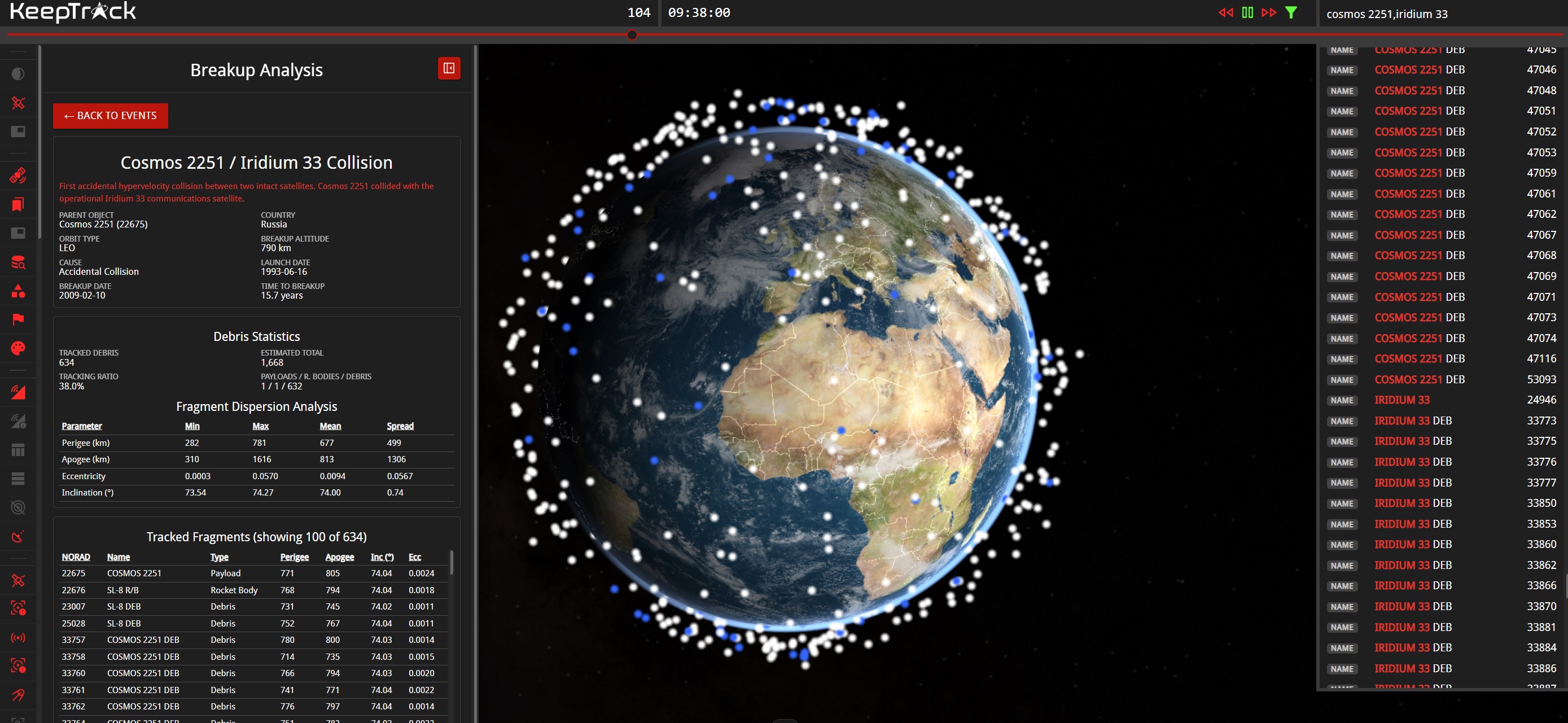
At 16:55:59 UTC on February 10, 2009, a 560-kilogram Iridium Low Earth Orbit communications satellite flying at 7.5 kilometers per second met a 900-kilogram Russian military communications satellite that had been dead since 1995. They passed through the same cubic meter of space, 789 kilometers above the Taymyr Peninsula in northern Siberia, at a closing velocity of approximately 11.7 kilometers per second. The combined kinetic energy at impact was roughly equivalent to several hundred kilograms of TNT.
This was the first known accidental collision between two intact satellites. We had been expecting something like this for years. We just didn’t know when, or between which pair.
The destruction was instantaneous and total. Iridium 33 (NORAD ID 24946, Catalog 1997-051C) and Cosmos 2251 (NORAD ID 22675, Catalog 1993-036A) ceased to exist as coherent spacecraft. In their place, expanding outward at tens of meters per second, were two distinct debris clouds - eventually catalogued as more than 2,300 trackable fragments larger than about 10 cm, plus an estimated 100,000 smaller fragments under the Space Surveillance Network’s detection threshold.
Nobody Saw It Coming. That Was the Problem.
The Iridium constellation was, in 2009, the largest active commercial satellite network in low Earth orbit. The original Motorola-designed system used 66 operational satellites in six polar orbital planes at 780 km altitude, inclined 86.4 degrees. Each satellite crossed the polar regions more than eleven times a day. Collisions with debris or other spacecraft had been a theoretical concern from the program’s start, but the conventional wisdom held that the probability of an intact-on-intact collision in any given year was vanishingly small.
Cosmos 2251 was a Strela-2M military communications satellite launched by the Soviet Union in June 1993 and declared dead two years later. It was one of roughly 800 Russian and Soviet satellites in LEO that had outlived their mission lifetimes and been left in orbit, drifting in circular or slightly elliptical paths at inclinations between 74 and 98 degrees.
What made the 2009 event possible was a collision geometry that virtually guaranteed destruction if it happened. Iridium 33 was in a retrograde-side orbit at 86.4 degrees; Cosmos 2251 was at 74 degrees. Their planes crossed at an angle of nearly 100 degrees at the point of intersection, which meant a direct intersection produced a near head-on collision. There was no way to absorb the energy. Kinetic energy scales as the square of closing velocity, and at 11.7 km/s, any impact meant complete fragmentation.
The forecast that should have warned Iridium of the approach came from the U.S. Joint Space Operations Center’s conjunction analysis. JSPOC at the time was tracking conjunctions between active satellites and debris, but its software was optimized to flag the highest-probability encounters and filter out the tens of thousands of less-likely close approaches. A conjunction message for Cosmos 2251 had been generated hours before the collision, but its calculated miss distance - 584 meters - was not considered alarming. Iridium’s operators, flying 66 satellites and receiving hundreds of conjunction messages daily, did not prioritize a maneuver.
2,300+
Trackable Debris Pieces Generated
Plus an estimated 100,000 fragments smaller than 10 cm that cannot be tracked. Nearly one-third of the larger pieces are still in orbit seventeen years later.
The actual miss distance turned out to be approximately zero. The error bars on orbital predictions for LEO objects at the time were typically around 500 meters to several kilometers, depending on the data quality. Iridium 33 and Cosmos 2251 fell within the overlap of each other’s uncertainty envelopes. The collision was, in a meaningful sense, inside the noise of the tracking system.
What the Debris Did
Space debris does not stay where it is born. The fragments from Iridium 33 and Cosmos 2251 were created with a range of velocity vectors relative to their parent satellites, which means they entered a range of orbits - some higher, some lower, some more eccentric. The debris cloud spread along the original orbits first, then, as atmospheric drag took hold, the cloud began to decay at different rates depending on fragment size and ballistic coefficient.
The initial danger was concentrated at the collision altitude of 789 km. For the first several weeks, ISS trajectory analysts monitored the debris cloud carefully because the fragments had been injected into orbits that intersected the Station’s 400 km altitude only at perigee - but any perigee-lowering kick from atmospheric drag could send them through the ISS orbital shell.
More broadly, the Iridium-Cosmos debris did what every large debris event does: it increased the long-term collision probability for every satellite that crosses its orbital regime. Sun-synchronous satellites at 500-900 km altitude now have to account for this debris cloud in their conjunction screening. ESA’s estimates suggest that the 2009 event increased the long-term collision risk for LEO satellites at sun-synchronous altitudes by roughly 5%.
The Fengyun 1C Context
The Iridium-Cosmos event is sometimes called “the worst debris-generating event in history.” It was not. The worst was the Chinese anti-satellite test of January 11, 2007, in which a Fengyun 1C weather satellite was deliberately destroyed by a kinetic-kill vehicle, producing more than 3,500 trackable fragments - about 50% more than the 2009 collision. The Fengyun 1C debris cloud sits at 865 km altitude, in a regime where atmospheric drag is extraordinarily weak, and will persist for centuries.
Fengyun 1C ASAT test
China destroys its own weather satellite with a kinetic-kill vehicle. Creates 3,500+ trackable fragments at 865 km. Debris will persist for 100+ years.
USA-193 shoot-down
U.S. Navy destroys its own failing USA-193 spy satellite with an SM-3 missile. Lower altitude (248 km), debris decayed within months.
Iridium-Cosmos collision
First intact-on-intact accidental satellite collision. 2,300+ trackable fragments at 789 km altitude.
Mission Shakti (India)
India destroys its Microsat-R satellite at 282 km altitude. Most debris decayed within a year.
Cosmos 1408 ASAT test (Russia)
Russia destroys defunct Cosmos 1408 at 465 km with direct-ascent missile. 1,500+ trackable fragments. ISS crew sheltered in Soyuz and Dragon.
Fengyun-1C breakup anniversary
Sixteen years after the 2007 test, more than 2,500 Fengyun-1C fragments are still in orbit.
But the Iridium-Cosmos collision mattered more politically. Fengyun was an act of policy - deliberate, public, and attributable. The world could respond to it with condemnation and treaties. Iridium-Cosmos was an accident between two satellites that had no quarrel with each other. It demonstrated that orbital collisions were not a hypothetical Kessler-cascade scenario to be worried about in some distant future. They were happening now, inside the existing satellite catalog, between operational hardware and dead hardware that had been sitting there for decades.
The Political Response
Within months of the collision, the U.S. Air Force expanded the Space Surveillance Network’s conjunction screening service from a curated list of high-priority assets to all active satellites in the catalog. Iridium, NASA, NOAA, and commercial operators began receiving orders of magnitude more conjunction data messages (CDMs) than before. The volume of CDMs increased from hundreds per day across the whole network to tens of thousands per day.
The collision also reframed space sustainability as a commercial issue. Before 2009, debris mitigation guidelines (like the 25-year deorbit rule) were viewed as government aspirations. After 2009, commercial operators began buying conjunction analysis products from third parties - first from the Space Data Association formed by Iridium, Inmarsat, SES, and Eutelsat in 2009 itself; later from companies like AGI, ExoAnalytic, LeoLabs, and Kayhan Space that built businesses around providing higher-fidelity conjunction screening than the Air Force offered.
Inside NASA, the collision accelerated investment in on-board collision avoidance and autonomous maneuvering technologies. The ISS now performs about two debris avoidance maneuvers per year on average, with each burn consuming modest amounts of propellant and requiring coordination between Moscow and Houston. Before Iridium-Cosmos, the station averaged less than one such maneuver per year.
How Iridium Responded
Iridium Communications - the company that had risen from the bankruptcy of Motorola’s original Iridium LLC - treated the loss of Iridium 33 as both a disaster and an opportunity. The company was already planning a $3 billion replacement of its aging constellation, and the collision reinforced the urgency of that plan. Iridium Next, developed in partnership with Thales Alenia Space and Orbital ATK, launched in eight SpaceX Falcon 9 flights between 2017 and 2019.
The new satellites included several features directly motivated by the 2009 collision: higher-precision GPS-based orbit determination, lower-fuel-cost maneuver capability, and participation in the Space Data Association’s collision screening service. Iridium also committed to de-orbiting its legacy satellites after replacement, rather than leaving them in orbit as passive hazards - a policy that cleared out more than 60 first-generation satellites between 2017 and 2022.
| Year | Legacy Satellites In Service | Next Satellites In Service | Policy |
|---|---|---|---|
| 2009 | 66 (minus Iridium 33) | 0 | No fleet-wide conjunction screening |
| 2017 | 60 | 10 | Staged replacement starts |
| 2019 | 6 | 66 | Final Iridium Next launch |
| 2023 | 0 | 75 (9 in-orbit spares) | All legacy de-orbited; full SDA participation |
The Iridium Next satellites carry Aireon payloads - an aviation surveillance system that tracks airplanes using ADS-B signals, a business model that could not have existed without the post-2009 reinvestment.
What It Changed About How We Track Satellites
Before February 2009, the orbital catalog was a bookkeeping problem. After February 2009, it became a real-time operational system. The shift manifested in several ways.
The Space Surveillance Network was upgraded to improve orbital accuracy. The Haystack radar got new sensors. Civilian observatories added tracking capability. DARPA’s Space Surveillance Telescope was accelerated. LeoLabs spun out of SRI International in 2016 with exactly this business model: selling commercial conjunction data at a fidelity the government could not offer for free.
Conjunction assessment software transformed. The old practice of screening a few thousand active satellites against a few hundred of the most-likely debris pieces was replaced by screening all cataloged objects against all cataloged objects, which at the current catalog size requires on the order of 10^9 pair-wise comparisons per screening run. This is now done multiple times per day.
The concept of “maneuver prescription” emerged. Previously, operators received a warning and decided whether to maneuver based on internal judgment. After 2009, with CDMs arriving hourly, a new practice evolved: the operator pre-computes maneuver options for a range of conjunction geometries so that when a high-probability conjunction arrives, the decision can be made in minutes rather than hours.
Most importantly, the sustainability conversation got serious. In 2009, debris mitigation guidelines were a voluntary afterthought. By 2025, NASA, the FCC, NOAA, ESA, and UNOOSA all have binding or quasi-binding debris mitigation requirements, and the 25-year post-mission disposal rule is under active pressure to tighten to five years for LEO missions.
What Seventeen Years Has Taught Us
The Iridium-Cosmos collision was not the Kessler syndrome in action. Donald Kessler’s 1978 paper described a scenario in which collision-generated debris itself triggers further collisions, setting off a cascade that destroys satellites faster than they can be replaced. The 2009 collision did not trigger any known secondary collisions. It did, however, confirm two things Kessler had predicted: that the collision rate in LEO had become large enough to notice, and that the debris generated by any single intact-on-intact event was large enough to materially increase the background collision probability for all nearby orbits.
Between 2009 and 2025, LEO got dramatically more crowded. The Starlink constellation grew from zero to over 7,500 satellites. OneWeb deployed 630. The Chinese Guowang and Qianfan constellations began launching. The number of active satellites in LEO rose from approximately 900 in 2009 to more than 10,000 by the end of 2025. During the same period, the Space Surveillance Network upgraded its tracking catalog from about 19,000 objects to nearly 47,000.
Despite the crowding, there has not been another accidental collision between intact operational satellites. That is either because collision avoidance has scaled faster than orbital density, or because the statistics of the distribution have been kind, or both. SpaceX alone now performs thousands of Starlink collision avoidance maneuvers per year.
The Uncomfortable Truth
A candid assessment of the Iridium-Cosmos event is that it was not unpredictable, and it was not even unlikely by 2009. The 789 km altitude band was known to be the most crowded orbital regime. The Cosmos 2251 satellite had been a tracked, cataloged, orbit-degrading piece of dead hardware for fourteen years. Iridium’s operations at 780 km overlapped with dozens of similar dead Russian satellites. The industry had the data to know that an intact-on-intact collision would happen; it just did not have the tools, the incentives, or the funded authority to act on that knowledge.
Seventeen years later, much of that has changed. What has not changed is the physics: 789 km is still crowded, Russia’s and China’s constellations of dead and active satellites still pass through that altitude, and the fraction of commercial operators performing real collision avoidance remains uneven. The next Iridium-Cosmos is not inevitable, but it is not impossible either. What is inevitable is that, the next time it happens, the debris cloud will form in an orbital environment with more than ten times as many nearby satellites than in 2009.
References(10)
- Iridium-Cosmos Collision: Facts and Consequences - NASA Orbital Debris Quarterly News, April 2009
- The Iridium 33 / Cosmos 2251 Collision: An After-Action Analysis - AIAA 2009-8144
- Collision Analysis for Debris Mitigation - NASA Technical Memorandum TM-2009-214785
- Space Surveillance Network Conjunction Assessment Upgrade - Air Force Space Command Briefing, 2010
- Iridium Next Program Final Report - Iridium Communications, 2019
- Kessler, D. and Cour-Palais, B. - Collision Frequency of Artificial Satellites, Journal of Geophysical Research, 1978
- ESA Space Environment Report 2024 - European Space Agency
- Collision Avoidance in Low Earth Orbit: A Decade After Iridium-Cosmos - Space Data Association Whitepaper, 2019
- FCC 5-Year Deorbit Rule Notice - Federal Communications Commission, 2022
- Mitigating Collisions Between Active Satellites and Derelicts - Secure World Foundation Briefing, 2021

Theodore Kruczek