· deep dive · 15 min read
Shimizu's Luna Ring - The Plan to Wrap the Moon in Solar Panels
A 220-year-old Japanese construction company wants to build an 11,000-kilometer belt of solar cells around the lunar equator and beam the power back to Earth. The physics checks out. Everything else is another story.
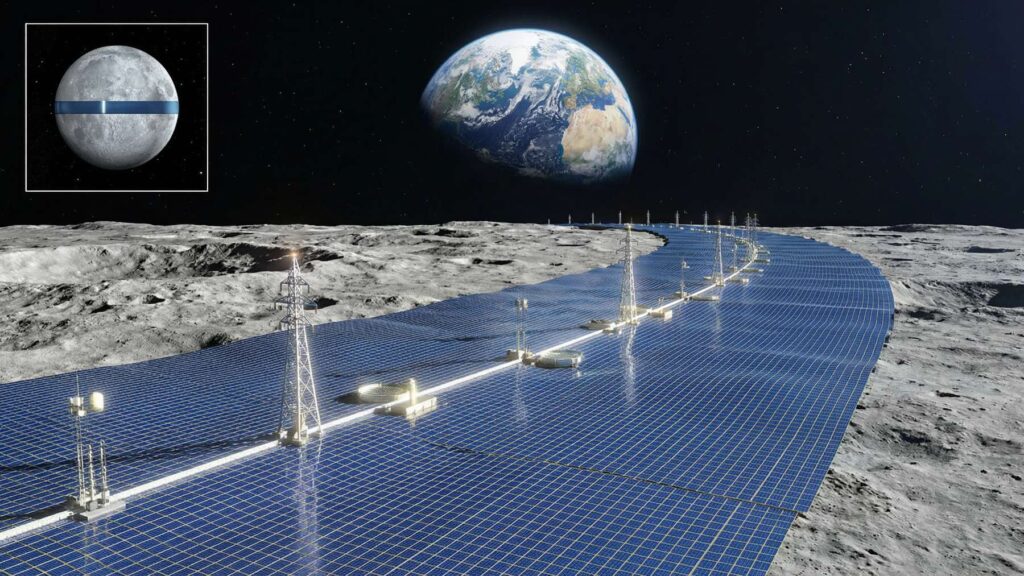
In late 2013, a Japanese construction company casually proposed building the largest structure in human history. Not on Earth - on the Moon. Shimizu Corporation, a firm that has been in continuous operation since 1804, put forward a concept called the Luna Ring: a continuous belt of solar panels stretching 11,000 kilometers around the lunar equator, converting sunlight into electricity and beaming it back to Earth as microwaves and lasers. The system, Shimizu claimed, could generate up to 13,000 terawatts of power - roughly 500 times the world’s current electricity consumption.
The idea sounds like the fever dream of a science fiction writer who just discovered infrastructure spending. But Shimizu isn’t some startup running on venture capital and optimism. It’s one of Japan’s “Big Five” contractors, publicly traded on the Tokyo Stock Exchange, with annual revenues north of $15 billion and a portfolio that includes skyscrapers, tunnels, dams, and the Tsukiji Hotel - Japan’s first Western-style hotel, completed in 1868. When Shimizu publishes a technical proposal, people at least read it before laughing.
And the physics, frustratingly, is not the problem. Solar panels on the Moon’s surface would receive unfiltered sunlight with no atmospheric absorption, no cloud cover, and no weather. The lunar equator offers near-constant illumination on one hemisphere or the other. The technology for converting electricity into microwave beams and transmitting them wirelessly has been demonstrated in laboratories since the 1960s. Everything about the Luna Ring is technically plausible. It’s everything else - the cost, the logistics, the fact that we’ve never built anything larger than a space station off-planet - that makes this a project caught between ambition and absurdity.
Still, the Luna Ring keeps resurfacing. It went viral again in early 2026, more than a decade after its original publication, because the underlying problem it addresses hasn’t gone away. If anything, it’s gotten worse.
The Concept
The Luna Ring is, at its core, a brute-force solution to a real engineering problem. Terrestrial solar power is intermittent. Panels stop producing at night. Clouds reduce output. Atmospheric scattering weakens the solar flux before it ever hits a cell. On a good day in the Arizona desert, a solar farm might convert around 20-25% of the sunlight that reaches it into electricity. On a bad day - overcast, short winter hours, dust storms - output drops dramatically. Grid operators compensate with natural gas peaker plants, battery storage, and a lot of hand-wringing.
The Moon has none of these problems. There’s no atmosphere to speak of, so sunlight hits the surface at full intensity - about 1,361 watts per square meter, compared to roughly 1,000 W/m² on Earth’s surface at peak. There are no clouds. There is no rain. The only thing approaching “weather” on the Moon is the occasional micrometeorite and a steady bombardment of solar radiation that would kill an unprotected human in short order but doesn’t bother solar cells much.
The key insight behind the Luna Ring is the geometry of the lunar equator. The Moon rotates on its axis once every 29.5 days, so any given point on the equator experiences roughly two weeks of daylight followed by two weeks of darkness. But because the belt wraps the entire circumference, some portion of it is always in sunlight. Electricity generated on the far side would travel via buried power cables to transmission stations on the near side - the hemisphere that permanently faces Earth - where it would be converted and beamed home.
Shimizu’s proposal outlines two transmission methods. The primary approach uses microwave beams generated by antennas approximately 20 meters in diameter, aimed at receiving stations on Earth called rectennas - portmanteau of “rectifying antenna” - which convert microwaves back into DC electricity. The secondary method uses high-energy laser beams for higher-density transmission. Both systems would rely on ground-based guide beacons to maintain targeting accuracy across the 384,000 kilometers between the Moon and Earth.
The Earth’s atmosphere is mostly transparent to microwaves, which is why this scheme works at all. It’s the same principle that allows your microwave oven to heat food - except scaled up by several orders of magnitude and pointed at the sky.
The Idea Behind the Idea
The Luna Ring didn’t emerge from nowhere. Space-based solar power has been a recurring fixation of aerospace engineers since 1968, when Peter Glaser, a Czech-American scientist at the consulting firm Arthur D. Little, published a paper in the journal Science proposing orbital solar power satellites. Glaser envisioned large photovoltaic arrays in geostationary orbit, 36,000 kilometers above Earth, beaming collected energy down as microwaves. He was granted a U.S. patent for the concept in 1973.
A shift from economical use of limited resources to the unlimited use of clean energy is the ultimate dream of all mankind.
Glaser’s timing was remarkable. His patent arrived the same year as the OPEC oil embargo, which turned space-based solar power from a theoretical curiosity into something NASA and the Department of Energy actually studied. The U.S. government spent much of the late 1970s evaluating massive orbital solar power stations, eventually concluding that the concept was promising but economically unfeasible with the launch costs of the era. The program was shelved in 1981.
Shimizu’s twist was to move the solar array off orbiting satellites and onto the Moon’s surface. This solves some problems and creates others. On the plus side, lunar-based panels don’t need to maintain station-keeping in orbit, they don’t face the same space debris risks as orbital arrays, and they can be anchored to a stable surface. On the minus side, you’re now building on the Moon, which introduces its own category of nightmares - lunar dust contamination, thermal cycling between -173°C and 127°C, and the minor detail of transporting construction equipment across 384,000 kilometers of vacuum.
The Luna Ring proposal was part of Shimizu’s “Dream” series - a collection of forward-looking megaproject concepts the company publishes as a kind of corporate thought exercise. Other entries in the series include an underwater city, a space hotel, and a desert solar energy farm. These aren’t engineering blueprints with budgets and timelines. They’re more like illustrated thought experiments from a company with enough institutional credibility to get away with publishing them.
Building on the Moon
The construction plan is where the Luna Ring shifts from ambitious to genuinely wild. Shimizu proposes using the Moon’s own resources for the bulk of the materials, a strategy known in aerospace circles as in-situ resource utilization, or ISRU. Lunar regolith - the layer of broken rock and dust covering the Moon’s surface - is rich in oxides, particularly silicon dioxide and various metal oxides. Shimizu’s engineers argue that this material can be processed into concrete, ceramics, glass fibers, and - most critically - the solar cells themselves.
The construction sequence would go roughly like this: machinery shipped from Earth would be assembled in lunar orbit or on the surface. Teleoperated robots, controlled by human operators on Earth with a 2.6-second round-trip communication delay, would level terrain along the equator, excavate regolith, and process it into building materials. Self-propelled production plants would move along the equatorial route, manufacturing solar cells from local materials and installing them as they go. The belt would start narrow - a few kilometers wide - and gradually expand to as much as 400 kilometers at its widest point.
A small team of astronauts would provide on-site support, but humans would play a secondary role. This is probably realistic - robotic construction is the only viable approach for a project of this scale on the Moon, and it’s consistent with the broader trend in planetary exploration toward teleoperation and autonomy. But “realistic” here is relative. As of 2026, the most complex robotic construction ever performed off-planet involved the Canadarm2 on the International Space Station, which is impressive but not exactly comparable to building a highway system around a celestial body.
The proposal also includes a dedicated transport route running along the equator, with power cables buried beneath it. This road would carry construction materials and serve as the backbone infrastructure for the entire system. Shimizu envisions a 30-year construction timeline, with actual building work potentially beginning around 2035 - a date that was already optimistic when it was proposed in 2013 and has only become more so.
The Power Delivery Chain
Getting the power from Moon to living room involves a chain of conversions that each introduce efficiency losses, and Shimizu’s proposal is somewhat vague on the cumulative numbers.
Moon vs. Earth Solar Power
| Luna Ring (Lunar Surface) Proposed | Terrestrial Solar Farm | |
|---|---|---|
| Solar Flux | 1,361 W/m² | ~1,000 W/m² peak |
| Atmospheric Interference | None | Significant |
| Weather Disruption | None | Frequent |
| Operating Hours | ~24/7 (belt geometry) | ~6-8 peak hours/day |
| Distance to Grid | 384,400 km | 0-500 km |
| Transmission Method | Microwave / Laser | Power lines |
| Construction Difficulty | Extreme | Routine |
- Solar Flux
- 1,361 W/m²
- Atmospheric Interference
- None
- Weather Disruption
- None
- Operating Hours
- ~24/7 (belt geometry)
- Distance to Grid
- 384,400 km
- Transmission Method
- Microwave / Laser
- Construction Difficulty
- Extreme
- Solar Flux
- ~1,000 W/m² peak
- Atmospheric Interference
- Significant
- Weather Disruption
- Frequent
- Operating Hours
- ~6-8 peak hours/day
- Distance to Grid
- 0-500 km
- Transmission Method
- Power lines
- Construction Difficulty
- Routine
The chain works like this. Sunlight hits the lunar solar cells and is converted to electricity - this step is well-understood, with modern photovoltaic cells reaching 20-25% efficiency on Earth and potentially higher in the Moon’s vacuum environment. That electricity then travels through cables to transmission stations on the near side of the Moon. There, it’s converted to microwave energy and beamed across space. The microwave beam propagates 384,400 kilometers to Earth, where it’s intercepted by a rectenna and converted back to DC electricity.
Each conversion step loses energy. Photovoltaic conversion, cable transmission losses, electricity-to-microwave conversion, atmospheric absorption of the beam (even microwaves lose some energy passing through our atmosphere), and rectenna conversion efficiency all compound. Shimizu hasn’t published detailed end-to-end efficiency estimates, but independent analyses of similar space-based solar power concepts typically estimate overall efficiencies in the range of 5-10% from sunlight to grid power. That’s significantly lower than the 15-20% you’d get from a rooftop panel, but the argument is that the Moon has vastly more sunlight available and no intermittency.
Shimizu also proposes using excess energy to produce hydrogen fuel via electrolysis, positioning the Luna Ring as part of a transition toward what the company calls a “hydrogen-based society.” This is a concept that has been floating around Japanese energy policy for years and has some traction in the country’s industrial planning, even if it remains controversial among energy economists elsewhere.
The Money Problem
For all the technical detail in Shimizu’s proposal, there’s a conspicuous void where a budget should be. Tetsuji Yoshida, then-president of Shimizu’s space consulting group CSP Japan, told media outlets in 2013 that he had no concrete cost estimate for the project. When industry analysts have attempted their own estimates, the numbers tend to start around $100 billion and climb from there - some projections run into the trillions.
To put that in perspective: the International Space Station, which masses about 420,000 kilograms and occupies a volume roughly the size of a football field, cost approximately $150 billion over its lifetime. The Luna Ring would require constructing a structure covering millions of square kilometers on the surface of another world, using materials processed in situ by robots that don’t exist yet, powered by manufacturing plants that haven’t been designed. The ISS is a garden shed by comparison.
Peter Glaser proposes space-based solar power
Czech-American engineer publishes concept for orbital solar power satellites in the journal Science, later patented in 1973
NASA/DOE study of solar power satellites
Multi-year U.S. government feasibility study concludes the concept is promising but too expensive with existing launch technology
Fukushima Daiichi nuclear disaster
Tōhoku earthquake and tsunami trigger meltdowns at three reactors, reshaping Japan's energy policy and public opinion on nuclear power
Shimizu Corporation unveils Luna Ring
Japanese construction giant publishes detailed proposal for 11,000-km solar belt on the Moon's equator, with construction targeted for 2035
Caltech MAPLE beams power from orbit
First wireless power transmission from space to Earth demonstrated, beaming detectable energy from the SSPD-1 satellite
Luna Ring goes viral - again
More than a decade after publication, the concept resurfaces in media coverage as space-based solar power gains renewed attention
Japan’s energy landscape adds context to why Shimizu published this when it did. Before the March 2011 Tōhoku earthquake and tsunami, 54 nuclear reactors supplied roughly 30% of Japan’s electricity. The Fukushima Daiichi meltdowns triggered a nationwide shutdown of nuclear capacity and a public backlash against atomic energy that persists in some form to this day. In the immediate aftermath, Japan was burning expensive imported natural gas and oil to keep the lights on, and any alternative - no matter how speculative - got a hearing it might not otherwise have received.
Masanori Komori, an economist at Japan’s Institute of Energy Economics, offered a blunt assessment when the proposal was published: lunar solar power might sound appealing in theory, but Japan should invest in proven alternatives like geothermal energy, which the country has in abundance and which doesn’t require building factories on the Moon. It’s hard to argue with the practicality of that position, even if it lacks the ambition of the Luna Ring.
The Legal Minefield
Even if the money materialized and the technology matured, the Luna Ring would face a legal framework that was never designed for megaprojects on celestial bodies. The 1967 Outer Space Treaty - ratified by 118 countries including Japan - prohibits national appropriation of the Moon and requires that space activities be carried out for the benefit of all countries. Building an 11,000-kilometer industrial installation along the lunar equator and using it to power one nation’s economy would almost certainly trigger international disputes about resource access and territorial claims.
The 1979 Moon Agreement goes further, declaring lunar resources to be the “common heritage of mankind” and calling for an international regime to govern any resource exploitation. But the Moon Agreement has been ratified by only 17 states, and no major spacefaring nation - including the United States, Russia, China, or Japan - is a party to it. The Artemis Accords, signed by more than 30 countries since 2020, offer a more permissive framework for lunar resource use but are non-binding and don’t explicitly address infrastructure projects at the scale Shimizu envisions.
In practical terms, international space law regarding construction on the Moon is largely untested because nobody has attempted anything remotely like it. The legal questions are real, but they’re currently academic - less urgent than the engineering and economic barriers.
The Competition Has Moved On
While the Luna Ring remains on Shimizu’s website as a concept drawing, the broader field of space-based solar power has evolved significantly. The action has shifted toward orbital systems rather than lunar installations, and several organizations have moved from paper studies to hardware demonstrations.
In 2023, Caltech’s Space Solar Power Demonstrator successfully beamed detectable energy from a satellite in low Earth orbit to a ground receiver - the first-ever wireless power transmission from space to Earth. The amount of energy was tiny (an effective isotropic radiated power of just 3.2 watts), but the proof of concept was real. The project was backed by more than $100 million in donations from Caltech trustee Donald Bren.
The UK-based firm Space Solar completed its CASSiDi project in 2025, a £1.7 million study funded by the UK Space Agency that produced an integrated design for a modular orbital solar power system. The company targets commercial deployment from 2030 and was selected for the NATO DIANA cohort in 2026, with NATO recognizing the potential military applications of power delivered from space.
China has announced plans to deploy a 1-kilometer-wide solar array in orbit by 2028. JAXA, Japan’s own space agency, maintains a roadmap for space-based solar power that conspicuously does not feature the Luna Ring. And in the United States, the Air Force Research Laboratory is developing Arachne, a flight experiment testing solar power collection and transmission capabilities, while DARPA’s POWER program recently set a distance record by beaming 800 watts of power over one kilometer using lasers.
None of these efforts approach the scale of the Luna Ring. But they share a common strategy that Shimizu’s proposal lacks: starting small, iterating, and building toward larger systems incrementally. The Luna Ring is an all-or-nothing megaproject. Everything else in the space solar power field is being developed one component at a time.
Where It Stands
As of 2026, the Luna Ring remains exactly what it was in 2013: a concept on a corporate website. No funding has been secured. No government has endorsed the project. No space agency has incorporated it into mission planning. Shimizu has not published any updates moving the project beyond the proposal stage. The 2035 construction target, already ambitious 13 years ago, is now less than a decade away with no visible progress toward it.
And yet the proposal refuses to die. It resurfaces periodically in media coverage - most recently in early 2026, when it went through another cycle of viral attention - because the problem it addresses is real and growing. Global energy demand is climbing. The appetite for AI computing and data centers is accelerating electricity consumption. Terrestrial renewables are scaling impressively but still struggle with intermittency and storage. The basic appeal of unlimited, weather-independent solar power from space hasn’t diminished.
The Luna Ring’s lasting contribution may not be as a buildable project but as a limit case - a thought experiment that forces the question of how far we’re willing to go for clean energy. It sits at the extreme end of a spectrum that runs from rooftop panels to orbital solar farms to lunar megastructures, and its existence helps define the boundaries of what’s conceivable, even if it never moves beyond conception.
Shimizu Corporation has been around for 222 years. It survived the Meiji Restoration, two world wars, and the collapse of Japan’s bubble economy. The company plays a long game. Whether the Luna Ring is visionary or delusional depends entirely on your time horizon - and whether you believe humanity will ever need energy badly enough to build a power plant on the Moon.
References(11)
- Luna Ring Concept Overview - Shimizu Corporation
- Luna Ring - Wikipedia
- Shimizu's Luna Ring to Beam Solar Energy from the Moon - New Atlas (2013)
- How to Turn the Moon Into a Giant Space Solar Power Hub - Space.com (2013)
- Japanese Firm Proposes LUNA RING - Phys.org (2013)
- Space-Based Solar Power Overview - Wikipedia
- Space-Based Solar Power for U.S. Energy Independence - POWER Magazine (2025)
- Why We Need Space-Based Solar Power - World Economic Forum (2025)
- Outer Space Treaty - United Nations Office for Outer Space Affairs
- NASA SBSP Assessment Report (2024)
- Shimizu Corporation - Corporate Profile

Theodore Kruczek