· deep dive · 11 min read
Starlink-34343 | The Second Fragmentation Event in Three Months
STARLINK-34343 broke apart at 560 kilometers. SpaceX's response - launch more satellites the next morning - tells you everything about the confidence gap between fleet statistics and individual failure modes.
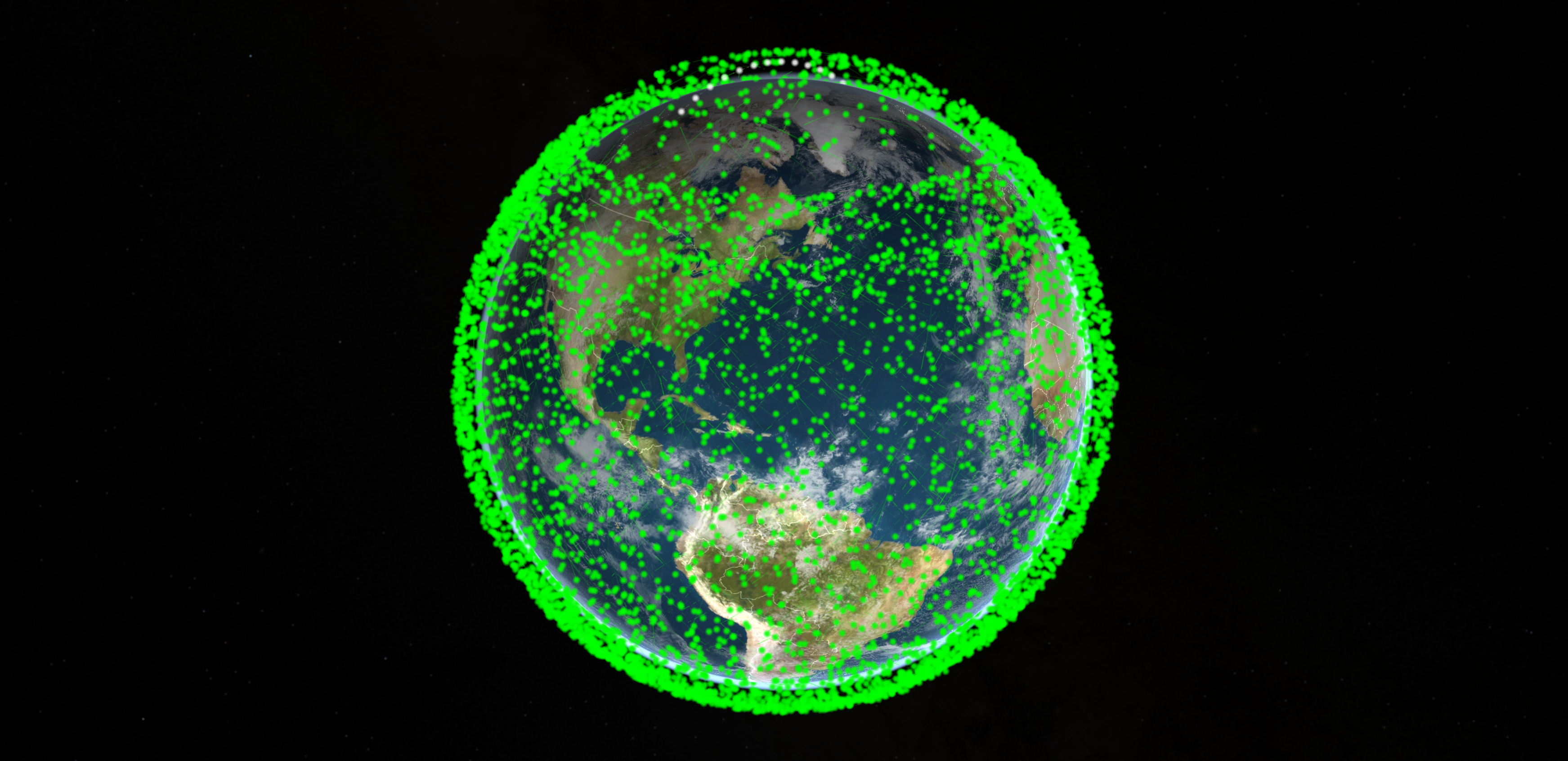
On March 29, 2026, SpaceX lost contact with STARLINK-34343. The satellite had been orbiting at roughly 560 kilometers altitude, circling the Earth every 96 minutes, doing its small part in a constellation of more than 10,000 spacecraft delivering broadband to ten million subscribers. Then something went wrong inside it, and the satellite started shedding pieces of itself into the void.
Within hours, LeoLabs - a commercial tracking firm that operates a network of ground-based radars - detected “tens” of new objects in the satellite’s vicinity, with potentially more too small to track. SpaceX confirmed the anomaly the following day, noting that STARLINK-34343 had suffered a complete loss of communications. The company said the debris posed no threat to the International Space Station or NASA’s upcoming Artemis II crewed lunar mission, then launched another 29 Starlink satellites about six hours later.
That confidence isn’t bluster. The physics genuinely favors SpaceX here - at 560 kilometers, atmospheric drag will pull most fragments down within weeks to months, and the ISS orbits well below at around 420 kilometers. But the nonchalance is also doing some work. This is the second Starlink fragmentation event in just over three months, and two data points make a trendline worth watching.
STARLINK-34343 was ten months old. Launched May 27, 2025, from Vandenberg Space Force Base aboard a Falcon 9, it was part of Starlink Group 17-1 - a batch of 24 satellites deployed into a sun-synchronous orbit. It was a V2 Mini Optimized, SpaceX’s current workhorse design, carrying argon Hall-effect thrusters and inter-satellite laser links. By all indications, it was a perfectly ordinary member of the largest satellite constellation ever assembled. Which is precisely what makes its failure interesting.
STARLINK-34343
inactiveWhat Happened
SpaceX hasn’t said exactly what went wrong. They’ve confirmed an “anomaly on-orbit” and left it at that, promising to “rapidly implement any necessary corrective actions” once root cause is determined. But there are clues in the orbital data and in what happened three months earlier.
On December 17, 2025, STARLINK-35956 suffered what appears to have been a very similar failure. That satellite, orbiting at a lower altitude of 418 kilometers, experienced sudden propulsion tank venting, a 4-kilometer drop in orbital altitude, loss of communications, and the release of trackable debris. LeoLabs assessed the cause as an “internal energetic source” - not a collision with external debris, but something going wrong inside the spacecraft. Batteries and propellant tanks were identified as likely candidates.
SpaceX responded to the December event by asking Vantor (formerly Maxar Intelligence) to photograph the stricken satellite using WorldView-3’s non-Earth imaging capability. The resulting 12-centimeter resolution image, captured from 241 kilometers away while STARLINK-35956 tumbled over Alaska, confirmed the spacecraft was “largely intact” despite generating debris. Michael Nicolls, SpaceX’s VP of Starlink Engineering, shared the imagery publicly - a notable act of transparency for a company that doesn’t always volunteer operational details. STARLINK-35956 reentered Earth’s atmosphere on January 17, 2026, about a month after the anomaly.
Now STARLINK-34343 appears to have followed a similar script, but at a higher altitude. The satellite was operating at approximately 560 kilometers - within the constellation’s standard 550-kilometer shell - meaning its debris will take longer to come down than the fragments from the December event.
Two-line element data tells part of the story. Before the anomaly, STARLINK-34343 had an eccentricity of 0.0019 - a slightly elliptical orbit with apogee near 583 kilometers and perigee around 556 kilometers. Post-anomaly TLE data shows the eccentricity collapsed to nearly zero (0.00007), the orbit circularized at around 556 kilometers, and the B* drag coefficient - a proxy for how much atmospheric drag the object is experiencing - roughly doubled. That’s consistent with a satellite that’s venting propellant, tumbling, and presenting a much larger effective cross-section to the thin atmosphere at that altitude.
The mean motion also increased slightly, indicating the orbit had already begun to decay. The satellite is coming down. It’s just a question of when.
The Pattern
Two satellites. Two internal failures. Three and a half months apart. SpaceX has not confirmed whether the anomalies share a root cause, but LeoLabs publicly stated the March event “appeared similar” to the December one. Industry analysts have pointed to batteries and propulsion tanks as the most likely culprits for both.
STARLINK-34343 Launched
Part of Starlink Group 17-1, launched from Vandenberg SFB on Falcon 9. One of 24 V2 Mini Optimized satellites deployed to a sun-synchronous orbit.
STARLINK-35956 Anomaly
First Starlink fragmentation event. Propulsion tank venting, 4 km altitude drop, loss of communications at 418 km. LeoLabs identifies internal energetic source.
Vantor Images STARLINK-35956
WorldView-3 captures 12 cm resolution image from 241 km, confirming satellite is largely intact but tumbling.
SpaceX Announces Shell Lowering
Michael Nicolls announces plan to lower ~4,400 satellites from 550 km to 480 km throughout 2026, citing space safety improvements.
STARLINK-35956 Reenters
Satellite completes atmospheric reentry approximately one month after the anomaly, confirmed by The Aerospace Corporation.
STARLINK-34343 Anomaly
Second fragmentation event. Loss of communications at ~560 km. LeoLabs detects tens of debris objects. SpaceX confirms anomaly March 30.
Transporter-16 Launches
SpaceX proceeds with scheduled Falcon 9 launch approximately six hours after confirming the anomaly. No launch pause indicated.
Here’s what’s worth paying attention to: after the December anomaly, SpaceX appeared to pause Starlink launches for about two and a half weeks - the next Starlink mission didn’t fly until January 4. After the March anomaly, a Falcon 9 launched the Transporter-16 rideshare mission the very next morning. SpaceX noted the mission was “designed to avoid Starlink with payload deploys well above or well below the constellation,” but there was no visible operational pause.
That difference could mean several things. Maybe SpaceX already understands the failure mode well enough to know it doesn’t warrant grounding the fleet. Maybe the December pause was about something else entirely. Or maybe there’s an institutional comfort level developing with a failure rate that, on paper, remains extraordinarily low.
The Scale Problem
SpaceX’s framing of these events emphasizes a statistic worth repeating: the Starlink constellation has accumulated the equivalent of more than 20,000 satellite-years of on-orbit operations. Two anomalies against that denominator is a remarkable reliability record. For context, a fleet reliability of 99.99% - a number most satellite operators would kill for - would still predict roughly one failure per year at current constellation size.
But scale cuts both ways. When you operate 10,000 satellites, low-probability events stop being hypothetical. They become scheduled. The question isn’t whether another Starlink will fragment - it’s how often, and what the cumulative effect looks like over a decade of operations.
The constellation currently numbers over 10,000 operational spacecraft out of roughly 11,500 launched. SpaceX is retiring first-generation V1.0 hardware on a rolling basis, replacing it with V2 Mini and eventually V3 satellites. The active fleet performs around 145,000 automated collision avoidance maneuvers every six months - roughly four per satellite per month. That’s an entire industrial operation dedicated to not hitting things, running continuously in the background while delivering internet to ten million subscribers across 150 countries.
It’s genuinely unprecedented infrastructure, and it mostly works. The “mostly” is where things get complicated.
The Shell Lowering
SpaceX’s response to the broader debris environment hasn’t been passive. On January 1, 2026 - two weeks after the first fragmentation event - Michael Nicolls announced that SpaceX would lower approximately 4,400 satellites from the 550-kilometer shell to a new operational altitude of 480 kilometers over the course of the year.
The physics rationale is straightforward. As the solar cycle approaches its minimum, atmospheric density in low Earth orbit decreases, which means dead satellites take much longer to naturally deorbit. At 550 kilometers during solar minimum conditions, an uncontrolled satellite could persist for more than four years. At 480 kilometers, that drops to a few months - an 80% reduction in what SpaceX calls “ballistic decay time.”
There are secondary benefits, too. The 480-kilometer altitude is less congested than the 500-600 kilometer corridor where several other planned constellations intend to operate. Lower orbits also reduce signal latency slightly, which matters for the real-time applications Starlink is increasingly targeting.
The move is being coordinated with U.S. Space Command, regulators, and other orbital operators. It’s a massive logistical undertaking - lowering 4,400 satellites requires thousands of individual thruster burns spread across months - but it’s also the kind of proactive safety measure that regulators have been pushing the entire industry toward.
| Parameter | Current (550 km) | Target (480 km) |
|---|---|---|
| Uncontrolled decay time (solar min) | 4+ years | ~months |
| Decay time reduction | Baseline | >80% |
| Orbital congestion | High (multiple constellations) | Lower |
| Round-trip latency | ~40 ms | ~37 ms |
| Atmospheric drag on active sats | Low | Moderate |
| Propellant cost to maintain orbit | Lower | Higher |
The tradeoff is fuel. Satellites at 480 kilometers experience more atmospheric drag, which means they burn more propellant over their operational lifetimes to maintain altitude. SpaceX apparently considers this an acceptable cost - and given the switch from expensive krypton to cheap argon propellant on the V2 Mini generation, the economics probably work out. Argon costs around $5-17 per kilogram in high purity, versus hundreds of dollars per kilogram for krypton. When you’re fueling 10,000 satellites, that matters.
But the shell lowering also has an uncomfortable subtext. If STARLINK-34343 had been operating at 480 kilometers instead of 560, its debris would be coming down much faster. SpaceX is, in effect, redesigning the constellation’s orbital architecture to limit the consequences of exactly the kind of failure we just watched happen.
What Nobody’s Talking About
SpaceX’s statements about both fragmentation events carefully noted that debris posed no risk to the ISS or Artemis II. Those are American assets. Neither statement mentioned the Chinese Space Station, Tiangong, which operates at approximately 390 kilometers altitude.
After the December event, some analysts noted this omission. The Starlink debris field from STARLINK-35956 at 418 kilometers was close enough to Tiangong’s orbital altitude to warrant at least an acknowledgment. Whether Chinese space authorities were notified through separate channels is unknown - the U.S. and China don’t have a robust framework for real-time space situational awareness sharing, which is a problem that extends well beyond Starlink.
The STARLINK-34343 debris at 560 kilometers is farther from Tiangong and the ISS, but as fragments decay, they’ll pass through every altitude below their starting orbit. Each piece traces its own descending spiral, and any spacecraft in the path needs accurate tracking data to know when to maneuver. That tracking data comes primarily from U.S. Space Force radars, commercial providers like LeoLabs, and the 18th Space Defense Squadron’s public catalog. The system works, mostly. But “mostly” keeps showing up.
Where This Goes
STARLINK-34343 will reenter Earth’s atmosphere. Its debris will follow. The satellite was designed to fully demise on reentry - SpaceX’s V2 Mini platform uses aluminum and composite materials selected to vaporize during the thermal stress of atmospheric entry. That said, a 2.5-kilogram piece of aluminum from a Starlink satellite was found on a Saskatchewan farm in August 2024, traced to a component that NASA and ESA models predicted would completely burn up. SpaceX acknowledged the incident and said it’s redesigning the problematic parts. Reentry demisability, like everything else in aerospace, is a work in progress.
The root cause investigation for both anomalies remains ongoing. SpaceX has committed to implementing corrective actions across the constellation once causes are confirmed - a process that could involve software updates, operational procedure changes, or hardware modifications pushed to future satellite builds. The company’s rapid deployment cadence means fixes can propagate through the fleet relatively quickly. A new batch of 29 Starlinks goes up nearly every week.
What the industry is watching for is whether these two events represent a contained issue - a manufacturing defect in a specific batch, perhaps - or something more fundamental in the V2 Mini Optimized design. The Starlink constellation has been in continuous production since 2019, and SpaceX iterates its satellite hardware frequently, sometimes making changes between individual launch batches. That agility is a strength when fixing problems, but it also means the fleet isn’t as uniform as it might appear from the outside.
For everyone else operating in low Earth orbit - and the list is growing fast, with Amazon’s Project Kuiper, Eutelsat OneWeb, and China’s Guowang constellation all building out - these events are data points. Every fragmentation, every debris field, every collision avoidance maneuver adds to the collective understanding of what happens when you put 10,000 things in the same neighborhood and expect them all to behave.
The FCC recently authorized an expansion of the Starlink Gen2 constellation to 15,000 satellites, with SpaceX’s application requesting up to 29,988 total. The math on failure rates doesn’t get more forgiving as those numbers climb. Two breakups in 10,000 satellites over three months is manageable. The same rate in a fleet of 30,000 would mean roughly one fragmentation event every six weeks.
SpaceX will point out - correctly - that they’re doing more than anyone else in the industry to address this. The shell lowering is real. The design-for-demise engineering is real. The automated collision avoidance running hundreds of thousands of maneuvers per year is real. They’re not ignoring the problem.
But STARLINK-34343 is a reminder that the problem isn’t going away, either. The debris will burn up. The questions about what happens when your constellation is big enough to generate its own weather - orbital weather, the kind measured in fragment counts and conjunction alerts rather than barometric pressure - those are just getting started.
Track STARLINK-34343 in KeepTrack’s 3D viewer using NORAD ID 64157.
References(12)
- Second Starlink Satellite Suffers Anomaly, Generating Debris - SpaceNews
- SpaceX Loses Contact With Starlink Satellite - SatNews
- LeoLabs Fragment Detection Event - LeoLabs via X
- Starlink Satellite Anomaly Confirmed - CGTN
- Starlink Reports Debris-Producing Satellite Anomaly - Space & Defense
- Doomed Starlink Satellite Photographed in Orbit (STARLINK-35956) - Universe Magazine
- Michael Nicolls Shares Vantor Imagery of STARLINK-35956 - X
- Starlink Initiates Orbital Lowering of 4,400 Satellites - SatNews
- Starlink Tops 9,986 Active Sats in Orbit - KeepTrack X Report
- SpaceX Launches First Upgraded Starlink Satellites (V2 Mini) - SpaceNews
- Starlink Group 17-1 Launch Details - Next Spaceflight
- Starlink - Wikipedia

Theodore Kruczek