· deep dive · 12 min read
Voyager 1
In November 2023, Earth's most distant spacecraft started speaking gibberish. Five months, one dead memory chip, and 30 billion miles of round-trip troubleshooting later, engineers got it talking again - using code written before most of them were born.
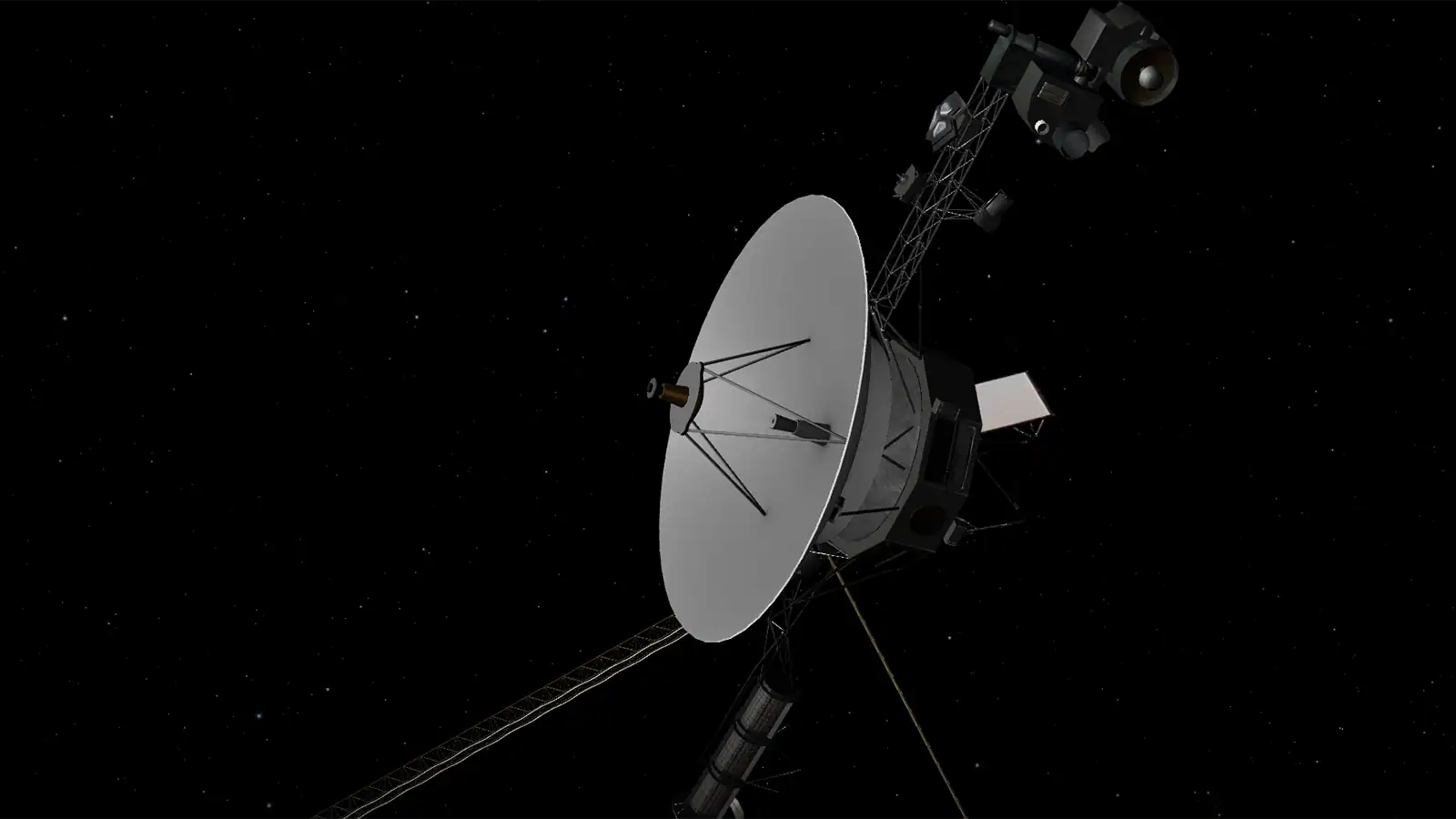
On November 14, 2023, Voyager 1 stopped making sense. The spacecraft - 15 billion miles from home, traveling at 38,000 mph through interstellar space, and older than most of the engineers responsible for keeping it alive - began transmitting a steady stream of ones and zeros that meant absolutely nothing. The radio link was fine. The probe was receiving commands. It just couldn’t form a coherent sentence anymore.
It took five months of painstaking remote diagnostics to find the culprit: a single failed memory chip inside the flight data subsystem, one of three onboard computers. The chip held about 3% of the FDS memory, including code essential for packaging science and engineering data before transmission. Whether a cosmic ray killed it or the silicon simply gave up after 46 years in the void, nobody can say for certain. What they can say is that the entire usable memory of that computer - the one responsible for everything Voyager tells us about interstellar space - is 69.63 kilobytes. That’s roughly the size of a low-resolution thumbnail image.
The fix was an act of software archaeology. Engineers broke the corrupted code into fragments, found empty corners of the FDS memory where the pieces would fit, rewrote the chunks so they’d still function as a whole, and beamed the patch to a spacecraft so distant that each command took 22.5 hours to arrive. On April 20, 2024, Voyager 1 started talking again. The JPL conference room erupted. Science data followed by June.
That episode captures something essential about Voyager 1. It was built for a four-year mission to Jupiter and Saturn. It has been operating for nearly 49 years. And the people who keep it alive are performing what one propulsion engineer accurately described as “palliative care” - on 1970s hardware, using assembly language, at distances where the speed of light becomes a genuine inconvenience.
VOYAGER 1
activeThe Road Not Taken
Voyager 1 launched from Cape Canaveral’s LC-41 on September 5, 1977, sixteen days after its twin, Voyager 2, aboard a Titan IIIE/Centaur. Despite the later launch date, Voyager 1 flew a faster trajectory and reached Jupiter first, arriving on March 5, 1979. The encounter produced images of the Great Red Spot in unprecedented detail, discovered active volcanism on the moon Io - the first volcanic activity found anywhere beyond Earth - and revealed the faint Jovian ring system.
Saturn came next, on November 12, 1980. And here the mission arrived at a fork in the road that would define Voyager 1’s entire trajectory - literally and figuratively.
Mission planners faced a choice. They could target Voyager 1 for a close flyby of Titan, Saturn’s largest moon and the only moon in the solar system known to possess a thick atmosphere. Or they could skip Titan and aim the spacecraft toward Pluto, where it would arrive around 1986. They couldn’t do both. The Titan flyby geometry would fling Voyager 1 below Saturn’s south pole and out of the ecliptic plane, ending any possibility of further planetary encounters. A Pluto trajectory would mean abandoning the best chance anyone had to probe Titan’s atmosphere up close.
They chose Titan. The reasoning was sound: the science community believed Titan’s atmosphere might be transparent enough for Voyager’s cameras to see the surface, and the atmospheric data alone justified the encounter. There was also a practical hedge built in - if Voyager 1 failed at Titan for any reason, Voyager 2’s trajectory could be redirected for a backup Titan flyby, which would have killed the Grand Tour to Uranus and Neptune.
Voyager 1 approached Titan to within 6,400 km. The cameras found nothing - the atmosphere was a featureless orange haze, opaque from top to bottom. But the radio science and ultraviolet spectrometer data revealed a nitrogen-dominated atmosphere with surface pressures 1.5 times that of Earth, methane chemistry, and conditions that hinted at the possibility of liquid hydrocarbon lakes. It took another 25 years and the Cassini-Huygens mission to confirm those lakes existed. The Titan decision wasn’t wrong. It just didn’t deliver the visual spectacle people hoped for.
With the Titan flyby complete, Saturn’s gravity flung Voyager 1 northward, out of the plane where the planets orbit. Its planetary science mission was over. It would never visit another world. But the mission was far from finished.
The Pale Blue Dot and Beyond
For nearly a decade, Voyager 1 coasted outward in relative quiet. Then, on February 14, 1990, at Carl Sagan’s insistence and over the objections of engineers who worried about pointing the camera toward the Sun, the spacecraft turned around. From 3.7 billion miles away, it photographed Earth - a speck smaller than a single pixel, caught in a band of scattered sunlight. The image, which Sagan named the Pale Blue Dot, became one of the most famous photographs ever taken by any instrument, anywhere.
Thirty-four minutes after the shutter closed, Voyager 1’s cameras were powered off permanently. Mission planners needed to conserve energy for the long road ahead. The software that controlled the cameras was eventually deleted from the spacecraft’s memory. The ground computers that could interpret the imaging data no longer exist. Even if someone wanted to take another picture, they couldn’t.
What Voyager 1 does carry, and will carry essentially forever, is the Golden Record - a 12-inch gold-plated copper disc containing 115 images, greetings in 55 languages, a 12-minute compilation of natural sounds, and 90 minutes of music ranging from Bach to Chuck Berry. Carl Sagan chaired the committee that assembled it. When folklorist Alan Lomax objected that rock and roll was too “adolescent” for an interstellar message, Sagan reportedly replied that there are a lot of adolescents on the planet. The record includes instructions for playback at 16⅔ rpm, along with a stylus and diagrams showing how to reconstruct the images from the encoded signals.
Nobody expects the Golden Record to be found. The odds are functionally zero. But as a cultural artifact - a statement of intent from a species that had only been launching things into space for 20 years - it remains one of the more compelling objects humanity has produced.
Crossing the Boundary
On August 25, 2012, Voyager 1 became the first human-made object to enter interstellar space, crossing the heliopause - the boundary where the Sun’s outward-flowing solar wind yields to the pressure of the interstellar medium. The crossing wasn’t immediately obvious. It took over a year of analysis and debate before the Voyager team confirmed that the spacecraft had passed through.
The confirmation came from the plasma wave subsystem, which detected oscillations in the surrounding plasma consistent with the higher density expected in interstellar space. Magnetic field measurements from the magnetometer provided additional evidence, though the expected change in magnetic field direction turned out to be more gradual than models predicted. This is the kind of data that only comes from actually being there - models of the heliopause boundary had been built from theory and remote observation, and Voyager found that reality was, predictably, more complicated.
Voyager 2 followed its twin across the heliopause on November 5, 2018, at a different location and angle. The two crossings showed that the heliosphere’s boundary is dynamic - it shifts and flexes in response to solar activity. Together, the Voyagers are providing a two-point measurement of a region that no other instrument can reach.
Launch from Cape Canaveral
Launched aboard Titan IIIE/Centaur from LC-41, 16 days after Voyager 2
Jupiter Flyby
Discovered active volcanism on Io, imaged the Great Red Spot, found Jupiter's ring system
Saturn and Titan Encounter
Close flyby of Titan at 6,400 km; trajectory bent northward out of ecliptic, ending planetary mission
Pale Blue Dot
Photographed Earth from 3.7 billion miles; cameras powered off permanently 34 minutes later
Entered Interstellar Space
Crossed the heliopause, confirmed by plasma wave data after months of analysis
FDS Memory Failure
Began transmitting garbled data; traced to a failed chip holding 3% of flight computer memory
Communications Restored
Engineers relocated corrupted code to working memory; science data fully restored by June
Cosmic Ray Subsystem Shut Down
Instrument powered off to conserve dwindling RTG output; three instruments remain active
Running on Fumes
Voyager 1’s three radioisotope thermoelectric generators convert the heat from decaying plutonium-238 into electricity. At launch, they produced about 470 watts. They lose roughly 4 watts per year - partly from the plutonium’s 87.7-year half-life, partly from degradation of the thermocouples that do the heat-to-electricity conversion. Nearly five decades in, the power situation is getting tight.
The original science payload included 11 instruments. Most were shut down long ago. The cameras went in 1990. The plasma science instrument degraded to the point of uselessness years back. In February 2025, JPL turned off the cosmic ray subsystem - the suite of three telescopes that had helped determine exactly when and where Voyager 1 crossed the heliopause. That left three instruments running: the magnetometer, the plasma wave subsystem, and the low-energy charged particle detector. The LECP is scheduled to go dark in 2026.
After that, Voyager 1 will have two instruments - the magnetometer and the plasma wave subsystem - measuring the interstellar magnetic field and electron density. These are the instruments that matter most for understanding the region Voyager is passing through, which is why they’ve been prioritized. JPL engineers believe they can keep at least one science instrument running into the 2030s. Engineering data - basic health and status telemetry - could potentially continue until around 2036, when the RTGs may no longer produce enough power to sustain the radio transmitter.
The power conservation isn’t the only challenge. Some of Voyager 1’s attitude control thrusters - the ones that keep the high-gain antenna pointed at Earth - have clogged hydrazine lines. There are no backups left. Everything aboard is what engineers call “single-string” - one failure away from mission-ending. In May 2025, the team managed to revive a set of backup roll-control thrusters that had been dormant since 2004, buying additional margin. They did this under a hard deadline: Deep Space Station 43 in Canberra, Australia - the only antenna on Earth powerful enough to send commands to either Voyager - went offline for upgrades from May 2025 through February 2026, with only brief operational windows in August and December.
That’s the operational reality of the Voyager mission in 2026. A handful of engineers, some of them advised by NASA retirees in their 80s who worked on the original hardware, keeping a spacecraft alive at the edge of the solar system using a command link that requires two days for a round-trip conversation, through a single antenna in Australia that spent most of the past year under construction.
What Voyager Is Actually Measuring
It’s easy to get lost in the romance of Voyager - the Golden Record, the Pale Blue Dot, the sheer audacity of a spacecraft outliving its creators’ expectations by a factor of twelve. But the mission’s ongoing scientific value is concrete and specific.
The interstellar medium isn’t uniform. It has structure - density variations, magnetic field fluctuations, and interactions with the heliosphere’s boundary that change over time. Voyager 1’s magnetometer measures the direction and strength of the local magnetic field, while the plasma wave subsystem detects electron density by listening for plasma oscillations. Together, these two instruments are mapping a region of space that no other telescope or probe can observe. The data is sparse - Voyager’s downlink rate is about 160 bits per second, roughly 23,000 times slower than a basic home internet connection - but it’s data from the only instruments in interstellar space.
One of the persistent questions is how far the Sun’s influence actually extends. The heliosphere has a defined boundary, but the Sun’s gravitational reach extends vastly farther - out to the Oort Cloud, a theoretical shell of icy bodies that may extend 50,000 AU from the Sun. Voyager 1 is at about 173 AU. It will reach the inner edge of the Oort Cloud in roughly 300 years and take about 30,000 years to pass through it. In about 40,000 years, it will drift within 1.6 light-years of Gliese 445, a dim star in the constellation Camelopardalis. By then, the RTGs will have been dead for millennia and the Golden Record will be the only functional thing aboard.
The 50th Anniversary and the End
The Voyager team is aiming to keep both spacecraft operational through their 50th anniversary in 2027. It’s an achievable goal, but barely. Every year brings new failures, new workarounds, and fewer options. The October 2024 incident - when a fault protection trigger shut down the X-band radio transmitter and briefly switched the spacecraft to its backup S-band transmitter, unused since 1981 - was resolved in weeks. The next incident might not be.
When Voyager 1 finally goes quiet, it won’t be because someone pulls the plug. It’ll be because a thruster line freezes and the antenna drifts off Earth, or because the RTGs drop below the minimum power threshold, or because a component fails that has no workaround. The spacecraft will continue on its trajectory indefinitely, moving at 17 km/s relative to the Sun, carrying the Golden Record through a galaxy that will never hear it play.
For now, though, Voyager 1 is still talking. Faintly, slowly, and through a single antenna in the Australian bush - but talking. And every bit of data it sends back is from a place no human instrument has ever reached before. That, more than the poetry or the records or the photographs, is why a team of engineers keeps spending their days nursing a 49-year-old spacecraft with 69 kilobytes of memory through one more orbit around the Sun.
References(10)
- Voyager Mission Status and Instruments - NASA Science
- NASA Turns Off Two Voyager Science Instruments to Extend Mission - JPL
- Voyager 1 Resumes Sending Engineering Updates to Earth - JPL
- How NASA Is Hacking Voyager 1 Back to Life - IEEE Spectrum
- NASA's Voyager 1 Revives Backup Thrusters Before Command Pause - NASA Science
- Voyager 1 Pale Blue Dot - NASA Science
- Voyager Fact Sheet - NASA Science
- Voyager Frequently Asked Questions - NASA Science
- What If Voyager Had Explored Pluto? - New Horizons PI Perspective
- Voyager 1 to Reach One Light-Day from Earth in 2026 - CNN

Theodore Kruczek