· space brief · 5 min read
Space Brief 30 Oct 2025
Today's brief explores rising investments in space with defense ties, potential Space Force-NRO coordination, and more, offering insight into current military and defense satellite dynamics.

📰Top Stories
Investors Eye Space Firms with Defense Links
Investors are increasingly focusing on space companies that have strong connections to defense, as indicated by recent trends in venture capital and private equity activities. The U.S. Department of Defense’s interest in commercial space technologies is driving this trend, encouraging firms to innovate to capture potential government contracts.
Read the full story: SpaceNews
Enhanced Coordination Between Space Force and NRO Considered
A nominee for the Pentagon has proposed closer integration between the U.S. Space Force and the National Reconnaissance Office (NRO). This potential collaboration aims to sustain America’s leadership in space activities, which could redefine how military and defense operations utilize satellite intelligence.
Read the full story: SpaceNews
U.S. and South Korea Collaborate on Nuclear Sub Tech
The U.S. plans to share nuclear submarine technology with South Korea, coupled with building submarines in Philadelphia. This development raises questions about the American maritime industrial base’s capacity and could impact future defense collaborations.
Read the full story: Breaking Defense
Boeing Defense Faces Minimal Impact from Strike
Despite a machinist strike, Boeing Defense reports negligible financial impact for the quarter. However, ripple effects from the strike have influenced the broader commercial programs, notably the KC-46 tanker and 777X jet production.
Read the full story: Breaking Defense
Military AI Utilization by Global Powers
An analysis reveals differing strategies in the use of military AI by China, Ukraine, and the U.S. China’s reliance on civilian surveillance to bolster its military AI efforts may face challenges, as discussed by experts. Understanding these divergent strategies is crucial for future satellite and AI defense applications.
Read the full story: Breaking Defense
Army’s New 3D Printed Drones Expanding Capabilities
The U.S. Army is pushing forward with 3D-printed FPV drones, underscoring their potential for deploying lethal effects swiftly. The adoption of these innovative manufacturing techniques is expected to play a critical role in the INDOPACOM theater, given the expansive geographical challenges.
Read the full story: Breaking Defense
🛰️Satellite Spotlight
- Satellite Name: APSTAR-6D
- NORAD ID: 45863
- Launch Date: July 9, 2020
- Mission: APSTAR-6D is designed for communication purposes, facilitating data transfer and connectivity across various regions.
- Orbit: GEO (Geostationary Orbit)
- Operator: APTS
- Fun Fact: APSTAR-6D is equipped with a Ka-band high throughput communications payload, enhancing its capacity to support large volumes of data transmission.
Track this satellite in real-time on our web app: Track APSTAR-6D
🌌Space Weather
Next 24 Hours
-
Radio Blackouts Probability
- Minor: 5
- Major: 1
- Risk: None
-
Solar Radiation
- Probability: 1
- Risk: None
-
Geomagnetic Storming
- Scale: 0
- Impact: none
- Activity: Low
-
Impact Summary
- Next 24 hours: No risk of radio blackouts.
- No risk of solar radiation storms.
- Geomagnetic outlook: G1 (Minor) geomagnetic storming is likely on 30 Oct due to persistent CH HSS effects.
- Radiation outlook: No S1 (Minor) or greater solar radiation storms are expected.
- No significant active region activity favorable for radiation storm production is forecast.
- Radio blackout outlook: A slight chance for R1-R2 (Minor-Moderate) radio blackouts is forecast for 01 Nov due to returning regions rotating onto the visible disk.
Long Term Forecast
- Impact Summary
- Forecast of Solar and Geomagnetic Activity from 27 October - 22 November 2025 indicates moderate solar activity on 31 Oct - 15 Nov due to the return of Region 4246.
- Low levels expected on 20 Oct - 30 Oct and 14 Nov - 22 Nov as multiple regions depart the visible disk.
- No proton events are expected at geosynchronous orbit from 27 Oct - 22 Nov; however, an isolated proton event is possible depending on the complexity of returning Region 4246.
- Greater than 2 MeV electron flux at geosynchronous orbit is expected to be at high levels from 31 Oct - 15 Nov due to responses from recurrent CH HSS influences.
- Moderate flux levels are expected on 27 - 30 Oct and 16 Nov - 22 Nov.
- Geomagnetic field activity is expected to be at quiet to unsettled levels on 01 Nov - 06 Nov, 10 Nov - 14 Nov, and 16 Nov - 22 Nov.
- Active conditions are expected on 27 Oct and 31 Oct, 07 Nov - 09 Nov, and 15 Nov, with G1/G2 conditions likely on 28 Oct - 30 Oct due to recurrent positive polarity CH HSS influence, mixed with possible weak influence from the CME that left the Sun on 23 Oct.
🚀Upcoming Space Launches
October 30
- SpaceX Falcon 9:
- Starlink Group 11-23 from Vandenberg Space Force Base, CA, USA (20:06 UTC) A batch of 28 satellites for the Starlink mega-constellation - SpaceX’s project for space-based Internet communication system.
October 31
- China Aerospace Science and Technology Corporation Long March 2F/G:
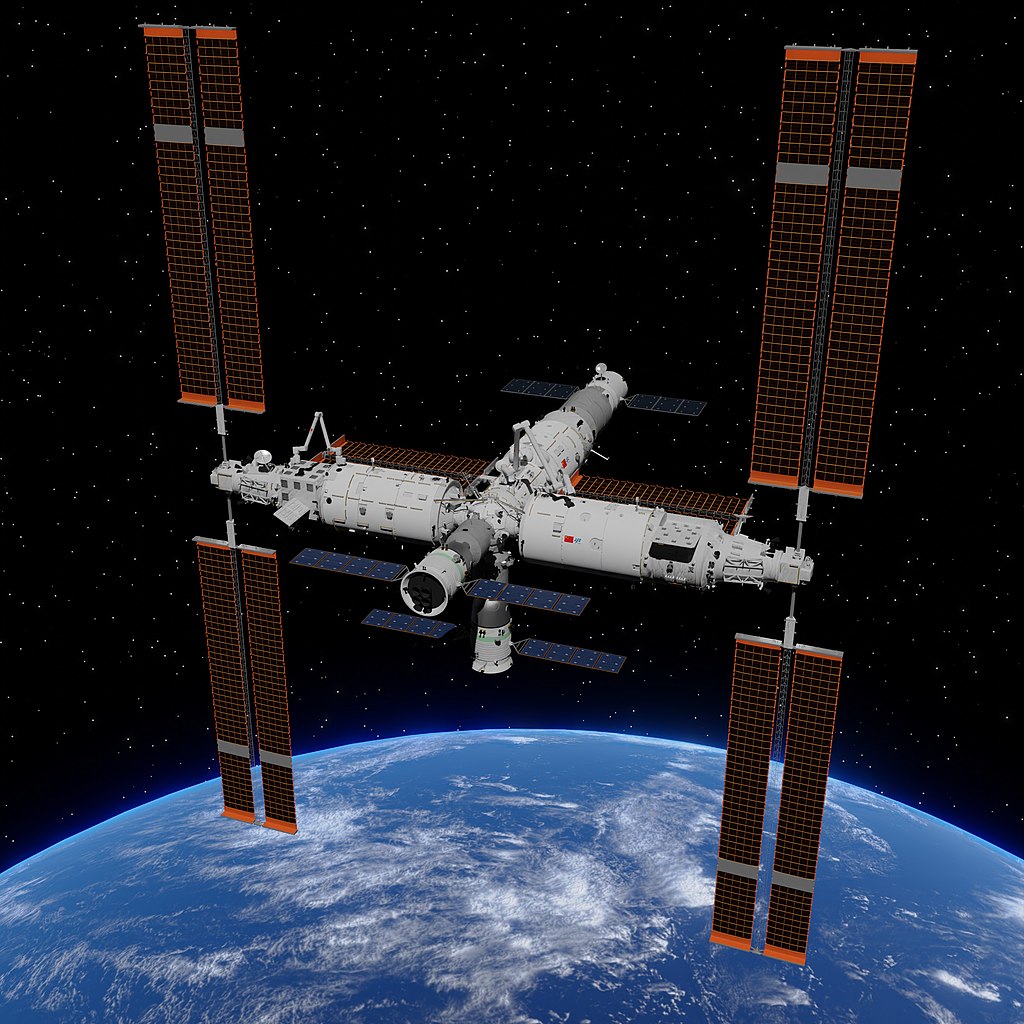
- Shenzhou 21 from Jiuquan Satellite Launch Center, People’s Republic of China (15:34 UTC) Tenth crewed flight to the Chinese space station.
November 2
- SpaceX Falcon 9:
- Bandwagon 4 (Dedicated Mid-Inclination Rideshare) from Cape Canaveral Space Force Station, FL, USA (05:00 UTC) Dedicated rideshare flight to a mid-inclination orbit with dozens of small microsatellites and nanosatellites for commercial and government customers.
- Indian Space Research Organization LVM-3:
- CMS-03 (GSAT-7R) from Satish Dhawan Space Centre, India (11:56 UTC) Communications Satellite for the Indian Navy, replacing GSAT-7 for secure real-time links between Indian warships, submarines, aircraft, and shore-based command centers across the Indian Ocean.
November 4
- Arianespace Ariane 62:
- Sentinel-1D from Guiana Space Centre, French Guiana (21:03 UTC) Sentinel-1D carries an advanced radar technology to provide an all-weather, day-and-night supply of imagery of Earth’s surface as part of the Sentinel-1 constellation.
November 5
- Rocket Lab Electron:
- The Nation God Navigates (iQPS Launch 5) from Rocket Lab Launch Complex 1, Mahia Peninsula, New Zealand (19:45 UTC) Synthetic aperture radar Earth observation satellite for Japanese Earth imaging company iQPS.
- SpaceX Falcon 9:
- Starlink Group 6-81 from Cape Canaveral Space Force Station, FL, USA (23:08 UTC) A batch of satellites for the Starlink mega-constellation - SpaceX’s project for space-based Internet communication system.
November 6
- United Launch Alliance Atlas V 551:
- ViaSat-3 F2 (ViaSat-3 EMEA) from Cape Canaveral Space Force Station, FL, USA (03:24 UTC) The ViaSat-3 is a series of three Ka-band satellites expected to provide vastly superior capabilities in terms of service speed and flexibility for a satellite platform. Each ViaSat-3 class satellite is expected to deliver more than 1-Terabit per second of network capacity.
November 7
- SpaceX Falcon 9:
- Starlink Group 11-14 from Vandenberg Space Force Base, CA, USA (20:34 UTC) A batch of satellites for the Starlink mega-constellation - SpaceX’s project for space-based Internet communication system.
Note: Launch dates and times are subject to change due to technical or weather considerations.

Maurice Stellarski