· space brief · 5 min read
Space Brief 20 Nov 2025
Today's briefing covers a DARPA award for Redwire's innovative satellite project, Ursa Major's expansion in defense engines, a Rocket Lab military test flight, and more.

📰Top Stories
Redwire Receives $44 Million DARPA Contract
Redwire Corporation has secured a significant $44 million contract from the Defense Advanced Research Projects Agency (DARPA) to develop an air-breathing satellite. This pioneering project aims to demonstrate a new type of spacecraft capable of enduring and maneuvering in the drag-intensive environment of very low Earth orbit. Such advancements could revolutionize satellite operations and survivability in challenging orbital conditions.
Read the full story: SpaceNews
Ursa Major Expands Defense Capabilities with $100M Investment
Ursa Major has raised $100 million to bolster its focus on defense technologies, particularly in the development of liquid engines for hypersonic vehicles and solid rocket motors. This strategic move underscores the growing intersection between private aerospace firms and defense needs, highlighting Ursa Major’s commitment to advancing military technologies.
Read the full story: SpaceNews
Rocket Lab Conducts Hypersonic Test for U.S. Military
Rocket Lab successfully launched its HASTE suborbital vehicle, carrying several payloads for the U.S. military. This represents the sixth launch of the vehicle and underscores Rocket Lab’s role in providing valuable testing capabilities for hypersonic technologies. These developments are crucial for advancing the U.S. military’s operational capabilities in space and missile defense.
Read the full story: Space.com
Pentagon Appoints New Role for Major Weapons Programs
The Pentagon has introduced a new position to manage critical major weapon systems, including the B-21, F-47, Air Force One, and ICBM programs. Lt. Gen. Dale White will take on this role, emphasized by a forthcoming fourth-star promotion, aimed at streamlining and optimizing management of these strategic assets.
Read the full story: Breaking Defense
MBDA to Establish Emirati Subsidiary
MBDA has announced plans to reinforce its presence in the Middle East by setting up a subsidiary in the UAE focused on missiles and loitering munitions. The initiative aims to capitalize on the growing defense partnerships and market demands within the region, underscoring the strategic importance of the Middle East in global defense dynamics.
Read the full story: Breaking Defense
CNAS Launches Pathfinder Essay Contest
The Center for a New American Security (CNAS) has launched the Pathfinder essay contest in partnership with Breaking Defense. The initiative seeks to engage individuals in defense-related topics, fostering innovation and strategic thinking through written submissions from a range of entrants, including experts and laypeople alike.
Read the full story: Breaking Defense
🛰️Satellite Spotlight
- Satellite Name: EUTELSAT 7C
- NORAD ID: 44334
- Launch Date: June 20, 2019
- Mission: This satellite is dedicated to providing communication services across Europe, the Middle East, and Sub-Saharan Africa.
- Orbit: GEO (Geostationary Orbit)
- Operator: EUTELSAT
- Fun Fact: EUTELSAT 7C is equipped with 44 Ku-band transponders, enabling high-capacity communication services for broadcasting and broadband.
Track this satellite in real-time on our web app: Track EUTELSAT 7C
🌌Space Weather
Next 24 Hours
-
Radio Blackouts Probability
- Minor: 15
- Major: 1
- Risk: None
-
Solar Radiation
- Probability: 1
- Risk: None
-
Geomagnetic Storming
- Scale: 0
- Impact: none
- Activity: Low
-
Impact Summary
- Next 24 hours: No risk of radio blackouts or solar radiation storms.
- Geomagnetic outlook: No G1 (Minor) or greater geomagnetic storms are expected.
- No significant transient or recurrent solar wind features are forecast.
- Radiation outlook: No S1 (Minor) or greater solar radiation storms predicted.
- Limited active region activity means minimal risk for radiation storm production is anticipated.
Long Term Forecast
- Forecast of Solar and Geomagnetic Activity (17 November - 13 December 2025)
- Solar activity is expected to reach R1 (Minor) levels on 12-27 Nov and 13 Dec, with potential increases to R1-R3 (Minor-Strong) levels from 28 Nov-30 Nov and 01-12 Dec.
- No proton events are forecast at geosynchronous orbit.
- Enhanced electron flux at geosynchronous orbit is expected on select dates in late November and early December due to coronal hole influence.
- Geomagnetic field activity may range from quiet conditions to G2 (Moderate) geomagnetic storms, especially on 26 Nov, 03 Dec, and 13 Dec.
- Active conditions anticipated during several intervals in late November and early December, influenced by coronal hole high-speed streams (CH HSS).
- Mostly quiet levels are expected on specific dates in November and early December.
🚀Upcoming Space Launches
November 20
- Rocket Lab Electron:
- Follow My Speed (BlackSky Gen-3 3?) from Rocket Lab Launch Complex 1, Mahia Peninsula, New Zealand (12:16 UTC)
3rd of the BlackSky Gen-3 high-resolution Earth-imaging satellites.
- Follow My Speed (BlackSky Gen-3 3?) from Rocket Lab Launch Complex 1, Mahia Peninsula, New Zealand (12:16 UTC)
November 21
- SpaceX Falcon 9:
- Starlink Group 6-78 from Kennedy Space Center, FL, USA (03:01 UTC)
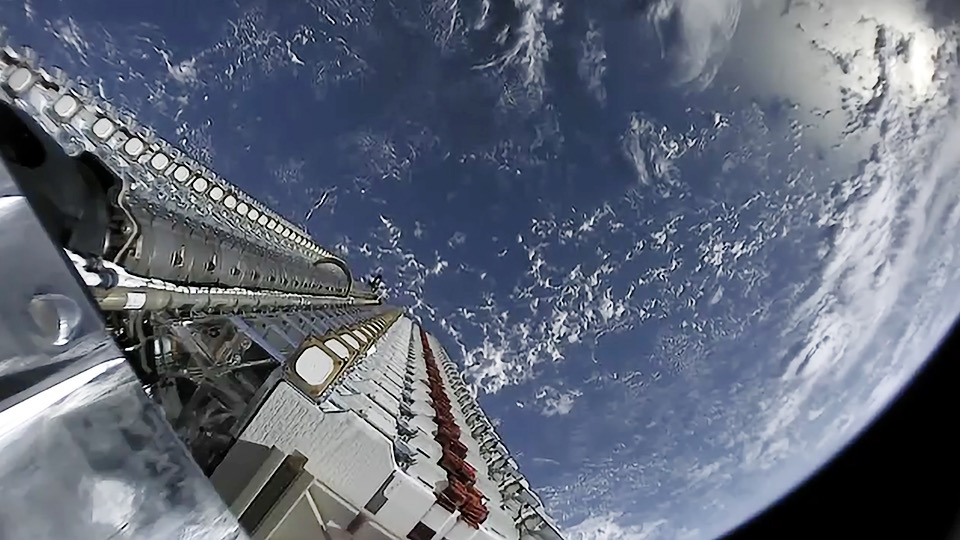
A batch of 29 satellites for the Starlink mega-constellation - SpaceX’s project for space-based Internet communication system.
- Starlink Group 6-78 from Kennedy Space Center, FL, USA (03:01 UTC)
- China Aerospace Science and Technology Corporation Long March 3B/E:
- Unknown Payload from Xichang Satellite Launch Center, People’s Republic of China (10:47 UTC)
Details TBD.
- Unknown Payload from Xichang Satellite Launch Center, People’s Republic of China (10:47 UTC)
November 22
- SpaceX Falcon 9:
- Starlink Group 6-79 from Cape Canaveral SFS, FL, USA (06:59 UTC)
A batch of 29 satellites for the Starlink mega-constellation - SpaceX’s project for space-based Internet communication system.
- Starlink Group 6-79 from Cape Canaveral SFS, FL, USA (06:59 UTC)
- Innospace HANBIT-Nano:
- Spaceward from Alcântara Space Center, Federative Republic of Brazil (18:00 UTC)
Maiden orbital launch attempt for the South Korean startup Innospace and its HANBIT-Nano small launch vehicle carrying multiple payloads.
- Spaceward from Alcântara Space Center, Federative Republic of Brazil (18:00 UTC)
- SpaceX Falcon 9:
- Starlink Group 11-15 from Vandenberg SFB, CA, USA (21:44 UTC)
A batch of satellites for the Starlink mega-constellation - SpaceX’s project for space-based Internet communication system.
- Starlink Group 11-15 from Vandenberg SFB, CA, USA (21:44 UTC)
November 23
- SpaceX Falcon 9:
- Starlink Group 11-30 from Vandenberg SFB, CA, USA (08:00 UTC)
A batch of 28 satellites for the Starlink mega-constellation - SpaceX’s project for space-based Internet communication system.
- Starlink Group 11-30 from Vandenberg SFB, CA, USA (08:00 UTC)
November 25
- China Aerospace Science and Technology Corporation Long March 2F/G:
- Shenzhou 22 from Jiuquan Satellite Launch Center, People’s Republic of China (04:01 UTC)
The spacecraft will later return three Chinese astronauts on the 10th flight to the Chinese Space Station back to Earth.
- Shenzhou 22 from Jiuquan Satellite Launch Center, People’s Republic of China (04:01 UTC)
- Khrunichev State Research and Production Space Center Angara 1.2:
- Kosmos (Unknown Payload) from Plesetsk Cosmodrome, Russian Federation (13:00 UTC)
Unknown Payload(s) for the Russian military.
- Kosmos (Unknown Payload) from Plesetsk Cosmodrome, Russian Federation (13:00 UTC)
- SpaceX Falcon 9:
- Starlink Group 15-10 from Vandenberg SFB, CA, USA (18:58 UTC)
A batch of satellites for the Starlink mega-constellation - SpaceX’s project for space-based Internet communication system.
- Starlink Group 15-10 from Vandenberg SFB, CA, USA (18:58 UTC)
Note: Launch dates and times are subject to change due to technical or weather considerations.

Maurice Stellarski