· space brief · 5 min read
Space Brief 24 Nov 2025
Today's highlights include a record number of launches from Florida's Space Coast, Germany's new military space strategy, SpaceX's Starlink deployment, and more.

📰Top Stories
Florida’s Space Coast Achieves Milestone with Over 100 Launches
The Space Coast of Florida has reached a major milestone, having successfully exceeded 100 launches this year. Col. Brian Chatman emphasizes the need for upgrading infrastructure to sustain this impressive volume, hinting at future enhancements to support further growth. This milestone underscores the increasing pace of space activities and the demand for robust launch facilities.
Read the full story: SpaceNews
Germany’s Ambitious Military Space Strategy Receives New Funding
Germany has unveiled a comprehensive military space strategy, backed by billions of euros in new investments aimed at enhancing its capabilities. This move highlights Germany’s growing commitment to securing its position in the space domain, focusing on the development of new technologies and partnerships.
Read the full story: SpaceNews
Redwire Awarded Contract for DARPA’s Otter VLEO Mission
Redwire Corporation has been awarded a $44 million contract to develop a spacecraft for DARPA’s Otter Very Low Earth Orbit demonstration. This phase 2 contract will focus on showcasing an innovative air-breathing platform, using Redwire’s SabreSat design, further cementing the potential of VLEO missions in military operations.
Read the full story: SpaceWar
NASA’s X-59 Marks a New Era for Supersonic Travel
NASA’s X-59 aircraft embarked on its maiden flight, representing a breakthrough in quiet supersonic technology. This research aircraft aims to revolutionize air travel by minimizing the sonic boom to a faint thump, contributing significantly to the agency’s Quesst mission aimed at quieter aviation.
Read the full story: SpaceDaily
SpaceX Expands Starlink Constellation with Latest Launch
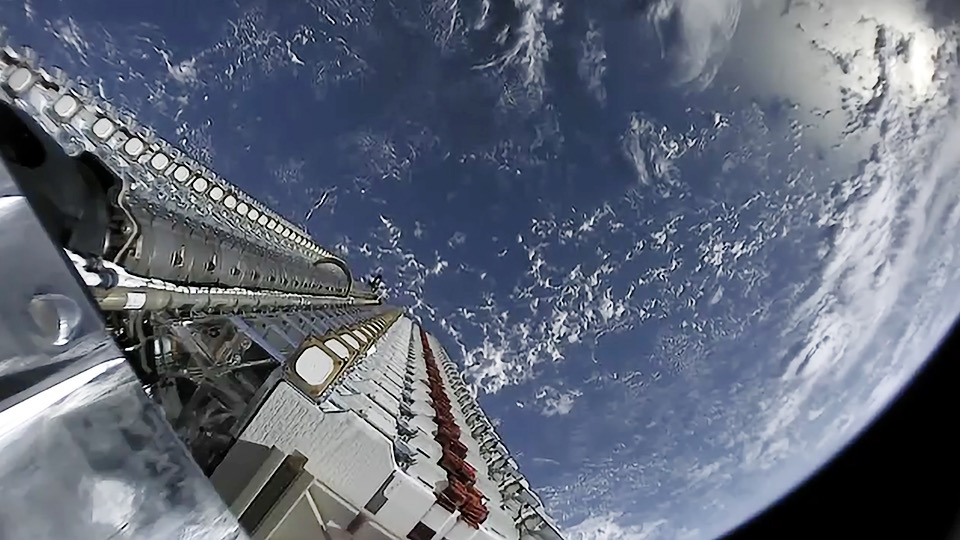
SpaceX successfully launched 28 Starlink satellites into low Earth orbit using a new Falcon 9 rocket from Vandenberg Space Force Base. This launch supports SpaceX’s ongoing efforts to expand the Starlink internet network, providing global broadband access through an ever-growing constellation of satellites.
Read the full story: Space.com | SpaceFlightNow
🛰️Satellite Spotlight
- Satellite Name: COSMOS 509
- NORAD ID: 06122
- Launch Date: July 20, 1972
- Mission: Military Communication
- Orbit: LEO (Low Earth Orbit)
- Operator: OKB10
- Fun Fact: COSMOS 509 was part of the Strela series, designed specifically for military communications, showcasing the early integration of space technology into military operations.
Track this satellite in real-time on our web app: Track COSMOS 509
🌌Space Weather
Next 24 Hours
-
Radio Blackouts Probability
- Minor: 15
- Major: 1
- Risk: None
-
Solar Radiation
- Probability: 1
- Risk: None
-
Geomagnetic Storming
- Scale: 0
- Impact: none
- Activity: Low
-
Impact Summary
- Next 24 hours: No risk of radio blackouts, no risk of solar radiation storms.
- Geomagnetic outlook: G1 (Minor) geomagnetic storms are likely on 26 Nov due to coronal hole high-speed stream (CH HSS) influence.
- No significant transient or recurrent solar wind features are forecast.
- Radiation outlook: No S1 (Minor) or greater solar radiation storms are expected.
- Slight chance for R1-R2 (Minor-Moderate) radio blackouts over 24-26 Nov.
Long Term Forecast
- Impact Summary
- Forecast of solar and geomagnetic activity (24 November - 20 December): Solar activity is expected to be at R1-R2 (Minor-Moderate) levels on 28-30 Nov and 01-11 Dec, primarily due to the flare potential and return of old Region 4274.
- C-class activity is expected on 24-27 Nov and 12-20 Dec with no proton events expected at geosynchronous orbit.
- Greater than 2 MeV electron flux at geosynchronous orbit is expected to be high on 28-30 Nov, 01-03 Dec, 08-12 Dec, and 16-17 Dec due to coronal hole influences.
- Geomagnetic field activity is expected to range from quiet to G1-G2 (Minor-Moderate) levels with G1-G2 likely on 26-27 Nov and 03-04 Dec due to anticipated CH HSS influence.
- Unsettled to active conditions will likely occur on 24-25 Nov, 28-30 Nov, 05-07 Dec, 12-14 Dec, and 17-19 Dec, while mostly quiet levels are expected on 01-02 Dec, 08-11 Dec, 15-16 Dec, and 20 Dec.
🚀Upcoming Space Launches
November 25
-
China Aerospace Science and Technology Corporation Long March 2F/G:
- Shenzhou 22 from Jiuquan Satellite Launch Center, People’s Republic of China (04:01 UTC) Shenzhou 22 is the 22nd flight of the Shenzhou program and will be uncrewed. The spacecraft is to replace Shenzhou 20, which was deemed unsuitable for crew re-entry.
-
Khrunichev State Research and Production Space Center Angara 1.2:
- Kosmos (Unknown Payload) from Plesetsk Cosmodrome, Russian Federation (13:00 UTC) Payload identity and Cosmos series numbering not confirmed. Unknown payload(s) for the Russian military.
November 26
-
Korea Aerospace Research Institute Nuri:
- CAS500-3 from Naro Space Center, South Korea (15:54 UTC) CAS500-3 is a South Korean Earth observation satellite for space technology verification and space science research.
-
SpaceX Falcon 9 Block 5:
- Transporter 15 (Dedicated SSO Rideshare) from Vandenberg SFB, CA, USA (18:18 UTC) Dedicated rideshare flight to a sun-synchronous orbit with dozens of small microsatellites and nanosatellites for commercial and government customers.
November 27
- Russian Federal Space Agency (ROSCOSMOS) Soyuz 2.1a:
- Soyuz MS-28 from Baikonur Cosmodrome, Republic of Kazakhstan (09:27 UTC) Soyuz MS-28 will carry three cosmonauts and one astronaut to the International Space Station aboard the Soyuz spacecraft.
November 30
-
China Aerospace Science and Technology Corporation Long March 8A:
- Unknown Payload from Wenchang Space Launch Site, People’s Republic of China (00:00 UTC) Details TBD.
-
Blue Origin New Shepard:
- NS-37 from West Texas Suborbital Launch Site/Corn Ranch, Van Horn, TX, USA (00:00 UTC) NS-37 is the 16th crewed flight for the New Shepard program.
-
SpaceX Falcon 9 Block 5:
- Starlink Group 15-10 from Vandenberg SFB, CA, USA (02:59 UTC) A batch of satellites for the Starlink mega-constellation - SpaceX’s project for space-based Internet communication system.
-
Arianespace Vega-C:
- KOMPSAT-7 from Guiana Space Centre, French Guiana (17:21 UTC) KOMPSAT-7 provides high-resolution satellite images to satisfy South Korea’s governmental and institutional needs.
-
SpaceX Falcon 9 Block 5:
- Starlink Group 6-86 from Kennedy Space Center, FL, USA (20:11 UTC) A batch of satellites for the Starlink mega-constellation - SpaceX’s project for space-based Internet communication system.
Note: Launch dates and times are subject to change due to technical or weather considerations.

Maurice Stellarski