· space brief · 5 min read
Space Brief 25 Nov 2025
Today's briefing covers Chinese satellite launches, military defense strategies in space, increasing launch activity at the Space Coast, and potential rivals to SpaceX's Starlink.

📰Top Stories
China Expands Satellite Fleet with TJS-21 and Shijian-30 Launches
China has successfully launched TJS-21 and a trio of Shijian-30 satellites toward a Molniya orbit. These additions expand the country’s satellite constellation, contributing to its TJS series which is largely shrouded in secrecy regarding its purposes. This marks a significant step in China’s ongoing enhancement of its space capabilities.
Read the full story: SpaceNews
Star Wars Redux: Challenges in Space-Based Missile Defense
The U.S. is revisiting the concept of space-based missile defense with the “Golden Dome” shield, designed to counter ballistic threats. This initiative echoes the ambitions of past projects like ‘Brilliant Pebble’, though it faces similar technological and economic challenges. This underscores the enduring complexity of achieving effective space-based defense systems.
Read the full story: SpaceNews
Florida Space Coast Hits Launch Milestone; Eyes Upgrades
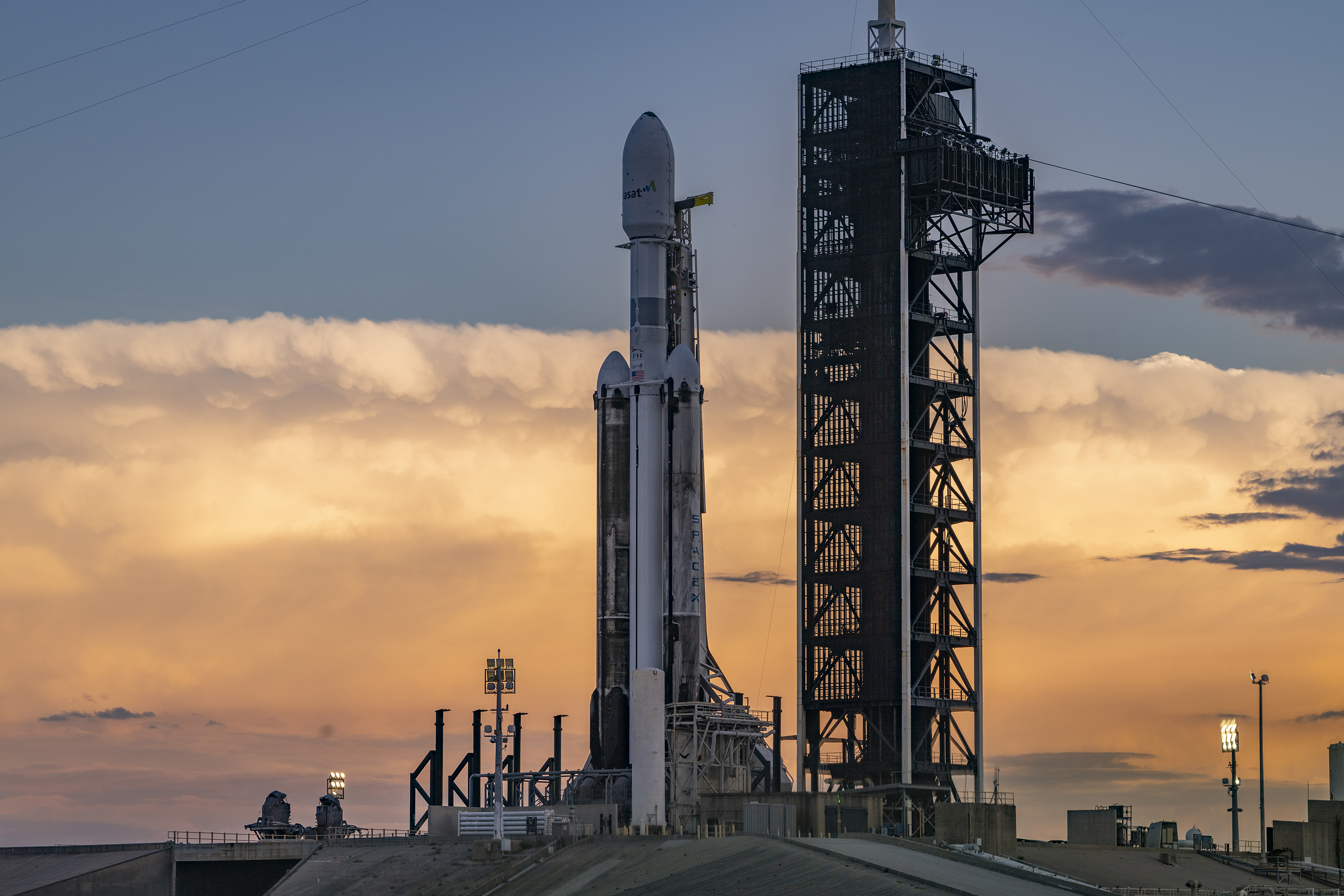
The Florida Space Coast has reached a milestone with over 100 launches this year, highlighting its critical role in U.S. space operations. Col. Brian Chatman emphasizes the need for infrastructure enhancements to accommodate this sustained launch volume. Efforts to upgrade the range are ongoing, ensuring the Space Coast remains at the forefront of orbital activities.
Read the full story: SpaceNews
Germany’s New Military Space Strategy Unveiled
Germany’s latest military space strategy prioritizes substantial investments over the next few years, aiming to fortify its position in space defense and technology. This strategy reflects a broader European interest in enhancing space-related military capabilities amid growing geopolitical tensions.
Read the full story: SpaceNews
U.S. Navy Revamps Acquisition Process in Industry Day
The Navy is conducting an industry day to foster collaboration with contractors and investors, centered around its new acquisition office. This initiative is part of a broader Pentagon strategy to streamline procurement processes and accelerate technological advancement across military branches, propelled by Defense Secretary Pete Hegseth’s directives.
Read the full story: Breaking Defense
Could Internet-Beaming Airships Overtake Starlink?
Innovations in stratospheric internet technologies, such as satellite-beaming planes and airships, could present future competition to SpaceX’s Starlink. Proponents suggest these stratospheric platforms could make traditional satellite constellations obsolete, offering a new frontier in global internet delivery.
Read the full story: Space.com
🛰️Satellite Spotlight
- Satellite Name: CHINASAT 32 (BEIDOU-1 G1)
- NORAD ID: 26599
- Launch Date: October 30, 2000
- Mission: This satellite is part of China’s navigation system, providing crucial positioning data for various applications.
- Orbit: Geostationary Orbit (GEO)
- Operator: China National Space Administration (CNSA)
- Fun Fact: CHINASAT 32 is equipped with two deployable solar arrays to power its operations, showcasing advanced engineering for its time.
Track this satellite in real-time on our web app: Track CHINASAT 32 (BEIDOU-1 G1)
🌌Space Weather
Next 24 Hours
-
Radio Blackouts Probability
- Minor: 15
- Major: 1
- Risk: None
-
Solar Radiation
- Probability: 1
- Risk: None
-
Geomagnetic Storming
- Scale: 1
- Impact: minor
- Activity: Moderate
-
Impact Summary
- Next 24 hours: No risk of radio blackouts.
- No risk of solar radiation storms.
- Moderate geomagnetic activity with minor geomagnetic storms expected.
- Geomagnetic outlook: G1 (Minor) geomagnetic storms are likely on 25-26 Nov due to CH HSS influences.
- Radiation outlook: No S1 (Minor) or greater solar radiation storms are expected.
- No significant active region activity favorable for radiation storm production is forecast.
- Radio blackout outlook: There is a slight chance for R1-R2 (Minor-Moderate) radio blackouts on 25-27 Nov.
Long Term Forecast
- Impact Summary
- Forecast of Solar and Geomagnetic Activity from 24 November to 20 December 2025:
- Solar activity is expected to be at R1-R2 (Minor-Moderate) levels on 28-30 Nov and 01-11 Dec due to the flare potential and return of old Region 4274.
- Mostly C-class activity is anticipated on 24-27 Nov and 12-20 Dec.
- No proton events are expected at geosynchronous orbit.
- The greater than 2 MeV electron flux at geosynchronous orbit is expected to be high on 28-30 Nov, 01-03 Dec, 08-12 Dec, and 16-17 Dec, all due to coronal hole influence.
- The remainder of the outlook period is likely to be at normal to moderate levels.
- Geomagnetic field activity is expected to range from quiet to G1-G2 (Minor-Moderate) geomagnetic storm levels.
- G1-G2 (Minor-Moderate) levels are likely on 26-27 Nov and 03-04 Dec due to CH HSS influence.
- Unsettled to active conditions are likely on 24-25 Nov, 28-30 Nov, 05-07 Dec, 12-14 Dec, and 17-19 Dec.
- Mostly quiet levels are likely on 01-02 Dec, 08-11 Dec, 15-16 Dec, and 20 Dec.
🚀Upcoming Space Launches
November 25
- Khrunichev State Research and Production Space Center Angara 1.2:
- Kosmos (Unknown Payload) from Plesetsk Cosmodrome, Russian Federation (13:00 UTC) Unknown Payload(s) for the Russian military.
November 26
- Korea Aerospace Research Institute Nuri:
- CAS500-3 from Naro Space Center, South Korea (15:54 UTC) CAS500-3 is a South Korean Earth observation satellite used for space technology verification and space science research.
- SpaceX Falcon 9 Block 5:
- Transporter 15 (Dedicated SSO Rideshare) from Vandenberg SFB, CA, USA (18:18 UTC) Dedicated rideshare flight to a sun-synchronous orbit with dozens of small microsatellites and nanosatellites for commercial and government customers.
November 27
- Russian Federal Space Agency (ROSCOSMOS) Soyuz 2.1a:
- Soyuz MS-28 from Baikonur Cosmodrome, Republic of Kazakhstan (09:27 UTC) This mission will carry three cosmonauts and one astronaut to the International Space Station.
November 30
- SpaceX Falcon 9 Block 5:
- Starlink Group 15-10 from Vandenberg SFB, CA, USA (02:59 UTC) A batch of 27 satellites for the Starlink mega-constellation.
- Arianespace Vega-C:
- KOMPSAT-7 from Guiana Space Centre, French Guiana (17:21 UTC) KOMPSAT-7 will provide high-resolution satellite images for South Korea’s governmental and institutional needs.
December 1
- SpaceX Falcon 9 Block 5:
- Starlink Group 6-86 from Kennedy Space Center, FL, USA (05:00 UTC) A batch of 29 satellites for the Starlink mega-constellation.
December 2
- SpaceX Falcon 9 Block 5:
- Starlink Group 11-25 from Vandenberg SFB, CA, USA (18:56 UTC) A batch of 28 satellites for the Starlink mega-constellation.
- SpaceX Falcon 9 Block 5:
- Starlink Group 6-95 from Cape Canaveral SFS, FL, USA (20:16 UTC) A batch of 29 satellites for the Starlink mega-constellation.
Note: Launch dates and times are subject to change due to technical or weather considerations.

Maurice Stellarski