· space brief · 7 min read
ULA Launches 29 Amazon Kuiper Satellites; Falcon Heavy Returns | KeepTrack Space Brief
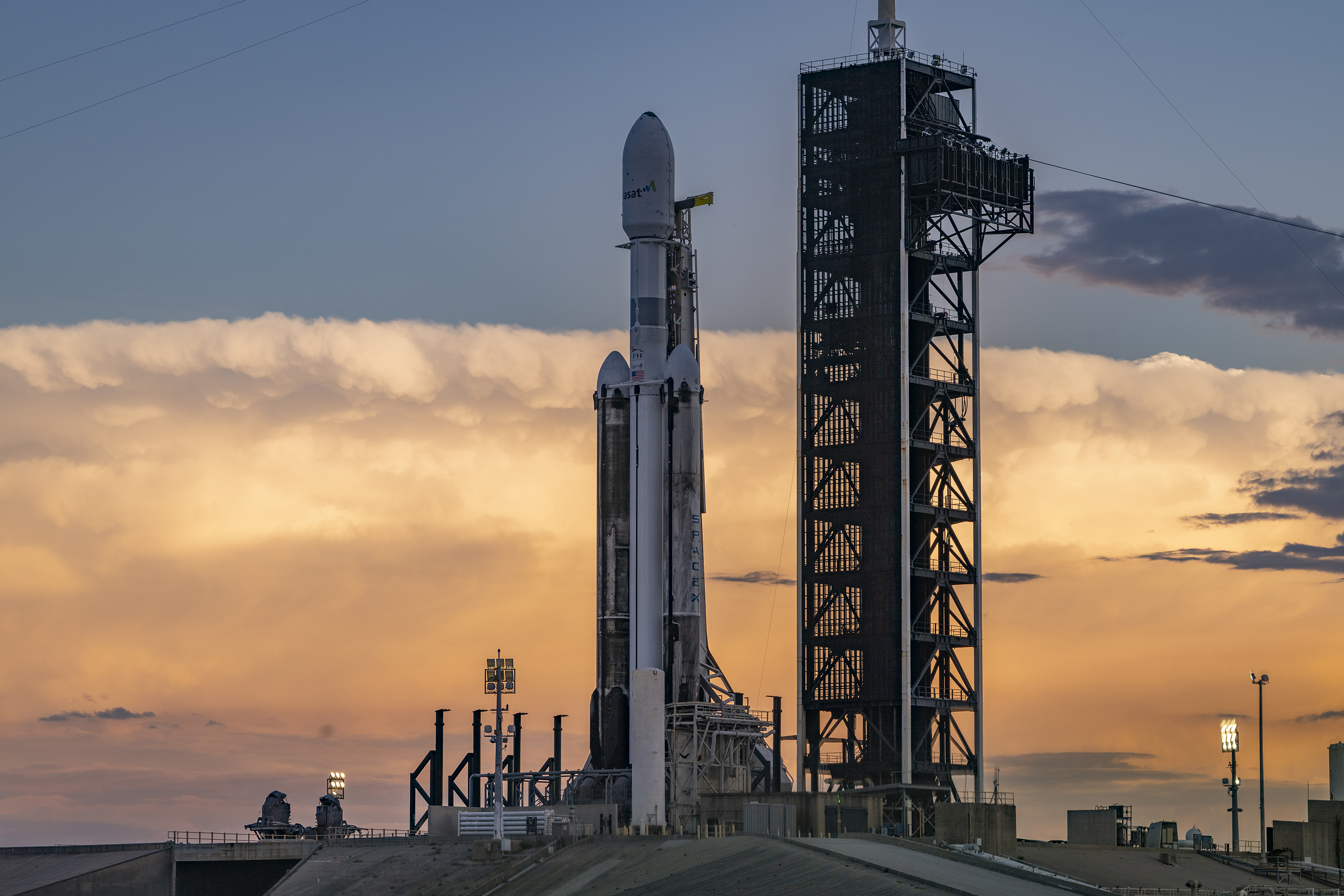
ULA's Atlas V deployed 29 Amazon Kuiper LEO satellites on April 27. Falcon Heavy returns this week with ViaSat-3 F3. Six orbital launches scheduled across three continents.
Top Stories
ULA Launches 29 Amazon Kuiper Satellites on Atlas V LA-06
Atlas V lifted off from Cape Canaveral Space Force Station pad 41 at 8:53 p.m. EDT on April 27, carrying 29 Amazon Kuiper LEO satellites. ULA designates the mission Amazon Leo 6; Amazon calls it Leo Atlas 6 (LA-06). This is the 10th production batch of Kuiper satellites delivered to orbit.
Six launches were scheduled from Florida, California, and French Guiana this week, including a Falcon Heavy return and an Ariane 6 Kuiper mission. The Kuiper constellation is building fast — tracking these objects as the catalog grows is worth watching in KeepTrack.
Read the full story: Spaceflight Now
Gen. Saltzman Tells Space Force to Prioritize ‘Minimum Viable Capabilities’
In his first Commander’s Note of 2026, Space Force Chief of Space Operations Gen. Chance Saltzman called for tighter collaboration between acquisition and operational corps. The explicit goal: faster delivery by scoping requirements down to what’s actually needed now, not eventually.
This push reflects ongoing frustration with long development cycles in military space programs. If it changes how programs like GPS IIIF or resilient PNT are structured, expect downstream effects on what gets tracked and when.
Read the full story: Breaking Defense
Seraphim Space Trust Seeks Up to $474 Million in London Raise
Seraphim Space’s London-listed investment trust is targeting up to £350 million ($474 million) in a new fundraise. The vehicle focuses on early and growth-stage space companies across launch, satellites, and related infrastructure.
That’s a large capital raise for a sector where many funds have struggled with liquidity. Whether Seraphim can close the full amount will be a useful indicator of where institutional appetite actually sits right now.
Read the full story: SpaceNews
Global Defense Spending Hits $2.89 Trillion; Europe Up 14%, US Down 7.5%
Global military expenditure reached $2.89 trillion, driven by a 14% surge in European defense budgets. U.S. spending dropped 7.5% in the same period.
The rebalancing has direct implications for space. European nations are accelerating investment in sovereign ISR, communications, and PNT capabilities — programs that will add objects to the catalog over the next several years.
Read the full story: Breaking Defense
Overview Energy Signs Agreement to Power Meta Data Centers via Space-Based Solar
Overview Energy, a startup developing space-based solar power (SBSP) systems, announced a deal to supply energy to Meta’s data centers. No capacity figures or timeline were disclosed.
SBSP remains pre-operational at commercial scale, so this is a development contract rather than an active power supply agreement. If Overview Energy moves toward demonstration hardware, it will eventually generate trackable objects in GEO or MEO.
Read the full story: SpaceNews
This Week’s Launch Slate: Falcon Heavy Returns Alongside Atlas V and Ariane 6
Six launches were on the schedule for the week of April 27, spanning Cape Canaveral, Vandenberg, and French Guiana. Falcon Heavy’s return is the headline; Atlas V and Ariane 6 are each carrying Amazon Kuiper payloads.
A week with six orbital attempts across three continents puts real pressure on range scheduling and debris conjunction monitoring. Use KeepTrack’s launch tracking tools to follow new objects as they’re cataloged post-insertion.
Read the full story: NASASpaceFlight
JWST Observations Fuel Dark Matter Theory on Early Supermassive Black Holes
James Webb Space Telescope data is surfacing more supermassive black holes in the early universe than existing formation models predict. One proposed explanation: decaying dark matter provided the seed energy needed to accelerate black hole growth in the first billion years after the Big Bang.
The theory is speculative but testable against continued JWST observations. More detections at high redshift will either tighten or break the model over the next few years.
Read the full story: Space.com
Satellite of the Day
SKYSAT-C13
SkySat-C13 is a compact Earth observation satellite operated by Planet Labs, launched aboard a SpaceX Falcon 9 on December 3, 2018, from Vandenberg Air Force Base. Part of Planet Labs’ SkySat constellation, this 110-kilogram microsatellite was manufactured by Surrey Satellite Technology Ltd (SSLMAX) using the SSTL-50 platform and is designed to capture high-resolution imagery of Earth’s surface. Despite its small size—just 1.2 meters long—SkySat-C13 packs serious imaging capability and has become a workhorse for applications ranging from agriculture and disaster response to infrastructure monitoring.
Operating in a near-polar, sun-synchronous orbit at 96.93° inclination, SkySat-C13 offers rapid revisit times and consistent lighting conditions ideal for tracking changes on Earth. The satellite is equipped with small hydrazine thrusters for orbital maneuvering and boasts a planned six-year mission lifetime. As part of Planet’s broader initiative to democratize Earth observation data, SkySat imagery has proven invaluable for humanitarian efforts, environmental monitoring, and commercial applications—making satellites like C13 key players in the modern space domain awareness ecosystem.
| Detail | Value |
|---|---|
| NORAD ID | 43802 |
| Operator | Planet Labs (US) |
| Launch Date | December 3, 2018 |
| Orbit | Sun-synchronous, 96.93° inclination |
| Purpose | Earth Observation |
| Status | Active |
Track this satellite in real-time: Track SKYSAT-C13
Upcoming Space Launches
April 29
- SpaceX Falcon Heavy:
- ViaSat-3 F3 (ViaSat-3 Asia-Pacific) from Kennedy Space Center, FL, USA (14:13 UTC) SpaceX’s Falcon Heavy will launch Viasat’s third and final satellite in its three-satellite geostationary communications series. The vehicle features two reusable Falcon 9-derived side boosters — B1072 flying for the second time and B1075 flying for its 22nd — both targeting landings at Cape Canaveral’s Landing Zones 2 and 40, while the central core will be expended. Watch Live Launch Preview
April 30
-
Arianespace Ariane 64:
- Amazon Leo (LE-02) from Guiana Space Centre, French Guiana (08:08 UTC) An Ariane 6 rocket with four solid boosters will launch a batch of broadband internet satellites for Amazon’s Kuiper low Earth orbit constellation, continuing the constellation’s buildout to deliver high-speed, low-latency connectivity to underserved and remote areas globally. Watch Live
-
RKK Energiya Soyuz-5:
- Demo Flight from Baikonur Cosmodrome, Republic of Kazakhstan (TBD) The inaugural demonstration flight of Russia’s new Soyuz-5 (Irtysh) launch vehicle, carrying a mass simulator. Soyuz-5 is designed to replace the capability of the Zenit-2 and Proton Medium rockets, powered by an RD-171MV first-stage engine and capable of lifting 17 tonnes to low Earth orbit. Launch Preview
-
LandSpace Zhuque-2E:
- Unknown Payload from Jiuquan Satellite Launch Center, People’s Republic of China (TBD) Details to be determined. Zhuque-2E is an enhanced methane/liquid oxygen medium-lift rocket capable of delivering up to 6,000 kg to low Earth orbit.
-
Russian Federal Space Agency (ROSCOSMOS) Soyuz 2.1b:
- 16 x Rassvet-3 from Plesetsk Cosmodrome, Russian Federation (TBD) A batch of 16 Rassvet-3 communications satellites for the Russian Byuro-1440 (Bureau 1440) low Earth orbit broadband constellation, intended to provide high-speed internet access across Russia. Payload identities are uncertain.
-
SpaceX Falcon 9 Block 5:
- Starlink Group 17-36 from Vandenberg SFB, CA, USA (02:00 UTC) A routine launch of 25 Starlink V2 Mini Optimized satellites to low Earth orbit. Booster B1071 will land on the drone ship Of Course I Still Love You in the Pacific Ocean after its 33rd flight. Watch Live
-
China Aerospace Science and Technology Corporation Long March 10B:
- Demo Flight from Wenchang Space Launch Site, People’s Republic of China (TBD) First test launch of the Long March 10B, a reusable medium-lift rocket derived from the Long March 10A core stage. The first stage is designed for downrange recovery using an arrestor-net-equipped barge, while the second stage is powered by a YF-219 methane/liquid oxygen engine. Launch Preview
-
China Aerospace Science and Technology Corporation Long March 7A:
- Unknown Payload from Wenchang Space Launch Site, People’s Republic of China (TBD) Details to be determined.
-
Russian Space Forces Angara 1.2:
- Kosmos (Unknown Payload) from Plesetsk Cosmodrome, Russian Federation (TBD) Launch of an unknown satellite or satellites for the Russian military under a Kosmos designation.
May 1
- SpaceX Falcon 9 Block 5:
- Starlink Group 10-38 from Cape Canaveral SFS, FL, USA (17:33 UTC) A routine launch of 25 Starlink V2 Mini Optimized satellites to low Earth orbit. Watch Live
May 3
- SpaceX Falcon 9 Block 5:
- CAS500-2 & Others from Vandenberg SFB, CA, USA (06:59 UTC) A Falcon 9 rideshare mission carrying 46 payloads, led by the CAS500-2 primary satellite manifested by Korea Aerospace Industries. Booster B1071 will return to Landing Zone 4 at Vandenberg approximately 7.5 minutes after liftoff. The full deployment sequence is expected to conclude around 2.5 hours after launch. Watch Live
May 6
- SpaceX Falcon 9 Block 5:
- Starlink Group 17-29 from Vandenberg SFB, CA, USA (02:00 UTC) A batch of 25 satellites for SpaceX’s Starlink broadband mega-constellation. Watch Live
Schedule Changes
- New launch added: SpaceX Falcon 9 Block 5 | Starlink Group 17-29 has been added to the manifest, scheduled for May 6, 2026 at 02:00 UTC from Vandenberg SFB, CA, USA.
- Launch removed from calendar: Atlas V 551 | Amazon Leo (LA-06) has been marked Launch Successful and has been removed from the upcoming launches list.
Note: Launch dates and times are subject to change due to technical or weather considerations.

Maurice Stellarski