· space brief · 5 min read
South Korea Plans Defense Satellite Constellation With Hanwha Systems | KeepTrack Space Brief
Hanwha Systems in talks with MDA Space and Telesat for South Korean defense satellite constellation. SpaceX preps GPS satellite launch for Space Force. Seismic networks now track space junk reentry.

📰Top Stories
Seismic Networks Track Space Junk
Researchers have unlocked a new method for tracking space debris reentering Earth’s atmosphere using seismic networks typically employed for earthquake detection. This innovative approach, developed by teams at Johns Hopkins University and Imperial College London, promises near real-time identification, helping to mitigate the risks posed by falling space debris to people and infrastructure. This development highlights ongoing efforts to enhance our space junk monitoring capabilities and could lead to improved safety protocols globally.
Read the full story: Space Daily
South Korea’s Defense Satellite Plans with Hanwha Systems
South Korean conglomerate Hanwha Systems is in discussions with MDA Space and Telesat to develop a dedicated defense satellite constellation for the nation. This partnership aims to bolster South Korea’s defense capabilities through advanced satellite technology, marking a notable step in international defense collaborations within the space industry.
Read the full story: SpaceNews
SpaceX Set to Launch GPS Satellite for U.S. Space Force
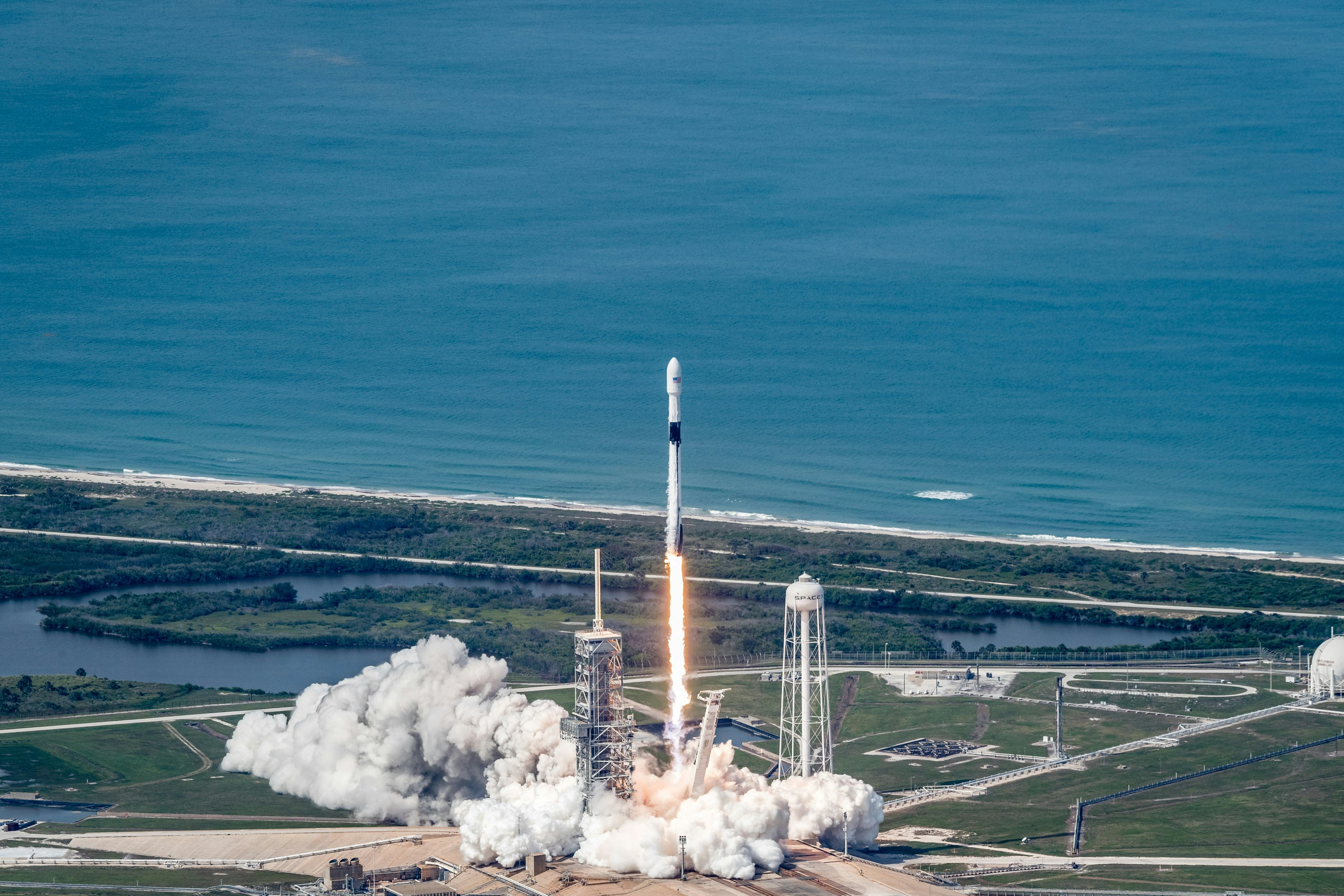
SpaceX is gearing up to launch an advanced, jam-resistant GPS satellite from Cape Canaveral for the U.S. Space Force. This new satellite aims to enhance the precision and reliability of GPS services, vital for both military and civilian applications, making it a significant launch to watch. The event will be broadcast live, inviting space enthusiasts worldwide to tune in.
Read the full story: Space.com
Space Force’s New Strategy for RG-XX Satellites
The U.S. Space Force is set to introduce rolling awards for its RG-XX neighborhood watch satellites, a crucial element in its space situational awareness strategy. These satellites will enhance tracking capabilities for objects in Earth’s orbit, potentially leading to increased awareness and management of space debris and other orbital activities.
Read the full story: Breaking Defense
Australia Receives First MC-55A Peregrine Jet
Australia has welcomed the arrival of its first MC-55A Peregrine surveillance and electronic warfare jet, marking a significant advancement in its ability to monitor and protect strategic interests. This development underscores Australia’s commitment to enhancing its defense infrastructure.
Read the full story: Breaking Defense
Artemis 2 Astronauts Prepare for Moon Mission
NASA’s Artemis 2 mission astronauts have entered quarantine ahead of their historic journey to the moon, slated for early February. This step ensures the safety and readiness of the crew, bringing the world closer to witnessing humanity’s continued exploration of lunar landscapes.
Read the full story: Space.com
🛰️Satellite Spotlight
- Satellite Name: QIANFAN-4
- NORAD ID: 60382
- Launch Date: August 6, 2024
- Mission: This satellite is designed for communication purposes, helping to enhance connectivity and data transmission capabilities.
- Orbit: Low Earth Orbit (LEO)
- Operator: YUANX
- Fun Fact: QIANFAN-4 is part of a series of satellites aimed at improving communication infrastructure and is noted for its solar cell and battery power system.
Track this satellite in real-time on our web app: Track QIANFAN-4
🌌Space Weather
Next 24 Hours
-
Radio Blackouts Probability
- Minor: 25
- Major: 5
- Risk: None
-
Solar Radiation
- Probability: 5
- Risk: None
-
Geomagnetic Storming
- Scale: 0
- Impact: none
- Activity: Low
-
Impact Summary
- No risk of radio blackouts expected.
- No risk of solar radiation storms in the coming day.
- G1 (Minor) geomagnetic storms are likely on January 28 due to coronal hole high-speed stream influences.
- Isolated M-class flares may lead to R1-R2 (Minor-Moderate) radio blackouts through January 29.
Long Term Forecast
- Impact Summary
- Solar activity is anticipated to remain predominantly low, with some chances for M-class flares (R1-R2/Minor-Moderate) until February 21.
- No proton events are predicted at geosynchronous orbit.
- The greater than 2 MeV electron flux is forecasted to reach high levels on certain days throughout late January and February.
- G1 (Minor) geomagnetic storms expected on January 28 and February 13, with active periods likely following these dates.
- Generally quiet conditions are expected for most of the forecasted period, allowing for stable operations for satellite users and ground-based systems.
🚀 Upcoming Space Launches
January 27
- Rocket Lab Electron:
- Bridging The Swarm (NeonSat-1A) from Rocket Lab Launch Complex 1, Mahia Peninsula, New Zealand (22:45 UTC)
The NeonSat-1A carries a high-resolution optical camera to test the constellation capabilities of the South Korean government’s Earth observation micro-satellite constellation, NeonSat.
- Bridging The Swarm (NeonSat-1A) from Rocket Lab Launch Complex 1, Mahia Peninsula, New Zealand (22:45 UTC)
January 28
- SpaceX Falcon 9:
- GPS III SV09 from Cape Canaveral SFS, FL, USA (04:38 UTC)
Ninth of ten GPS III missions.
- GPS III SV09 from Cape Canaveral SFS, FL, USA (04:38 UTC)
January 29
- SpaceX Falcon 9:
- Starlink Group 17-19 from Vandenberg SFB, CA, USA (15:17 UTC)
A batch of 25 satellites for the Starlink mega-constellation - SpaceX’s project for space-based Internet communication system.
- Starlink Group 17-19 from Vandenberg SFB, CA, USA (15:17 UTC)
January 30
- SpaceX Falcon 9:
- Starlink Group 6-101 from Cape Canaveral SFS, FL, USA (04:00 UTC)
A batch of 29 satellites for the Starlink mega-constellation - SpaceX’s project for space-based Internet communication system.
- Starlink Group 6-101 from Cape Canaveral SFS, FL, USA (04:00 UTC)
January 31
- China Aerospace Science and Technology Corporation Long March 7A:
- Unknown Payload from Wenchang Space Launch Site, People’s Republic of China (00:00 UTC)
- China Rocket Co. Ltd. Smart Dragon 3:
- Unknown Payload from Haiyang Oriental Spaceport (00:00 UTC)
Possibly an Earth observation satellite for the Pakistan government’s SUPARCO, details TBD.
- Unknown Payload from Haiyang Oriental Spaceport (00:00 UTC)
February 1
- SpaceX Falcon 9:
- Starlink Group 6-103 from Cape Canaveral SFS, FL, USA (23:04 UTC)
A batch of 29 satellites for the Starlink mega-constellation - SpaceX’s project for space-based Internet communication system.
- Starlink Group 6-103 from Cape Canaveral SFS, FL, USA (23:04 UTC)
February 2
- SpaceX Falcon 9:
- Starlink Group 17-32 from Vandenberg SFB, CA, USA (15:17 UTC)
A batch of 24 satellites for the Starlink mega-constellation - SpaceX’s project for space-based Internet communication system.
- Starlink Group 17-32 from Vandenberg SFB, CA, USA (15:17 UTC)
February 4
- SpaceX Falcon 9:
- Starlink Group 6-104 from Cape Canaveral SFS, FL, USA (08:45 UTC)
A batch of 29 satellites for the Starlink mega-constellation - SpaceX’s project for space-based Internet communication system.
- Starlink Group 6-104 from Cape Canaveral SFS, FL, USA (08:45 UTC)
February 6
- SpaceX Falcon 9:
- Starlink Group 17-33 from Vandenberg SFB, CA, USA (17:05 UTC)
A batch of 25 satellites for the Starlink mega-constellation - SpaceX’s project for space-based Internet communication system.
- Starlink Group 17-33 from Vandenberg SFB, CA, USA (17:05 UTC)
Note: Launch dates and times are subject to change due to technical or weather considerations.

Maurice Stellarski