· x report · 4 min read
SpaceX Lofts 45 Payloads Including Korean CAS500-2 | KeepTrack X Report
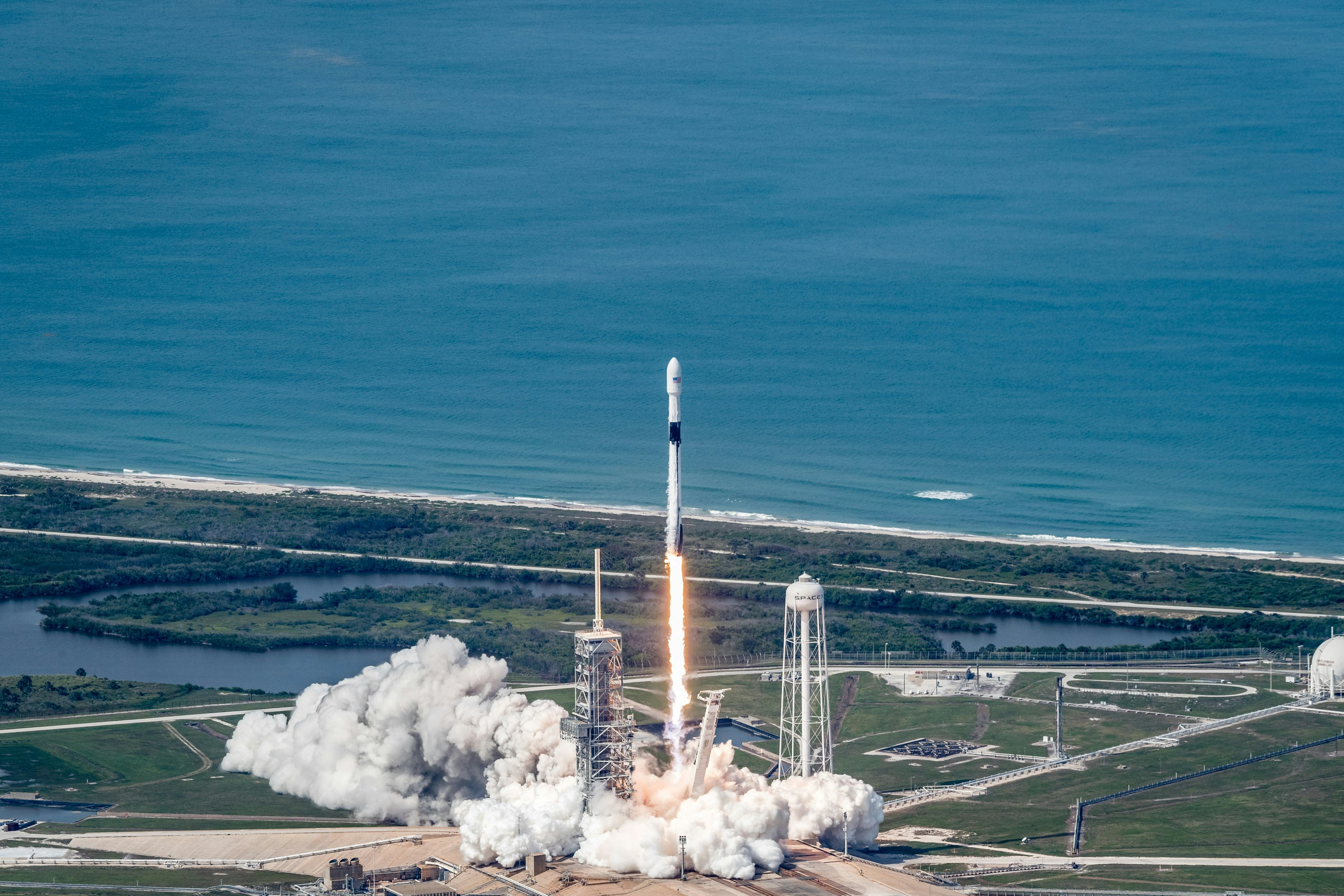
SpaceX's Falcon 9 rideshare lifted 45 satellites including South Korea's CAS500-2 Earth observer from Vandenberg at 0700 UTC May 3.
Latest Developments
SpaceX executed a 45-payload Falcon 9 rideshare mission from Vandenberg Space Force Base’s SLC-4E at 0700 UTC on May 3, delivering South Korea’s Compact Advanced Satellite 500-2 (CAS500-2) as the primary passenger alongside 44 additional payloads. The CAS500-2, built by Korea Aerospace Industries, was the first to separate approximately one hour after liftoff, destined for a Sun-synchronous orbit to conduct high-resolution Earth observation operations. The mission adds to an already densely populated low Earth orbit environment where Starlink’s constellation stands at 10,280 operational satellites out of 10,296 currently in orbit across 11,877 launched to date. Rideshare events like this underscore the growing commercial and governmental demand for affordable orbital access as operators from multiple nations continue to populate LEO alongside SpaceX’s own megaconstellation.
Space Safety
As of early May 2026, the Starlink conjunction picture shows four moderate-risk events concentrated in mid-April, with no high-risk conjunctions currently predicted. The most significant threat involves STARLINK-33563 approaching debris from COSMOS 2251 on Apr 13, 2026 at a closest approach of 12 km with a collision probability of 39.7%, though this remains below critical thresholds. Concurrently, 10 Starlink satellites are tracking toward reentry between May 3–6, 2026, with decay windows ranging from 7 to 48 hours; none are flagged as high-interest objects, but tracking updates are ongoing for operational safety and debris mitigation planning.
| Risk | Starlink Sat | Other Object | Status | Min Range (km) | Rel Speed (km/s) | Max Prob | Time of Closest Approach |
|---|---|---|---|---|---|---|---|
| MODERATE | STARLINK-33563 | COSMOS 2251 DEB | Non-operational | 0.012 | 11.318 | 0.3973 | Apr 13, 21:44 UTC |
| MODERATE | STARLINK-5601 | DELTA 1 DEB | Non-operational | 0.014 | 8.499 | 0.3479 | Apr 11, 06:26 UTC |
| MODERATE | STARLINK-33680 | FLOCK 4G-17 | Operational | 0.024 | 12.627 | 0.1287 | Apr 9, 13:55 UTC |
| MODERATE | STARLINK-35339 | THEA | Operational | 0.022 | 14.11 | 0.1272 | Apr 11, 01:33 UTC |
| LOW | STARLINK-32841 | YAOGAN-43 01D | Operational | 0.038 | 9.497 | 0.0672 | Apr 11, 14:30 UTC |
| LOW | STARLINK-36431 | WT 1B | Unknown | 0.052 | 1.153 | 0.0450 | Apr 14, 13:45 UTC |
| LOW | STARLINK-32376 | OBJECT AD | Operational | 0.046 | 11.243 | 0.0441 | Apr 12, 08:38 UTC |
| LOW | STARLINK-30245 | SL-19 R/B | Non-operational | 0.037 | 14.371 | 0.0441 | Apr 7, 16:55 UTC |
| LOW | STARLINK-35657 | ION SCV-008 | Operational | 0.041 | 13.969 | 0.0390 | Apr 12, 19:09 UTC |
| LOW | STARLINK-31383 | TEVEL2-7 | Operational | 0.038 | 14.746 | 0.0384 | Apr 8, 19:55 UTC |
| Satellite | NORAD ID | Predicted Decay | Window (min) | Inclination | Lat | Lon |
|---|---|---|---|---|---|---|
| STARLINK-1799 | 46699 | May 3, 09:14 UTC | 420 | 53.0° | -51.5° | 206.8° |
| STARLINK-4349 | 53044 | May 3, 11:42 UTC | 420 | 97.6° | 68.5° | 124.3° |
| STARLINK-33906 | 63785 | May 3, 18:51 UTC | 1440 | 43.0° | -40.8° | 197.6° |
| STARLINK-1975 | 47573 | May 4, 04:21 UTC | 900 | 53.0° | 42.5° | 142.1° |
| STARLINK-32730 | 62447 | May 4, 06:15 UTC | 1260 | 53.2° | -50.1° | 51.7° |
| STARLINK-31761 | 59615 | May 4, 08:48 UTC | 2880 | 43.0° | 0.6° | 57.9° |
| STARLINK-5228 | 54180 | May 4, 18:13 UTC | 1440 | 53.2° | -53.0° | 211.9° |
| STARLINK-1567 | 46038 | May 4, 21:39 UTC | 2880 | 53.1° | -14.9° | 12.1° |
| STARLINK-6070 | 56802 | May 6, 00:01 UTC | 1440 | 70.0° | -42.0° | 136.0° |
| STARLINK-1593 | 46119 | May 6, 13:17 UTC | 2880 | 53.0° | 23.1° | 291.7° |
Detailed Coverage
Falcon 9 Midnight Rideshare Deploys 45 Satellites from Vandenberg
A Falcon 9 rocket lifted off from Space Launch Complex 4E at Vandenberg Space Force Base at precisely midnight PDT (0700 UTC) on May 3, carrying 45 satellites on a dedicated rideshare mission. The deployment sequence was led by Korea Aerospace Industries’ CAS500-2, a compact 500-kilogram-class Earth observation satellite that separated from the vehicle roughly one hour into the flight, allowing ground teams to confirm a clean release before subsequent payloads followed.
The CAS500-2 represents a continued expansion of South Korea’s domestic space industry, with Korea Aerospace Industries demonstrating its ability to design and deliver operational Earth observation assets to orbit. The remaining 44 co-manifested payloads span a range of commercial and governmental operators, reflecting the broad market appetite for SpaceX’s rideshare program, which continues to serve as one of the most cost-competitive routes to Sun-synchronous orbit available globally. Satellite trackers should anticipate a new cluster of objects to monitor in the coming days as the deployment sequence completes and U.S. Space Force’s 18th Space Control Squadron publishes catalog entries.
Read the full story: Spaceflight Now
45 Satellites Bound for Orbit in Early May 3 Launch — Watch Live
Space.com provided live coverage of the overnight Falcon 9 launch event, offering viewers a real-time look at the multi-payload deployment from California’s Central Coast. The mission represented another rapid cadence flight for SpaceX, which has maintained an aggressive launch tempo through 2026 to serve both its Starlink constellation expansion and third-party rideshare customers.
The accessibility of live coverage for events like this continues to grow public engagement with orbital operations, and with 45 new objects entering LEO simultaneously, the mission also serves as a reminder of the increasing complexity of the orbital environment. For analysts and trackers using platforms like KeepTrack, rapid ingestion of new two-line element sets following a deployment of this scale is essential to maintaining accurate situational awareness alongside the existing Starlink fleet of 10,280 working satellites.
Read the full story: Space.com
Constellation Status
No changes have occurred in the Starlink constellation since the last check. The constellation currently maintains 11,877 total launched satellites, with 10,296 in orbit, 10,280 of which are actively working, and 1,581 that have decayed from orbit.
- Total Launched: 11877
- Total On Orbit: 10296
- Total Working: 10280
Track Starlink satellites in real-time: Track Starlink

B1049