


· space brief · 5 min read
Army Recruiting 1,000 Space Specialists Alongside Space Force | KeepTrack Space Brief
Army launches space career field seeking 1,000 new specialists. HASC chair Rogers eyes $1.5T defense budget. Army and Marines share fire mission data via JADC2.
📰Top Stories
Pentagon’s Golden Dome Initiative Spurs Quicker Defense Procurement
The Pentagon is drawing a new roadmap for defense purchases with its Golden Dome initiative, intended to boost speed and risk tolerance in defense procurement processes. The program emphasizes efficiency and collaboration, presenting a modern take on contracting within the military sector. Officials aim for the strategy to make the Pentagon a more agile partner for defense contractors.
Read the full story: SpaceNews
U.S. Arms Transfer Strategy Prioritizes Key Defense Systems
The latest “America First Arms Transfer Strategy” outlines priority weapons for international sales, reinforcing the U.S. defense industrial base. This initiative is designed to heighten American military and allied capacities, aligning with broader goals of increased burden-sharing among allies.
Read the full story: Breaking Defense
Joint Fire Mission Data Sharing Success in Army and Marine Corps
In a notable display of joint interoperability, the Army and Marine Corps successfully exchanged fire mission data during recent exercises. This achievement underscores the Next Generation Command and Control (C2) capability, a key aspect of the Pentagon’s Joint All-Domain Command and Control (JADC2) vision.
Read the full story: Breaking Defense
Army Expands Space Career Field without Overstepping on Space Force
The Army seeks to recruit 1,000 new space specialists, launching a career field that complements existing Space Force efforts rather than competing with them. This expansion signifies the growing importance of space in military strategy while maintaining clear operational boundaries with the Space Force.
Read the full story: Breaking Defense
Paths to a $1.5 Trillion Defense Budget Explored by Mike Rogers
Mike Rogers, chair of the House Armed Services Committee, has outlined ambitious plans to elevate the U.S. defense budget to $1.5 trillion. This proposal, discussed in the latest Congressional Roundup, signals an intensified focus on national defense and strategic resource allocation.
Read the full story: Breaking Defense
Chinese Military Leadership Shakeup Under Xi Jinping’s Purge
Recent purges within the Chinese military leadership under Xi Jinping reflect significant strategic restructuring in the People’s Liberation Army (PLA). Analysts speculate on the motivations behind these changes and their future impact on military operations and international relations.
Read the full story: Breaking Defense
🛰️Satellite Spotlight
- Satellite Name: GORIZONT 13
- NORAD ID: 17083
- Launch Date: November 18, 1986
- Mission: Gorizont 13 was launched primarily for communication purposes, equipped with multiple transponders to facilitate transmission.
- Orbit: Geostationary Orbit (GEO)
- Operator: MSVYAZ
- Fun Fact: Gorizont 13 was part of a series of satellites that significantly advanced communication capabilities in the Soviet Union, featuring several C-band and Ku-band transponders.
Track this satellite in real-time on our web app: Track GORIZONT 13
🌌Space Weather
Next 24 Hours
-
Radio Blackouts Probability
- Minor: 80
- Major: 35
- Risk: None
-
Solar Radiation
- Probability: 25
- Risk: None
-
Geomagnetic Storming
- Scale: 0
- Impact: none
- Activity: Low
-
Impact Summary
- No risk of radio blackouts for satellite communication.
- No risk of solar radiation storms, ensuring stable conditions for ground-based observations.
- Geomagnetic activity is low, posing minimal impact on satellite operations.
Long Term Forecast
- Impact Summary
- Moderate to high levels of solar activity are expected, increasing the potential for M-class (R1-R2) and X-class (R3 or greater) flares in early February, affecting satellite operations and communication.
- Enhanced proton flux levels (S1-S2) may impact satellite instrumentation from 02-04 February.
- Electron flux at geosynchronous orbit will see high levels intermittently, which could influence satellite drag and operational functionality.
- Geomagnetic activity will vary, with periods of unsettled to active levels likely between 13-21 February, potentially affecting satellite stability and performance.
🚀Upcoming Space Launches
February 7
- SpaceX Falcon 9 Block 5:
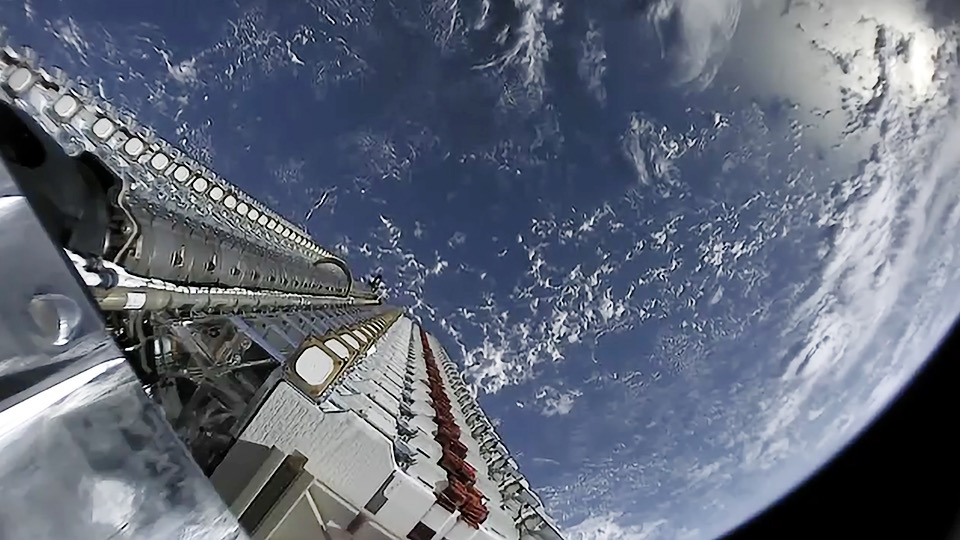
- Starlink Group 17-33 from Vandenberg Space Force Base, California, USA (17:05 UTC) A batch of 25 satellites for the Starlink mega-constellation - SpaceX’s project for space-based Internet communication system.
February 11
- China Rocket Co. Ltd. Smart Dragon 3:
- Unknown Payload from Haiyang Oriental Spaceport (06:26 UTC) Possibly an Earth observation satellite for the Pakistan government’s SUPARCO, details TBD.
- SpaceX Falcon 9 Block 5:
- Crew-12 from Cape Canaveral Space Force Station, Florida, USA (11:01 UTC) SpaceX Crew-12 is the twelfth crewed operational flight of a Crew Dragon spacecraft to the International Space Station as part of NASA’s Commercial Crew Program.
- SpaceX Falcon 9 Block 5:
- Starlink Group 17-34 from Vandenberg Space Force Base, California, USA (14:07 UTC) A batch of 25 satellites for the Starlink mega-constellation - SpaceX’s project for space-based Internet communication system.
February 12
- United Launch Alliance Vulcan VC4S:
- USSF-87 from Cape Canaveral Space Force Station, Florida, USA (08:00 UTC) USSF-87 will launch two identical Geosynchronous Space Situational Awareness Program (GSSAP) satellites directly to a near-geosynchronous orbit.
- Khrunichev State Research and Production Space Center Proton-M/Blok DM-03:
- Elektro-L No.5 from Baikonur Cosmodrome, Republic of Kazakhstan (08:52 UTC) Elektro-L is a series of meteorological satellites developed for capturing real-time images of clouds and Earth’s surface.
- Arianespace Ariane 64:
- Amazon Leo (LE-01) from Guiana Space Centre, French Guiana (16:45 UTC) Amazon Leo is a mega constellation of satellites in Low Earth Orbit that will offer broadband internet access, managed by Kuiper Systems LLC, a subsidiary of Amazon.
February 14
- Firefly Aerospace Firefly Alpha:
- Stairway to Seven from Vandenberg Space Force Base, California, USA (00:50 UTC) Firefly Alpha’s Flight 7 will test and validate key systems after its April 2025 launch failure and be the last flown in Alpha’s current configuration.
- SpaceX Falcon 9 Block 5:
- Starlink Group 6-103 from Cape Canaveral Space Force Station, Florida, USA (05:00 UTC) A batch of 29 satellites for the Starlink mega-constellation - SpaceX’s project for space-based Internet communication system.
Note: Launch dates and times are subject to change due to technical or weather considerations.

Maurice Stellarski


