· space brief · 7 min read
US Military Likely Jamming Iran Satellite Comms | KeepTrack Space Brief
US military praised for space operations against Iran assessed as jamming or spoofing satellite communications. Electronic warfare effects invisible to orbital tracking data.

Top Stories
US Space Operators Are Likely Jamming or Spoofing Communications in the Iran Conflict
Senior US officials have praised military space contributions to operations against Iran without specifying what those contributions are. Experts speaking to Breaking Defense assessed the most probable activities as jamming or spoofing satellite communications — capabilities that degrade adversary coordination without leaving obvious physical signatures.
This is a reminder that the most consequential space operations are rarely visible in orbital data. Glossary: electronic warfare effects don’t show up in TLE feeds, but the satellites enabling or targeted by those effects are trackable.
Read the full story: Breaking Defense
Eutelsat Drops Two Russian Satellite Capacity Leases After On-Orbit Failure
Eutelsat has terminated capacity agreements on two Russian spacecraft. One satellite failed in orbit; the other is relocating. Both contracts were already complicated by Western sanctions on Russian space assets, and declining demand for GEO-based TV broadcast capacity made the exits easier to justify commercially.
This continues a broader pullback by European operators from Russian orbital infrastructure that accelerated after 2022. Tracking Russian GEO assets has become increasingly relevant as their operational status grows uncertain — changes in orbital slot or failure events can affect interference and spectrum coordination for neighboring spacecraft.
Read the full story: SpaceNews
China Breaks Month-Long Launch Hiatus with Guowang and Shiyan-30 Missions
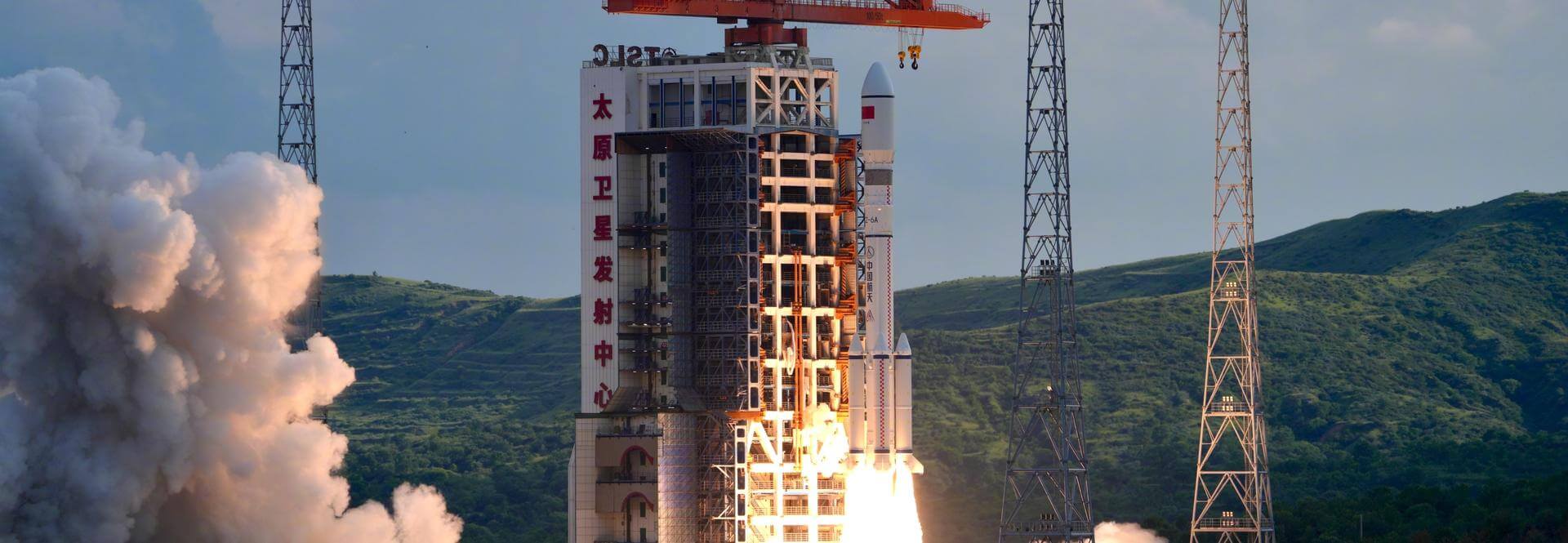
China launched two orbital missions on Thursday from separate spaceports. One mission from Hainan added satellites to the Guowang broadband constellation — China’s state-backed answer to Starlink. The second, from Xichang, carried Shiyan-30 technology demonstration satellites.
The month-long gap in Chinese launches was unusual given the pace China has maintained over the past two years. Guowang has been building out slowly compared to Starlink’s cadence, but each batch increases the constellation’s catalog footprint. New Guowang objects will appear in the KeepTrack catalog as NORAD assigns IDs following tracking confirmation.
Read the full story: SpaceNews
New UK Space Agency Director Outlines Strategic Priorities
Rebecca Evernden, recently appointed Director of the UK Space Agency, spoke with SpaceNews at Space Comm Expo in London. Her stated focus areas center on economic growth and national security — the same dual mandate UKSA has carried for years, but with a new leadership voice behind it.
The UK has been investing in sovereign launch capability, space domain awareness, and defense-adjacent space contracts. How Evernden prioritizes between commercial growth and security applications will shape which UK programs attract international partnerships over the next few years.
Read the full story: SpaceNews
Air Force Awards E-7 Contracts After Congressional Pressure
The Air Force issued new contracts for the E-7 airborne early warning and control aircraft following criticism from Congress over delays. The awards cover an undisclosed number of developmental aircraft and address supply chain problems with the radar system’s components.
The E-7 is intended to replace the aging E-3 Sentry fleet. While not a space story directly, the E-7’s mission depends heavily on datalinks and space-based communications infrastructure — the same networks that military space operators support and adversaries target.
Read the full story: Breaking Defense
Iran Conflict Ordnance Burn Rate Is Straining US Munitions Stockpiles
Operation Epic Fury’s expenditure of precision munitions has reached a scale that analysts say threatens long-term deterrence capacity. A supplemental budget request for munitions production is now being pushed as a near-term necessity rather than a planning consideration.
Sustaining high-tempo precision strike operations requires uninterrupted GPS and space-based targeting support. Stockpile depletion at this rate puts pressure on both the industrial base and the command architecture — including the space layer — that makes those weapons effective.
Read the full story: Breaking Defense
Satellite of the Day
NAPA-1
NAPA-1 is a 6U CubeSat operated by the Royal Thai Air Force (RTAF) and built by ISIS BV, a Dutch small-satellite manufacturer. Launched on September 3, 2020, aboard a Vega rocket from French Guiana, this compact 10-kilogram satellite represents Thailand’s growing presence in space-based Earth observation. The mission carries a camera payload designed for both technology demonstration and practical Earth observation applications, showcasing how even small, affordable satellites can contribute meaningful data from orbit.
Flying in a near-polar sun-synchronous orbit, NAPA-1 allows the RTAF to conduct independent imaging operations and test satellite technologies that could support future national space initiatives. The CubeSat’s standardized form factor and relatively low cost make it an ideal platform for developing in-house expertise in satellite operations and data analysis. This mission exemplifies the democratization of space, where smaller nations and military branches can now access orbital capabilities once reserved for major space powers.
| Detail | Value |
|---|---|
| NORAD ID | 46320 |
| Operator | Royal Thai Air Force |
| Launch Date | September 3, 2020 |
| Orbit | Sun-synchronous, 97.258° inclination |
| Purpose | Earth observation, technology demonstration |
| Status | Active |
Track this satellite in real-time: Track NAPA-1
Upcoming Space Launches
March 14
- SpaceX Falcon 9 Block 5: Starlink Group 10-48 from Space Launch Complex 40, Cape Canaveral SFS, FL, USA (10:00 UTC) A batch of 29 Starlink V2 Mini Optimized satellites launching to low Earth orbit. Watch Live Launch Preview
March 15
- China Aerospace Science and Technology Corporation Long March 6A: Unknown Payload from Launch Complex 9A, Taiyuan Satellite Launch Center, People’s Republic of China (13:14 UTC) Payload details are not yet available. The Long March 6A is China’s first rocket to feature solid rocket boosters, developed by CASC and the Shanghai Academy of Spaceflight Technology. It uses two YF-100 engines on the first stage augmented by four solid rocket boosters, and made its maiden flight in March 2022. Launch Preview
March 16
- ExPace Kuaizhou 1A: Unknown Payload from Launch Area 95A, Jiuquan Satellite Launch Center, People’s Republic of China (04:04 UTC) Payload details are not yet available. The Kuaizhou 1A is a quick-reaction small-lift solid-fueled launch vehicle flying since 2013, capable of delivering up to 300 kg to low Earth orbit. Launch Preview
March 17
-
SpaceX Falcon 9 Block 5: Starlink Group 17-24 from Space Launch Complex 4E, Vandenberg SFB, CA, USA (02:37 UTC) A batch of 29 Starlink V2 Mini Optimized satellites launching to low Earth orbit. Watch Live Launch Preview
-
SpaceX Falcon 9 Block 5: Starlink Group 10-46 from Space Launch Complex 40, Cape Canaveral SFS, FL, USA (10:26 UTC) A batch of 29 Starlink V2 Mini Optimized satellites launching to low Earth orbit. Watch Live Launch Preview
March 19
-
SpaceX Falcon 9 Block 5: Starlink Group 10-33 from Space Launch Complex 40, Cape Canaveral SFS, FL, USA (10:35 UTC) A batch of 29 Starlink V2 Mini Optimized satellites launching to low Earth orbit. Watch Live
-
Rocket Lab Electron: Eight Days A Week (StriX Launch 8) from Rocket Lab Launch Complex 1, Mahia Peninsula, New Zealand (17:45 UTC) This mission will deliver the eighth Strix synthetic aperture radar (SAR) satellite for Synspective, a Japan-based Earth-observation company. The StriX-class satellites weigh approximately 100 kg and have a five-year operational lifespan. This is one of 27 dedicated Electron launches procured by Synspective for its growing SAR constellation.
-
Isar Aerospace Spectrum: Onward and Upward from Orbital Launch Pad, Andøya Spaceport (20:00 UTC) The second test flight of Isar Aerospace’s Spectrum rocket, carrying five CubeSats: CyBEEsat (TU Berlin), TriSat-S (University of Maribor), Platform 6 (EnduroSat), FramSat-1 (NTNU), and SpaceTeamSat1 (TU Wien Space Team), plus the “Let it Go” experiment from Dcubed. Exolaunch is managing payload integration and deployment. The mission was delayed from January 21 due to a pressurization valve issue. Watch Live
March 20
- SpaceX Falcon 9 Block 5: Starlink Group 17-15 from Space Launch Complex 4E, Vandenberg SFB, CA, USA (21:48 UTC) A batch of 29 Starlink V2 Mini Optimized satellites launching to low Earth orbit. Watch Live
March 22
- Russian Federal Space Agency (ROSCOSMOS) Soyuz 2.1a: Progress MS-33 (94P) from 31/6, Baikonur Cosmodrome, Republic of Kazakhstan (11:59 UTC) An uncrewed Progress cargo resupply mission to the International Space Station.
March 24
- Rocket Lab Electron: Daughter Of The Stars (LEO-PNT Pathfinder A) from Rocket Lab Launch Complex 1, Mahia Peninsula, New Zealand (00:00 UTC) The European Space Agency’s LEO-PNT (Low Earth Orbit Positioning, Navigation and Timing) pathfinder mission will launch two demonstrator satellites built by Thales Alenia Space and GMV to a 510 km orbit. These Pathfinder A satellites are early demonstrators for a planned 10-satellite constellation designed to work alongside the Galileo and EGNOS systems to provide Europe with enhanced positioning, navigation, and timing capabilities from low Earth orbit.
Schedule Changes
- SpaceX Falcon 9 Block 5 | Starlink Group 17-31 has been removed from the upcoming launch calendar following a successful launch. Its status was updated from Go for Launch to Launch Successful.
Note: Launch dates and times are subject to change due to technical or weather considerations.

Maurice Stellarski