


· space brief · 10 min read
Artemis 2 Targets April 1 Lunar Flyby with 4-Person Crew | KeepTrack Space Brief
NASA's Artemis 2 launches April 1 with Commander Reid Wiseman and 3 crew members for first crewed lunar flyby since Apollo 17 in 1972.
Top Stories
Artemis 2 Targets April 1 Launch — First Crewed Lunar Flyby Since Apollo 17
NASA’s Artemis 2 remains on schedule for an April 1 liftoff. Four astronauts will fly around the Moon aboard an Orion capsule atop the Space Launch System — the first crewed lunar mission since Apollo 17 in December 1972. Commander Reid Wiseman leads the crew.
NASA says it has high confidence in the launch date. If successful, this is the first time humans have left low Earth orbit in over 53 years. No orbital insertion is planned; the mission profile is a free-return trajectory around the Moon.
Read the full story: Space.com
SpaceX Transporter-16 Carries 119 Payloads from Vandenberg
SpaceX’s Transporter-16 rideshare mission is scheduled to lift off from Vandenberg Space Force Base at 4:02 a.m. PDT on March 30. The Falcon 9 carries 119 payloads, making it the 21st flight in SpaceX’s smallsat rideshare program.
Sun-synchronous orbit will be the destination for most payloads. Expect a surge of new objects in the catalog over the coming days as tracking stations acquire and catalog the dispersed satellites. KeepTrack users can monitor newly launched objects as they’re assigned NORAD IDs via the satellite catalog.
Read the full story: Spaceflight Now
Michoud Assembly Facility’s Role in Artemis Comes Full Circle
NASA’s Michoud Assembly Facility in New Orleans built the core stages for every Saturn V flown during Apollo and has now produced the SLS core stages for Artemis. The facility manufactured the liquid hydrogen and liquid oxygen tanks, engine section, and forward skirt for Artemis 2’s rocket.
The historical thread from Apollo through SLS at a single factory is worth understanding for anyone tracking the industrial capacity behind U.S. deep space launch. Michoud’s throughput will determine how fast NASA can build additional SLS cores for Artemis 3 and beyond.
Read the full story: NASASpaceFlight.com
Satellite Imaging Vendors Struggle to Share Data Across Systems
Executives across the commercial imaging industry say the lack of financial incentives and technical standards is blocking effective “tipping and cueing” — the practice of using one sensor’s data to direct another sensor for a faster, sharper look at a target. The problem is cross-vendor: companies have little commercial reason to make their pipelines talk to competitors’ systems.
For defense and intelligence users, this fragmentation limits how quickly a cue from a radar or RF sensor can trigger an optical revisit. Industry groups have flagged interoperability as a priority, but no binding standards framework is in place yet.
Read the full story: SpaceNews
NASA Opens Observing Proposals for Roman Space Telescope Ahead of Launch
NASA has begun accepting the first round of community science proposals for the Nancy Grace Roman Space Telescope. The call signals the agency is treating Roman as an operational observatory, not just a hardware program.
Roman is designed for wide-field infrared surveys, with a field of view roughly 100 times larger than Hubble’s. Once launched and on station at L2, it will generate substantial catalog data relevant to anyone tracking near-Earth or deep-space object populations. Proposal deadlines and program specifics are available through the Space Telescope Science Institute.
Read the full story: Space Explored
Artemis 2 Commander Reid Wiseman on the Mission Ahead
Commander Reid Wiseman has described Artemis 2 as consuming his full attention in the lead-up to launch. Wiseman, a Navy test pilot and former ISS commander, leads a crew of four on a mission lasting roughly 10 days from launch to splashdown.
The crew will not land on the Moon — that mission profile is reserved for Artemis 3. Artemis 2 validates Orion’s life support, navigation, and crew systems in deep space before a landing attempt.
Read the full story: Space.com
Amazon Greenlights Sally Ride Mini-Series with Kristen Stewart
Amazon has greenlit The Challenger, a limited series in which Kristen Stewart will play Sally Ride, the first American woman in space. Ride flew aboard Space Shuttle Challenger on STS-7 in June 1983. The series marks Stewart’s TV debut.
The production is separate from the 1986 Challenger disaster; the title references the orbiter Ride flew on during her first mission.
Read the full story: Space.com
Satellite of the Day
Aist-2D
Aist-2D is a Russian Earth observation microsatellite developed and operated by Kazan National Research Technical University (KGTU). Launched on June 27, 2023, aboard a Soyuz-2-1B rocket from the Vostochny Cosmodrome, this compact 10-kilogram satellite carries imaging payloads designed for remote sensing applications. The mission is part of Russia’s continued effort to maintain independent Earth observation capabilities and support various civilian and research applications.
Operating in a near-polar, sun-synchronous orbit, Aist-2D joins a growing constellation of small satellites dedicated to monitoring Earth’s surface. Its lightweight design and box-shaped structure make it an efficient platform for technology demonstration and data collection. The satellite represents the kind of innovative, cost-effective approach to space that smaller nations and research institutions are increasingly adopting to participate in the space domain.
| Detail | Value |
|---|---|
| NORAD ID | 57174 |
| Operator | KGTU (Kazan National Research Technical University) |
| Country | Russia |
| Launch Date | June 27, 2023 |
| Orbit | Sun-synchronous, 97.5° inclination |
| Launch Vehicle | Soyuz-2-1B |
| Launch Site | Vostochny Cosmodrome |
| Purpose | Earth observation |
| Status | Active |
Track this satellite in real-time: Track Aist-2D
Upcoming Space Launches
March 30
-
SpaceX Falcon 9 Block 5: Transporter 16 (Dedicated SSO Rideshare) from Space Launch Complex 4E, Vandenberg Space Force Base, CA, USA (10:19 UTC) A SpaceX Falcon 9 rocket will launch dozens of satellites into a Sun-synchronous Earth orbit on this SmallSat rideshare mission. Numerous customers are flying onboard the rocket, including 57 customer payloads being manifested by German company Exolaunch, and 19 payloads from Texas-based Seops Space. Watch Live Launch Preview
-
CAS Space Kinetica 2: Qingzhou Spacecraft Demo Flight from Launch Area 140, Jiuquan Satellite Launch Center, People’s Republic of China (10:52 UTC) First test launch and mission of CAS Space’s Kinetica-2 rocket and Qingzhou cargo resupply spacecraft for future cargo transport to the Chinese Tiangong Space Station under a commercial contract from the CMSEO. The launch may also carry a batch of LEO communication satellites for an unidentified customer as a secondary payload. Kinetica-2 is a reusable medium-lift rocket capable of delivering 12,000 kg to low Earth orbit.
-
SpaceX Falcon 9 Block 5: Starlink Group 10-44 from Space Launch Complex 40, Cape Canaveral Space Force Station, FL, USA (21:15 UTC) A SpaceX Falcon 9 rocket will launch 29 Starlink V2 Mini Optimized satellites into low Earth orbit. The first stage booster, tail number 1067, launching for a 34th time, will target a landing on the drone ship “Just Read the Instructions” in the Atlantic Ocean. Watch Live Launch Preview
March 31
-
LandSpace Zhuque-2E: Unknown Payload from Launch Area 96A, Jiuquan Satellite Launch Center, People’s Republic of China (TBD) Details TBD. Zhuque-2E is an enhanced medium-lift rocket powered by liquid oxygen and methane, capable of lifting 6,000 kg to a 200 km low Earth orbit.
-
Isar Aerospace Spectrum: Onward and Upward from Orbital Launch Pad, Andøya Spaceport, Norway (TBD) A Spectrum rocket from Isar Aerospace will launch on its second test flight. The two-stage rocket is carrying five CubeSats: CyBEEsat (TU Berlin), TriSat-S (University of Maribor), Platform 6 (EnduroSat), FramSat-1 (NTNU), and SpaceTeamSat1 (TU Wien Space Team), along with a “Let it Go” experiment from Dcubed. Exolaunch is managing payload integration and deployment. Watch Live Launch Preview
-
China Aerospace Science and Technology Corporation Long March 2C: Unknown Payload from Launch Area 94, Jiuquan Satellite Launch Center, People’s Republic of China (TBD) Details TBD.
-
Blue Origin New Glenn: BlueBird Block 2 #2 from Launch Complex 36A, Cape Canaveral Space Force Station, FL, USA (TBD) AST SpaceMobile’s Block 2 BlueBird satellites deliver up to 10 times the bandwidth of Block 1 satellites, designed to support 24/7 continuous cellular broadband coverage in the United States. This flight carries one satellite — BlueBird 7 (Block 2 FM2) — featuring a communications array of up to 2,400 square feet, making it among the largest commercial satellites ever deployed in low Earth orbit.
-
China Aerospace Science and Technology Corporation Long March 12B: Demo Flight from Long March 12 series Pad, Jiuquan Satellite Launch Center, People’s Republic of China (TBD) First test launch of CASC’s Long March 12B rocket, a reusable orbital launch vehicle based on the Long March 12 and extensively redesigned for first-stage recovery. Capable of lifting 20,000 kg to low Earth orbit, its first stage uses nine YF-102R engines and will land at a downrange pad in Minqin County, Gansu Province.
April 1
-
Russian Space Forces Soyuz 2.1a/Fregat-M: Meridian-M No.21L from Plesetsk Cosmodrome, Russian Federation (02:00 UTC) Meridian is a series of communications satellites serving both military and civilian users. The payload identity for this particular flight is uncertain. The Soyuz 2.1a features a digital flight control system and uprated engines, capable of lifting 7,020 kg to low Earth orbit.
-
National Aeronautics and Space Administration Space Launch System Block 1: Artemis II from Launch Complex 39B, Kennedy Space Center, FL, USA (22:24 UTC) NASA’s Space Launch System will launch the Orion spacecraft on the Artemis 2 mission — the first crewed flight of the Artemis program. NASA astronauts Reid Wiseman, Victor Glover, and Christina Koch, along with Canadian Space Agency astronaut Jeremy Hansen, will perform a lunar flyby during a roughly 10-day mission. Their capsule, named “Integrity,” will splash down in the Pacific Ocean upon return. The SLS Block 1 is the most powerful operational rocket in the world, capable of lifting 95,000 kg to low Earth orbit. Watch Live
April 2
-
Space Pioneer Tianlong-3: Demo Flight from Tianlong-3 Launch Pad, Jiuquan Satellite Launch Center, People’s Republic of China (03:52 UTC) First test launch of Space Pioneer’s Tianlong-3 rocket, a reusable medium-to-heavy lift vehicle capable of lifting 17,000 kg to low Earth orbit. Reports indicate this launch may carry a batch of satellites for the SpaceSail/G60/Qianfan LEO communication satellite constellation.
-
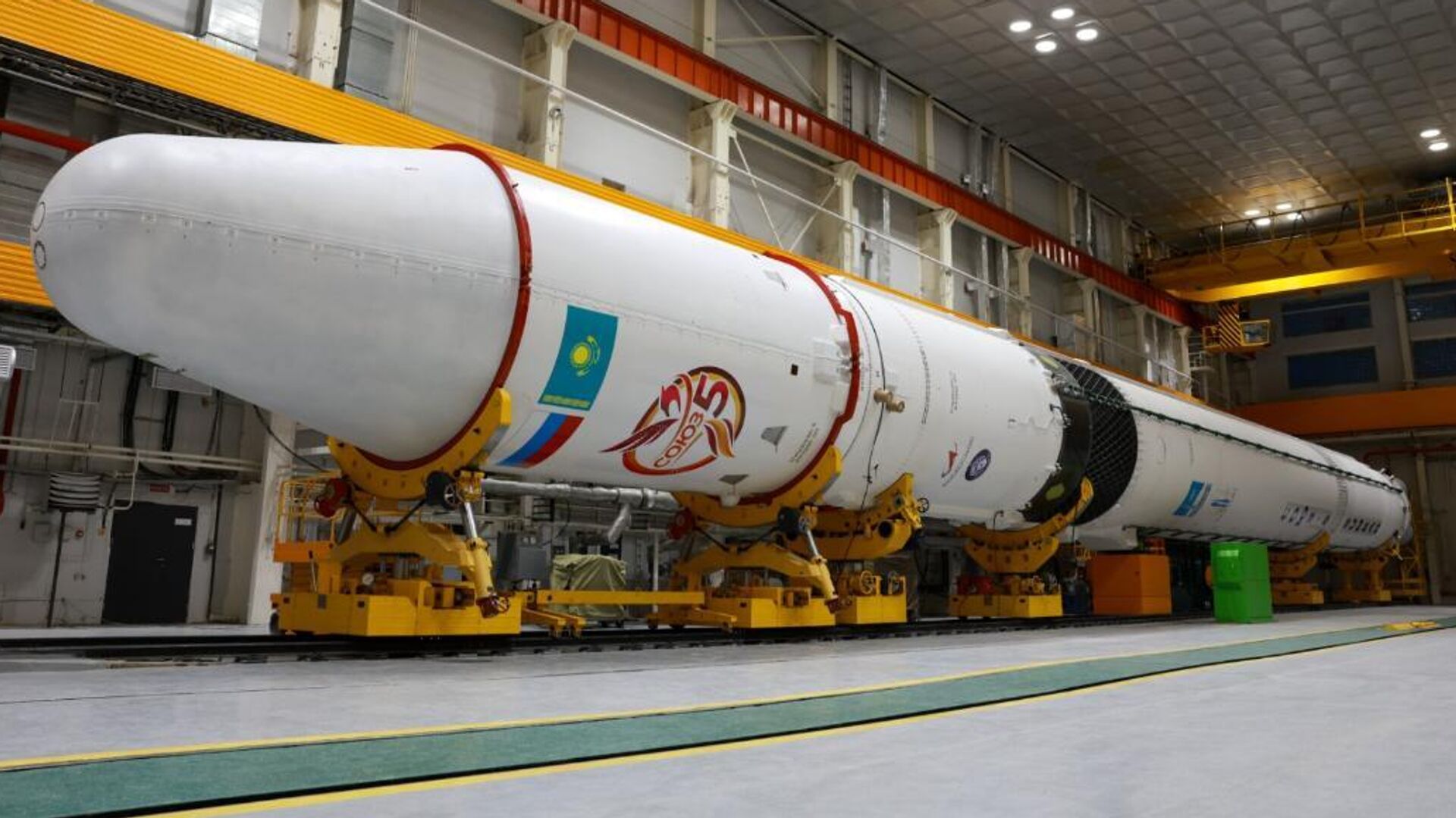
RKK Energiya Soyuz-5: Demo Flight from Launch Pad 45/1, Baikonur Cosmodrome, Republic of Kazakhstan (11:00 UTC) Demonstration flight for Russia’s new Soyuz-5 (Irtysh) launch vehicle, carrying a mass simulator. Developed by JSC SRC Progress under Project Feniks, Soyuz-5 is intended to replace the Zenit-2 and Proton Medium rockets. The 525-tonne rocket is powered by an RD-171MV engine on its first stage and two RD-0124MS engines on its second stage, with a capacity of 17,000 kg to low Earth orbit.
-
SpaceX Falcon 9 Block 5: Starlink Group 10-58 from Space Launch Complex 40, Cape Canaveral Space Force Station, FL, USA (11:52 UTC) A SpaceX Falcon 9 rocket will launch 29 Starlink V2 Mini Optimized satellites into low Earth orbit. The first stage booster, tail number 1067, launching for a 34th time, will target a landing on the drone ship “Just Read the Instructions” in the Atlantic Ocean. Watch Live
-
SpaceX Falcon 9 Block 5: Starlink Group 17-35 from Space Launch Complex 4E, Vandenberg Space Force Base, CA, USA (23:03 UTC) A batch of 25 Starlink satellites for SpaceX’s space-based internet communication constellation. Watch Live
April 4
- United Launch Alliance Atlas V 551: Amazon Leo (LA-05) from Space Launch Complex 41, Cape Canaveral Space Force Station, FL, USA (05:45 UTC) A United Launch Alliance Atlas V 551 rocket will launch a batch of broadband internet satellites for Amazon’s Project Kuiper low Earth orbit constellation. This is the sixth of nine Atlas V rockets purchased by Amazon for its satellite deployment campaign. The Atlas V 551 configuration features five solid rocket boosters and a 5-meter payload fairing, with capacity to lift 18,850 kg to low Earth orbit. Watch Live Launch Preview
Schedule Changes
- Tianlong-3 | Demo Flight: Status updated from To Be Determined to Go for Launch, confirming Space Pioneer’s first Tianlong-3 test flight is now scheduled for April 2.
- Kinetica 2 | Qingzhou Spacecraft Demo Flight: Status updated from To Be Determined to Go for Launch, confirming CAS Space’s Kinetica-2 debut is now scheduled for March 30.
- Atlas V 551 | Amazon Leo (LA-05): Status downgraded from Go for Launch to To Be Confirmed, introducing some uncertainty around the April 4 launch window.
- Falcon 9 Block 5 | Starlink Group 17-35: Newly added to the manifest, scheduled for April 2 at 23:03 UTC from Vandenberg Space Force Base.
Note: Launch dates and times are subject to change due to technical or weather considerations.

Maurice Stellarski


