· space brief · 8 min read
Space Force Eyes 30,000 Satellites by 2040 | KeepTrack Space Brief
Space Force projects 30,000-satellite orbital architecture by 2040 amid combat integration revelations. Gen. Saltzman confirms space operations were critical in Iran conflict.
Top Stories
Space Force Chief: Space Combat Was ‘Critical to Mission Success’ in Iran War
Gen. Chance Saltzman stated publicly that space operations played a decisive role in the U.S. war in Iran, calling the Space Force a fully “combat credible” force. This is the clearest official acknowledgment yet that space capabilities — likely including ISR satellites, positioning systems, and electronic warfare — were operationally integrated into active combat.
For analysts tracking on-orbit assets, this confirms that satellites currently in the catalog are no longer just support infrastructure — they’re warfighting tools under active operational stress.
Read the full story: Space.com
Space Force Absorbs SDA — ‘Go Fast’ Model Gets Folded Into Portfolio Structure
The Space Development Agency will cease to exist as a standalone organization under a Space Force reorganization. Officials say the acquisition philosophy SDA pioneered — rapid, iterative satellite development using commercial standards — will continue under a new portfolio-based structure.
SDA built the Proliferated Warfighter Space Architecture (PWSA), now fielding hundreds of satellites in low Earth orbit for data transport and missile warning. Whether the new structure preserves SDA’s speed or bogs it down in traditional acquisition bureaucracy is the open question. Tracking PWSA nodes via Space-Track remains relevant as the constellation continues to expand.
Read the full story: SpaceNews
Space Force 2040 Plan Calls for 30,000 Satellites and Thousands More Guardians
The Space Force’s new Objective Force plan projects an orbital architecture of 30,000 satellites by 2040, with a workforce expansion of “thousands” of Guardians. Gen. Saltzman confirmed the service is pursuing new hardware for orbital warfare and electronic warfare, though those specifics are classified.
The 30,000-satellite figure dwarfs current U.S. government on-orbit assets and implies heavy reliance on proliferated commercial constellations. That density will create real conjunction analysis challenges for SSA operators.
Read the full story: Breaking Defense
Golden Dome’s Space-Based Interceptors Not a Sure Thing, Says Gen. Guetlein
Space Force Gen. Michael Guetlein, leading the Golden Dome missile defense initiative, said boost-phase intercept from space will only move forward if it’s affordable and scalable. His exact words: “If boost-phase intercept from space is not affordable and scalable, we will not produce it, because we have other options to get after it.”
This is a meaningful constraint on what had been widely assumed as a centerpiece of the Golden Dome architecture. Space-based interceptors would represent an entirely new class of objects in the catalog — maneuvering, weapons-capable platforms in orbit — with significant SSA and debris implications.
Read the full story: Breaking Defense
Air Force Opens AMTI Competition for First Operational Space-Based Aircraft Tracking Satellites
Air Force Secretary Troy Meink said awards for the Aerial Moving Target Indication (AMTI) program’s first increment will come “fairly shortly.” AMTI satellites will track aircraft from orbit — a persistent overhead ISR capability with no current operational equivalent in the U.S. inventory.
The first increment represents the transition from experimentation to fielded systems. Once launched, these satellites will be trackable assets with direct tactical relevance to anyone monitoring military space operations.
Read the full story: Breaking Defense
Blue Origin Down-Selected for New Glenn Launch Site at Vandenberg SFB
The U.S. Space Force selected Blue Origin to potentially develop a new launch site at Vandenberg Space Force Base in California. This adds a second active coast option for New Glenn, which currently operates from Cape Canaveral.
A Vandenberg pad gives Blue Origin access to sun-synchronous and polar orbits without dogleg maneuvers, opening the rocket to a wider range of government and commercial missions. Construction timelines have not been announced.
Read the full story: Spaceflight Now
Space Force Budget Surge Coming — But Workforce and Acquisition Gaps Could Stall Delivery
Air Force Secretary Meink warned that even with a budget increase on the way, workforce shortfalls and acquisition bottlenecks inside the Space Force could prevent timely delivery of new capabilities. Service leaders did not specify dollar figures but framed execution — not funding — as the primary constraint.
This is relevant context for anyone tracking program timelines across PWSA, AMTI, GPS follow-on, and other active procurements. Money arriving faster than the acquisition system can absorb it typically produces schedule slips and cost growth, not acceleration.
Read the full story: SpaceNews
Satellite of the Day
XM-4 (BLUES)
XM-4, also known as “BLUES,” is a communication satellite operated by XM Radio (XMR) that has been delivering digital audio radio services since its launch in October 2006. Built by Boeing Space & Security (BOES) on the robust BSS-702HP bus, this satellite was lofted into orbit aboard a Zenit-3SL rocket from Sea Launch and quickly became operational. With its pair of S-band transponders and impressive 13.3 kW of digital audio radio equipment, XM-4 represents the backbone of XM Radio’s continental coverage, beaming music, news, and entertainment to millions of subscribers across North America.
What makes XM-4 particularly noteworthy is its remarkable longevity—the satellite was designed for a 15-year mission life, and its continued presence in geostationary orbit demonstrates the resilience of modern satellite design. The spacecraft spans over 40 meters when its solar arrays are deployed and carries 16 active transponder channels (plus 6 spares) equipped with 228 W Traveling Wave Tube Amplifiers (TWTAs). For tracking enthusiasts, this is one of the classic commercial communication birds that defined early 2000s satellite radio and remains a fixture in the geostationary belt.
| Detail | Value |
|---|---|
| NORAD ID | 29520 |
| Operator | XM Radio (XMR) |
| Launch Date | October 30, 2006 |
| Orbit | Geostationary, 2.6888° inclination |
| Purpose | Digital Audio Radio Communication |
| Status | Active |
Track this satellite in real-time: Track XM-4 (BLUES)
Upcoming Space Launches
April 17
- China Aerospace Science and Technology Corporation Long March 2D:
- Unknown Payload from Jiuquan Satellite Launch Center, People’s Republic of China (04:02 UTC) A Long March 2D rocket — a two-stage Chinese carrier rocket capable of delivering up to 3,500 kg to low Earth orbit, with its maiden flight dating to 1992 — will launch an undisclosed payload. Mission details are currently unavailable. Launch Preview
April 18
- SpaceX Falcon 9 Block 5:
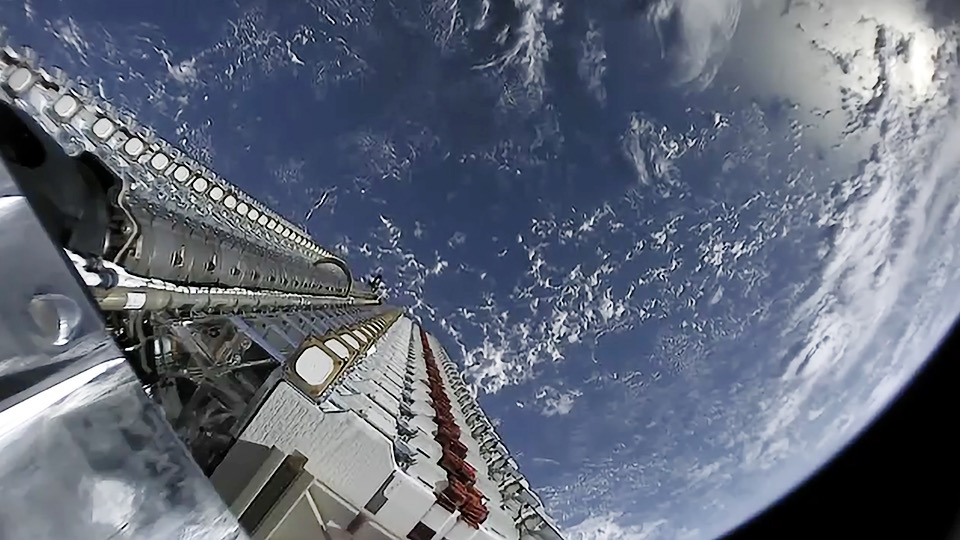
- Starlink Group 17-22 from Vandenberg Space Force Base, CA, USA (14:00 UTC) A SpaceX Falcon 9 rocket will launch 29 Starlink V2 Mini Optimized satellites into low Earth orbit. Booster B1080, flying for its 26th time, will land on the drone ship Just Read the Instructions. Watch Live Launch Preview
April 19
- Blue Origin New Glenn:
- BlueBird Block 2 #2 from Cape Canaveral Space Force Station, FL, USA (10:45 UTC) A Blue Origin New Glenn rocket — a 7-meter-diameter, two- or three-stage vehicle with a 45,000 kg low Earth orbit capacity — will launch AST SpaceMobile’s second BlueBird next-generation satellite, designed to deliver space-based cellular broadband for commercial and government customers. This will be New Glenn’s third flight overall. Booster recovery intentions have not been confirmed. Watch Live Launch Preview
April 20
- SpaceX Falcon 9 Block 5:
- GPS III SV10 from Cape Canaveral Space Force Station, FL, USA (06:48 UTC) The tenth and final mission in the GPS III series, launching for the United States Space Force. GPS III satellites are part of the U.S. government’s Global Positioning System constellation, which provides geolocation and time information to receivers worldwide. The Falcon 9 Block 5, designed for rapid reusability, carries a 22,800 kg low Earth orbit capacity.
April 22
-
Rocket Lab HASTE:
- Bubbles from Wallops Flight Facility, Virginia, USA (00:00 UTC) A sub-orbital launch under Rocket Lab’s Hypersonic Accelerator Suborbital Test Electron (HASTE) program. The HASTE variant of the Electron rocket serves as a suborbital testbed for hypersonics research. Mission details are currently unavailable.
-
SpaceX Falcon 9 Block 5:
- Starlink Group 17-14 from Vandenberg Space Force Base, CA, USA (02:00 UTC) A SpaceX Falcon 9 rocket will launch 29 Starlink V2 Mini Optimized satellites into low Earth orbit. Booster B1080, flying for its 26th time, will land on the drone ship Just Read the Instructions. Watch Live
-
Agency for Defense Development South Korean ADD Solid-Fuel SLV:
- Demo Flight from Sea Launch (05:00 UTC) The first orbital full-version launch of South Korea’s military small satellite launch vehicle, following two sub-orbital stage tests in 2022 and one orbital test flight without its second stage on 4 December 2023. The launch vehicle name is provisional. Further details are pending.
April 23
- Rocket Lab Electron:
- Kakushin Rising (JAXA Rideshare) from Rocket Lab Launch Complex 1, Mahia Peninsula, New Zealand (03:09 UTC) A Japan Aerospace Exploration Agency-manifested rideshare of eight spacecraft, including educational small satellites, an ocean monitoring satellite, a multispectral camera demonstrator, and OrigamiSat-2 — featuring a deployable antenna that unfurls to 25 times its packed size using origami folding techniques. The satellites were originally planned to fly on a Japanese Epsilon-S rocket but were moved following Epsilon-S test firing failures. Satellites aboard: MAGNARO-II, KOSEN-2R, WASEDA-SAT-ZERO-II, FSI-SAT2, OrigamiSat-2, Mono-Nikko, ARICA-2, and PRELUDE.
April 25
-
SpaceX Falcon 9 Block 5:
- Starlink Group 17-16 from Vandenberg Space Force Base, CA, USA (14:00 UTC) A batch of 25 satellites for the Starlink mega-constellation, SpaceX’s space-based internet communication system. Watch Live
-
Russian Federal Space Agency (ROSCOSMOS) Soyuz 2.1a:
- Progress MS-34 (95P) from Baikonur Cosmodrome, Republic of Kazakhstan (22:21 UTC) A Progress resupply mission delivering cargo to the International Space Station.
Schedule Changes
- New Launch Added: Rocket Lab HASTE | Bubbles has been added to the manifest, scheduled for 22 April 2026 from Wallops Flight Facility, Virginia. This is a sub-orbital hypersonics research flight under the HASTE program.
- Status Update: Rocket Lab Electron | Kakushin Rising (JAXA Rideshare) has been upgraded from To Be Determined to Go for Launch, targeting 23 April 2026 from Rocket Lab Launch Complex 1, Mahia Peninsula, New Zealand.
Note: Launch dates and times are subject to change due to technical or weather considerations.

Maurice Stellarski